Exercise timing and sleep quality
Is your late workout helping fitness but hurting sleep?
By Mr.Apps · Jul 13, 2026
Category:Sleep

Exercise usually helps sleep, but a hard workout too close to bedtime can keep the body switched on. Here’s how to time evening training without losing consistency.
The problem with late workouts is that they can feel like the most responsible bad idea of the day.
You finish work late. The gym is still open. The run is still possible. The training plan is sitting there like a passive-aggressive reminder. So you do the session at 8:30 PM, feel proud for not skipping it, take a shower, eat something, get into bed, and then lie there with a heart that still thinks it is halfway through intervals.
That is the annoying part. The workout was good for fitness. It may even have saved the day mentally. But the body did not get the memo that the day was over.
Exercise is generally good for sleep. That is not the argument. The real question is more specific: what kind of exercise, how intense was it, and how close was it to bedtime?
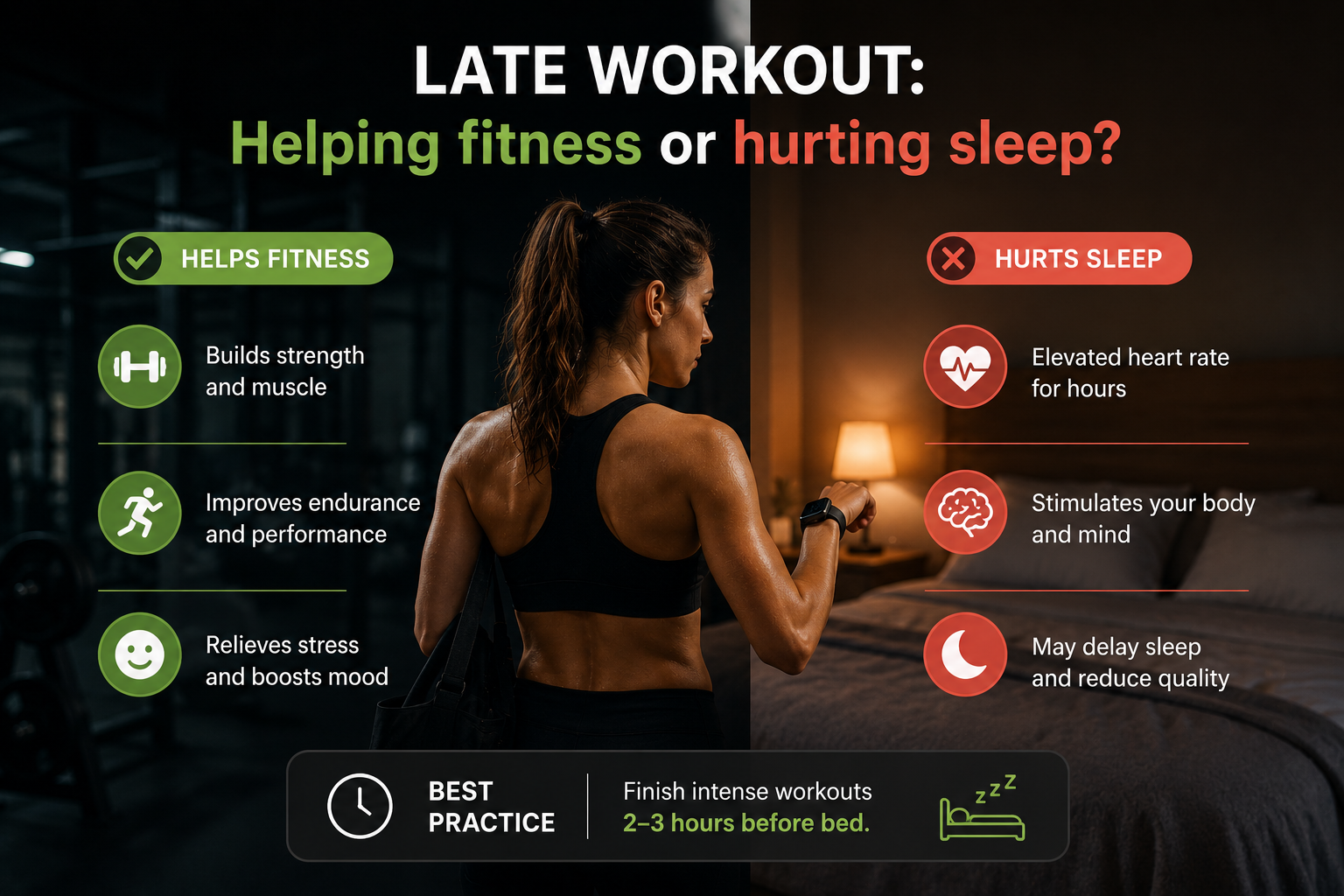
A calm evening walk and a heavy leg session are not the same bedtime signal. Gentle mobility and hard hill sprints do not leave the nervous system in the same state. A short stretch after dinner may help the body downshift. A late high-intensity session may push sleep later, raise overnight heart rate, and make recovery feel worse.
A large study published in Nature Communications found that strenuous exercise ending within four hours of bedtime was associated with later sleep, shorter sleep duration, lower sleep quality, higher resting heart rate, and lower HRV. That does not mean nobody can train at night. It means intensity and timing matter.
So the goal is not to fear evening exercise. The goal is to stop treating every workout as the same.
Why timing changes how exercise feels at night
A workout does not end when the session ends.
The timer stops. The watch saves the activity. The shoes come off. But inside the body, the workout is still being processed.
Heart rate may stay elevated. Body temperature may stay higher. Stress hormones and nervous system activity may still be up. Muscles may be repairing. Digestion may be starting if food comes after training. The whole system may still be in “do something” mode while the person is trying to sleep.
This is why late exercise can feel confusing. The mind says, “I am tired.” The body says, “Great, but we are still activated.”
That activation is not a flaw. It is part of training. Hard exercise is supposed to challenge the body. The issue is timing. If the challenge happens too close to bedtime, the recovery process begins right when the body is supposed to be winding down.
The same Nature Communications study looked at more than 4 million nights of objective data and found a dose-response pattern: the combination of later timing and higher exercise strain was linked with more disrupted sleep and nocturnal autonomic activity. In plain English, the harder and later the workout, the more likely sleep was to suffer.
Monash University summarized the finding clearly: exercise within four hours of bedtime was linked with falling asleep later, getting less and worse-quality sleep, higher resting heart rate, and lower heart rate variability.
That is the sleep version of “it depends.” A 20-minute walk after dinner is not the same as late-night CrossFit. A relaxed yoga flow is not the same as heavy deadlifts. A light jog is not the same as VO2 max intervals.
The body understands the difference even when the calendar just says “workout.”
The difference between soothing movement and activating training
Evening movement is not the enemy.
For many people, the right kind of movement at night can help. It can reduce stress, loosen the body after a long sitting day, improve mood, and create a clean break between work mode and sleep mode.
The problem is when the session asks too much from the body too late.
A useful way to think about it is this:
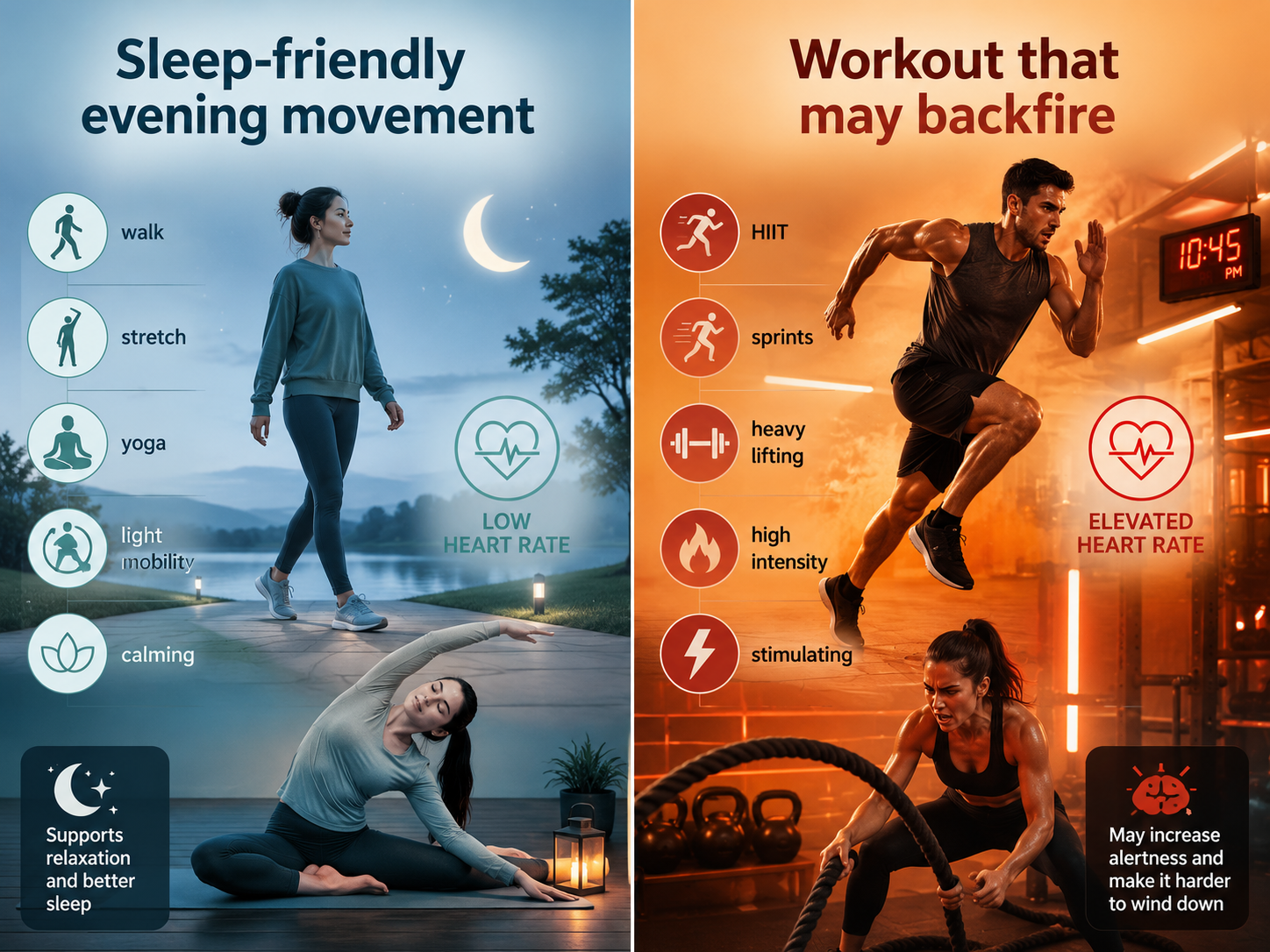
Sleep-friendly evening movement usually feels calming, low-pressure, and easy to recover from.
Sleep-risky evening training usually feels intense, competitive, hot, heavy, or mentally stimulating.
That first group includes things like walking, easy cycling, gentle stretching, mobility work, relaxed swimming, and light yoga. These activities can move the body without turning the whole system up to maximum volume.
Walking is one of the simplest examples. A 2026 meta-analysis in Frontiers in Public Health evaluated walking and subjective sleep quality in adults and looked at how walking interventions relate to sleep quality. Walking is not glamorous, but that is exactly why it works for many people. It is movement without drama.
The second group includes hard intervals, heavy lifting, late competitive sports, intense spin classes, long tempo runs, and workouts where the body leaves the session buzzing instead of calmer.
These workouts are not bad. They just may need more distance from bedtime.
A hard workout at 6 PM may be fine. The same workout ending at 10:15 PM may become a sleep problem. Timing changes the cost.
The evening workout matrix
Here is a simple way to decide what belongs near bedtime.
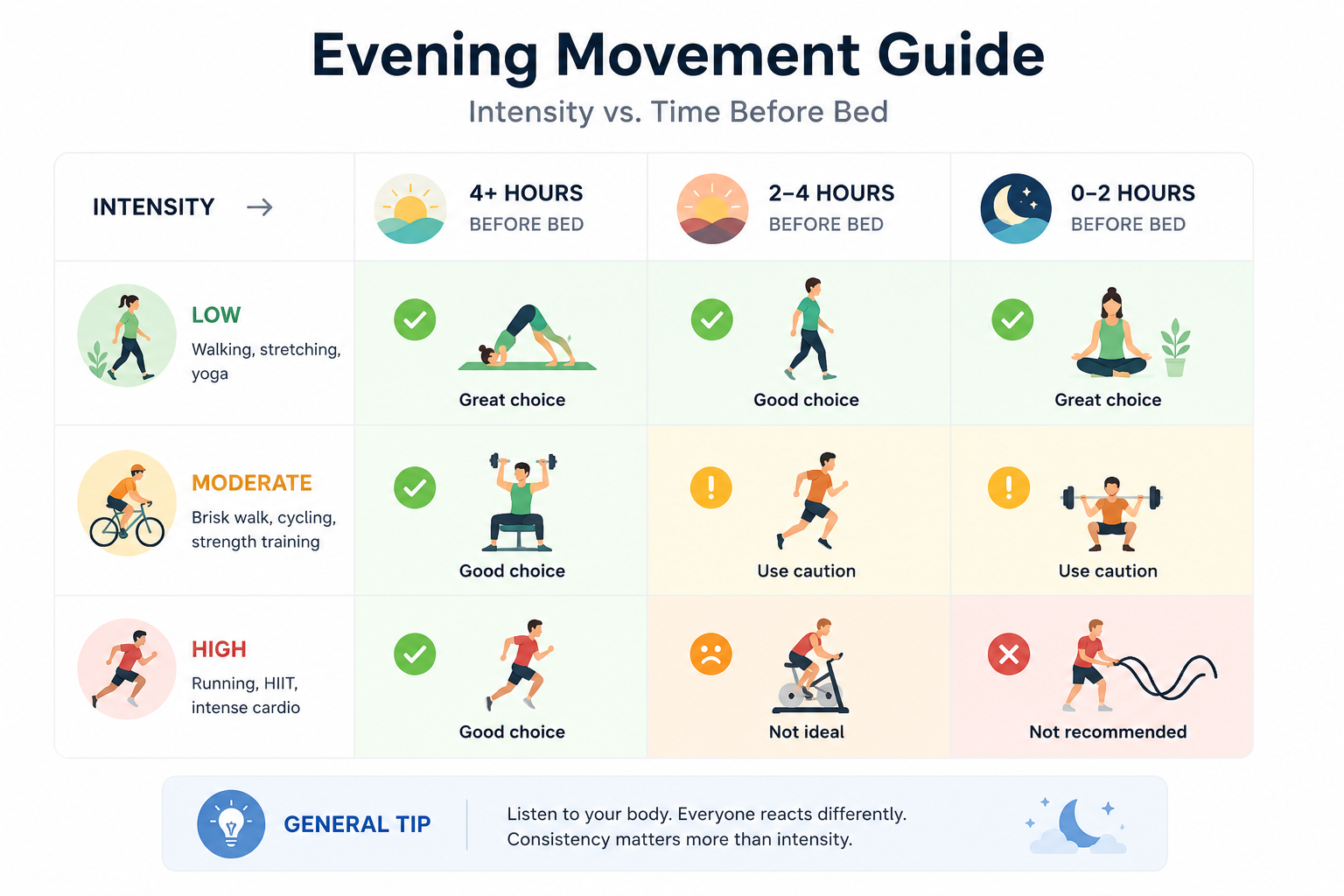
| Timing before bed | Low intensity | Moderate intensity | High intensity |
|---|---|---|---|
| 4+ hours before bed | Usually safe | Usually safe | Often okay, but watch recovery |
| 2–4 hours before bed | Usually safe | Depends on the person | Higher risk for sleep disruption |
| 0–2 hours before bed | Best kept very light | Risky if stimulating | Most likely to backfire |
This is not a law. It is a starting point.
Some people can lift at 9 PM and sleep like furniture. Others do one late interval session and stare at the ceiling until 1 AM. The only useful answer is the one that shows up repeatedly in the data and the body.
The best signs that a late workout is hurting sleep are simple:
- bedtime starts drifting later
- it takes longer to fall asleep
- sleep feels lighter or more broken
- overnight resting heart rate is higher
- HRV drops below the usual range
- morning energy feels worse
- the next workout feels harder than it should
One weird night does not prove anything. A repeated pattern does.
What kinds of movement are more sleep-friendly?
The best evening exercise is usually the kind that leaves the body quieter than it found it.
That does not mean useless. It just means the session should help the nervous system downshift instead of starting a second workday inside the body.
Walking
Walking is the obvious one because it is easy to scale. Ten to thirty minutes after dinner can help transition out of the day without creating the same level of strain as a hard workout.
It is also low-friction. No special plan. No perfect outfit. No heroic playlist. Just movement.
For people who sit most of the day, an evening walk can feel like taking the body out of airplane mode.
Mobility and stretching
Gentle mobility work is a good fit because it does not need to become a performance event. The goal is not to set a personal record in hip flexor length. The goal is to release tension and make the body feel less locked up before bed.
Easy cycling or very light cardio
If cycling or easy cardio feels calming, it can work. The key is keeping intensity honest. If the session slowly turns into a sweat contest, it has moved into a different category.
Light yoga or breathing-focused movement
For some people, gentle yoga is useful because it combines movement with a slower breathing rhythm. The important word is gentle. A power class that feels like a competitive plank tournament may not have the same effect.
Easy technique work
Some people can do low-intensity skill practice in the evening without sleep issues. Think light form work, easy drills, or a relaxed session that never turns into a challenge.
The common thread is simple: if the workout leaves the body calmer, it is more sleep-friendly. If it leaves the body wired, it probably needs to move earlier.
What kinds of workouts are more likely to backfire?
The highest-risk late workouts are the ones that combine intensity, heat, competition, and high mental arousal.
That includes:
- HIIT
- hard running intervals
- heavy strength training
- max-effort sets
- late team sports
- intense spin or boxing classes
- long strenuous workouts
- workouts that end with the heart still racing
Again, these are not bad workouts. They are often excellent workouts. They just may not belong close to bedtime for everyone.
The Nature Communications paper found that evening exercise, especially high cardiovascular strain, may disrupt sleep and nocturnal autonomic function. The WHOOP summary of the same study also notes that high-strain workouts within four hours of bedtime can disrupt sleep onset, reduce total rest, and impair cardiovascular recovery.
This is where HRV becomes useful, but not as a panic button.
If evening exercise HRV looks lower the next morning after hard late workouts, and overnight resting heart rate is higher, that may be the body showing that recovery was still in progress during sleep. The question is not “was the workout good or bad?” The question is whether the timing made recovery harder.
Recovery is not only the workout
People often think the workout is the whole adaptation.
It is not.
The workout is the signal. Recovery is where the body actually adapts. Sleep matters because it is one of the main windows where repair, hormone regulation, and recovery processes run.
This is especially relevant for strength training. A review on physical activity, protein consumption, sleep quality, and muscle protein synthesis discusses how resistance exercise, protein intake, and sleep/recovery interact in muscle adaptation. The practical point is simple: training hard and sleeping badly is not a great long-term combination.
A late workout can create an awkward tradeoff. The session may support fitness, but if it repeatedly shortens or worsens sleep, the recovery side of the equation suffers.
That does not mean evening training is pointless. Many people can only train after work, and consistency matters. A realistic late workout is better than a perfect morning routine that never happens.
But if late training keeps hurting sleep, the answer is not necessarily to quit. It may be to change the type, timing, or intensity.
How to experiment without losing consistency
Most people do not need a new identity. They need a small experiment.
The mistake is deciding that evening workouts are either “fine” or “bad” forever. The better approach is to test what actually happens.
Step 1: Keep the workout, change the intensity
For one week, keep the same workout time but lower the intensity.
Instead of hard intervals, do an easy run.
Instead of heavy legs, do technique work or accessories.
Instead of HIIT, do a walk plus mobility.
Then check sleep latency, overnight heart rate, HRV, and morning energy.
If sleep improves, intensity was probably part of the problem.
Step 2: Keep the intensity, move the timing
For another week, keep the hard workout but move it earlier when possible.
Even shifting a session from 9 PM to 6:30 PM may change the night. Not always, but often enough to test.
Step 3: Build a post-workout downshift
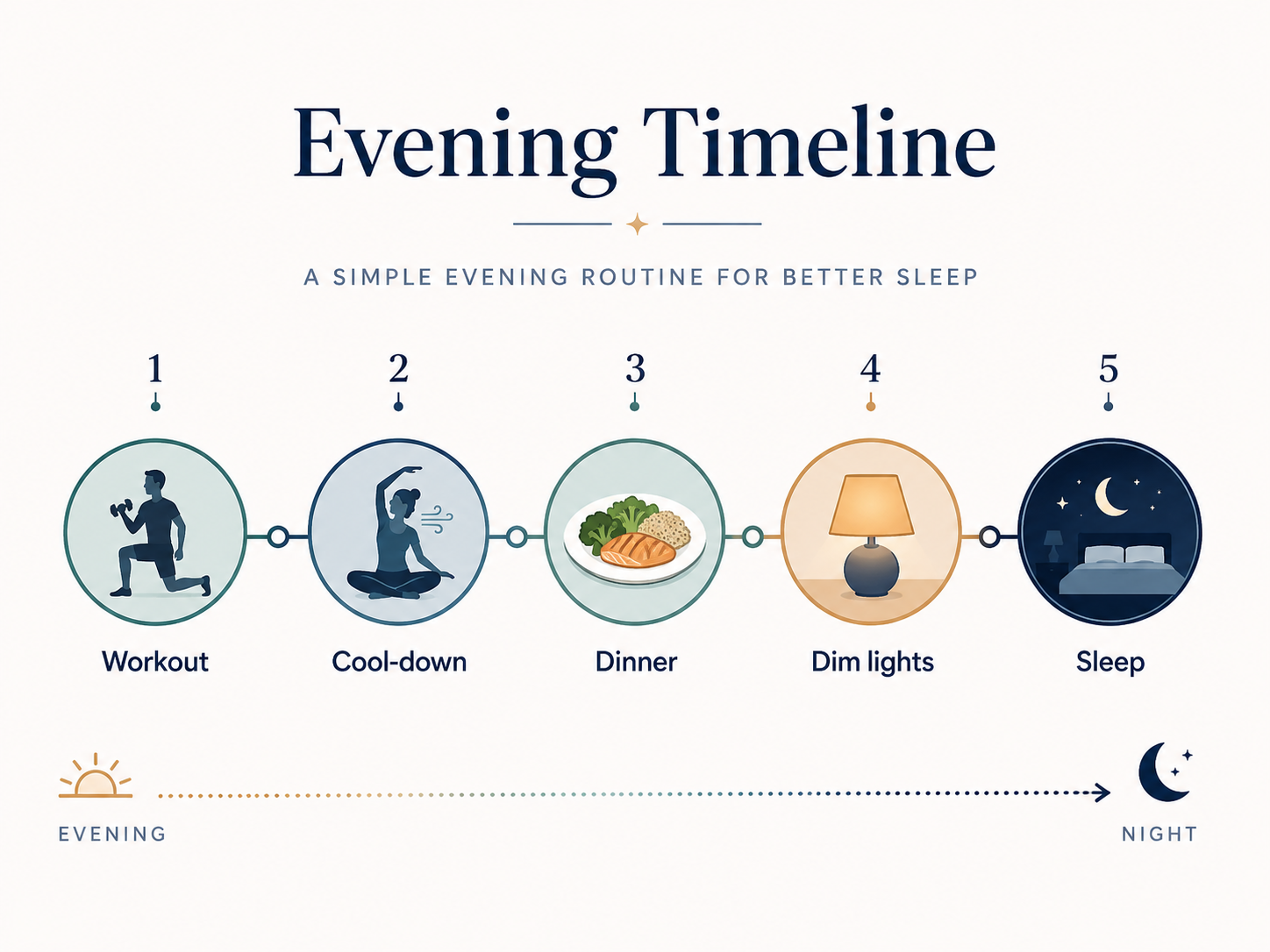
If late training is unavoidable, create a real landing strip afterward.
Cool down properly.
Take a warm shower if it helps relaxation.
Avoid turning the post-workout meal into a huge late dinner.
Dim lights.
Skip intense work messages.
Give the body at least some time to come down.
The goal is not perfection. The goal is to stop sprinting into bedtime physiologically.
Step 4: Track patterns, not single nights
One bad sleep after one late workout does not prove much. Look for repeated patterns over two to three weeks.
Ask:
- Do hard late workouts delay bedtime?
- Is sleep shorter on those nights?
- Is resting heart rate higher overnight?
- Is HRV lower the next morning?
- Does morning energy feel worse?
- Is performance suffering later in the week?
If the same answer keeps appearing, believe the pattern.
What if evening is the only time to train?
This is the real-life section.
Not everyone can train at 10 AM under perfect sunlight with a meal plan and emotional stability. Many people train after work because that is the only slot available.
That is fine.
The question is not whether evening workouts are allowed. The question is how to make them less likely to sabotage sleep.
Try this hierarchy:
Best: hard workouts earlier in the day, light movement in the evening.
Good: hard workouts early evening, with a proper cool-down and wind-down.
Acceptable: late workouts kept moderate and predictable.
Risky: intense workouts ending close to bedtime, especially if sleep is already fragile.
If the only available time is late, consistency still matters. But the workout may need to become more sleep-aware. Fewer all-out finishers. Less caffeine. More cool-down. Earlier dinner if possible. Dimmer lights after training. A realistic bedtime buffer.
The most useful workout is the one that can be repeated without slowly breaking recovery.
The honest take
Exercise is one of the best things someone can do for sleep and health.
But timing changes the effect.
A walk after dinner can be a downshift. A hard workout near bedtime can be an alarm bell. The same person can benefit from evening movement and still struggle with late high-intensity training.
That is why the question is not “is exercise before bed bad?” The better question is:
What kind of exercise, how close to bedtime, and what happens afterward?
If the workout leaves the body calmer and sleep stays normal, keep it. If the workout leaves the body wired, pushes bedtime later, raises overnight heart rate, lowers HRV, or makes mornings feel worse, adjust the plan.
Move intensity earlier when possible. Keep late sessions easier when needed. Use walking, mobility, and gentle movement as evening tools. Protect sleep like it is part of the training program, because it is.
A workout that improves fitness but quietly damages recovery is not really winning.
FAQ
Is exercising before bed bad?
Not always. Light or gentle movement before bed may be fine for many people. The bigger issue is hard or strenuous exercise close to bedtime, especially if it makes it harder to fall asleep or worsens recovery signals.
How late is too late to work out?
It depends on the person and the workout, but strenuous exercise within about four hours of bedtime is more likely to affect sleep for some people. Light movement is usually less risky.
What is the best evening exercise for sleep?
Walking, gentle stretching, mobility, light yoga, and easy cycling are usually more sleep-friendly than HIIT, heavy lifting, hard running intervals, or competitive sports close to bedtime.
Can late workouts lower HRV?
They can. A hard late workout may keep the body more activated overnight, which can show up as higher resting heart rate and lower HRV the next morning.
Should training be skipped if evening is the only option?
Not necessarily. Consistency matters. If evening is the only available time, try lowering intensity, adding a cool-down, avoiding late caffeine, and leaving a buffer before bed.
*This article is for informational purposes only and is not a substitute for professional medical advice, diagnosis or treatment.*
Sources:
Nature Communications·Monash University·WHOOP Press Center·Frontiers in Public Health·PMC·arXiv