Handrail support changes the context of a treadmill session
By Mr.Apps · Nov 3, 2026
Category:Training
Record how treadmill handrails were used
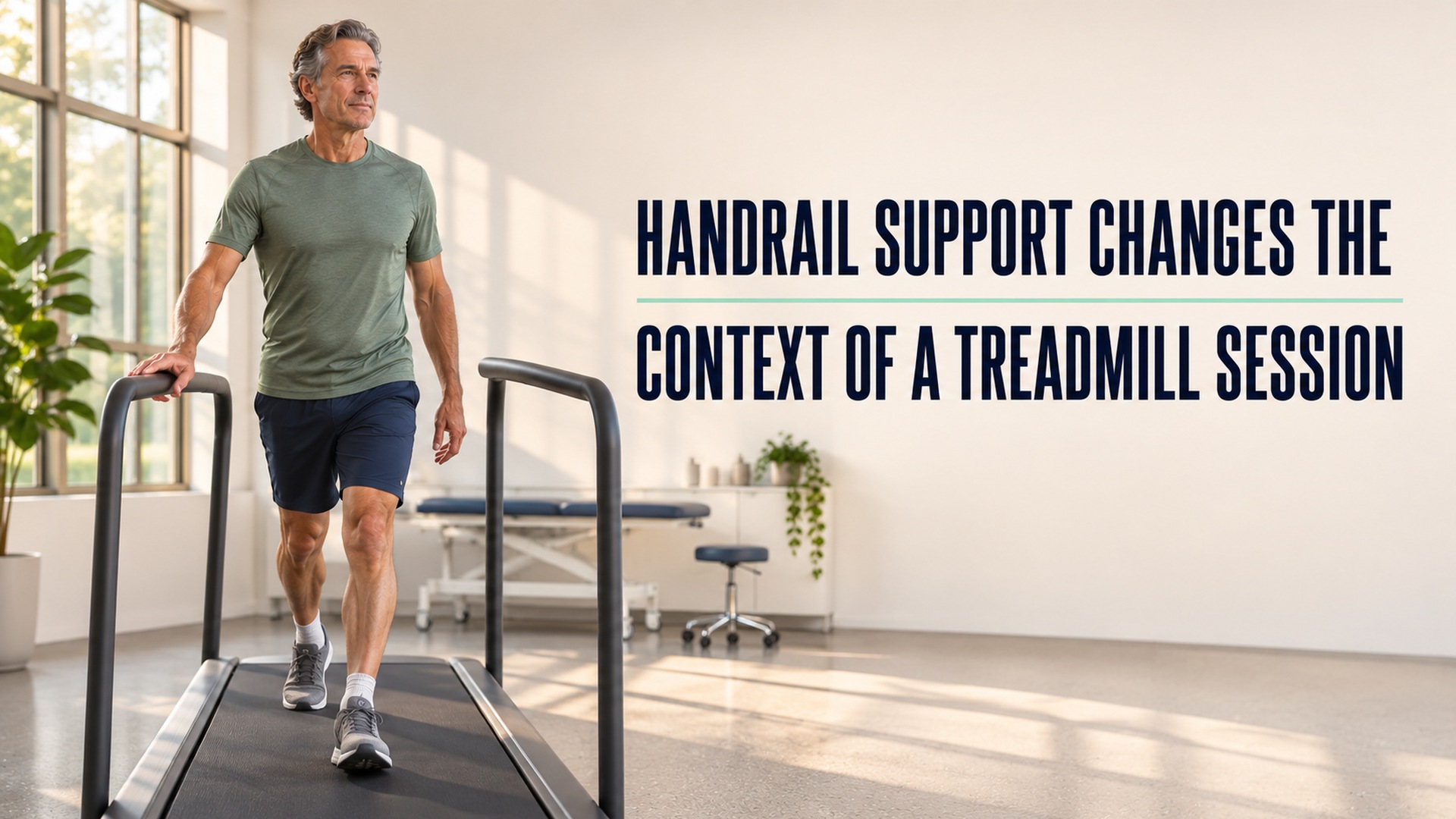
Handrail support changes the context of a treadmill session even when the belt speed and incline stay the same. A person who lightly touches a rail for balance, rests both forearms on it, or grips it while leaning has changed the movement task. Those are not equivalent ways to walk. The rails may be necessary for safety, so the goal is not to remove support. The useful goal is to preserve what support was used when reviewing the workout or comparing one session with another.
I record the rail pattern as context instead of applying a guessed calorie adjustment.
In a small study of healthy volunteers, gripping the rails and, to a lesser extent, resting the hands on them changed heart-rate and oxygen-uptake responses during steady treadmill exercise. The study abstract on handrail support and oxygen uptake reports a specific protocol with ten participants, not a universal adjustment factor. It supports recording rail use as context; it does not tell a reader how many calories to subtract from an individual session.
Why the same console setting can describe a different task
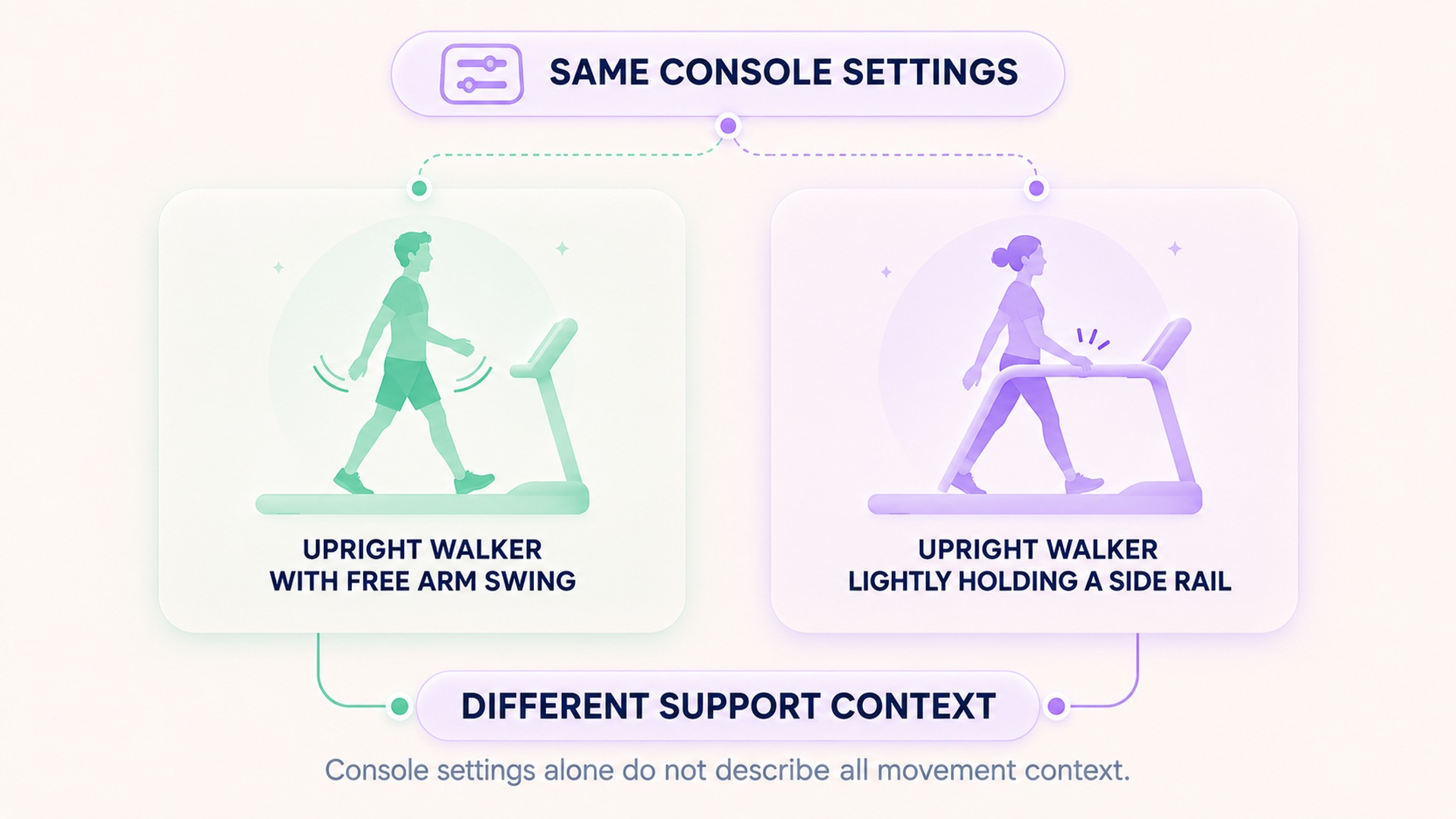
A treadmill console controls belt speed and elevation. The body still has to move in relation to the moving belt. Arm swing, trunk position, stride, and the amount of weight placed through the hands can all change that relationship. When someone supports body weight through the rails, the legs may perform a different amount of work than they would with free arm swing at the same belt setting.
The effect depends on how the rails are used. A fingertip contact for balance is not the same as leaning heavily, pulling against the rails, or holding the front bar while walking. A person may also use one side more than the other. A workout summary that only records speed, grade, and time cannot distinguish these situations. This does not make the console data useless. It means the console fields describe settings, while rail use describes part of the person's interaction with the equipment.
Research in this area uses defined protocols and participants. For example, a separate treadmill study with continuous handrail support examined submaximal exercise in women. A later open-access study of handrail use during maximal treadmill testing asked a different physiological question in young adults. A recent controlled study of handrail contact examined cortical responses in healthy adults at selected walking speeds. The populations, test designs, and outcomes are not interchangeable. Taken together, they show why rail use can matter during testing, but they do not provide a simple correction for every everyday workout.
Keep safety needs ahead of data comparability
People use treadmill rails for different reasons, including balance, fatigue, mobility limitations, unfamiliar equipment, or clinician instructions. A handrail can prevent a fall. Do not encourage someone to walk without support simply to make a workout look more comparable or to match a study protocol. Follow the person's care plan and the equipment instructions. If a clinician or exercise professional has specified how to use the rails during a test, preserve that protocol rather than substituting a generic rule.
Even a treadmill test performed in a supervised setting may have a defined rule about rail use. The reason is measurement consistency. If a protocol estimates exercise capacity from speed and grade, leaning or pulling can affect the relationship between the settings and the person's effort. The clinical testing review of treadmill oxygen-uptake estimates discusses handrail use among protocol details that can affect interpretation. It does not establish that a consumer workout should mimic a laboratory test.
Safety instructions can be model-specific. The manual explains where a person may hold the equipment, how to use the emergency stop, and what the machine expects during operation. The treadmill product manual is one example of manufacturer documentation to consult for its own product. Use the manual for equipment operation, and the responsible professional for individualized exercise guidance.
Describe the support rather than guessing its effect
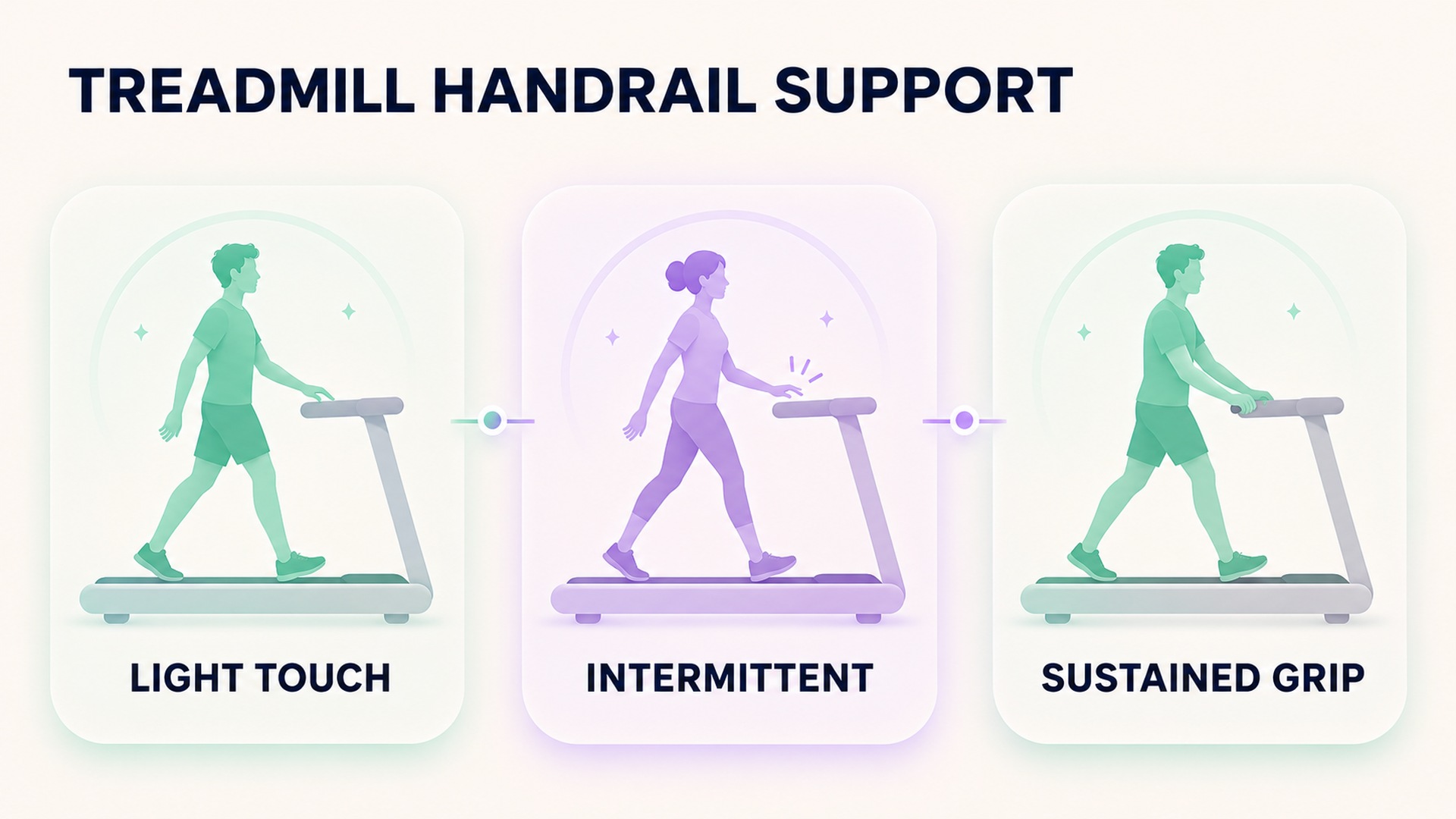
A practical workout note can use plain categories: no rail contact, light balance contact, intermittent hand support, or sustained gripping or leaning. Add a short detail if the pattern changed during the session, such as “used front rail during the final incline interval.” The purpose is not to create a laboratory measure of force. It is to tell a future reader what the person did.
If support was used because of a symptom, stability concern, or instruction, the reason may be relevant. Record only what is appropriate to share, and avoid turning a note into a diagnosis. “Held the side rail for balance” is a behavioral description. “Had poor balance” is an interpretation unless that conclusion was established by a qualified assessment.
When a device or app allows a free-text note, keep it tied to the correct activity. If the workout is edited later, retain the original record and add a dated correction rather than overwriting the source. A treadmill export may include speed, incline, and duration but omit the way a person used the rails. Keeping the original fields helps distinguish what the machine measured from what the person reports.
Compare sessions only when the context is similar
Within-person comparisons are easier to interpret when the equipment, settings, and support pattern are similar. A session with free arm swing and one with sustained rail gripping may not represent the same movement task, even if the visible settings match. This does not mean one session is invalid. It means the difference should be recognized before assigning a reason to a change in heart rate, perceived effort, or distance.
For an ordinary training log, retain the fields the machine actually recorded and add a brief support note. Avoid converting that note into an estimated calorie correction. Calorie displays already depend on device assumptions and user-entered inputs. A universal deduction for rail use would hide differences in body position, grip, speed, grade, and individual movement. The data does not support one fixed subtraction for all users.
If a planned comparison requires a specific technique, make that requirement explicit before the session and keep it safe. For example, a supervised protocol may call for light touch rather than leaning. Someone who needs more support should use it and report the change. A difference in method is useful context, not a failure to complete a workout.
Distinguish a short touch from sustained leaning
People may touch a rail briefly when stepping onto the belt, adjusting clothing, or regaining balance. That moment should not automatically be treated as equivalent to supporting body weight through an entire interval. A record can preserve duration or timing when it matters. “Touched rail briefly during transition” conveys something different from “held both rails throughout.”
Body position also matters. A person can hold the rails while standing upright, or bend forward and transfer more load to the hands. The grip may be symmetric or may rely on one arm. A workout diary usually cannot quantify force, but a simple note can preserve visible differences. If a clinical evaluation needs a precise measure, the evaluator can choose an appropriate method. A consumer log should not imply force readings it never collected.
When rail use changes because of discomfort or unusual breathlessness, preserve that observation and follow the appropriate clinical guidance. Do not rely on a heart-rate number or calorie estimate to explain a symptom. A treadmill session is one piece of information. How the person felt and why support was needed may matter more than the machine's summary.
Make treadmill records easier to interpret later
Keep the treadmill model or location, speed, incline label, duration, and rail-use note together. If a workout platform imports the machine data automatically, use a note field for what the device did not capture. A screenshot may help explain the console values, but it cannot show the person's grip across the full session. A short written note is often more useful than trying to infer rail use from a heart-rate trace after the fact.
When two sessions differ, review their settings and support pattern before interpreting the numerical change. A higher heart rate could reflect many things, including pace, grade, temperature, rest, illness, or effort. Handrail support is one context variable, not a standalone explanation. The same caution applies to treadmill incline; a recorded grade should keep its original unit and machine context.
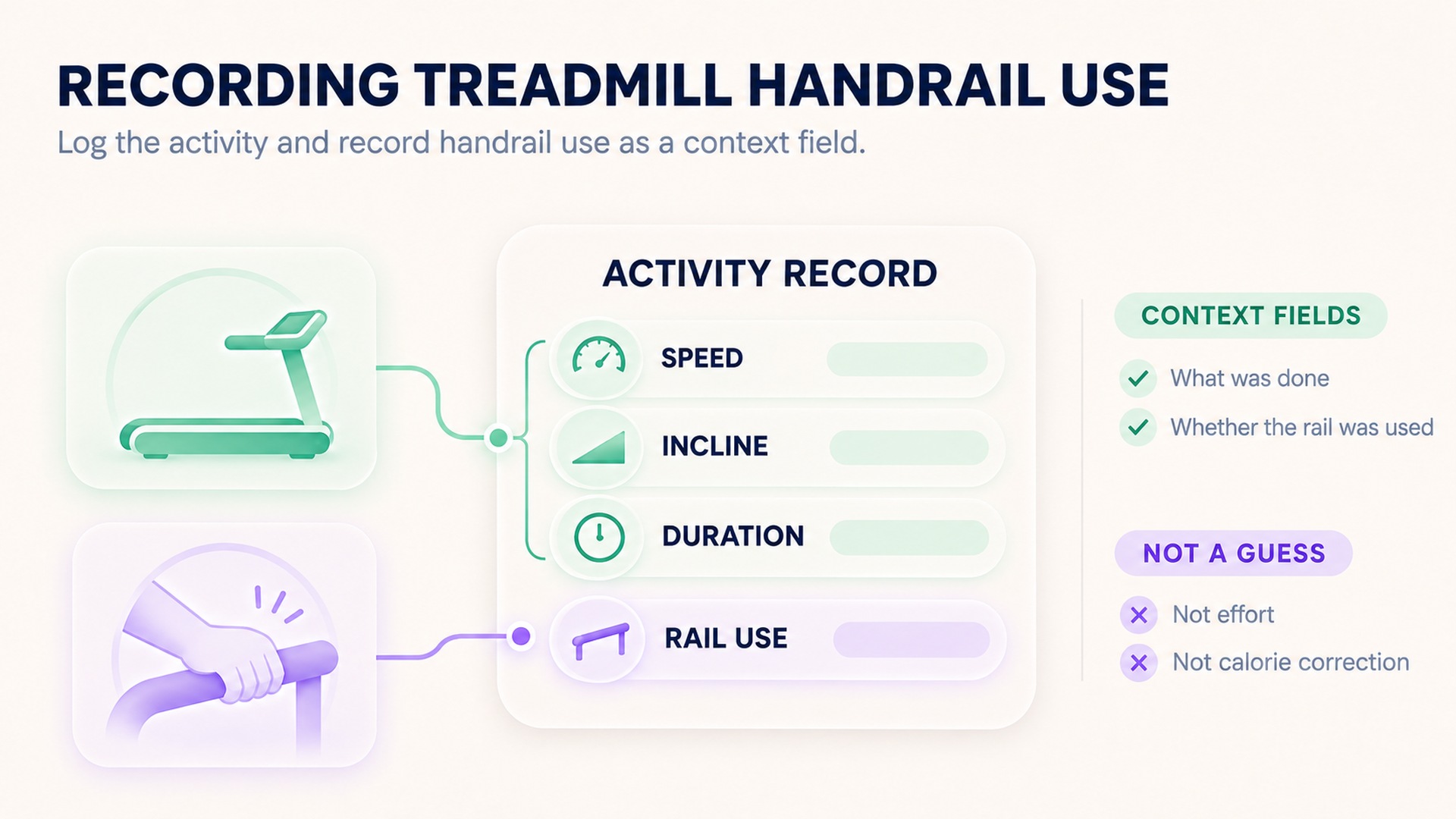
The most defensible record is direct: what the treadmill displayed, how long the session lasted, whether rails were used, and whether that use changed. Avoid adding a guessed physiological value. This lets a clinician, coach, or future reader decide whether a session is comparable without assuming the equipment captured details it did not measure.
Frequently asked questions
Does holding the handrail always lower workout intensity?
The effect depends on how the person uses the rails and on the activity. Research protocols show that sustained gripping or resting can change physiological responses, but they do not establish the same effect for every person or every treadmill session.
Should I stop using the rails to make my data comparable?
No. Keep support needed for balance or safety and follow any clinical instructions. Record how the rails were used so a later comparison includes that context.
Can I subtract a fixed number of calories for rail use?
No universal calorie adjustment is supported. Record the support pattern and retain the device's estimate as a device estimate rather than applying an invented correction.
*This article is for informational purposes only and is not a substitute for professional medical advice, diagnosis or treatment.*
Sources:
Journal of Cardiopulmonary Rehabilitation·Research in Nursing & Health·Scientific Reports·Journal of NeuroEngineering and Rehabilitation·Journal of the American Heart Association·Precor