Treadmill incline percentages are not angles in degrees
By Mr.Apps · Nov 3, 2026
Category:Training
Why a treadmill incline percentage is not an angle
Treadmill incline percentages and angles in degrees describe a slope in different ways. A grade percentage compares vertical rise with horizontal distance, while an angle describes the slope's rotation from level. The values can refer to the same surface, but their numbers are not interchangeable. If a machine displays a grade of 10%, that does not mean the belt is tilted by 10 degrees. Preserving the unit in a workout record prevents a display setting from being mistaken for a measured angle or compared with another machine using a different convention.
The distinction is a small piece of geometry with practical consequences. Workout summaries may show incline as a percent, a level, or a proprietary resistance setting. An app may store a numeric field without displaying its unit in every view. I keep the original label, device, and session context together instead of converting a number unless the intended quantity and conversion are clear. The unit checklist's percentage convention treats a percentage as a ratio-based expression, and the SI reference on quantities and units explains why a reported measurement needs its unit. That supports the basic definition, while a particular treadmill manual remains the source for what its own control reports.
What grade percentage means
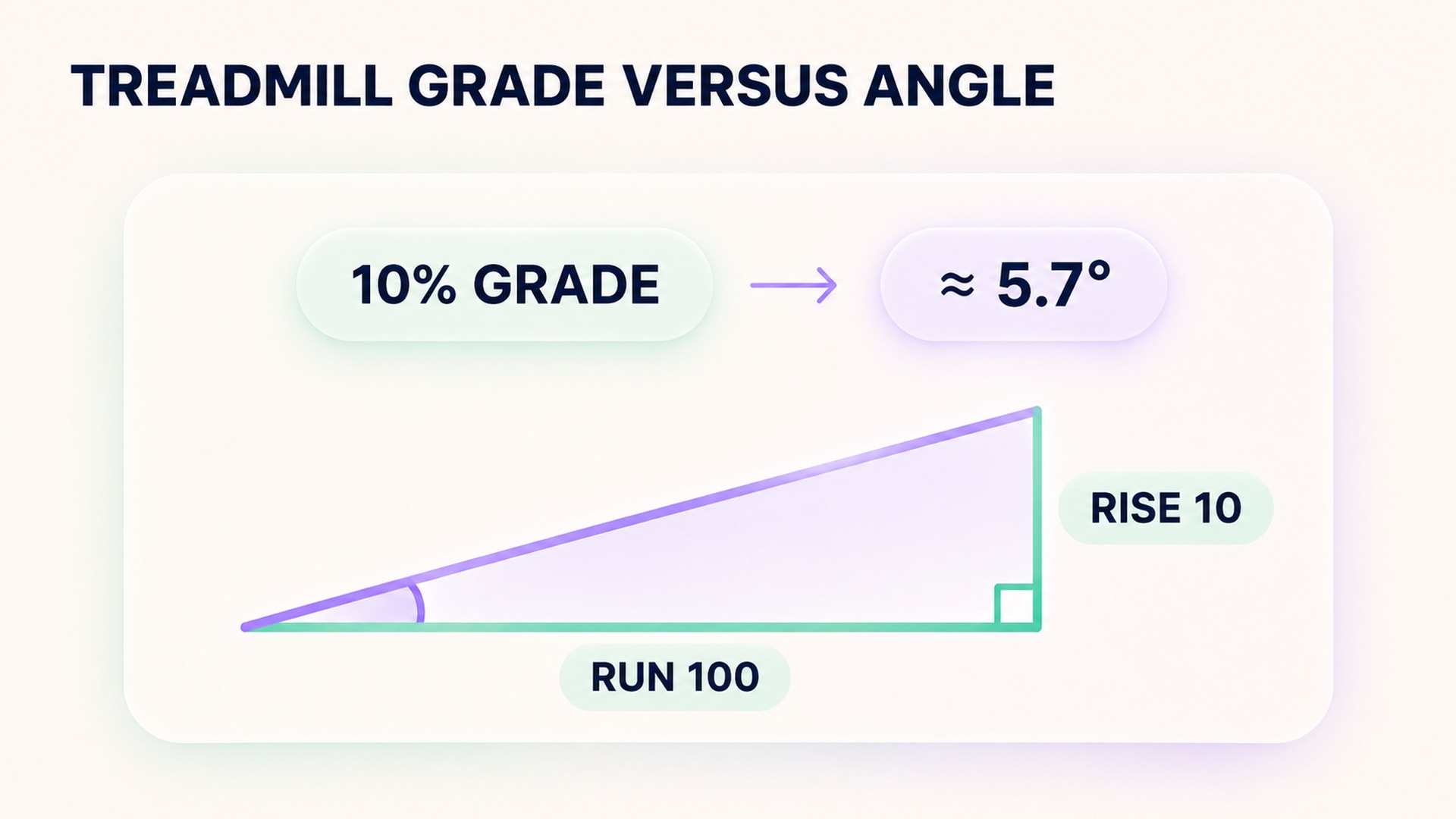
Grade is rise divided by horizontal run, multiplied by 100. If a surface rises 10 units for every 100 horizontal units, its grade is 10%. The units cancel in that ratio, so the percentage is dimensionless. It communicates how much elevation changes over a horizontal distance. It does not state how many degrees a line rotates from the horizontal.
The angle uses a different mathematical relationship. For a straight slope, the tangent of the angle equals rise divided by horizontal run. Converting from a percentage grade to an angle therefore requires an inverse tangent operation. A 10% grade corresponds to an angle of about 5.7 degrees, not 10 degrees. Conversely, an angle of 10 degrees corresponds to a grade a little above 17%. Those examples illustrate the geometry; they do not establish that every treadmill's displayed setting is an independently measured belt angle.
The difference becomes more pronounced as the slope increases. At small inclines, both values are small, which can make their different scales easy to overlook. The percentage and angle still use different numerical relationships. A training log that drops the percent sign removes information, even if the entry began as a familiar treadmill setting. Keep the unit as shown in the machine's interface or manual.
Check the machine's own display convention
Manufacturers do not always use the same display labels, step sizes, or control ranges. A treadmill may report grade in percent, show a numbered level, or use an incline setting whose relation to physical geometry is not explained in the workout export. The manual or product documentation identifies the control's meaning. If the display says only “incline,” retain that wording and the machine model rather than relabeling the value as degrees.
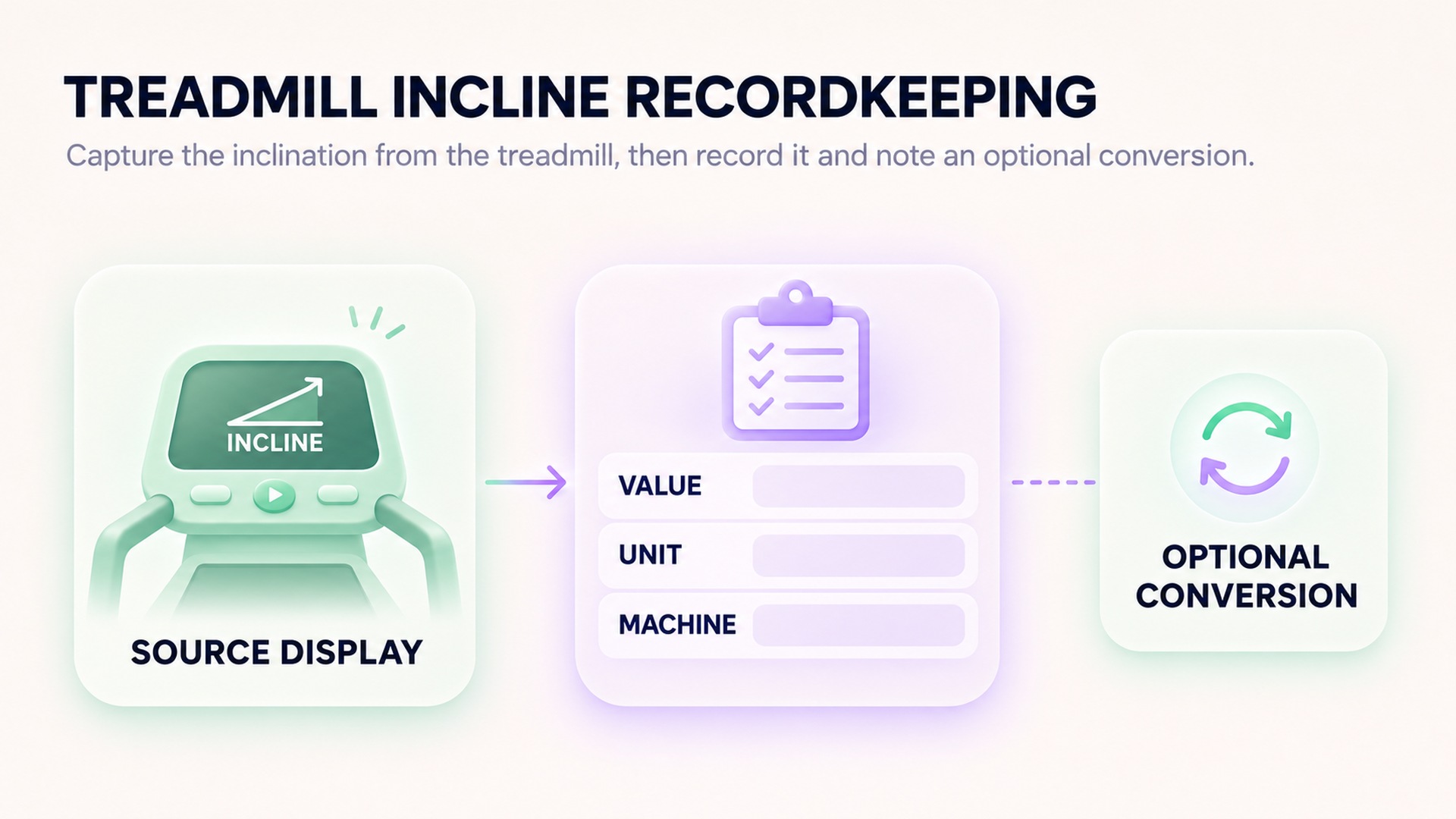
The useful record has four parts: the displayed number, its unit or label, the machine or model, and the session date. If the workout was exported through another platform, note whether the number came from the treadmill, a connected app, or a manually entered summary. That distinction matters because a platform may map a device field into its own format. A data field titled “grade” can still inherit an undocumented source convention. One treadmill specification lists its range in percent grade, while an owner manual describes incline resolution and accuracy in percent grade. They illustrate why the source document matters; they do not define every machine.
When two machines use different controls, similar numbers do not guarantee similar slopes. One may report percent grade and another a level index. Even when both report percent, calibration, belt geometry, maintenance, and the exact operating state can affect what a setting represents. Use a documented device label for comparison and avoid claiming equivalence from a matching numeral alone. Some console instructions describe selectable incline levels, so keep a level number labeled as a level unless the manual defines a conversion.
Convert only when the original quantity is known
If a specific calculation is useful, first confirm that the recorded value is percent grade and that it represents rise over horizontal run. Divide the percentage by 100 to get the ratio, then use the inverse tangent to find the corresponding angle. For example, 8% becomes a ratio of 0.08; its angle is arctan(0.08), approximately 4.6 degrees. Keep the original value alongside the converted value, and label each clearly.
The reverse conversion starts with an angle. Take the tangent of the angle, multiply by 100, and label the result percent grade. This is not a special treadmill calculation. It follows the geometry of a straight incline. In a real machine, the angle of the walking surface, the angle of the frame, and the control's displayed grade can be distinct measurements. Do not imply that a calculated angle was measured by the treadmill unless it actually was.
Rounding also matters. A value rounded to the nearest percent does not support a highly precise angle. If the source display provides only a whole number, a converted result with several decimal places creates false precision. A note such as “10% grade, approximately 5.7° by geometry” is more honest than presenting a long decimal as an instrument reading. The SI conversion guide's unit conventions are useful when converting a measurement, but they do not turn an estimate into an instrument reading.

Keep the original workout record intact
The original session file is useful even after a cleaned-up summary is made. Preserve its incline field, source, and unit as exported. If a second field is needed for analysis, store the converted result separately and make the conversion rule visible. This allows someone reviewing the record to distinguish an instrument-reported setting from a later calculation.
Keep distance and incline fields independent. A treadmill's displayed distance may be based on belt speed and time, whereas an incline percentage describes slope. Neither value alone establishes the full mechanical work of a session. Grade, speed, duration, body position, hand support, and machine behavior provide different context. A related guide to handrail support during treadmill walking explains why holding the rails is another detail worth preserving when comparing sessions.
Do not rewrite a historical record after learning a more precise definition. If an older entry says “10 incline” without a unit, retain it as entered and mark the unit as unknown. You may add a separate note explaining the ambiguity, but do not infer percent or degrees from the number alone. When a platform imports workouts automatically, check its documentation before changing the field mapping. A silent conversion can make older and newer sessions look comparable when they are not.
Compare sessions on stable terms
For a within-machine comparison, use the same machine and retain the same display convention. Record speed, duration, and the incline label in the format the console shows. Note whether the session included pauses or manual changes. This does not make every workout equivalent; it makes the recorded settings easier to interpret.
For comparisons across machines, identify the source model and confirm the units. If the documentation is not available, treat the displayed value as a device-specific setting. Avoid converting it or matching it to another console's number. Where a facility has multiple treadmills, recording the machine identifier may be enough to distinguish one setting scale from another.
Use the unit to prevent avoidable confusion
If a coach, clinician, or training partner asks for a treadmill incline, report the machine's label and unit. “Ten percent grade on this treadmill” is clearer than “ten degrees” when the screen actually shows a percent. If the screen uses a level number, give the number as a level and identify the machine. A concise label can prevent a later reader from assuming an angle or an interchangeable percentage.
When the machine's convention remains uncertain, ask the manufacturer or facility rather than guessing. That is especially important when a training plan specifies a grade or when a test protocol requires fixed settings. A numeric field without a unit may be sufficient for a device's own internal use, but it is not a complete measurement for someone trying to interpret the session later.
A practical record format
A durable treadmill entry can include date, machine or source, displayed incline number, unit exactly as shown, speed, duration, and any support used. If the device exports a second incline field, retain its original name rather than overwriting it. Add a converted angle only when the source definition is verified and the conversion is useful for the reader.
This record does not need to imply more precision than the machine provides. It simply protects the meaning of the number. Percent grade and degrees both describe slopes, but they use different relationships. The percentage compares rise with horizontal run; degrees express angular rotation. Once the unit is preserved, the workout can be compared on the terms the machine actually reported.
Frequently asked questions
Does a 10% treadmill incline mean 10 degrees?
No. A 10% grade corresponds to an angle of about 5.7 degrees for an ideal straight slope. The treadmill may display a grade percentage, a level, or another device-specific setting, so check its own label and manual before converting.
Can I compare incline numbers from two treadmills?
Only after confirming that both machines report the same quantity and unit. If either uses numbered levels or an undocumented scale, preserve the displayed setting as device-specific rather than treating matching numbers as equal slopes.
What should I write in a workout log?
Record the value and unit exactly as displayed, along with the treadmill or data source, speed, and duration. Keep a calculated angle in a separate labeled field and retain the original setting for comparison.
*This article is for informational purposes only and is not a substitute for professional medical advice, diagnosis or treatment.*