Keeping prescribed breathing treatment separate from a sleep score
By Mr.Apps · Oct 19, 2026
Category:Sleep
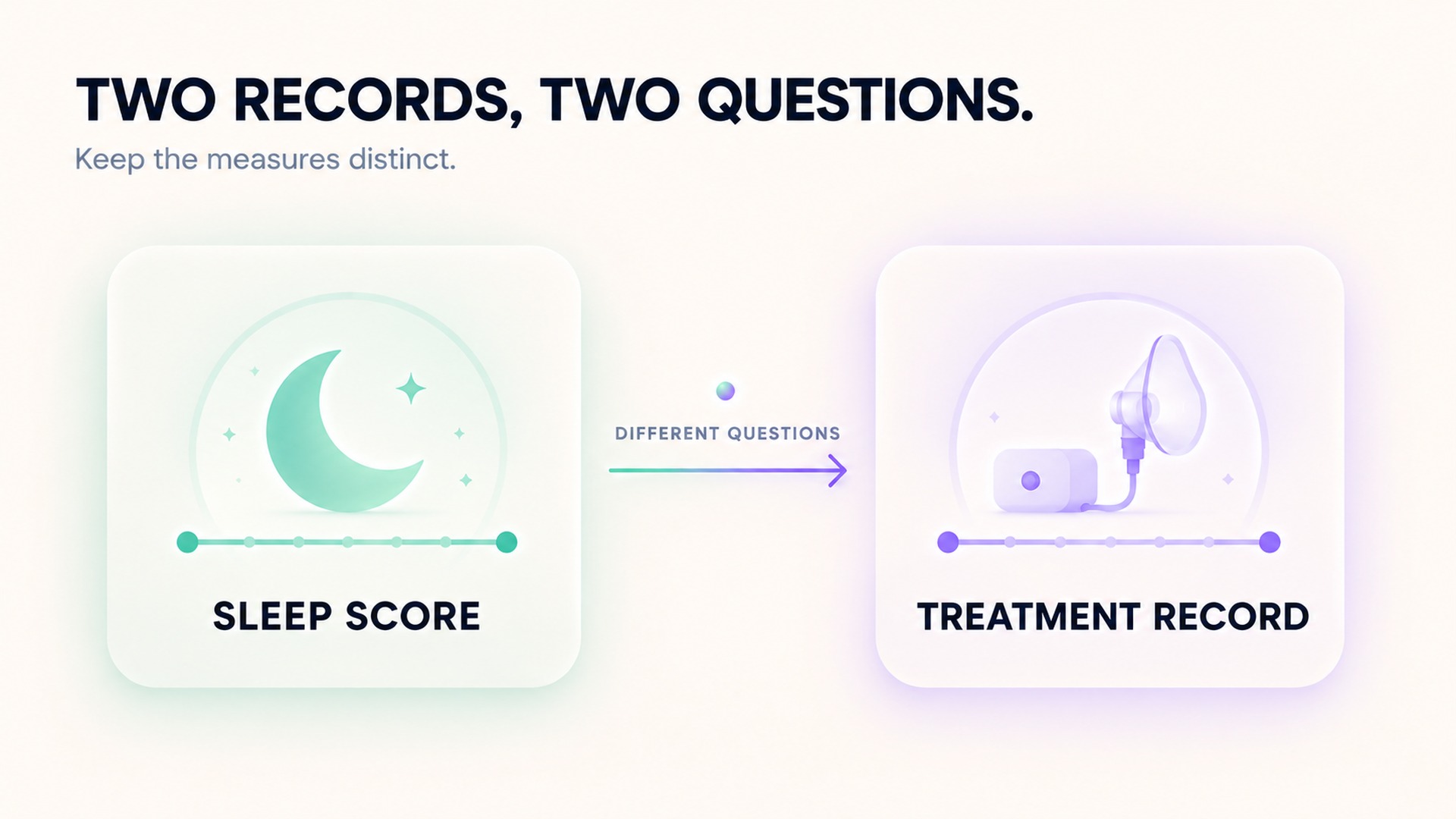
A sleep score can summarize parts of a night, but it cannot tell you whether a prescribed breathing treatment was used as directed or whether it is controlling a diagnosed condition. A nightly score may reflect estimated duration, movement, timing, or a device’s stage classification. A treatment record can show use, mask fit reports, and equipment data. Neither replaces a clinical review.
I would keep the two records side by side without letting one answer for the other. If a score improves while treatment use becomes irregular, that score does not confirm the treatment is unnecessary. If the score stays low during consistent treatment, it does not prove that the therapy has failed. The useful next step is to identify what each record measured, what is missing, and what question belongs with the treating professional.
What a sleep score can summarize
Consumer sleep scores combine selected signals into a simplified result. Depending on the product, those signals may include estimated sleep duration, movement, heart rate, timing, or stage estimates. The score hides its inputs and can change when one field shifts.
A score can help a person notice a repeated pattern in the data the device collects. For example, it may show that nights with shorter estimated sleep also receive lower scores. That observation can be useful as a prompt to check the underlying sleep and daily context. It does not measure airflow through a prescribed device, diagnose the cause of awakenings, or verify that a breathing treatment is controlling sleep apnea.
Even a score that includes oxygen estimates has limits. The overview of sleep apnea describes symptoms and evaluation as part of a broader clinical picture, rather than a score-based diagnosis. The sensor, placement, sampling, and algorithm affect what the device records. A consumer estimate is not a sleep study or treatment report. The clinical guidance on home and laboratory testing for sleep apnea describes diagnostic testing as a clinical process using validated methods and patient context. An app score is not a shortcut around that process.
If the score moves, first check its components and the time window. A device update, missing wear, a changed bedtime, or a different scoring formula can alter the result.
What treatment records can answer
For positive airway pressure treatment, the machine can record whether it was running, how long it was used, and selected signals such as leak or residual respiratory events. Those data have different levels of reliability and meaning. The clinical statement on CPAP tracking systems explains that use time can be measured more consistently than some residual-event and leak values, whose definitions may vary across manufacturers. A device-generated number still needs interpretation.
The treatment record can help identify practical issues. A shorter use period might prompt a conversation about comfort, mask fit, dryness, pressure sensations, or the routine around putting the device on. A high leak estimate may be worth checking against the equipment instructions and the clinician’s advice. A residual event number may be part of a follow-up review. None of those observations gives permission to change pressure settings or stop therapy on your own.
A clinical practice guideline for positive airway pressure treatment calls for follow-up that includes troubleshooting and monitoring objective usage and efficacy data. That recommendation matters because a treatment plan includes more than a nightly score. It also involves whether the prescribed device is used, whether the person can tolerate it, what the treatment data show, and whether symptoms have changed.
clinical guidance on longitudinal sleep apnea management distinguishes routine follow-up from situations where symptoms return or data are unexplained. It does not say that every change in a consumer score requires another sleep study. It explains that testing may be considered in selected clinical circumstances, including persistent symptoms despite good use or unexplained device data. That decision belongs to the clinician who knows the diagnosis and treatment history.
Keep the records separate, then compare the timing
A useful journal can hold the sleep score, treatment use, symptoms, and relevant context in separate fields. Record the date and whether each item came from a device, a person’s note, or a clinician’s report. If a field was not available, mark it as missing rather than entering zero. A blank can mean the device was not worn or data failed to sync; zero asserts something different.
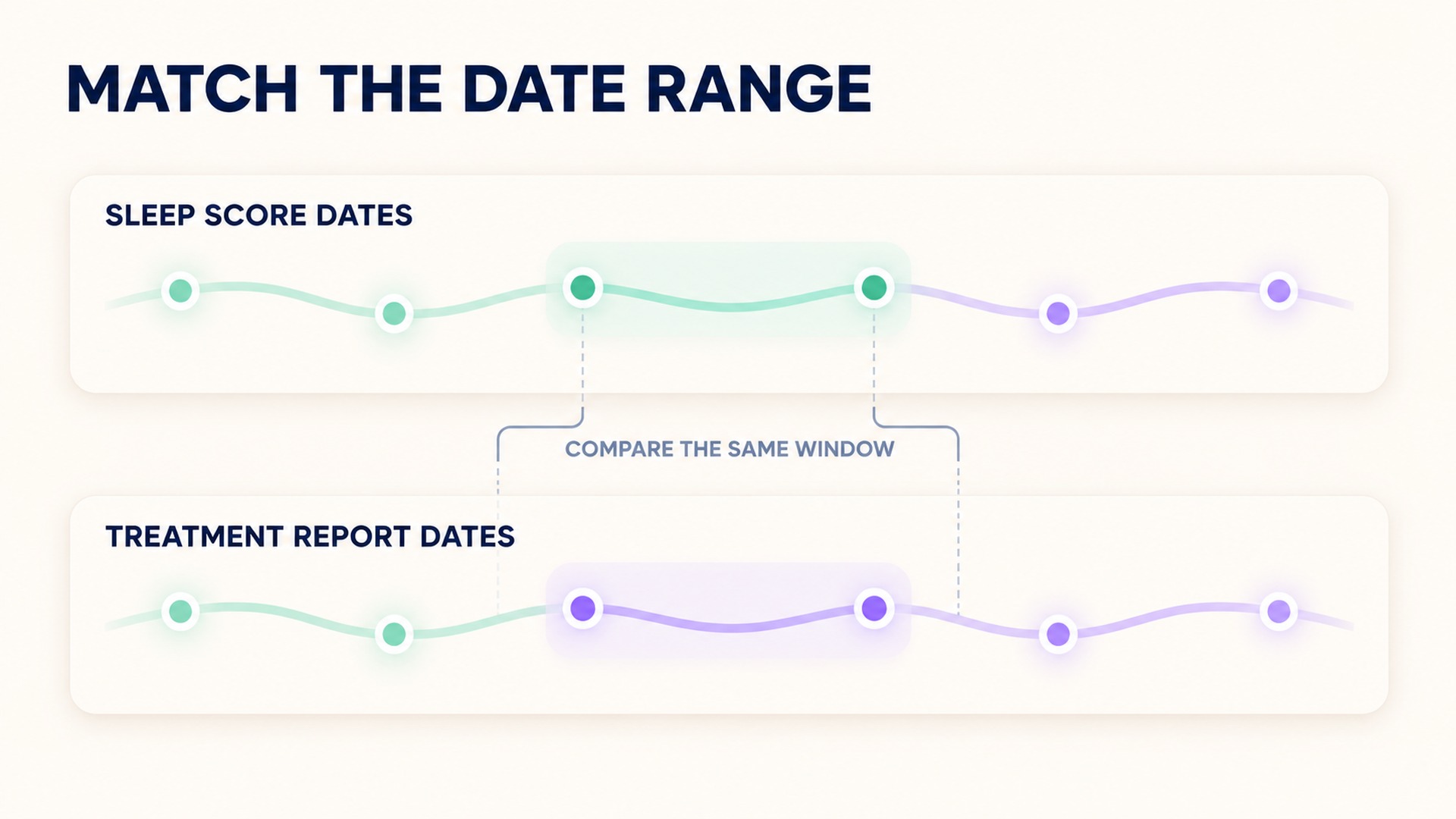
It also helps to preserve the time period. A score may cover one night, while a treatment summary may show use across a week or month. Comparing a weekly treatment report with a single poor-scoring night can produce a misleading impression. Align the dates before looking for a pattern, and note whether the device, mask, treatment settings, or scoring method changed during that period.
Do not calculate a home-made treatment score from sleep score and device use. A long night with a favorable consumer score does not establish that prescribed treatment worked. A lower score during consistent use does not establish that it did not. The values answer different questions, and combining them into a new number does not improve their accuracy.
If you discuss the records at follow-up, bring the original reports when possible. A clinical overview of CPAP treatment explains that CPAP is prescribed to keep the airway open during sleep and that patients should work with their health professionals on how to use it. The most helpful conversation is specific: what changed, when it changed, how consistently the treatment was used, and which symptoms remain. Avoid asking the app to decide whether a prescribed setting is still needed.
A score can still be useful as a personal observation. If it repeatedly changes alongside a change in sleep timing or daytime experience, that pattern may be worth noting. It should remain labeled as a device estimate. A related guide on reading sleep-stage estimates with a confidence indicator explains why a simplified sleep display should not be treated as a clinical measurement.
Build a record that preserves the question
A record is most useful when it keeps observation separate from interpretation. Instead of writing “treatment failed” beside a low score, note the score value, the device that produced it, whether the breathing equipment was used, and what you noticed the next day. A short label such as “estimated by wrist device” or “copied from machine report” prevents later readers from treating the fields as equivalent measurements. If the app allows notes, use them for context rather than a diagnosis.
Consistency can help, but it does not remove every source of uncertainty. A device may have a missing night, a clock that differs from another device, or a report that summarizes a different interval. A score may change its method after a software update. A treatment machine may classify an event using manufacturer-specific rules. Keep the original date range and the exported report when possible. If you compare a new summary with an old one, record whether the calculation and equipment are unchanged.
The same caution applies to symptoms. A note that you woke often, felt unrefreshed, or had trouble tolerating the mask is useful because it describes an experience. It does not prove why it happened. The treatment team can decide whether the pattern points to fit, a setting question, another sleep issue, or a different cause. Clear records help that conversation; they do not turn an app into a clinical assessor.
A weekly view can sometimes be easier to discuss than a string of daily grades. It may show that treatment use changed on the same dates as a schedule shift, travel, illness, or a change in equipment. That timing can suggest a question to ask, but it cannot establish cause. Keep the note neutral: “score fell after the schedule changed” describes two observations, while “the schedule caused the low score” goes beyond what the record can show. This distinction is useful whenever several factors changed together.
When the score and treatment data disagree
A disagreement is a reason to inspect the records, not to choose the more reassuring number. Check whether treatment ran for the period shown, whether the equipment report covers the same dates, whether the score has gaps, and whether either device changed. Then note the symptoms that matter to you, such as continued unrefreshing sleep or daytime sleepiness. Such symptoms have many possible causes. A sleep score cannot identify which one applies.
If the treatment report shows trouble, follow the equipment instructions and contact the treating team about persistent problems. Do not alter prescribed settings based on an app result. If you are unsure whether a problem is urgent, use the clinical contact instructions already provided for your care rather than waiting for a score trend to resolve it.
If the device shows good use but symptoms continue, mention both facts. Clinical guidance notes that persistent or recurrent sleep-related complaints can call for closer assessment even when treatment use appears adequate. A clinician may review the original diagnosis, equipment data, other sleep conditions, medications, schedule, or additional testing. The next step depends on the full picture, not on one consumer metric.
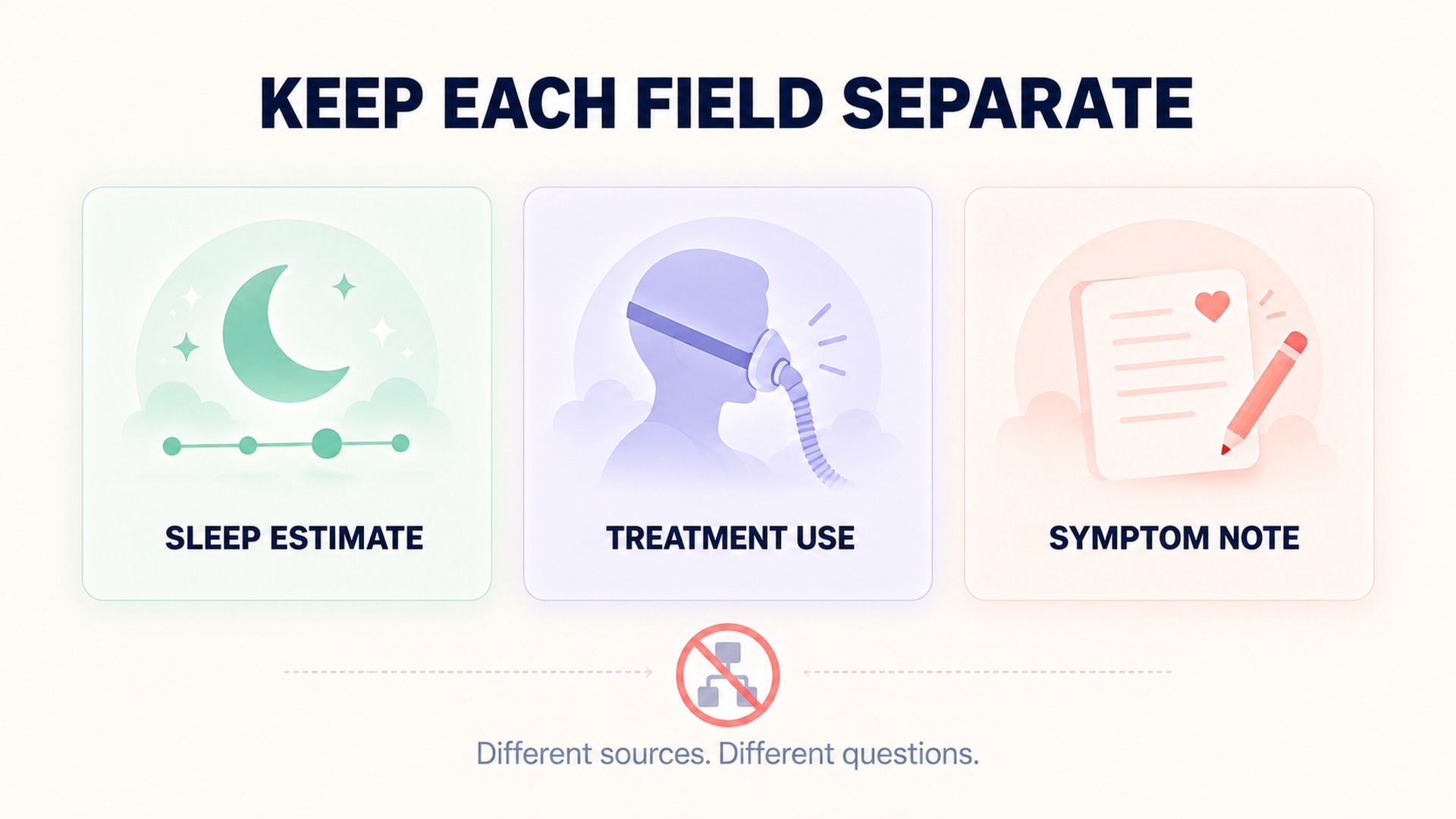
A sleep score and a treatment record can both be worth keeping, but they should remain distinct. The score summarizes selected estimates from a night; the treatment record documents use and equipment signals. Compare dates and context, preserve the source of every value, and bring unresolved questions to the professional managing the treatment. Neither record alone can authorize a treatment change.
FAQ
Can a high sleep score show that my breathing treatment is working?
No. A consumer score does not verify treatment use or clinical effectiveness. Review the prescribed device data and symptoms with the professional managing your care.
Should I stop using a prescribed device if my sleep score improves?
No. Do not stop or change a prescribed treatment because of a consumer score. Ask the treating clinician how to interpret the improvement and the treatment record.
What should I bring to a follow-up appointment?
Bring the treatment report, the dates covered, any relevant sleep-score history, and a concise note of changes in symptoms or routine. Keep estimated values separate from treatment-device data.
*This article is for informational purposes only and is not a substitute for professional medical advice, diagnosis or treatment.*
Sources:
Journal of Clinical Sleep Medicine·National Heart, Lung, and Blood Institute·American Journal of Respiratory and Critical Care Medicine·Journal of Clinical Sleep Medicine·Journal of Clinical Sleep Medicine·National Heart, Lung, and Blood Institute
Related articles

How to Read a Sleep Graph When Deep Sleep Appears in Short Bursts
Short deep-sleep blocks on a wearable graph can reflect stage estimates, chart resolution, or missing sensor intervals. Read the time scale and coverage notes alongside the total sleep window before interpreting the pattern.

Why Sleep Stage Percentages Need a Confidence Indicator
A sleep-stage percentage can look precise even when the tracker has limited evidence for part of the night. A confidence indicator should explain whether it refers to signal coverage, classifier uncertainty, or validation against a reference method.

How to Tell Whether Zero Deep Sleep Is a Data Gap or a Classification Result
Zero deep sleep in a wearable graph can reflect an incomplete record or a classification that assigned no eligible interval to that stage. Check the full timeline, coverage notes, and the app’s stage method before interpreting the value.

Why Main Sleep and Naps Need Separate Breathing Analysis
Main sleep and naps can differ in timing, duration, sensor coverage, and how a tracker identifies each interval. A breathing summary should show which session it analyzed and keep a nap separate unless the product explains how both periods enter the same calculation.

Why a Percentage of Optimal Breathing Needs a Clear Denominator
A percentage of optimal breathing can look exact even when its denominator is unclear. Learn why a tracker should state which sleep minutes count, how it treats sensor gaps, and whether its method stays consistent across nights.

Why Bedtime Consistency Scores Can Misread a Deliberate Time Shift
A bedtime consistency score compares clock labels, but a deliberate schedule shift can make familiar sleep timing appear unusually variable. Check the score’s time frame, observation window, and treatment of transition nights before reading the result as a change in sleep quality.

Why a Sleep Tracker Needs a Time-Shift Mode
A time-zone change can alter the way a sleep tracker labels a night without showing when the body’s internal clock has adjusted. A temporary time-shift mode should preserve original timestamps, mark the transition, and pause comparisons that assume a steady schedule.

Why a Time Shift Should Pause Schedule-Based Coaching
A time shift can make schedule-based sleep advice compare local bedtimes against a different clock reference. A tracker should preserve each sleep record, pause stale coaching, and explain what observations it needs before the comparison resumes.

Why Blood Oxygen Average and Breathing Quality Percentage Should Not Share a Scale
A blood oxygen average and a breathing-quality percentage can both use percent signs while measuring different things. The interface should name each denominator, time window, and method so readers do not mistake one scale for another.

Why a Health App Day Boundary Should Follow the Main Sleep Window
A midnight-to-midnight calendar day can split one sleep period across two dates. A health app should identify the sleep window it uses to group overnight signals and explain how it labels nights that cross midnight or shift in timing.