What Does an HRV Spike or HRV Drop Actually Mean?
By Mr.Apps · Jun 17, 2026
Category:HRV
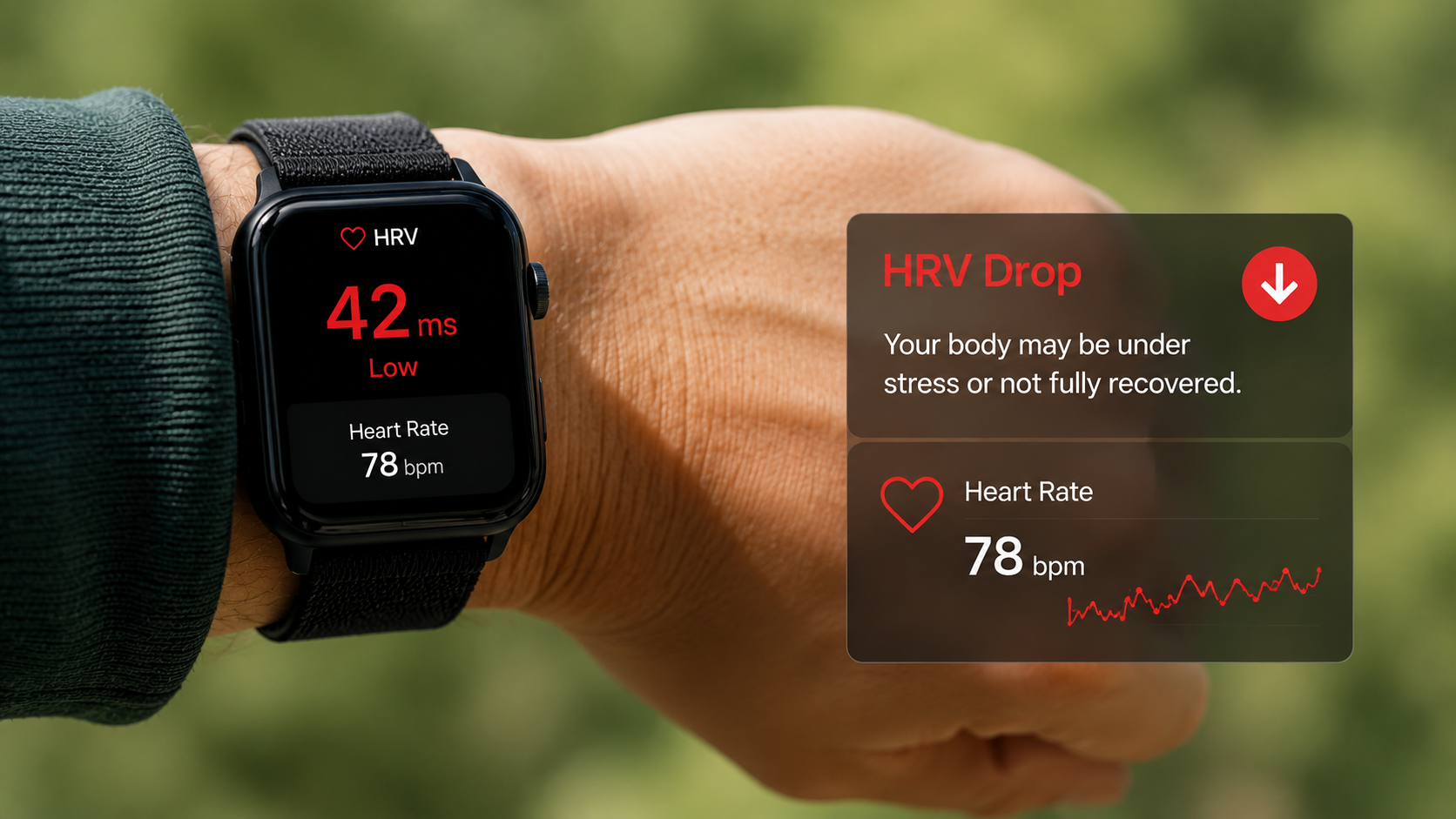
The first time I saw my HRV jump well above its usual range, it looked like recovery had finally clicked. Best number in weeks. I made coffee, felt smug, started planning a hard session. By that evening my throat hurt. Two days later, flat on the sofa with a cold. That spike wasn't a sign of readiness. It was the body bracing for something that couldn't be felt yet.
An HRV spike and an HRV drop are both just signals, and neither means what most people assume. It comes down to two questions worth answering properly: why HRV changes overnight, and when a low reading is actually worth worrying about.
First, What HRV Is Actually Measuring
Quick version, because the meaning matters more than the mechanics. Heart rate variability is the tiny variation in time between your heartbeats. The gaps shift constantly because your autonomic nervous system balances two branches: the sympathetic side that revs you up, and the parasympathetic side that handles rest and repair. Higher HRV usually means the rest-and-repair side is in charge and recovery is going well. Lower HRV means the stress side is doing more work. So a spike means that variation jumped above my normal, a drop means it fell below it, and the part I care about is why.
What Counts as Normal HRV
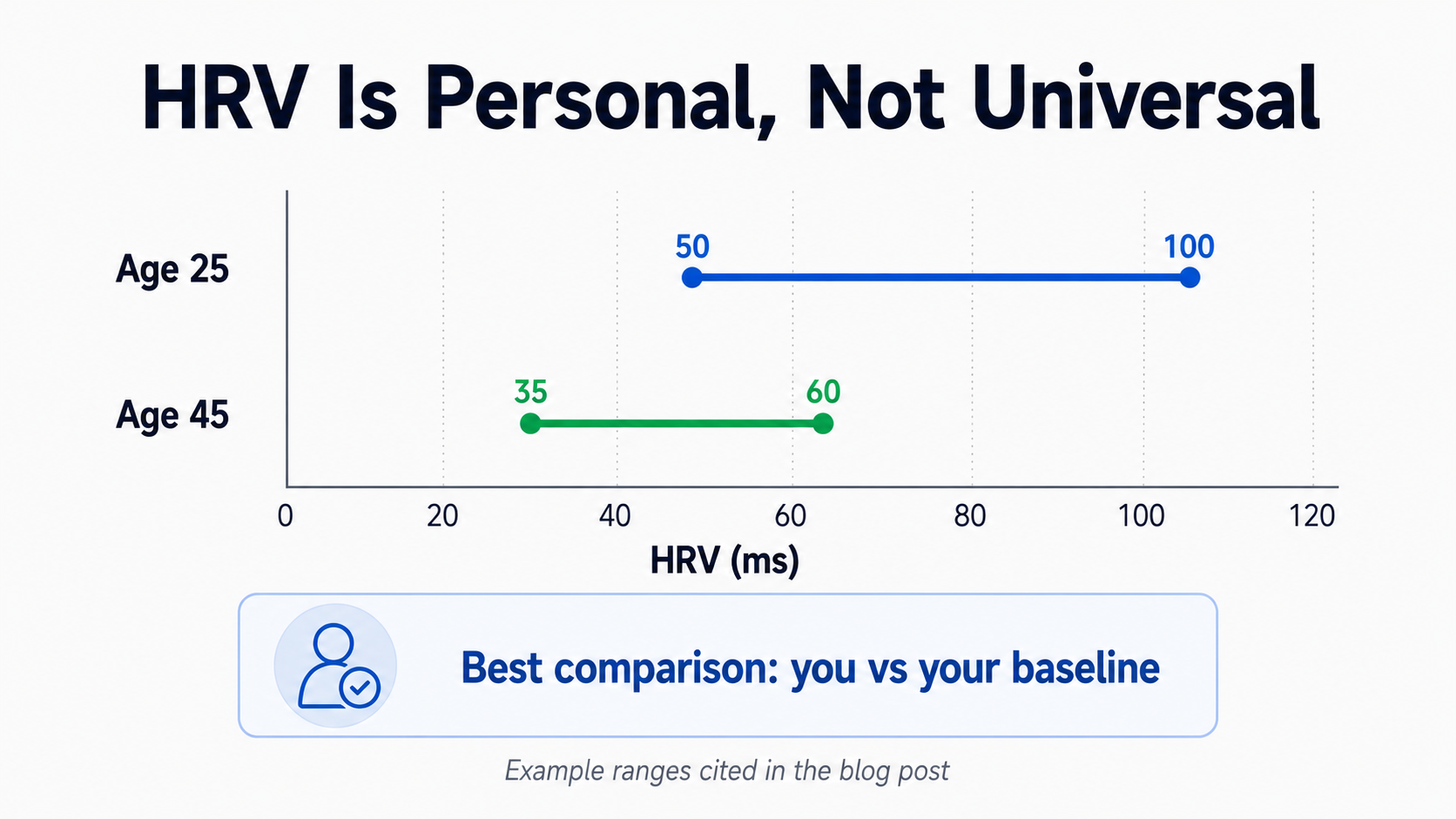
This trips people up for longer than most would like to admit, so here's the blunt version: there is no universal "normal HRV" number to chase. The figures swing enormously between people. WHOOP's own data shows a 25-year-old often sits somewhere in the 50 to 100 ms range, while a 45-year-old is more likely around 35 to 60. HRV also declines with age at roughly one to two percent a year after about 30, which is normal and not a sign anything is wrong. So a 55-year-old with an HRV of 38 isn't unhealthy just because a 22-year-old averages 68. The only comparison I've found that means anything is me against my own baseline. I stopped reading other people's numbers years ago.
What an HRV Spike Means, and Why It's Not Always Good
Here's the one almost nobody mentions. A big HRV spike can be a warning sign too. A high HRV usually reads as pure good news, and often it is: deep rest, good adaptation, a calm few days. But if HRV shoots up abnormally high in a short window, it can mean the parasympathetic system has slammed on the brakes to protect you. Marco Altini describes it as the body being "busy recovering" rather than genuinely recovered. That's exactly what happened with the cold I mentioned at the top. The spike looked like a victory; it was the body downshifting hard to fight something off. So the honest answer to "what does an HRV spike mean" depends on size and context. A modest rise toward the top of your range after good sleep is the happy version. A sharp jump well outside the normal, especially when something feels slightly off, deserves a second look rather than a celebration.
5 Reasons Your HRV Changed Overnight
This is the one I googled at 3am once, half asleep, when the number looked nothing like my usual morning figure. A list like this would have saved a lot of spiraling. When HRV moves overnight, it's almost always one of these five.
1. It didn't actually change
This was the 3am answer, and it's the most common one. A single spot reading and a full-night average are not the same measurement. Overnight HRV is the most trustworthy version going, because there's no coffee, movement, or stress muddying it, and it runs higher during sleep when the rest-and-digest side is most active. A one-off glance at 3am proves nothing. Before assuming the body changed, the thing to check is whether it's the same kind of reading.
2. Alcohol
I rarely drink, so this one barely comes up, but the few times it does the effect is obvious. Dinner at a friend's place last year, two glasses of red, nothing wild. My HRV the next morning was well below normal, and it stayed suppressed into the second night. That's not bad luck, it's just what alcohol does: a glass or two before bed can knock HRV down for more than a day because it blunts the parasympathetic activity you need during sleep. On the rare night a drink happens, a dip the next morning is no mystery.
3. A late or heavy meal
Eating close to bedtime keeps the body working when it should be winding down, and overnight HRV shows it. A big, late dinner is digestion competing with recovery, and recovery loses. If I see a dip after a 10pm meal, I don't look any further.
4. A hard or late evening workout
Training is supposed to stress the body, that's the point, but a hard session late in the evening leaves my nervous system still revved up at bedtime. The drop the next morning isn't a sign the workout was bad. It's a sign the body is still paying for it, which is exactly what I'd expect.
5. A warm room, poor sleep, or stress carried to bed
The quiet ones. A bedroom that's too hot, a short or broken night, or a stressful day never really put down will all pull an overnight number lower. None feel dramatic in the moment, but they add up. One more thing caught me out here: switching wearables once made it look like HRV had collapsed, when really the new device just measured it its own way. Different devices produce different numbers, so the move is to pick one source, build a baseline on it, and judge the trend only inside it.
HRV and Respiratory Rate: Read Them Together
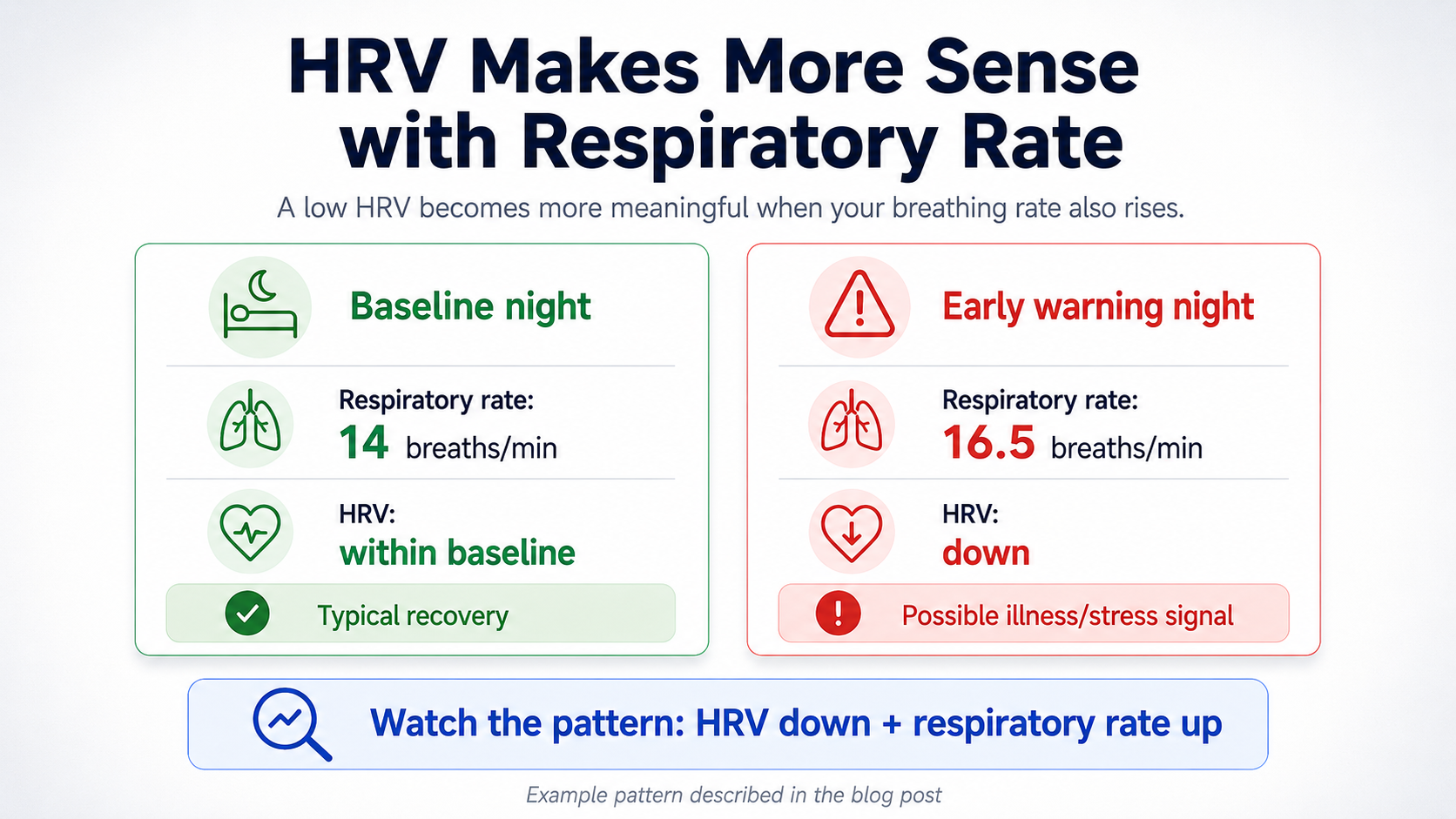
This is where it gets genuinely useful. Respiratory rate is how many breaths you take per minute, and overnight it's remarkably stable, usually between 12 and 20 for adults at rest. It barely moves from night to night, which makes it a good alarm: a shift of even one or two breaths above baseline can be one of the earliest signs the body is dealing with illness, fever, or stress. I caught a cold this way once before having any idea it was coming. My respiratory rate had crept from its usual 14 up to about 16 and a half, my HRV had dropped, and I still felt fine. I almost ignored it. Thirty-six hours later the cold landed properly. When those two move together, HRV down and breathing rate up, it's a far stronger signal than any single metric on its own.
Low HRV: Stress, Sickness, Alcohol, or Just Noise?
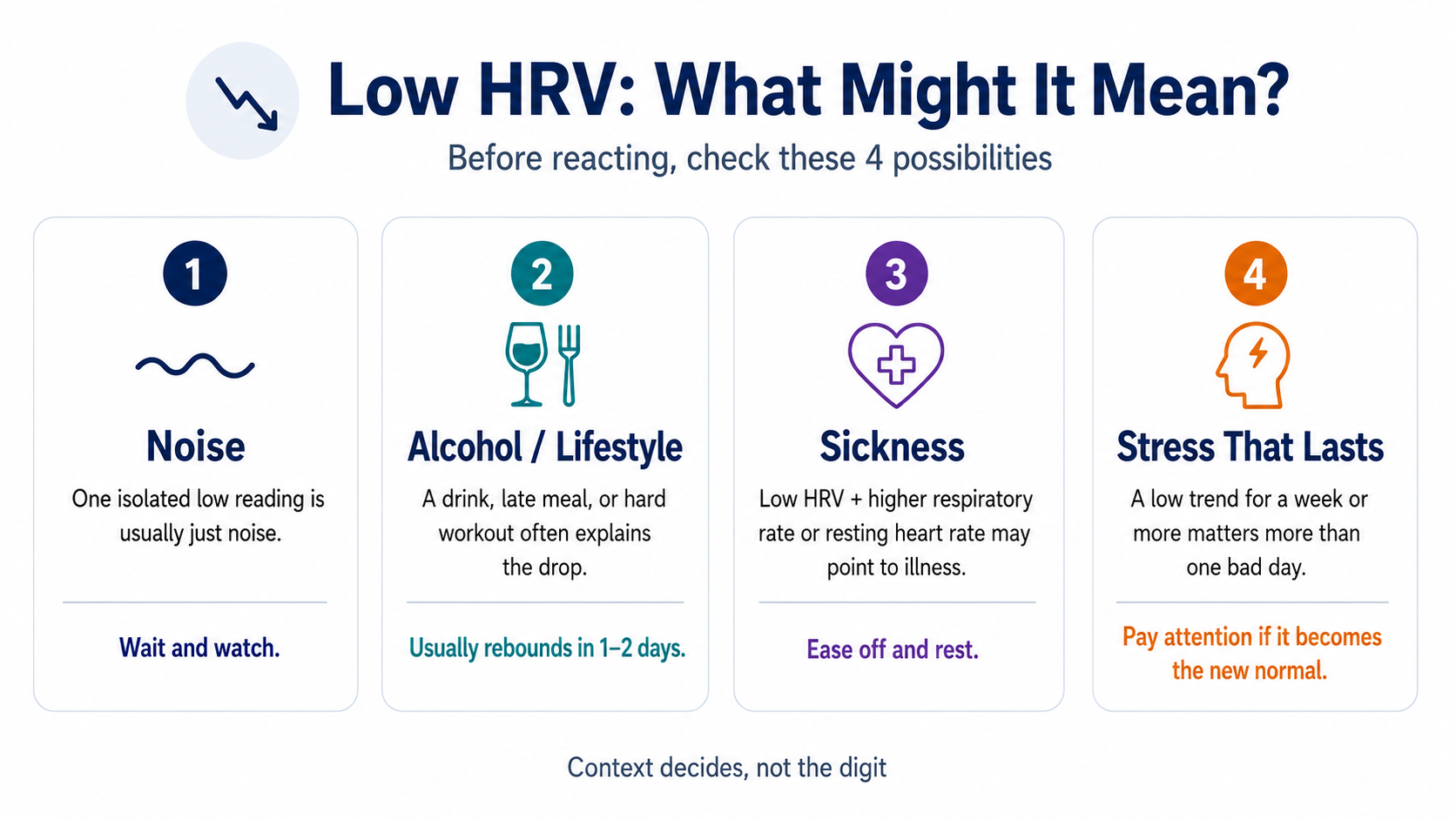
A drop is the reading that makes people anxious, so this is the part worth understanding early. When HRV comes in low, it's worth running through four buckets before reacting at all.
Noise. A single low morning with nothing else going on is almost always noise, and reacting to one reading is a fast way to drive yourself slightly mad. One odd number deserves a shrug and nothing more.
Alcohol or lifestyle. A drink, a late meal, or a hard session the night before is usually the whole answer. These drops are predictable and recover on their own in a day or two. No action needed beyond letting the body do its thing.
Sickness. This is where the other metrics earn their keep. If respiratory rate or resting heart rate is moving the wrong way at the same time, or something feels slightly off, the drop leans toward illness. That combination, HRV down and breathing rate up, is the pattern that showed up before my cold. When I see it, ease off and rest rather than push through.
Stress, the kind that lasts. One bad day is a shrug. A bad week is a message. Research on athletes shows a sustained fall of around 20 percent or more can show up before illness or before the body tips into overtraining. The question that matters isn't whether today is low, it's whether low has become the new normal. A drop that holds for a week or more with no obvious lifestyle cause is the one to take seriously, and possibly to a doctor.
Most low readings turn out to be noise or last night's choices. The skill worth building is telling the message apart from the static, and the trick is never reading the number on its own. A low HRV next to calm breathing and a good night's sleep is a different story than a low HRV next to fast breathing and a higher resting heart rate. The context decides, not the digit.
When an HRV Change Is Worth a Doctor's Time
Most HRV swings trace back to lifestyle and sort themselves out. Sometimes they don't. If HRV stays well below baseline for several weeks with no obvious cause, or it shifts alongside symptoms like a lasting high resting heart rate, breathlessness, chest discomfort, or persistent fatigue, see a doctor. Trend data is useful to bring to that conversation, but it's not a diagnosis.
FAQ
Why did my HRV change overnight?
Usually one of five things: it didn't really change and you compared a spot reading to a full-night average, or it was alcohol, a late meal, a hard evening workout, or a warm room and stress. Switching to a different device that measures HRV its own way can also fool you. Overnight averages are far more reliable than a one-off glance.
When is a low HRV something to worry about?
A single low morning is usually noise. A drop that lines up with alcohol, a late meal, or a hard workout will recover on its own. A drop alongside a rising respiratory rate, a higher resting heart rate, or feeling off leans toward illness. A drop that lasts a week or more with no clear cause is the one worth taking seriously.
*This article is for informational purposes only and is not a substitute for professional medical advice, diagnosis or treatment.*
Sources: