Why heart rate alone doesn't explain strength training
By Mr.Apps · Jun 23, 2026
Category:HRV

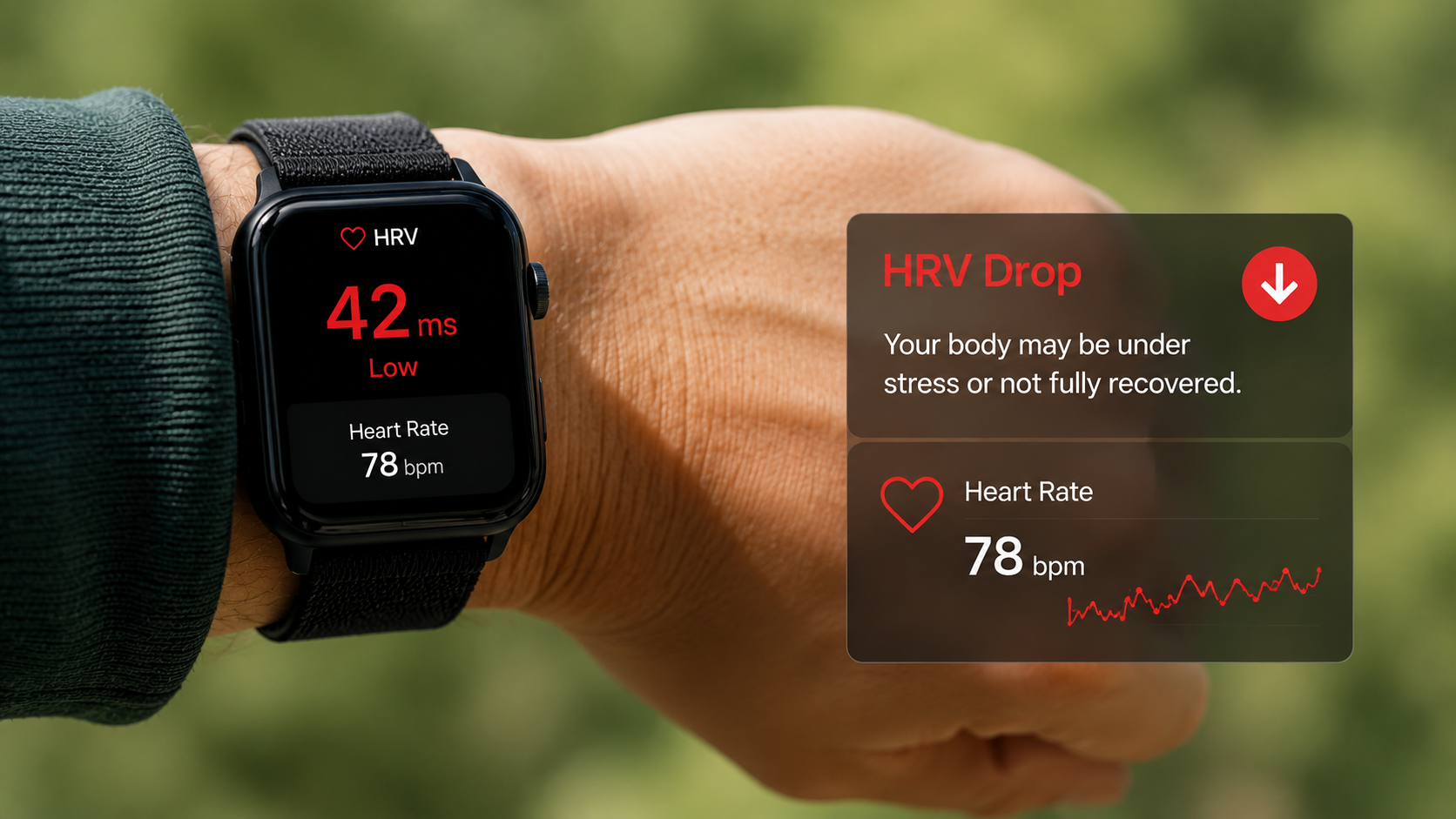
The day I finally pulled 180 kilos off the floor, I couldn't press down a French press the next morning. My forearms had quit on me. I stood at the kitchen counter shoving the plunger with both hands like an idiot, and it would not move. Here's the part that bugged me for weeks afterward: my watch had logged that deadlift session as a light day. Average heart rate around 95. It spiked to maybe 140 for about four seconds on the last rep, then dropped right back. By the watch's accounting, I'd done less work than my walk to the bakery.
That gap is the whole subject of this post. Heart rate is a brilliant signal for some kinds of effort and close to useless for others, and lifting sits squarely in the useless column. If you train with weights and you've ever felt wrecked after a session your tracker called easy, you're not broken and neither is the device. It's measuring the wrong thing.
What heart rate actually measures
Heart rate tells you how hard your heart is working to move oxygen around your body. That's the whole job. For running, cycling, rowing, anything where your muscles need a steady oxygen supply for minutes at a stretch, it's an excellent stand-in for effort. The number climbs because your legs are demanding more fuel, and it tracks that demand pretty honestly.
I think of it as a delivery van. Heart rate tells you how busy the van is, how many trips it's making per hour. For cardio that's a fair read on how hard you're working, because the work really is about moving fuel back and forth. The trouble starts when the hardest part of a workout has nothing to do with delivery volume at all. Researchers have measured this directly: a heavy lift produces much less of a heart rate rise than aerobic work, even when it leans far harder on the muscle.
Why heart rate misses weightlifting
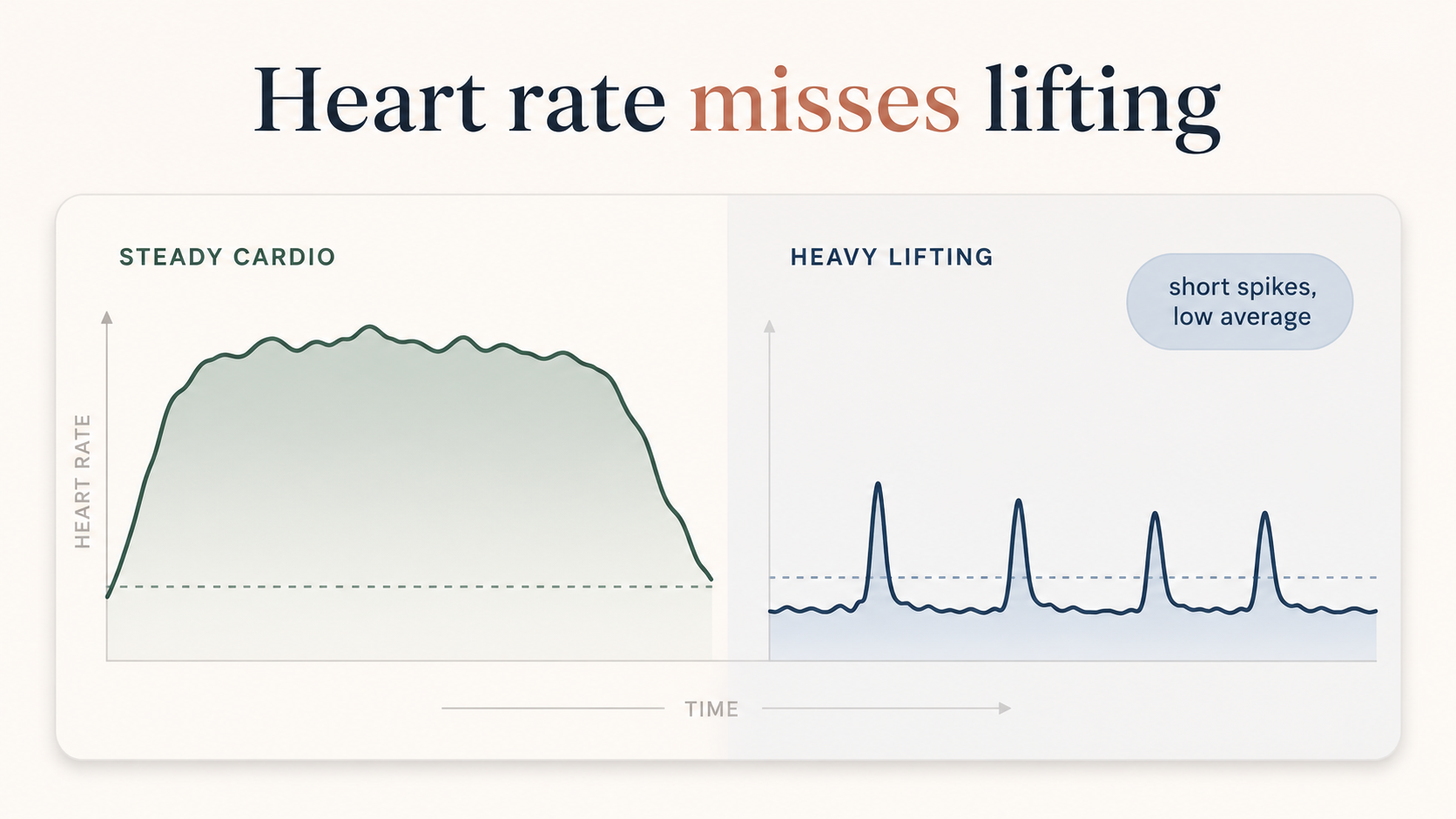
A heavy set of squats is short and violent. Three reps, maybe ten seconds of actual effort, then two or three minutes of standing around catching your breath and chalking your hands before you do it again. During those ten seconds your muscles pull energy from systems that don't depend on oxygen the way distance running does, so your heart never gets the sustained signal to ramp up and stay up. With short, fast sets like these, peak heart rate barely climbs, so the pulse stays modest even while the muscle fibers are taking serious damage.
My team ran a small test on exactly this. We took two workouts and matched them on average heart rate as closely as we could manage. One was a steady bike interval session. The other was a heavy lower body day, back squats and Romanian deadlifts. On the heart rate readout, the two looked like twins. Forty-eight hours later we asked both groups to repeat their workout. The cyclists shrugged and did it again no problem. The lifters couldn't get anywhere near the same loads. Their legs were still rebuilding. Identical heart rate story, completely different recovery story.
So when heart rate misses weightlifting, it isn't a calibration glitch you can fix with a fancier sensor. The thing that makes lifting hard, and the thing that makes it take days to bounce back from, simply doesn't show up in your pulse.
Muscular load is a different currency
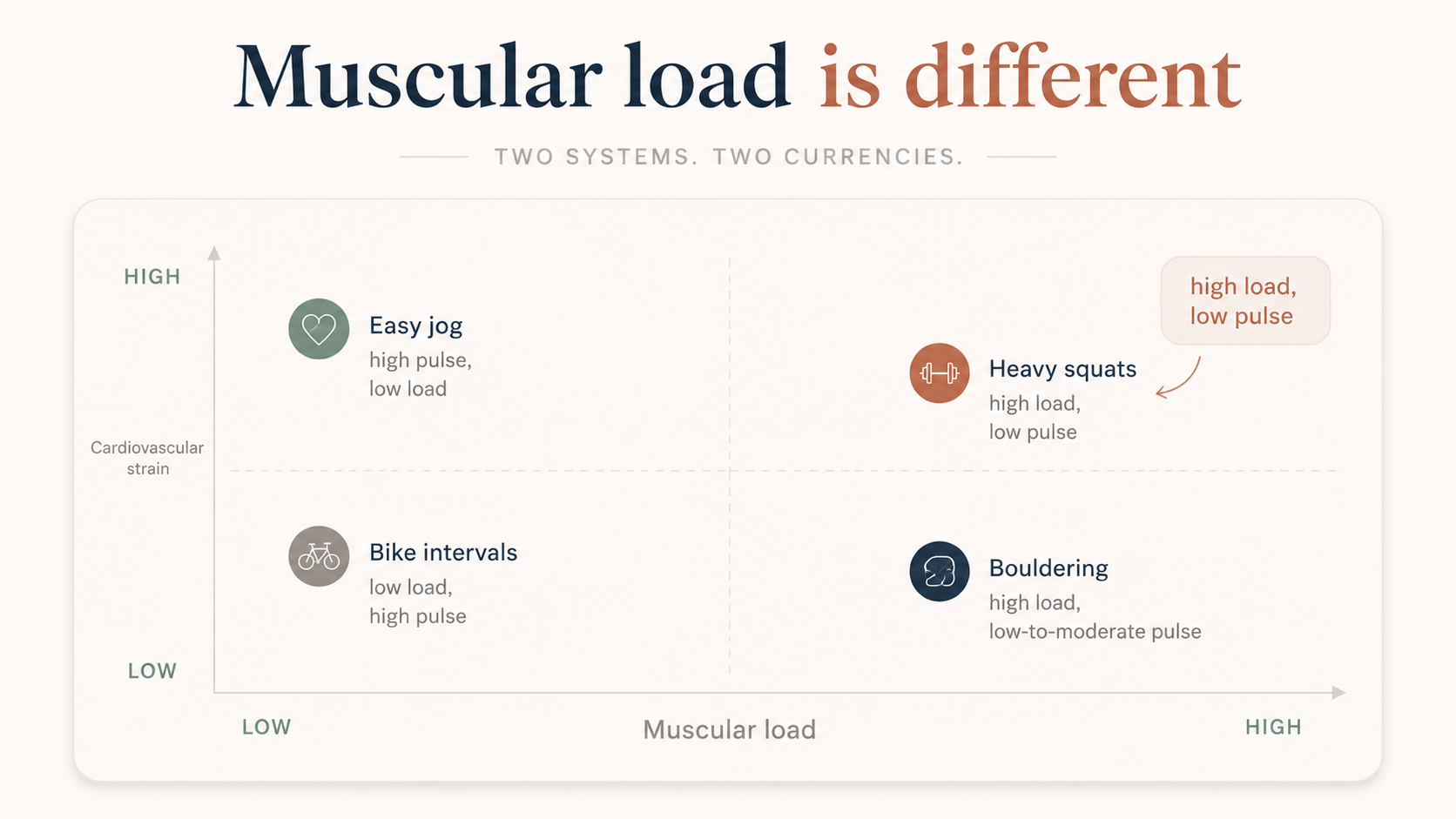
The honest measure for lifting is muscular load, and it runs on different units than heart rate. What taxes a muscle is mechanical tension plus the total work you stack onto it: how heavy the weight is, how many reps, how many sets, how close you push toward failure. A set of five at a weight you can barely budge does enormous damage to a muscle while asking almost nothing of your heart. A long easy jog does the exact reverse: it keeps your pulse elevated for an hour and leaves your muscles barely touched. Two different demands, and heart rate only knows how to see one of them.
I got the clearest lesson on this helping a friend haul an upright piano up three flights of stairs. The climbing had my heart pounding, textbook cardio, the van making trip after trip. But the next morning the parts of me that hurt weren't my lungs or my legs in any cardio sense. It was my lats and my forearms, both furious from gripping and bracing that piano so it wouldn't slide back down on us. My watch had caught the stair climbing and scored the whole afternoon as a cardio event. The part that genuinely destroyed me, the static holding and the dead grip, never moved the needle once.
Bouldering pulls the same trick in reverse and even faster. I can spend an hour on the wall with my heart rate calm the entire time and walk out with forearms so pumped I can't get my own front door key to turn. That's pure muscular load with almost no cardiovascular strain for lifting or pulling. A pulse reading would swear I'd spent the hour relaxing.
What this means for strength training recovery
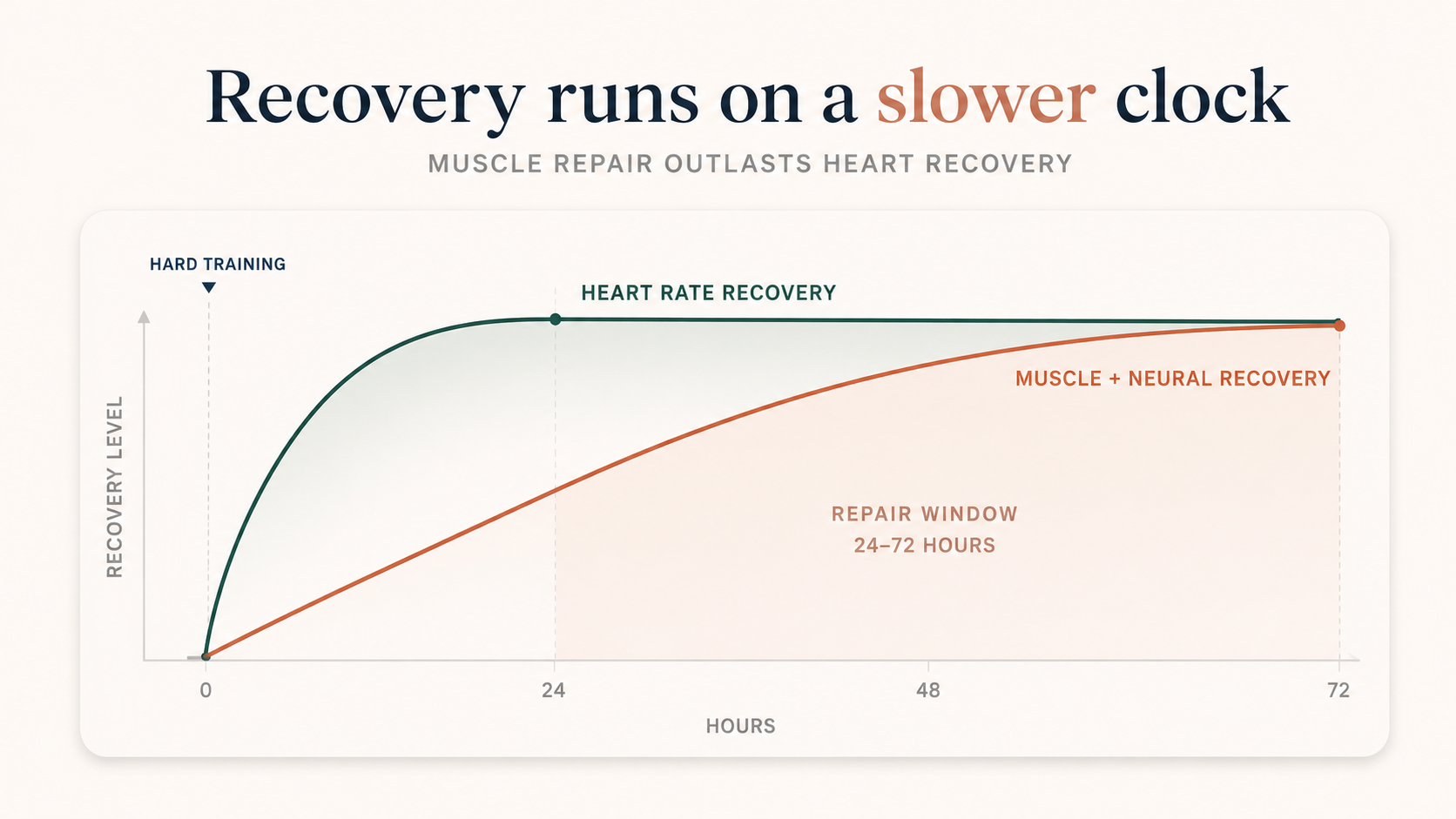
Here's where the gap stops being a fun curiosity and starts costing you progress. Strength training recovery is driven by repair, not by your heart settling down. After a hard session your muscle fibers carry tiny tears that need rebuilding, your tendons and connective tissue are under stress, and your nervous system is tired from firing hard to move heavy loads. That last one, neural fatigue, is the sneaky one. You can feel mentally sharp and well slept and still be unable to produce the force you managed two days ago.
These repair processes run on a clock of roughly 24 to 72 hours, and the closer you train to failure the longer it drags out, depending on how hard you went and which muscles you hammered. Big compound lifts on large muscle groups take the longest. Your resting heart rate, meanwhile, may be perfectly normal the very next morning. Most recovery scores lean heavily on heart rate variability overnight, and your heart rate variability can bounce back well before your quads have any interest in squatting again. If you let that score be the judge, you'll either train a muscle that isn't ready or hold back on a day you were actually fine.
I went the wrong way on this myself for a good while. My recovery metrics looked green every single morning, so I kept smashing my legs twice a week, convinced I was fresh. The numbers on the bar told a different story. They stalled flat for two months. My heart was recovered. My muscles and my nervous system were nowhere close, and nothing on my wrist was tracking that difference.
How to track strength training recovery
You don't need a lab for this. You need to watch the right signals instead of the loud, convenient one. A handful that actually work:
Log your volume. Write down the sets, reps, and weight for every session. Total work across a week tells you far more about the load you're carrying than any pulse reading ever will. This is the single most useful habit in the gym and almost nobody bothers with it.
Rate your effort honestly. After a tough set, ask yourself how many reps you really had left in the tank. Two workouts can look identical on the page and feel worlds apart in your body. That subjective number is real data, so treat it that way.
Let performance be the referee. If last week you hit five clean reps and today the same weight turns into a grinder at three, your muscles are telling you straight out that they aren't recovered. The bar doesn't lie and it doesn't care what your watch reported overnight.
Watch the small tells. A grip that feels oddly weak, stairs that feel heavier than they should, a warm up weight that suddenly feels like a working set. These low grade signals catch muscular fatigue earlier than any recovery percentage I've seen.
Guard your sleep. Skimping on it measurably saps your strength and slows the repair work, so heavy lifting effectively raises how much sleep you need. When my team dug through lifters' own logs, the sessions followed by short nights were the ones that consistently bled into the next week as missed lifts and stalled numbers. If you're going to fixate on one input, make it sleep rather than heart rate.
The honest take
None of this means you should toss the heart rate strap in a drawer. For your conditioning and your easy cardio days, it's a genuinely good tool and I still wear mine. The mistake is handing one sensor a question it was never built to answer. Heart rate reports on your engine. Strength training is mostly a story about the chassis, and you have to measure the chassis on its own terms.
So if your tracker keeps filing your hardest lifting days under "light," trust the barbell over the wrist. Count your sets, respect the soreness for the information it's giving you, sleep like it's part of the program, and judge your recovery by the only test that matters: whether you can actually lift the weight again. That's the part your heart rate will never tell you.
FAQ
Does your heart rate even go up during weightlifting? It does, but usually in short spikes that drop fast once a set ends. With heavy low rep work and long rests, your session average often lands lower than a brisk walk, which is why trackers score lifting as easy when it isn't.
How long does it take to recover from a hard strength session? For big compound lifts on large muscle groups, full recovery usually takes 24 to 72 hours. Smaller muscles come back faster. Your real test is whether you can produce the same force a couple of days later.
Can a fitness tracker measure strength training at all? It can count time and flag the cardio bits, but it can't see the tension and volume that drive muscular load. For lifting, your training log tells you far more than any wrist reading.
Should I stop using heart rate completely if I lift? No. Heart rate is still useful for your conditioning and your general health. Just don't ask it to judge your strength training recovery, because that sits outside what it can see.
*This article is for informational purposes only and is not a substitute for professional medical advice, diagnosis or treatment.*
Sources:
American Heart Association·International Journal of Sports and Exercise Medicine·Frontiers in Sports and Active Living·Journal of Applied Physiology·PubMed