When a vitamin B12 result needs a methylmalonic acid check
By Mr.Apps · Oct 26, 2026
Category:Energy

A vitamin B12 result can leave a clinical question open. The reported value may sit near a laboratory's decision boundary, symptoms may not fit neatly, or the broader record may raise concern even though the first measurement is not clearly low. In selected cases, a clinician may order methylmalonic acid (MMA) to add information. That does not mean everyone with fatigue needs an MMA test, or that an additional marker should be used without considering kidney function, medicines, symptoms, and the reason testing began.
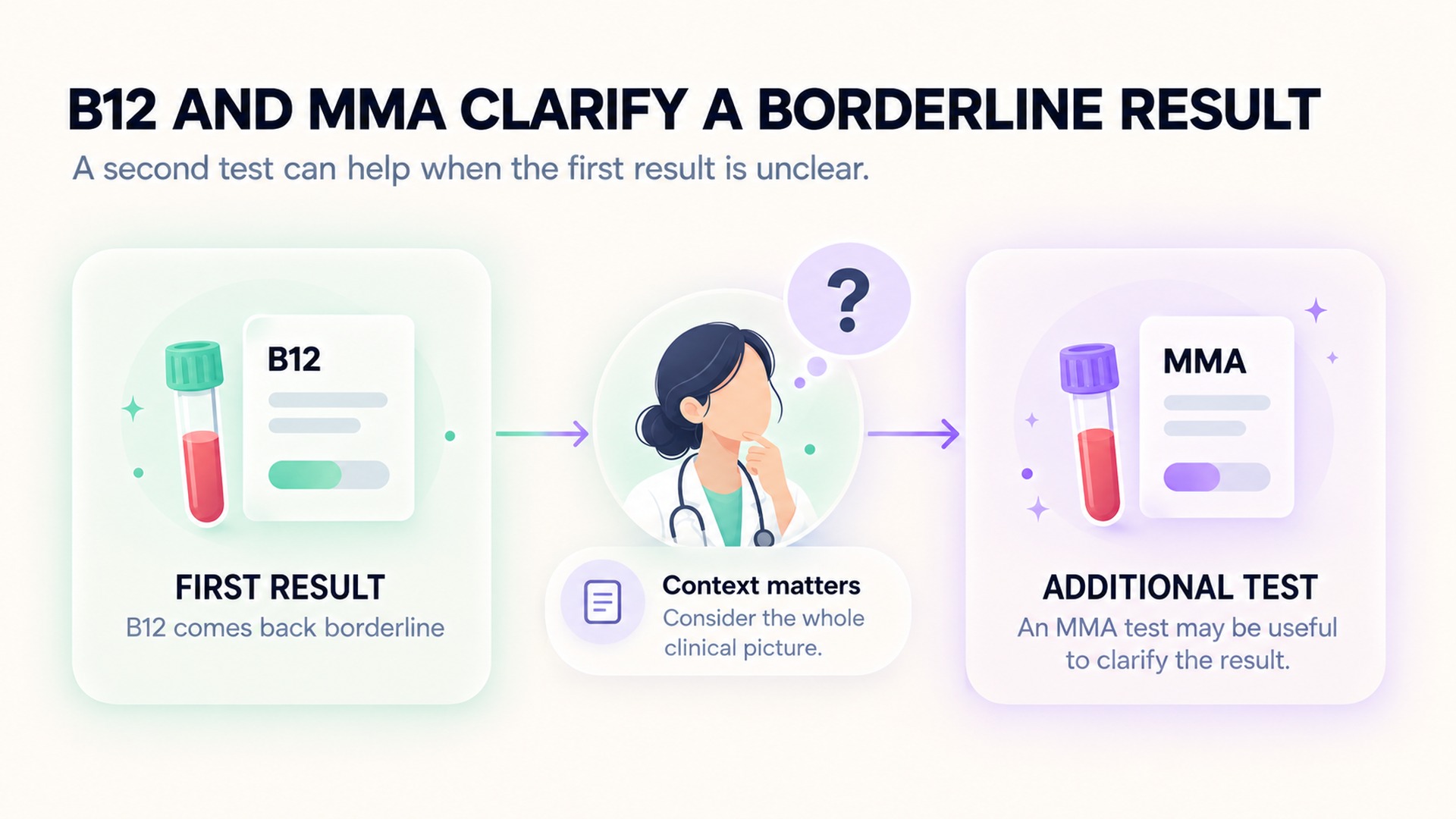
I think of B12 and MMA as related but different observations. The first measures circulating vitamin B12 in a blood sample. MMA is a substance that can rise when B12-dependent metabolism is impaired. A clinician may use the combination when the first result does not settle the question. Neither value on its own gives a full explanation for fatigue, establishes the cause of a symptom, or determines a supplement dose. The useful task is to understand why a second measurement is being considered and how it may change the next clinical question.
What a B12 result tells you
Vitamin B12 supports normal red blood cell formation, nerve function, and other processes. A blood test commonly reports the amount of B12 in serum or plasma. The result is interpreted using the laboratory's own method, units, and reference interval. Different laboratories can use different assays and cutoffs, so a value should be read with the report that produced it instead of copied into a generic chart without its units or range.
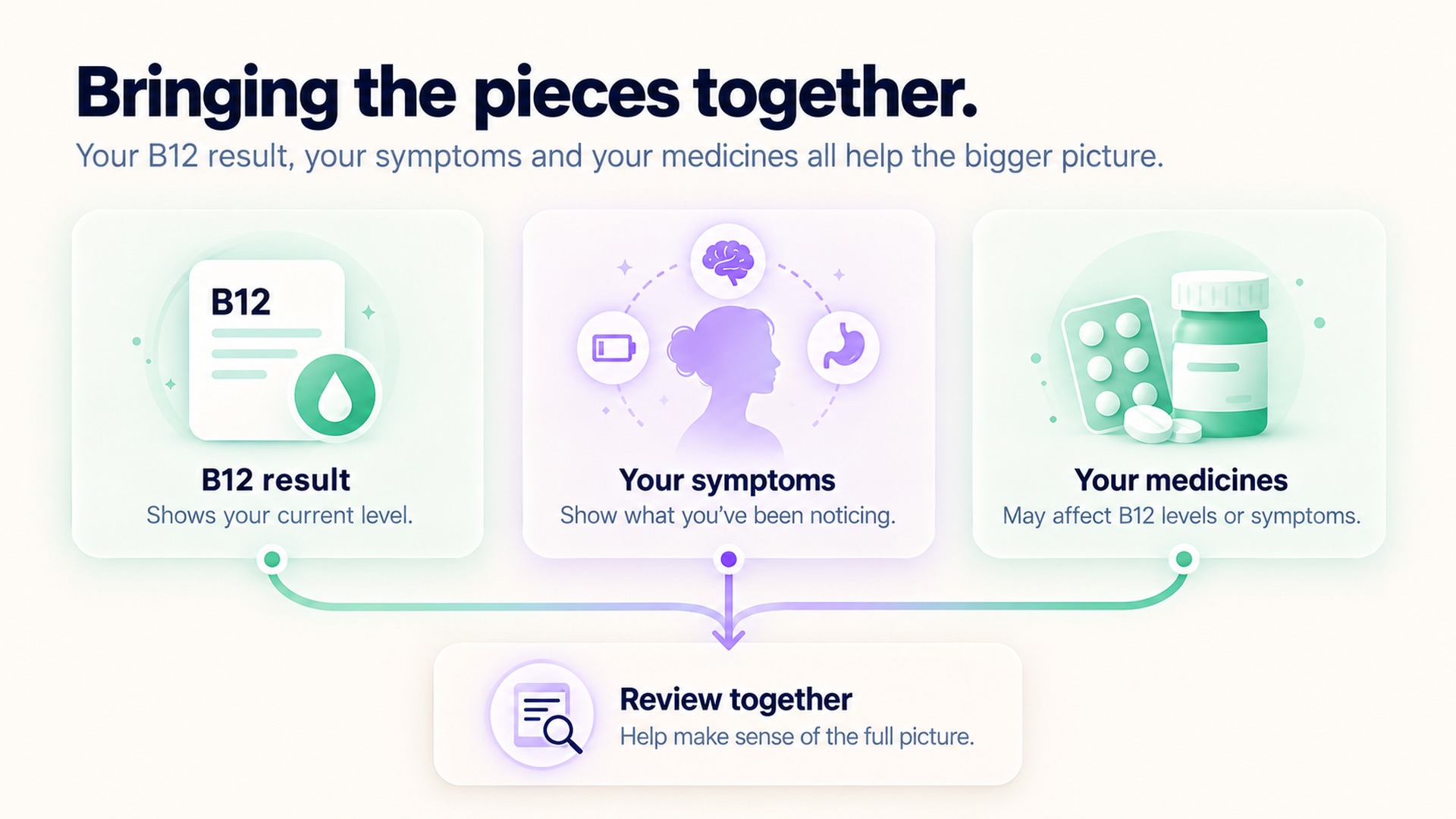
A result below a laboratory's interval can be important, but a value near a cutoff may be less decisive. Symptoms, blood counts, diet, absorption history, medicines, and previous results can all influence what a clinician considers. A single test is a snapshot. It does not show how long a person's status has been changing, why it changed, or whether a symptom is caused by B12. The vitamin B12 blood test overview explains what the test measures and why results are interpreted with other information.
Symptoms can be broad. Fatigue, weakness, numbness, balance changes, or concentration difficulty may have many causes, and some people with a low laboratory value may not report an obvious symptom. A symptom should therefore prompt an appropriate clinical review rather than a self-diagnosis. A complete blood count can add information about red blood cells, but it does not answer every question about B12 status. The clinical overview of laboratory results is a useful reminder to compare the reported result with the reference interval and the reason the test was ordered. Current clinical guidance similarly advises that B12-related symptoms are not unique to one condition and that a blood count alone should not be used to rule the question in or out. The diagnosis and management recommendations for vitamin B12 deficiency describe when clinicians may test and how they use judgement with symptoms and risk factors.
What MMA adds
MMA is a metabolite involved in a pathway that depends on vitamin B12. When B12 is insufficient for that pathway, MMA may rise. This makes the measurement useful as an additional clue when a B12 result is borderline or otherwise uncertain. The MMA test explanation describes why the test can be ordered as part of a B12 assessment and why its result must be interpreted with other findings.
A raised MMA does not automatically prove that a person's symptoms are caused by B12 deficiency. Kidney function can affect MMA because the kidneys help clear it from the blood; age and other clinical factors can also influence the result. A clinician may compare MMA with the B12 value, blood count, kidney measures, symptoms, medicines, and the overall history. The health professional fact sheet on B12 discusses MMA as a marker and notes that reduced kidney function can raise its concentration. That limitation is one reason a result should not be interpreted as an isolated yes-or-no answer.
Why an additional test is selective
Ordering another test is useful only when its result can clarify a decision. If the first measurement is clearly low and the clinical picture supports deficiency, a clinician may already have enough information to plan an evaluation. If the result is within the expected range and there is no reason to suspect a problem, routine MMA testing may add little. When the initial result is in a zone of uncertainty, the clinician may decide that a second marker could help distinguish possibilities or guide follow-up.
The question is not simply whether MMA is more sensitive. A more sensitive marker can detect a biochemical change, but the value still has to be interpreted in context. Test performance, the population studied, kidney function, the person's symptoms, and the assay all matter. For that reason, a clinician may ask whether the result would change the plan before ordering it. A test should answer a question, not just add another number to a dashboard.
The timing of tests can matter too. Results drawn at different times may reflect changes in health, treatment, or laboratory method. If an earlier B12 result is being compared with a new MMA test, record both collection dates and the units. Keep the name of the laboratory and any reference interval with each result. If the test follows a recent change in supplements or medicines, include that information for the clinician. A trend is easier to interpret when the original context is preserved.
What belongs beside the result
Keep a concise symptom record that describes the issue without trying to assign a cause. Note when it began, whether it is persistent or intermittent, what has changed, and whether it affects daily function. Add relevant observations such as numbness, balance changes, or weakness if present, and share urgent or worsening symptoms with a care professional rather than waiting for an app trend. The record should help clarify the clinical question, not turn ordinary variation into a diagnosis.
List current medicines and supplements when asked. Some medicines can affect B12 absorption or the interpretation of a clinical picture, while supplements may change the measured value. Record the product and when it is taken rather than assuming that the label amount equals absorbed B12 or a treatment effect. Do not stop prescribed medicines or begin high-dose supplements because a value appears low or borderline. The next step depends on the reason for testing and the full medical record.
If blood count information is part of the review, retain the specific components rather than reducing them to a single label. Hemoglobin, cell size, and other red-cell measures answer related but distinct questions. A normal blood count does not by itself establish that B12 status is adequate in every circumstance. A low or changing count also has causes beyond B12. The complete blood count overview describes the different components that may be reported and interpreted together.
Keep the next step with the clinician
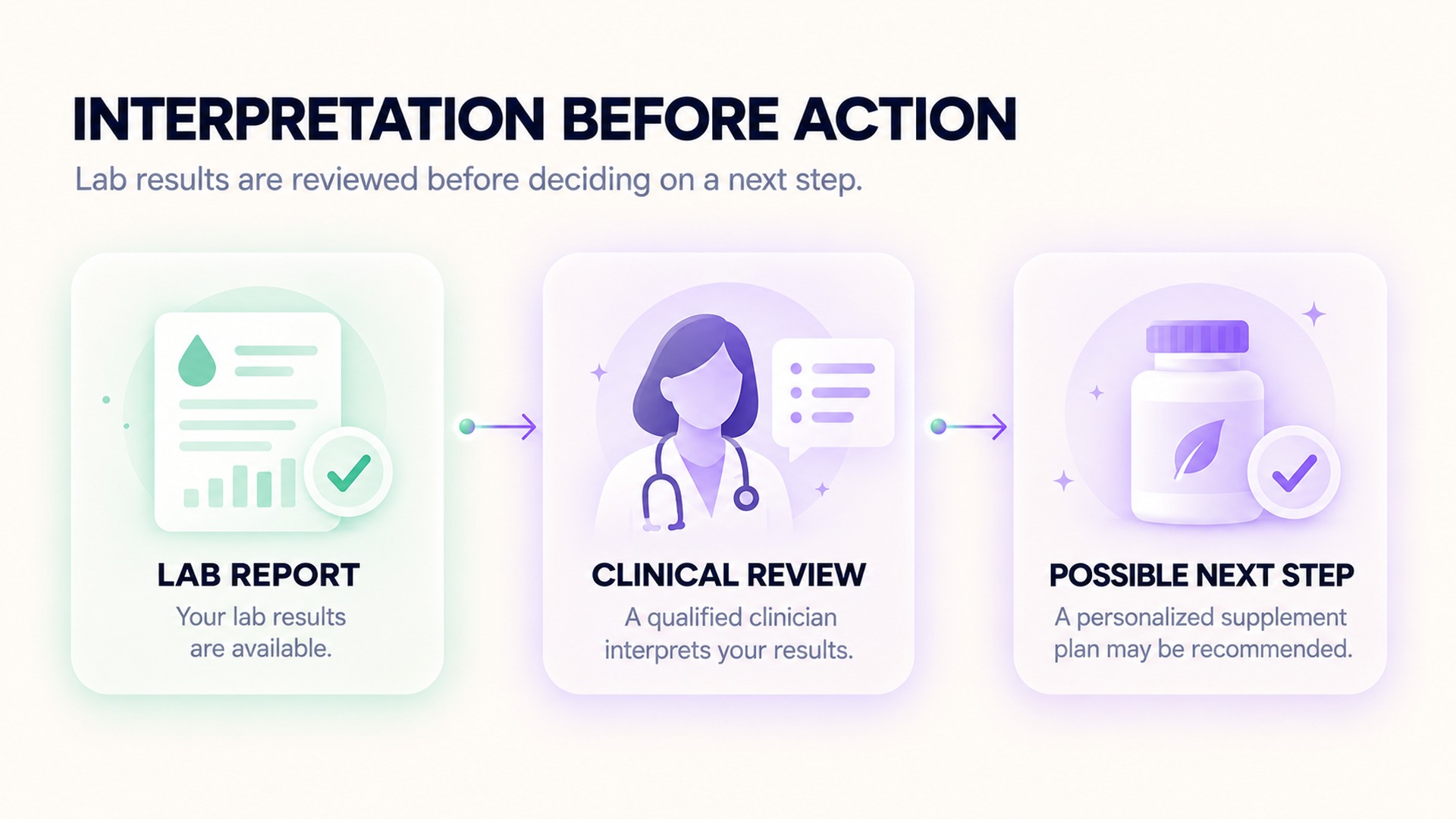
The result of a follow-up test may support a diagnosis, prompt additional evaluation, or reduce uncertainty. It does not automatically determine treatment. If the clinician recommends supplementation or another intervention, ask what the recommendation is intended to address, how progress will be reviewed, and whether other causes of symptoms are still being considered. The question is not only how to raise a number; it is whether the measurement fits the person's health history and current need.
Wearable data can add background about sleep, activity, or changes in routine, but it cannot measure B12 or MMA and cannot diagnose a deficiency. A lower energy score does not make a borderline laboratory value more specific. A useful record keeps the device trend as an observation and leaves the laboratory interpretation to the clinician who can review symptoms, medicines, test methods, and other results together.
For a broader explanation of why health app measurements should be kept in context, see this overview of interpreting health biomarkers. For the B12 question, preserve the original report and ask why MMA is being considered, what other factors affect it, and how the result could change follow-up. That conversation is more useful than treating a second marker as a stand-alone verdict.
Questions people ask
Does every borderline B12 result need an MMA test?
No. A clinician decides whether an additional test is useful based on the B12 result, symptoms, other laboratory information, kidney function, medicines, and the clinical question. The test is not required for everyone and does not replace a full assessment.
Can a high MMA prove that fatigue is caused by B12 deficiency?
No. MMA can support an assessment, but kidney function and other factors can affect it, and fatigue has many possible causes. The result should be interpreted with the B12 value, symptoms, medical history, and other relevant tests.
Should a person start a supplement while waiting for results?
A person should follow the clinician's instructions rather than choosing a dose from an online explanation or wearable score. Supplement decisions depend on the clinical situation, current medicines, and whether further testing is planned. Ask the care team how to proceed.
*This article is for informational purposes only and is not a substitute for professional medical advice, diagnosis or treatment.*
Sources:
National Library of Medicine·National Library of Medicine·National Library of Medicine·NIH Office of Dietary Supplements·National Library of Medicine·National Institute for Health and Care Excellence
Related articles

Why Metabolic Energy Efficiency and Daily Energy Are Different Concepts
Metabolic energy efficiency describes processes involved in handling fuel, while a daily energy score is usually a separate app estimate about patterns such as sleep, activity, and recovery. Similar wording does not mean the two measures track the same thing.

Why a Monthly Metabolic Trend Cannot Explain One Meal
A monthly metabolic trend summarizes signals across a longer window and cannot identify what one meal did to glucose or insulin. Read it as a broad estimate, keep meal notes in their proper context, and use clinical testing for medical questions.

How Charging Gaps Break a 24-Hour Energy Timeline
Removing a wearable to charge creates a period when the device may not record the signals used by an energy model. A 24-hour timeline should mark that gap instead of treating it as neutral or connecting the surrounding values as continuous measurement.

How to Compare Energy Drain Across Days With Different Starting Scores
The ending value alone can hide how much an energy score changed during the day. Compare the start, decline, timing and data coverage on the same scale before interpreting differences between days.

Why Missing Hours Need to Be Visible on an Energy Timeline
Connecting two known points across an unmeasured interval can invent a smooth story about the day. An energy timeline should mark missing hours clearly so estimates, observations and unknown periods remain distinct.

How to Tell Recharge From Reduced Drain in an Energy Timeline
A flatter energy curve can mean that the model estimates slower decline, while a rising curve suggests modeled recharge. Check the timeline’s direction, update timing and inputs before deciding which interpretation fits the display.

Why a Full Morning Energy Score Can Fall Quickly
A high morning energy score is a starting estimate, not a guarantee that the rest of the day will decline slowly. The later curve depends on what the model tracks, which inputs arrive and how the score represents changing demand.

How to Read a Predicted Energy Peak That Never Arrives
A predicted energy peak is an estimate of timing, not a promise that the day will follow a script. When it fails to appear, check coverage, update timing and changed inputs before deciding what the miss means.

Why an Energy Forecast Needs a Confidence Range
A single future line can look more certain than its inputs support. A forecast range can show how much the outlook may shift as new measurements, demands and model assumptions change through the day.

Why a Health App Needs an "I Cannot Do That" Setting
Health advice becomes more useful when it respects the limits of the day. An explicit constraint setting can prevent technically reasonable recommendations from becoming impossible instructions.