When naps help your energy and when they quietly make sleep worse
By Mr.Apps · Jul 3, 2026
Category:Sleep

Excerpt: A smart nap can rescue an afternoon. A badly timed or overly long one can leave you groggy now and wide awake tonight. Here’s how to tell the difference.
Most people do not start searching for nap advice because they are deeply passionate about sleep architecture. They start because around 2:17 PM the brain turns to mashed potatoes, the inbox still has opinions, and there is a very real temptation to put a forehead directly on the desk.
That is where naps get interesting.
A nap can absolutely help. A short one can improve alertness, sharpen attention, and make the second half of the day feel more manageable. But naps also have a sneaky downside. Take the wrong kind of nap, at the wrong time, for the wrong reason, and the result can be grogginess now and worse sleep later.
That is why naps are not automatically good or bad. They are a tool. And like most tools, they work well when used on purpose and badly when used by accident.
The simplest way to think about it is this: a nap should either help the day or reveal a problem. If a short daytime nap leaves someone more alert and does not interfere with nighttime sleep, great. If naps are becoming longer, more frequent, or harder to live without, that may be less of a productivity hack and more of a clue that nighttime sleep, schedule, stress, or even a sleep disorder needs attention.
Research on napping is messy, but the broad pattern is pretty consistent. Short naps can be restorative, while longer or irregular naps are more likely to come with tradeoffs. A recent umbrella review on daytime napping and health outcomes also supports the idea that nap duration matters, and a review on the “nap paradox” explains why naps can be both helpful and complicated depending on timing, length, and the person taking them.
So if the real question is “should I nap today?” the better question is usually: what kind of nap, at what time, and why?
The difference between a power nap and sleep inertia
A good nap and a bad nap can look almost identical from the outside. Same couch. Same blanket. Same “just 20 minutes” promise. The difference is often what happens right after waking up.
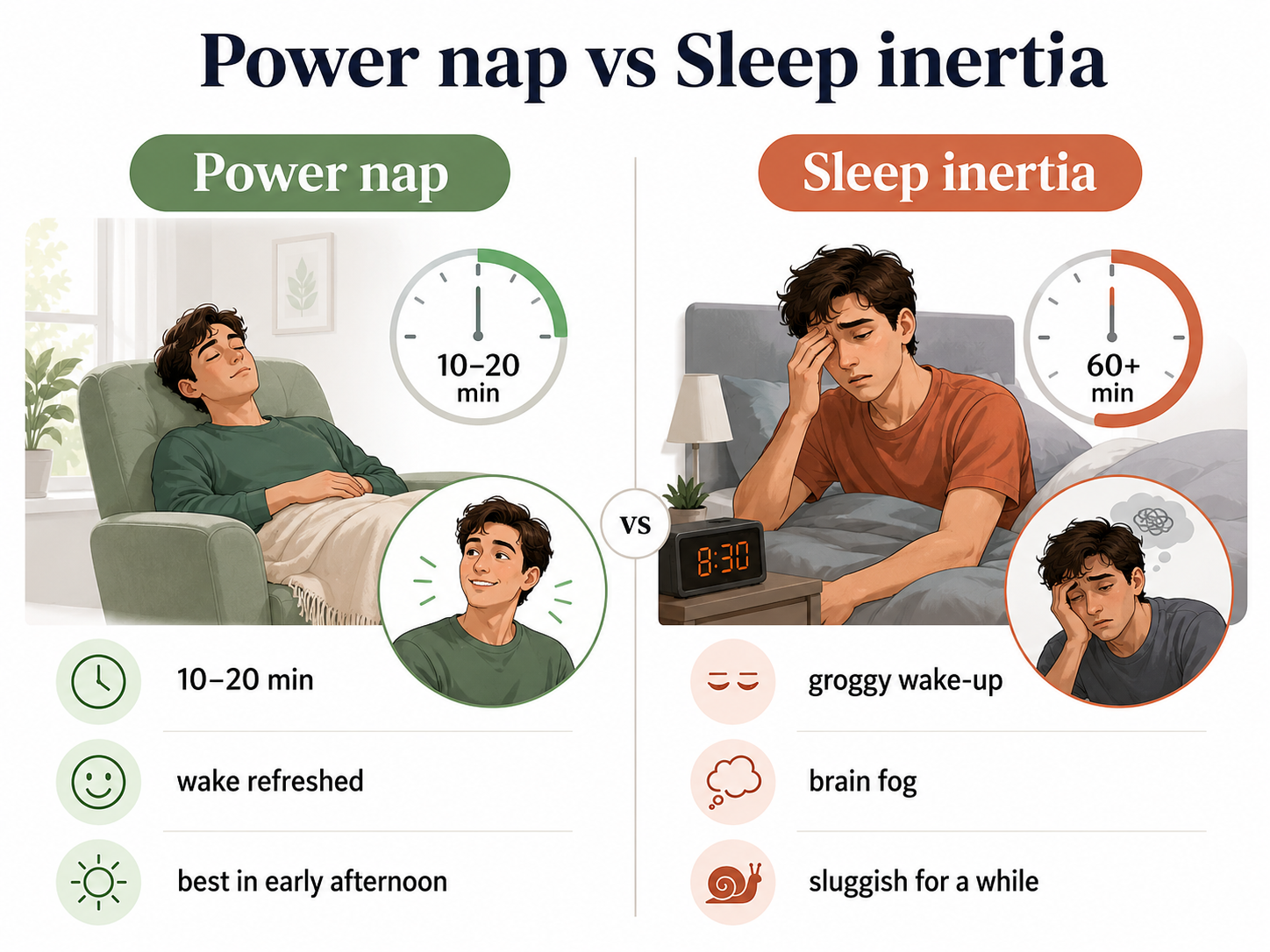
A power nap is the classic useful nap. It is short, intentional, and taken mainly to improve alertness and reduce sleepiness without dropping too deeply into sleep. For many people, that means somewhere around 10 to 20 minutes of actual sleep time, or a nap opportunity of roughly 15 to 25 minutes once falling asleep is factored in.
The reason short naps work is that they often stop before the body settles into deeper sleep stages. That makes waking up easier.
Sleep inertia is the opposite experience. It is that thick, confused, mildly tragic state after waking when the body is technically awake, but the brain seems to be loading very slowly. Research describes sleep inertia as a temporary period of reduced alertness and impaired performance after waking. In plain English, it is why a nap can sometimes leave someone feeling worse before feeling better.
This is the part that surprises people. A nap is supposed to fix tiredness, so when it creates brain fog instead, it feels like betrayal. But it usually comes down to depth and timing. Wake up from deeper sleep, and the chances of grogginess go up.
That is why some naps feel like a reset and some feel like being hit by a soft pillow full of cement.
The practical takeaway is simple: if the goal is to function better soon after the nap, shorter is usually safer.
Best nap length: what actually works
This is the part people want reduced to one magic number, but there is no perfect nap length for every person and every situation. Still, there are useful patterns.
10 to 20 minutes: usually the sweet spot
For most busy adults, this is the best place to start.
A short nap can reduce sleepiness and improve alertness without creating much sleep inertia. If someone needs enough of a reset to stop feeling flat but still wants to be functional 10 minutes later, this is usually the best bet.
This is the nap for:
- the office worker with the afternoon slump
- the parent who needs to survive the evening shift at home
- the traveler who slept badly
- the person who needs a boost, not a full second sleep
A review on napping and sleep-related performance found that naps can improve sleepiness and performance, while also noting that waking from deeper sleep can temporarily blunt those benefits through sleep inertia.
Around 30 minutes: the risky middle
This is the nap length that sounds harmless and often is not.
A 30-minute nap is long enough that some people start slipping into deeper sleep, but not always long enough to complete a more natural sleep cycle. That is exactly the zone where many people wake up feeling heavy, disoriented, and vaguely offended by existence.
Not everyone reacts the same way, but if naps often backfire, this middle zone is a common reason.
60 to 90 minutes: useful sometimes, not practical for most people
Longer naps can have benefits in some settings, especially when someone is sleep-deprived or when memory consolidation is the goal. But for everyday life, they are much more likely to come with tradeoffs.
A long nap is more likely to trigger sleep inertia immediately after waking and more likely to steal pressure away from nighttime sleep later. In other words, it may help now and then quietly push bedtime later, make falling asleep harder, or reduce sleep quality that night.
For some people, especially those running on major sleep debt, a longer nap may still be worth it. But for the average person trying to rescue an afternoon without damaging the night, a long nap is usually not the first move.
Best nap timing: when to nap so it helps instead of hijacking your night
Timing matters almost as much as length.
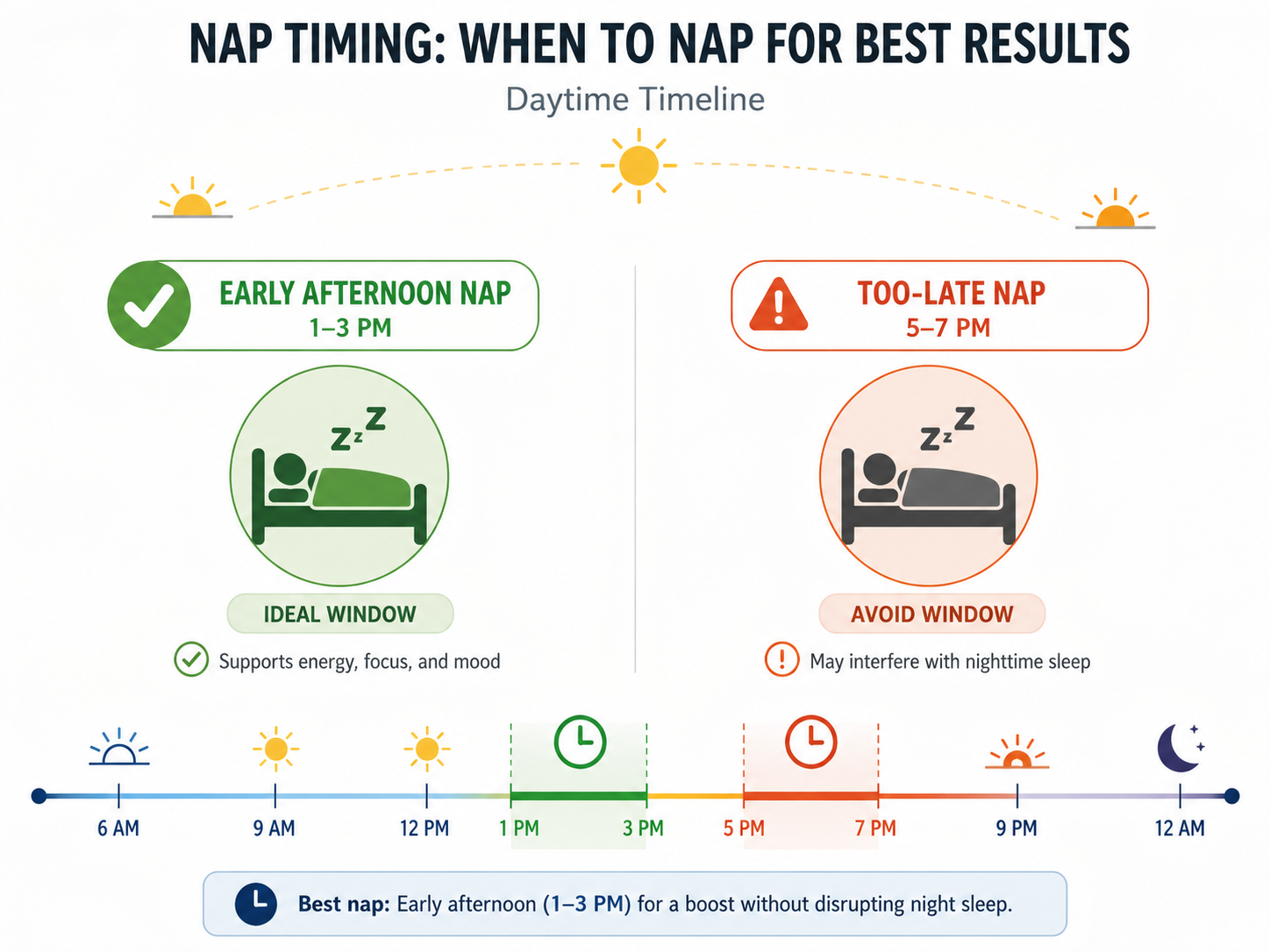
A nap taken too late in the day can feel good in the moment and then come back to cause trouble at bedtime. That is because naps reduce sleep pressure — the body’s growing drive to sleep. A little reduction can be helpful in the afternoon. Too much reduction too late in the day can make nighttime sleep harder.
For most people, the best nap window is early to mid-afternoon, often somewhere around 1 PM to 3 PM. That lines up with the natural dip in alertness many people feel after lunch, although lunch is not the only reason that dip exists.
If bedtime is already a struggle, the safest rule is simple: do not nap late.
There is no universal cutoff that fits everyone, because schedules vary. But as a general rule, a nap should be far enough away from bedtime that it does not compete with the main sleep period.
That matters especially for:
- people who already have insomnia
- parents trying to hold onto a normal bedtime
- anyone with a naturally late body clock
- shift-adjacent workers whose schedules already wobble between “normal” and “why am I eating pasta at 11 PM?”
If nighttime sleep is fragile, the nap has to earn its place.
Need a nap or need better night sleep?
This is the decision point most people skip.
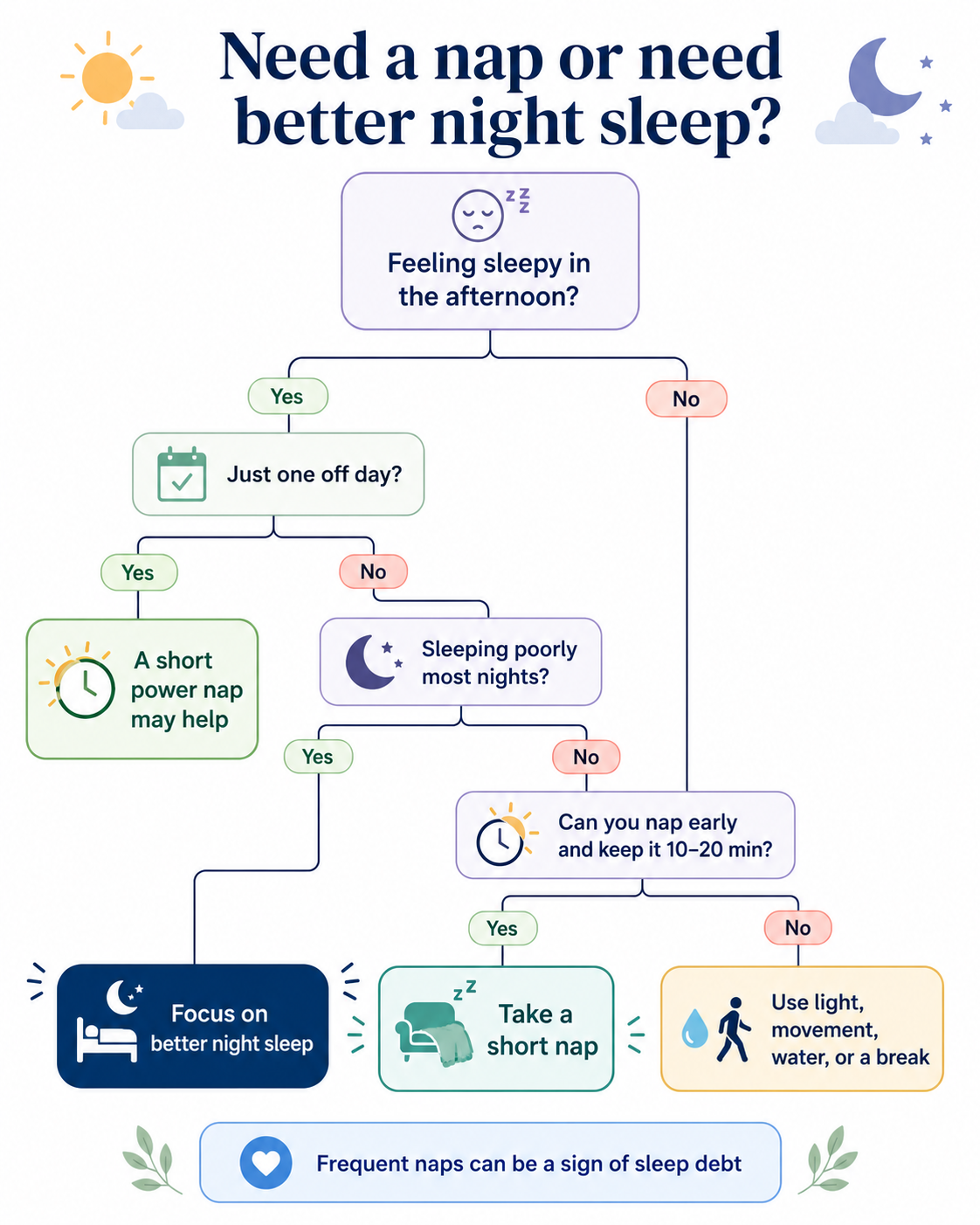
A nap can be useful, but it should not become a daily patch over a bigger problem. If naps are happening because the previous night was short, stressful, broken, or chaotic, the nap may still help. But the main fix is usually not “become better at napping.” The main fix is to look at nighttime sleep.
The CDC notes that adults generally need at least 7 hours of sleep in a 24-hour period, and the CDC’s general sleep guidance emphasizes that both sleep quantity and sleep quality matter.
That is important because a person can technically be in bed long enough and still not be sleeping well enough.
A useful question is: What is the nap doing?
If the nap:
- improves alertness
- stays short
- does not delay bedtime
- is occasional rather than essential
then it is probably acting like a tool.
If the nap:
- keeps getting longer
- leaves grogginess behind
- happens most days just to function
- pushes bedtime later
- still does not make the person feel restored
then it may be acting like a clue.
And clues matter.
When frequent naps are a red flag
Frequent naps are not automatically a problem. Some people have schedules, sleep habits, or cultures where daytime rest is normal. Some new parents are simply doing what survival requires. Some shift workers are using naps strategically. Some people are recovering from illness or a period of major sleep debt.
But there are situations where regular napping deserves a second look.
1. Naps are becoming necessary, not optional
If someone needs a nap most days just to stay functional, that often points to insufficient nighttime sleep, fragmented sleep, or ongoing sleep debt.
2. Naps are long and unrefreshing
Short naps are usually the restorative ones. Long naps that still do not help can be a sign that the issue is not just a rough afternoon. MedlinePlus notes that drowsiness and excessive daytime sleepiness can sometimes point to an underlying sleep problem.
3. There are signs of a sleep disorder
Excessive daytime sleepiness can show up in conditions like sleep apnea, narcolepsy, idiopathic hypersomnia, and other sleep disorders. The NIH’s NHLBI explains that daytime sleepiness can be a symptom of sleep apnea, especially when it comes with snoring, gasping, or unrefreshing sleep.
If someone regularly:
- falls asleep unintentionally
- feels sleepy while driving
- snores heavily
- wakes up choking or gasping
- sleeps “enough” but still feels exhausted
that is not really a nap problem anymore. That is a reason to talk with a healthcare professional.
4. Naps are getting longer, more irregular, or both
This is where the research gets more cautionary.
A recent SLEEP meeting abstract on objectively assessed napping behaviors and mortality in middle-to-older adults reported that longer, more variable, and midday napping patterns were associated with higher mortality risk. That does not mean naps are causing harm by themselves. It means these patterns may be markers of poorer health, worse sleep, or underlying issues worth paying attention to.
That distinction matters. Association is not the same as causation.
But if napping habits are changing noticeably, the smart move is not to panic. It is to get curious.
How to take a nap that actually helps
If the goal is better energy rather than accidental sabotage, the practical nap recipe is not complicated.
Keep it short
Aim for about 10 to 20 minutes of actual sleep, or set an alarm for roughly 20 to 30 minutes total if falling asleep usually takes a little time.
Nap earlier, not later
Early afternoon is usually the safest bet. If bedtime already runs late, be even more conservative with timing.
Treat naps as support, not replacement
A nap can rescue a rough day. It is not a substitute for building a decent night.
Pay attention to the after-effects
If the nap leaves more alertness and does not disturb the night, good sign. If it leaves grogginess or shifts bedtime later, something needs adjusting.
Notice the pattern, not just the day
A nap after a terrible night is one thing. Napping every afternoon because the body never feels fully awake is a different story.
The honest take
Naps are not cheating, laziness, or a character flaw disguised as a blanket.
A short daytime nap can be one of the simplest ways to feel more awake and less sloppy when energy crashes in the afternoon. Used well, naps can absolutely help.
But naps are also easy to romanticize.
The problem is not napping itself. The problem is when naps get longer, later, or more necessary than they should be. That is usually where they stop acting like a helpful reset and start exposing a different issue — poor nighttime sleep, schedule chaos, accumulating sleep debt, or sometimes a real sleep problem.
So the best nap advice is not “always nap” or “never nap.” It is more boring and more useful than that:
Take a short one if it helps.
Take it early enough that it does not hijack the night.
And if naps keep becoming the only way to function, stop treating them as a trick and start treating them as information.
FAQ
What is the best nap length?
For most adults, the best nap length is usually around 10 to 20 minutes. That is long enough to reduce sleepiness and improve alertness, but short enough to lower the chance of sleep inertia.
Why do naps sometimes make people feel worse?
Usually because of sleep inertia — the groggy, heavy feeling that can happen after waking from deeper sleep. Longer naps or naps that drift beyond the light stages of sleep are more likely to cause it.
What time should an afternoon nap happen?
For most people, early to mid-afternoon is the safest window. A late nap is more likely to interfere with nighttime sleep.
Are naps bad for sleep quality at night?
Not always. A short, early nap may not cause any problem at all. But long or late naps are more likely to reduce sleep pressure and make falling asleep at night harder.
When are frequent naps a red flag?
Frequent naps deserve more attention when they are long, unrefreshing, increasingly necessary, or paired with excessive daytime sleepiness, snoring, gasping, or poor nighttime sleep.
*This article is for informational purposes only and is not a substitute for professional medical advice, diagnosis or treatment.*