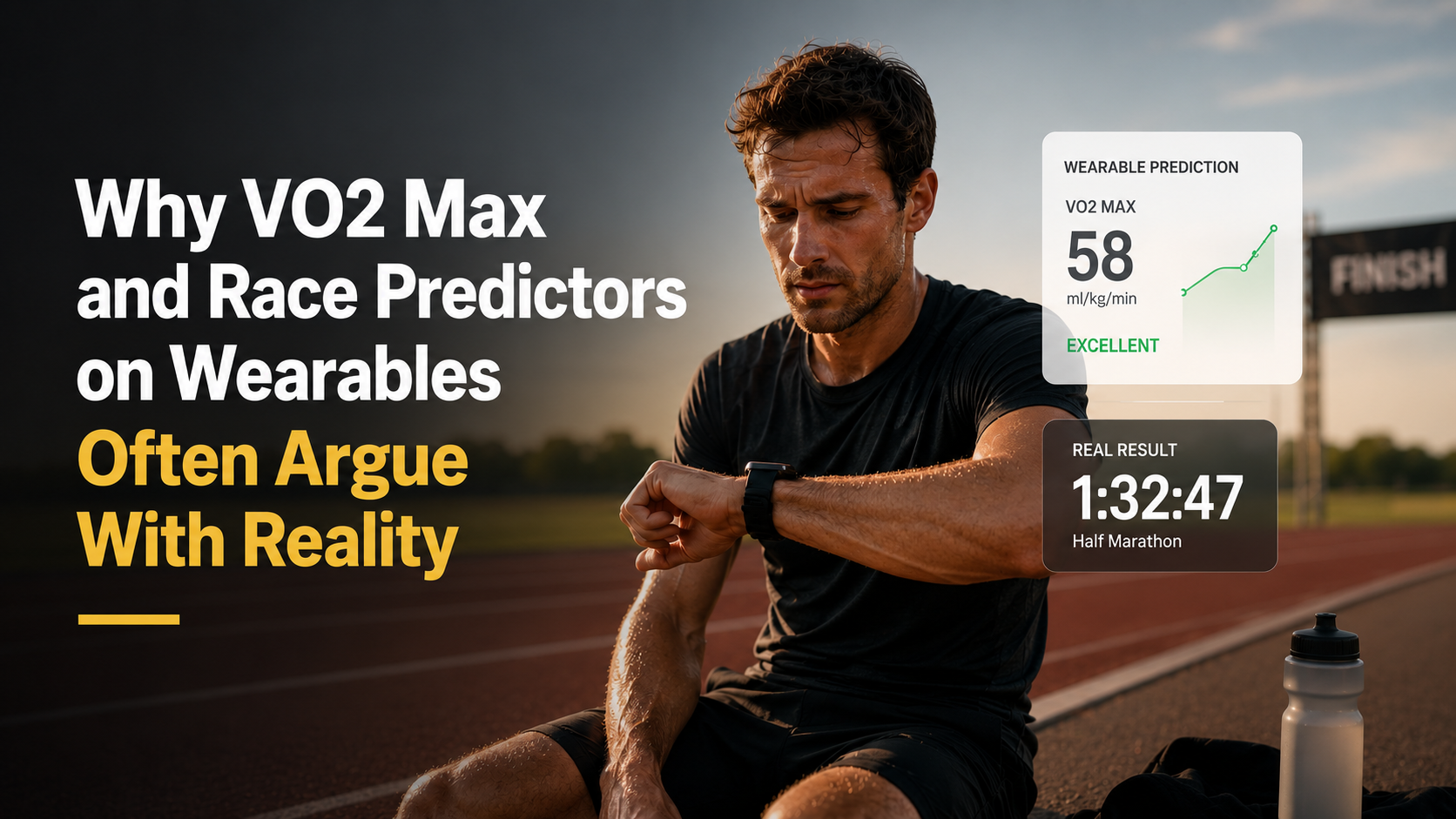
Why VO2 Max and Race Predictor Often Disagree With Real Life
By By Mr.Apps · Jun 25, 2026
Category: HRV
Why VO2 max on a watch can feel wrong
The first time a watch told me my VO2 max had dropped, I was standing in a parking lot after one of the best runs I had done all month. The pace was solid, the effort felt controlled, and I had not spent the last kilometer negotiating with God. Then I opened the app and saw the number had gone down.
That is a special kind of insult. You do the work, feel fitter, and the watch quietly says: not according to me.
A few weeks later, the opposite happened. I felt flat, my legs were heavy, and the run was average at best. The watch rewarded me with a better VO2 max estimate and a race predictor that suddenly believed I was a more talented person than I actually was.
That is when I stopped treating wearable VO2 max like a verdict.
VO2 max is real. It matters. It is one of the most useful measurements for understanding aerobic fitness. Cleveland Clinic explains VO2 max as the maximum amount of oxygen your body can absorb and use during intense exercise. In a lab, it is measured directly while you exercise with equipment that tracks oxygen use.
A watch does not do that. A watch estimates.
That difference explains almost every argument people have with their wearable.
1. Lab VO2 max and watch VO2 max are not the same thing
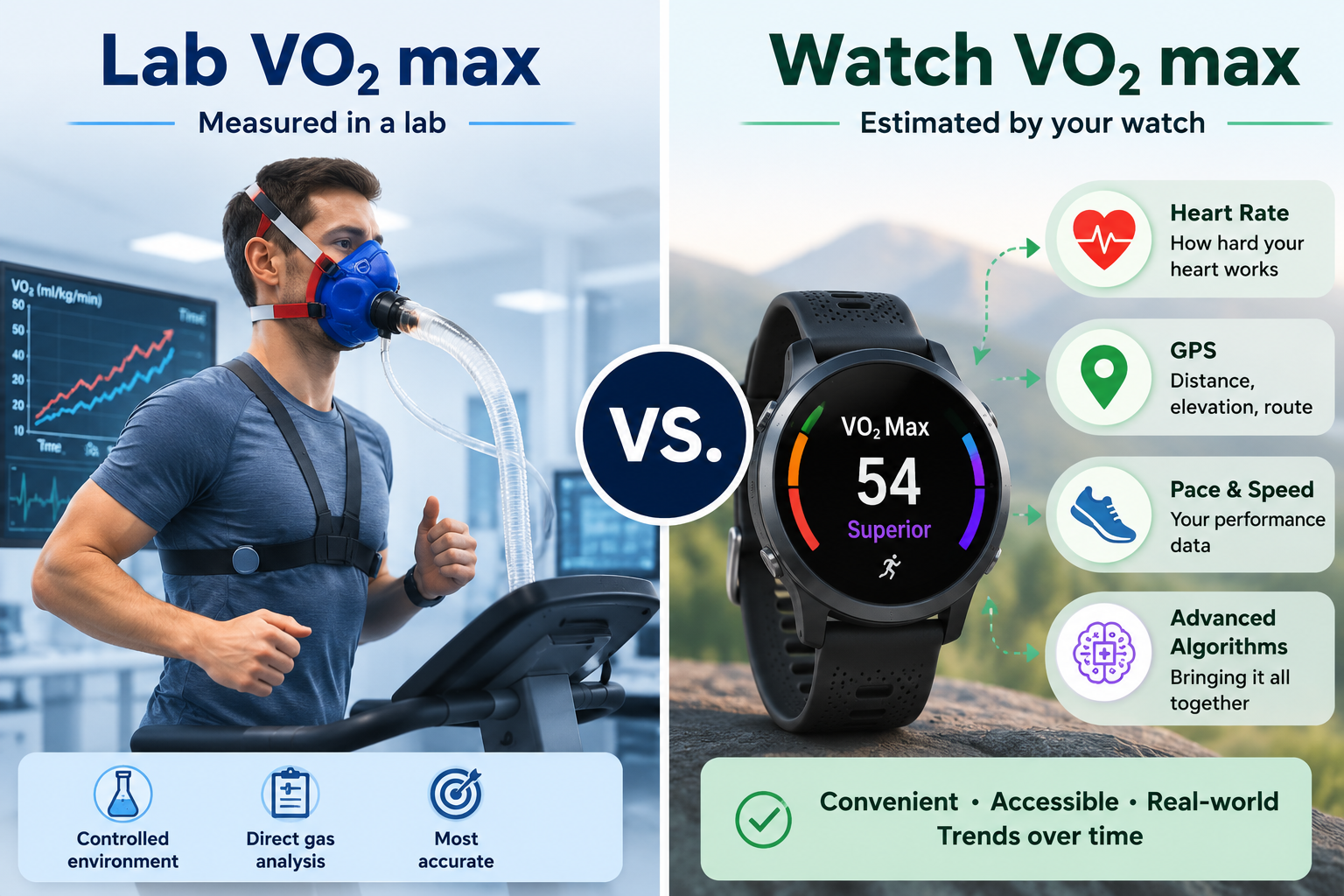
A proper VO2 max test is not subtle. You run or cycle while wearing a mask, the intensity increases, and the equipment measures how much oxygen you use. That is why lab testing is usually treated as the more direct method.
A wearable does something else. It looks at signals like heart rate, pace, speed, GPS, age, sex, weight, and sometimes environmental or training data. Then it uses an algorithm to estimate what your VO2 max probably is.
That can be useful, but it is not the same as measuring oxygen consumption directly.
This is why “VO2 max lab vs wearable” can produce a big gap. The lab is measuring the thing itself. The watch is estimating the thing from the outside. It is like guessing how hot an oven is by looking at how fast the bread browns. Sometimes the guess is close. Sometimes the oven, the bread, and the room all have opinions.
Research on consumer wearables keeps finding the same practical lesson: these devices can be helpful for trends, but they should not be treated as perfect replacements for lab testing. A study in JMIR Biomedical Engineering looked at the accuracy and reliability of Apple Watch VO2 max estimation and framed the central issue well: wearables are convenient, but their estimates need to be understood as estimates.
So if a lab says one number and a watch says another, it does not automatically mean one is useless. It means they are answering the question with different tools.
2. Your watch is judging the run, not your entire fitness
A wearable does not know your whole body. It knows what it can observe.
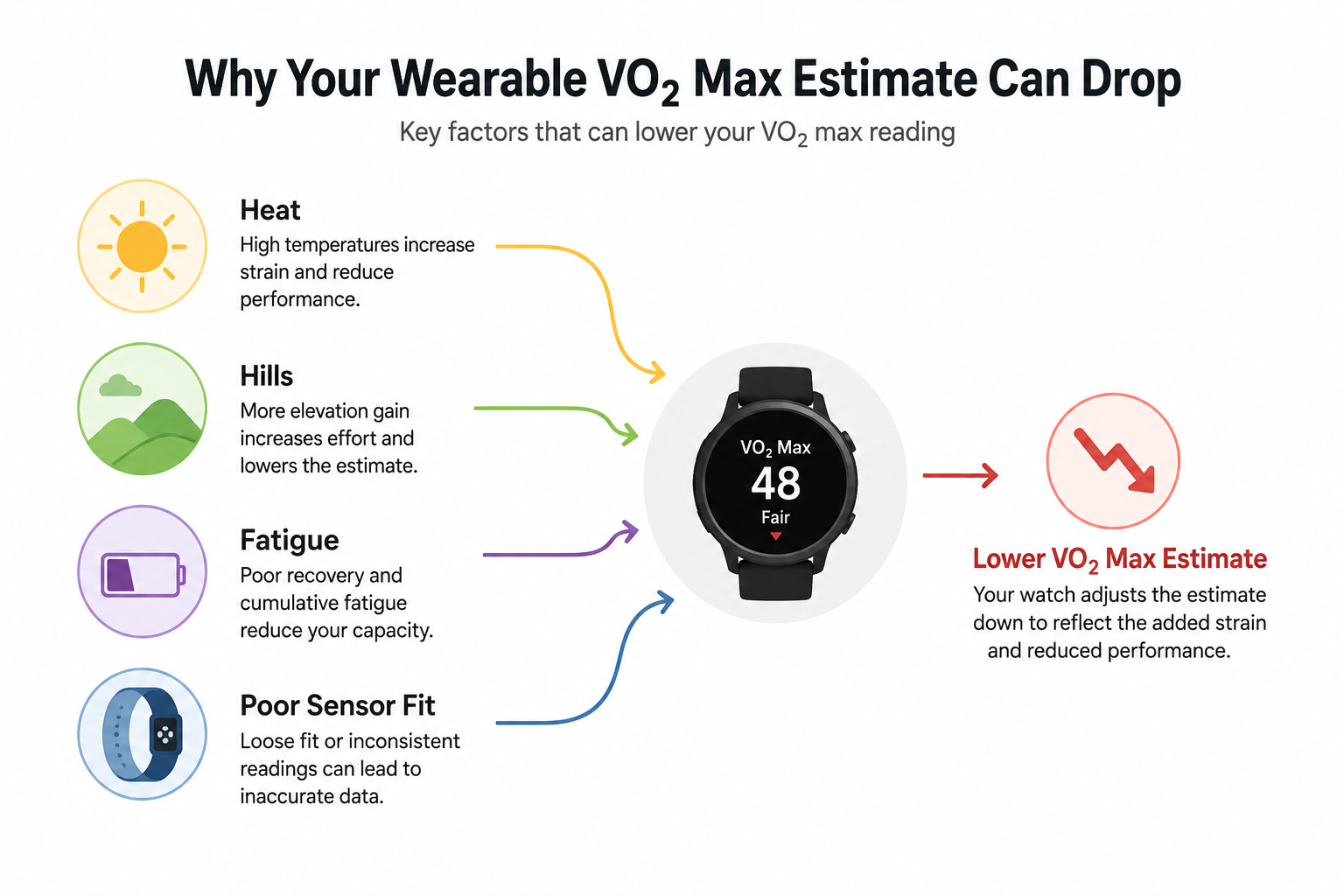
If you run tired, dehydrated, overheated, stressed, under-slept, or on a hilly route, your watch may interpret the session as a sign of lower fitness. It sees a higher heart rate for a given pace and thinks: this person is working harder than usual to go the same speed.
Sometimes that means fitness dropped. Sometimes it means Tuesday was just ugly.
This is the trap. VO2 max estimate changes can look personal, but many of them are situational. One bad run in heat, wind, poor sleep, or fatigue can make the number move in a way that feels more dramatic than it deserves.
Garmin even builds some of this into its own ecosystem. Its support page explains that compatible devices can apply heat and altitude acclimation corrections to VO2 max estimates and training status when conditions are hot or at altitude. That detail matters because it admits the obvious: the environment can distort the estimate.
A summer run is not the same test as a cool spring run. The same body, same route, and same effort can produce a different heart-rate response when the temperature climbs. So when someone asks, “Why did my VO2 max drop in summer?” the answer may be less mysterious than it feels.
The watch may not be seeing worse fitness. It may be seeing heat.
3. Heart rate errors can become VO2 max errors
Most wearable VO2 max estimates depend heavily on heart rate. That means heart rate accuracy matters.
Wrist heart rate sensors are convenient, but they are not magic. They use optical sensing at the wrist, and that signal can be affected by movement, fit, skin contact, tattoos, sweat, temperature, and exercise type. If the heart rate reading is wrong, the VO2 max estimate built on top of it can also drift.
That is why a loose watch during a run can become more than a small annoyance. If the device thinks heart rate was higher than it really was, it may assume the body worked harder for the pace and lower the VO2 max estimate. If it misses spikes or reads too low, it may do the opposite.
Research on wrist-worn devices has also raised concerns about accuracy across different bodies and skin tones. A 2026 preprint on PPG-based heart rate accuracy found that error varied by device and that higher BMI and darker skin tones were associated with increased heart-rate error. That does not mean every reading is wrong. It means the input data is not equally clean for everyone.
This is a big reason not to obsess over one number. A wearable estimate is only as good as the signals underneath it.
4. Race predictor is even more fragile
Race predictor feels more emotional than VO2 max because it turns a number into a promise.
A watch saying VO2 max is 48 is one thing. A watch saying a 5K, 10K, half marathon, or marathon time is another. Suddenly the device is not just describing fitness. It is making a prediction about who you are on race day.
The problem is that racing is not only VO2 max.
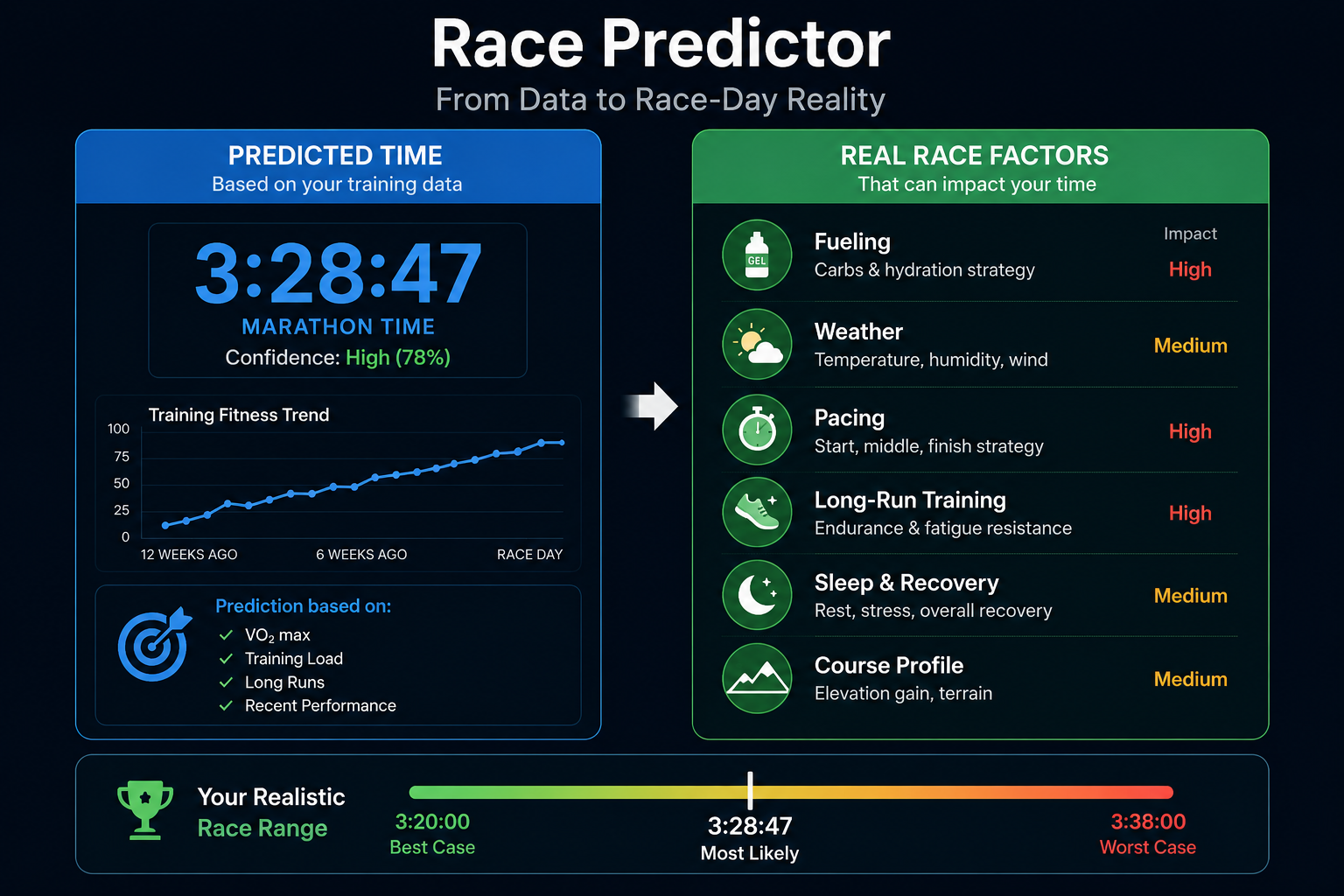
A good race depends on pacing, fueling, heat tolerance, running economy, lactate threshold, muscular durability, course profile, sleep, nerves, weather, and whether your stomach decides to become a political movement at kilometer 17.
VO2 max is part of the story, but it is not the whole story.
Harvard Health describes VO2 max as an indicator of aerobic fitness and the body’s ability to use oxygen during exercise. That is valuable. But a race predictor takes that kind of fitness signal and stretches it into a performance forecast. The farther the race, the more other variables matter.
A 5K prediction may be somewhat close for someone who regularly runs hard efforts. A marathon prediction can be fantasy literature if the person has not built the long-run durability, fueling practice, and weekly volume to support it.
So when a race predictor says you can run a time you have never come close to, do not immediately plan the victory post. Ask what the watch is missing.
5. A lower VO2 max does not always mean you got less fit
The most common panic is simple: “Why did my VO2 max drop?”
Sometimes the answer is real. Fitness can decrease with detraining, illness, poor recovery, or a long break. But sometimes the answer is much less dramatic.
VO2 max estimates can drop because of heat, hills, fatigue, poor GPS, bad wrist heart rate, dehydration, lack of sleep, altitude, or running on terrain that makes pace less efficient. If the watch sees slower pace at higher heart rate, it may assume aerobic fitness declined.
That assumption can be wrong.
A heavy training block is a good example. During hard weeks, performance can temporarily look worse because the body is tired. The watch may see that tiredness and call it lower fitness. But after recovery, performance may bounce back.
This is why trends matter more than single updates. One drop after a hot run is not a story. A steady decline over several weeks, across similar conditions, might be.
The American Heart Association has long emphasized cardiorespiratory fitness as an important health marker, and its scientific work on fitness reference standards shows how seriously VO2-type testing is treated in clinical and exercise contexts. But that does not mean a wrist estimate should be treated with the same certainty as a controlled test. The AHA’s work on cardiorespiratory fitness reference standards is a reminder that context, testing method, and population all matter.
A watch number is not meaningless. It is just not the whole courtroom.
6. When to trust the trend
The best way to use wearable VO2 max is to stop asking whether today’s number is “true.”
A better question is whether the trend makes sense.
If the estimate slowly rises over months while training becomes easier, paces improve, and recovery feels normal, the watch is probably capturing a real improvement. If the estimate slowly falls while runs feel harder, pace drops, and sleep or training consistency has been poor, that is worth paying attention to.
But if the number jumps or drops after one unusual run, stay calm.
Check the conditions first.
Was it hot?
Was the route hilly?
Was GPS messy?
Was the watch loose?
Was sleep bad?
Was there illness or fatigue?
Was the run on trails instead of flat road?
Was the effort actually steady enough for the estimate to be useful?
A wearable can be a good pattern detector. It is a bad fortune teller.
7. How to make VO2 max estimates more useful
The goal is not to ignore VO2 max. The goal is to read it correctly.
Use similar routes when comparing changes. A flat road run and a windy trail run are not the same test.
Keep the watch snug during workouts. Bad heart-rate data can poison the estimate.
Do not judge summer numbers against cool-weather numbers without context. Heat changes the body’s response.
Look at four to eight weeks, not four to eight hours. Fitness is a trend.
Use race predictor as a conversation starter, not a contract. It can suggest a range, but your recent workouts are usually a better judge.
Compare the estimate with real performance. If your easy pace improves at the same heart rate, that matters. If intervals get faster at the same effort, that matters. If long runs feel smoother, that matters. The number should serve the training, not bully it.
The most useful sentence is this: trust trends over absolutes.
A watch saying 49 instead of 51 may not matter. A steady climb from 42 to 48 over six months probably does. A race predictor saying 3:18 for a marathon when your longest run is 14 kilometers should be treated as comedy.
The honest take
VO2 max on a wearable is not fake. It is also not a lab test.
It is an estimate built from imperfect signals, interpreted by an algorithm, shaped by your body, your device, your route, your weather, and your recent fatigue. That makes it useful, but only if it is used with humility.
The same goes for race predictor. It can be fun. It can be motivating. It can even be directionally helpful. But it does not know how well you will fuel, how hot race day will be, how your legs will feel after 30 kilometers, or whether you have actually trained for the distance it is predicting.
So when the watch says VO2 max dropped, do not panic. When the race predictor says you are ready for a heroic personal best, do not immediately believe it either.
Ask what changed. Check the context. Look at the trend. Compare it with real workouts.
The watch is not the coach, the lab, or the finish line.
It is one useful witness.
FAQ
Why is my VO2 max watch estimate inaccurate?
Because most watches estimate VO2 max from pace, heart rate, GPS, age, weight, and other signals instead of directly measuring oxygen use. Errors in heart rate, GPS, heat, hills, fatigue, or algorithm assumptions can affect the result.
Why did my VO2 max drop even though I feel fitter?
It may have dropped because of heat, poor sleep, fatigue, dehydration, hills, bad sensor fit, or a hard training block. One drop does not always mean fitness decreased.
Is lab VO2 max more accurate than a wearable?
Yes. A lab test directly measures oxygen consumption during exercise, while a wearable estimates VO2 max from indirect signals.
Why does VO2 max drop in summer?
Heat can raise heart rate at the same pace, making the watch think the effort is harder than usual. Some devices apply heat correction, but not all estimates handle conditions perfectly.
How accurate is race predictor?
Race predictor can be directionally useful, but it depends on more than VO2 max. Pacing, training volume, race distance, weather, fueling, running economy, and fatigue all affect the real result.
Sources: