Folate equivalents and folic acid amounts should remain distinguishable
By Mr.Apps · Oct 28, 2026
Category:Apps

A folate label can show dietary folate equivalents alongside a separate amount of folic acid. These numbers are related, but they do not mean the same thing. A record that combines them as if they were two independent nutrients will count the same folate contribution twice. I recommend preserving both label values with their labels, then using the appropriate quantity for the question being answered.
What dietary folate equivalents describe
Dietary folate equivalents, usually abbreviated DFE, adjust for differences in how naturally occurring food folate and folic acid are absorbed. The measure gives a common basis for expressing folate intake from different sources. Folic acid is a specific form of folate used in supplements and fortified foods; DFE is a calculated equivalent that accounts for its greater bioavailability in the relevant context.
A nutrient reference explains this in its folate overview for health professionals. It distinguishes dietary folate from folic acid and describes why labels use DFE. The two numbers on a label can therefore appear together without being duplicate amounts: one represents the DFE value, while a parenthetical amount may identify the actual folic acid quantity that contributes to it.
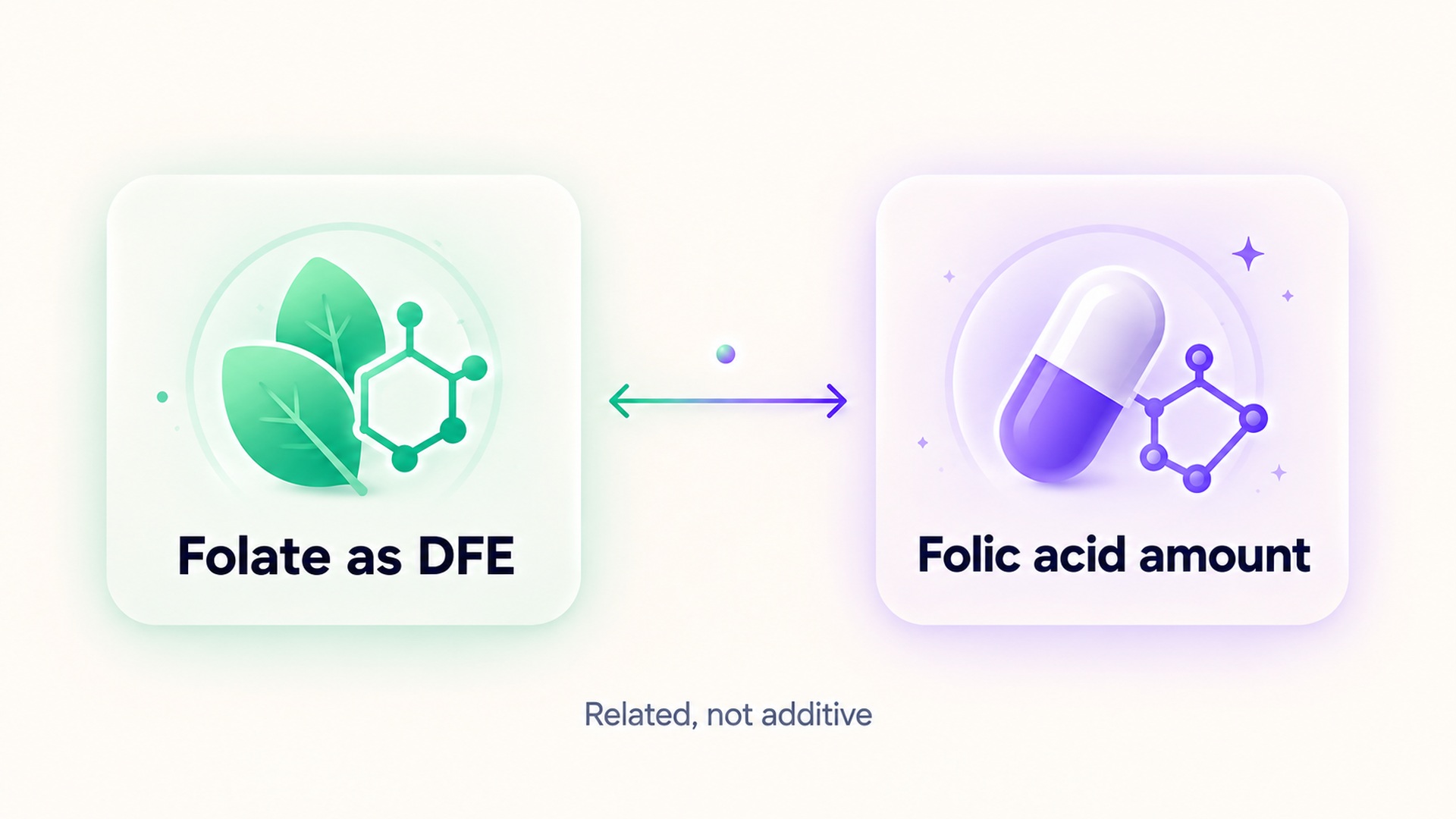
That distinction matters when an app asks for a daily folate total. If the field expects DFE, enter the DFE amount. If a separate field explicitly asks for folic acid, use the folic acid amount. Do not add the DFE figure and the folic acid figure together into one folate total. The DFE value already accounts for the folic acid contribution on the label’s basis.
The conversion behind DFE is why the numbers can differ. The nutrient reference describes one microgram of naturally occurring food folate as one microgram DFE. Folic acid is counted differently: the DFE calculation uses a smaller folic acid mass to represent the same folate equivalent, with the exact relationship depending on whether it is consumed with food or on an empty stomach. The label’s DFE amount reflects that adjustment. Readers should use the value printed on the panel rather than recreating the calculation from the ingredient list.
The folic acid amount still has a useful role. It identifies how much of that specific form is present in a serving, while DFE puts the folate contribution onto the adjusted comparison basis. The two figures are not competing label values, and choosing one does not mean the other is wrong. They describe related but different parts of the product’s nutrient information. Keeping both visible can be useful when checking a record, even though only the appropriate field value should enter a total.
A database may report folate using DFE, folic acid, or a different data field, depending on its source and intended use. Before importing a value, inspect its field name and unit. A number without the label “DFE” or “folic acid” is incomplete context. Do not infer the basis from a familiar-looking magnitude, and do not convert a database entry unless the source explains which amount it represents. The package can resolve some questions, but the app’s field definition still matters.
Read the whole Supplement Facts panel
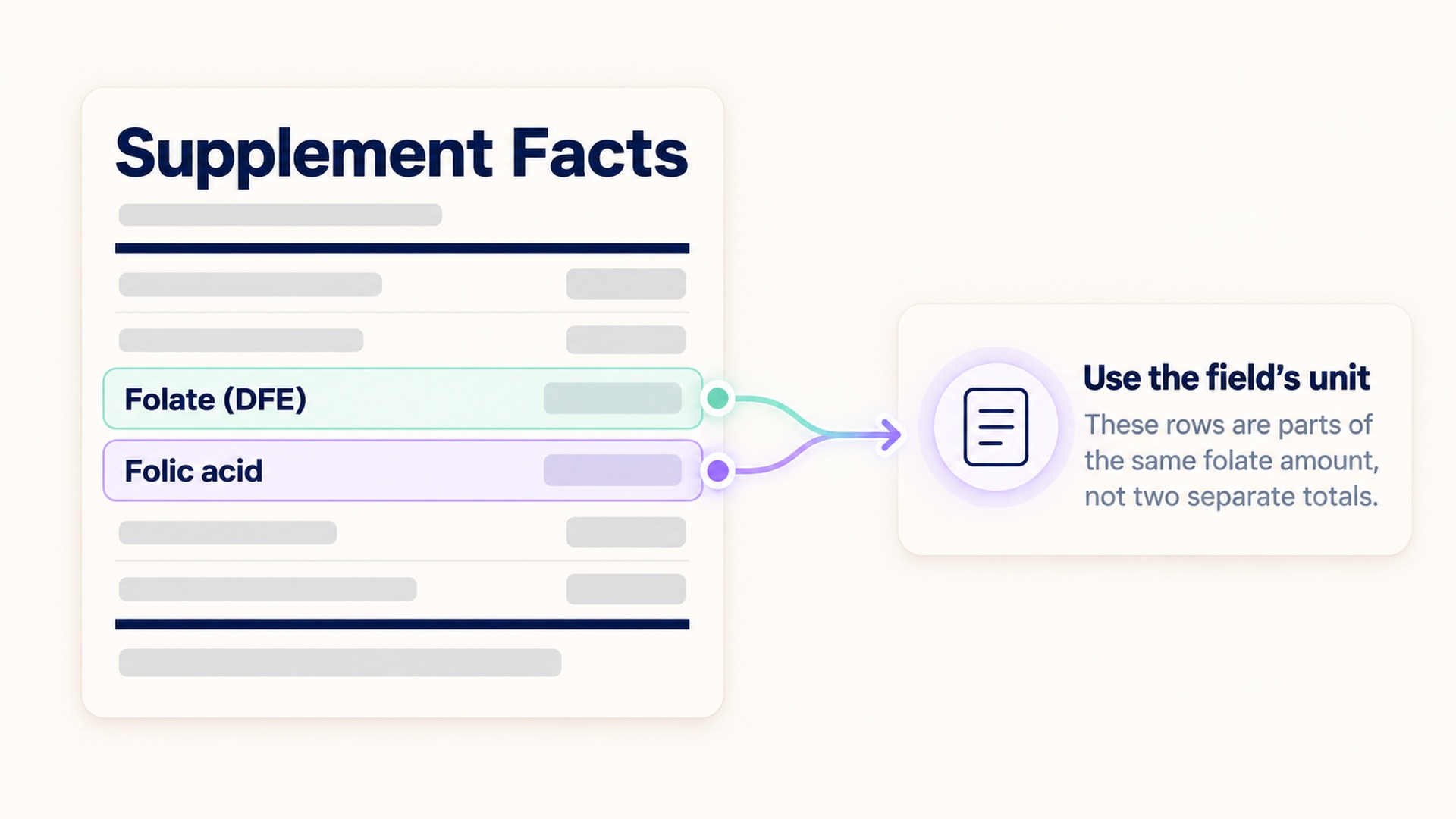
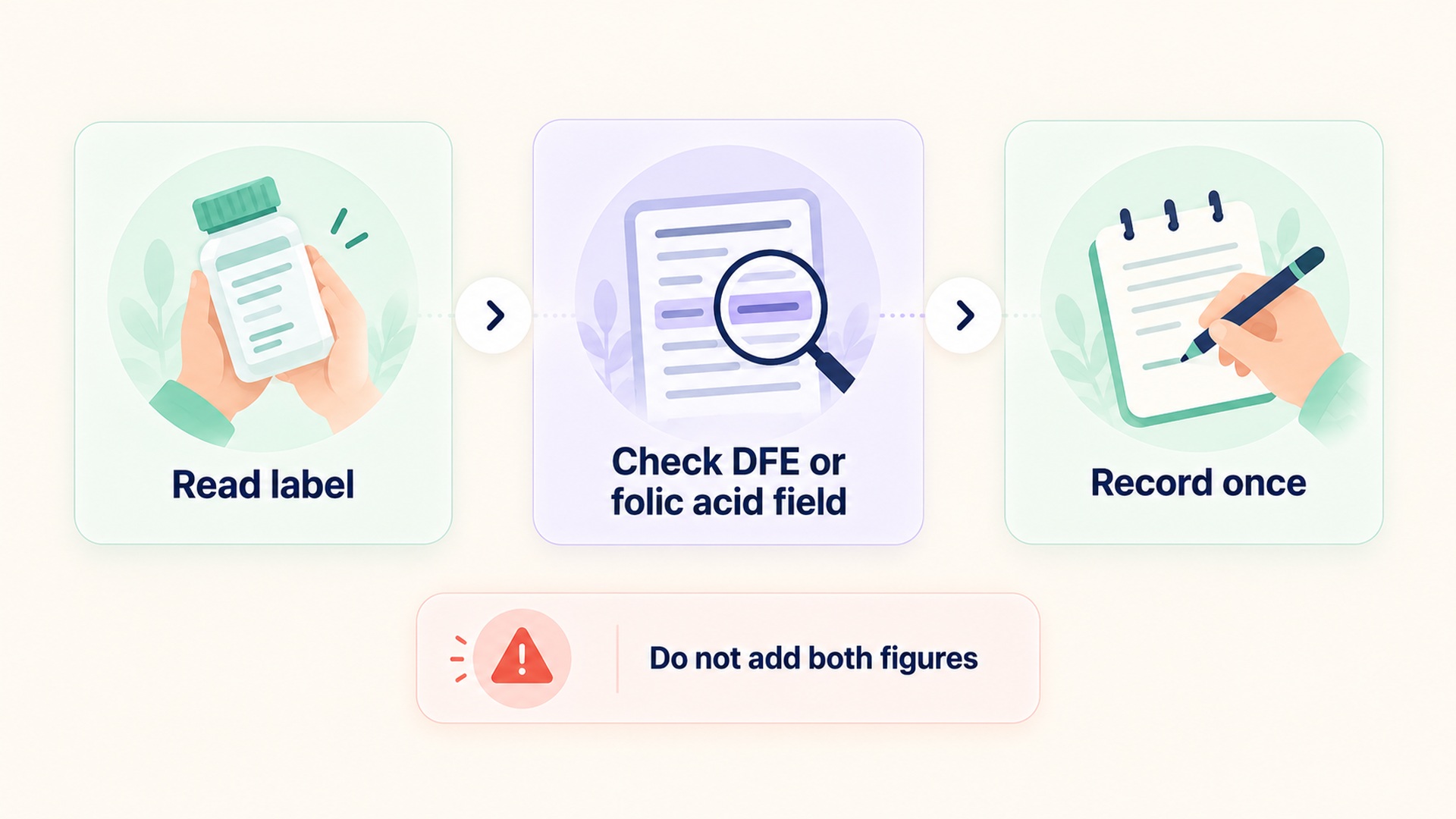
Start by identifying the nutrient line, its unit, and the serving size. A product may provide more than one capsule or tablet per serving. The amount shown applies to that serving, not automatically to one physical unit. If the label includes a parenthetical folic acid amount, keep it paired with the DFE amount rather than copying both into the same field.
The consumer folate overview gives a plain-language overview of folate and explains the DFE terminology. The guidance on Supplement Facts labeling describes how dietary ingredients and their amounts are presented. Read the product’s own panel first; a database entry may summarize the nutrient differently or omit the parenthetical amount.
If a label presents DFE and folic acid in a single line, those values should remain distinguishable in the record. One field can preserve the declared folate amount in DFE, and a note or additional field can retain the folic acid amount for reference. If an app offers only one nutrient field and does not say whether it expects DFE or folic acid, do not guess based on the number’s size. Check the app’s unit definition or use a manual note so the entry is not falsely precise.
The product description should also match the form in the package. A supplement may list folate as a nutrient while identifying folic acid as its source or form. Those words do not make the amounts separate servings. If a database result gives only a nutrient name and omits the DFE basis, compare it with the panel or select a record whose unit is explicit. A clear note can preserve the missing label context without forcing an unsupported conversion.
Keep food folate and folic acid context visible
Food folate and folic acid from a supplement or fortified food can contribute to a total, but their quantities may be represented on different bases. DFE helps make that combined intake comparable. A label that lists both values is not telling you to take both amounts. It is showing the folate equivalent and the amount of folic acid that was used to calculate or explain it.
The Daily Value explanation describes how percentage Daily Values appear on Nutrition and Supplement Facts labels. A percentage is label context; it is not another folate amount to add to a DFE total. Use the quantitative amount and its unit when entering a value, and keep the percent DV separate. If a nutrient field has no visible unit, confirm it before comparing values.
Avoid double counting across products
When several products contribute folate, inspect each panel and enter the relevant amount once per serving consumed. A multivitamin may list folate in DFE with a folic acid quantity in parentheses, while a second product may use another format. Convert or map the values to a common DFE basis only when the source provides enough information. Do not sum the parenthetical amount on top of its DFE equivalent, and do not assume every folate entry is already using DFE.
The questions and answers on dietary supplements explain that Supplement Facts panels include serving size and amounts of dietary ingredients per serving. That context is important when checking whether two entries refer to one serving or multiple servings. Duplicate product records can also cause a total to be counted twice; compare the product form and label before treating two lines as separate sources.
If the package has been reformulated or the app record appears to use a different unit, use the label in hand and preserve the discrepancy in a note. The consumer overview of folic acid discusses folic acid as a nutrient form, but it does not make every app field interchangeable. A record can be accurate only when its unit and source are clear.
If a panel has changed, replace the old product record with one that matches the current serving and nutrient display, then review any saved totals that depend on it.
Separate label arithmetic from supplement advice
DFE is a unit for describing folate intake. It does not prescribe a supplement, determine an individual need, or replace advice for a specific health circumstance. This article focuses on reading and recording general adult nutrition information. Decisions about supplementation belong with a qualified professional when personal health context matters.
A label may include a percent DV, a DFE quantity, and a folic acid amount. Each one has a distinct purpose. The amount in DFE supports comparison on the adjusted folate basis. The parenthetical amount identifies the folic acid quantity. The percent DV places the amount in the context of the label’s reference value. Keeping those pieces separate makes the record easier to review without making it a treatment plan.
For another example of recording two related nutrient units without mixing them, see how to convert vitamin D units before adding supplements to a daily total. In both cases, preserve the original label value, its unit, and the serving basis. A conversion can make a total comparable; it cannot tell you what amount is right for an individual.
If the serving size changes, base the entry on the current panel rather than carrying forward an old per-serving value.
FAQ
Should I add the DFE amount and folic acid amount together?
No. The DFE figure and parenthetical folic acid figure are related descriptions, not independent nutrient contributions to add together. Use the value that matches the field’s requested unit and keep the other amount as label context.
What does DFE mean on a supplement label?
DFE means dietary folate equivalents. It is a common expression that accounts for differences in the bioavailability of food folate and folic acid. Keep it separate from the folic acid amount printed alongside it.
What if my food-log app does not specify DFE or folic acid?
Check the field definition or help text before entering the number. If the app does not identify its unit, preserve the label’s DFE and folic acid values in a note or choose a manual record that clearly states the basis.
*This article is for informational purposes only and is not a substitute for professional medical advice, diagnosis or treatment.*
Sources:
NIH Office of Dietary Supplements·NIH Office of Dietary Supplements·U.S. Food and Drug Administration·U.S. Food and Drug Administration·U.S. Food and Drug Administration·MedlinePlus
Related articles

Convert vitamin D units before adding supplements to a daily total
Vitamin D labels may state international units, micrograms, or both, and those values need a common unit before they are added. Check each serving and keep the arithmetic separate from decisions about supplementation.

Logging canned foods depends on whether the liquid was drained
A canned food can be weighed with its packing liquid or measured after draining, and those are different food forms. Match the label and database entry to the portion you actually consumed instead of applying a guessed adjustment.

Check the current label after scanning a food barcode
A barcode scan is a useful starting point, but the food record still needs to match the package in hand. Check the current label, serving basis, and amount eaten before accepting the entry.

Food weight ounces and fluid ounces require different entries
Ounces by weight and fluid ounces measure different quantities. Match the entry to the scale, measuring cup, package label, and food form before logging a portion.

Stable body weight does not rule out inadequate fueling for training
A steady body-weight trend does not show whether food intake supports training and normal body functions. Learn why scale readings need training, recovery, and health context, and when to seek individualized advice.

Carbohydrate replenishment and a normal recovery score are different signals
A normal recovery score does not show whether muscle glycogen has been replenished after exercise. Learn how to read training, food, and autonomic signals as separate pieces of context.

A beverage log does not capture all sources of dietary water
A drink tracker may omit water that comes from food, and an intake total does not establish hydration status. Learn how to label beverage entries, food moisture, and uncertainty separately.

Track digestive tolerance when dietary fiber increases
A nutrient total cannot show how a fiber change felt. Learn how to log food details, digestive symptoms, and uncertainty separately without assuming every symptom came from fiber.

Daily protein totals can hide how intake is distributed
A daily protein total does not show how intake was spread across meals. Learn how to preserve meal-level entries, interpret research limits, and keep recorded patterns separate from nutrition targets.

Short-term weight changes do not identify how much body fat changed
A scale measures total body mass, which combines water, fat, lean tissue, and digestive contents. Learn why a short-term change cannot isolate body-fat change or replace a composition assessment.