Logging canned foods depends on whether the liquid was drained
By Mr.Apps · Oct 28, 2026
Category:Apps

A canned food can be weighed with its packing liquid, measured after draining, or recorded from a label that specifies one of those forms. The resulting amounts are not automatically interchangeable. Before logging the portion, check what the label or database entry represents. I recommend keeping the liquid and solids question visible rather than applying a guessed drainage adjustment.
What “drained” changes in a food record
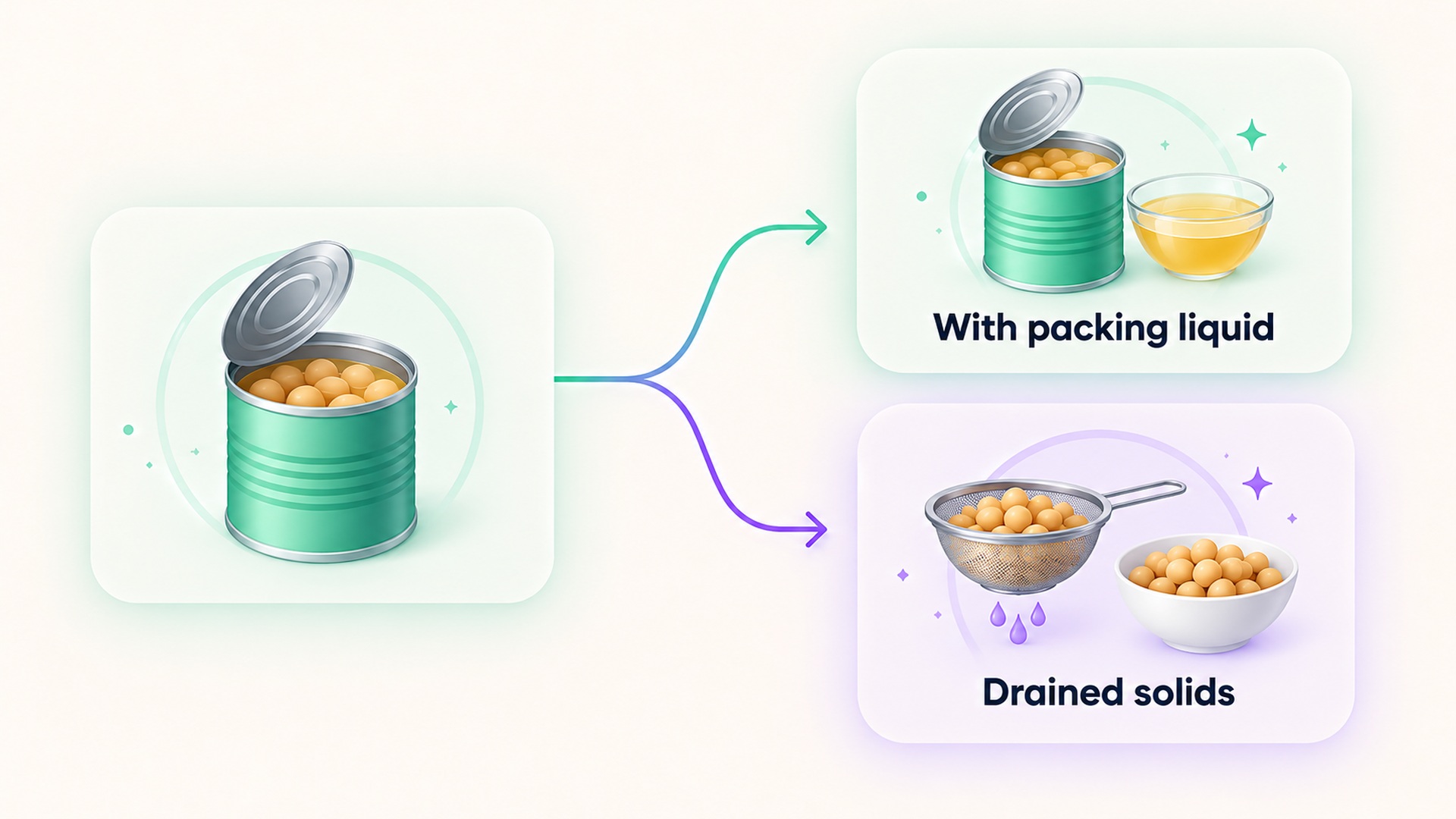
A food packed in water, brine, syrup, or another liquid contains more than the solid portion alone. If the liquid is eaten or used, a record for the food with its packing medium may fit. If the liquid is poured away, the solids remaining in the can are the portion to match. The difference is not a correction factor that applies to every product; it depends on the exact item and the measurement used.
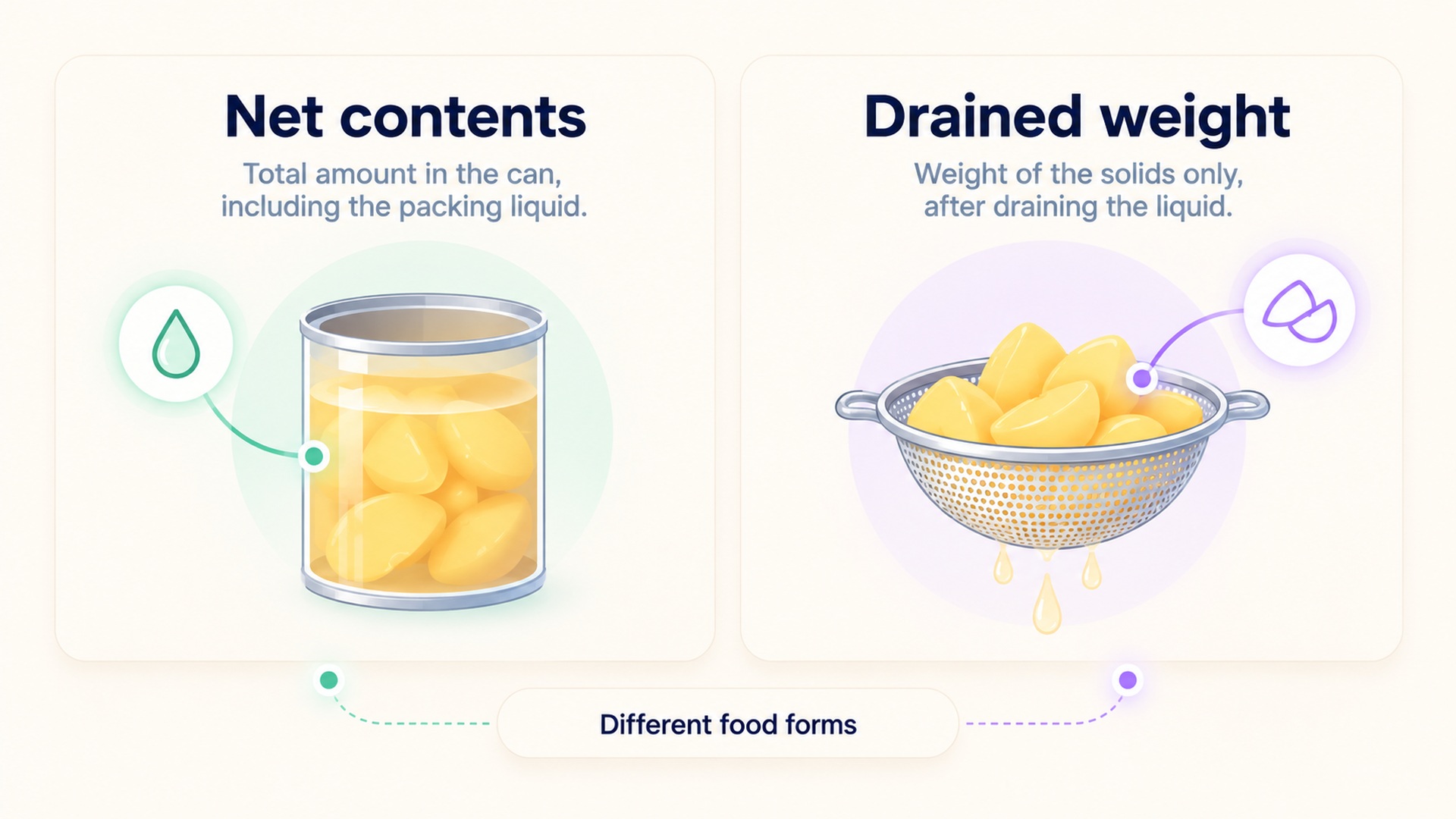
The food labeling guide explains how net quantity is declared and notes that packing liquid is generally included in the stated quantity. It also describes cases where a drained weight is declared when the packing medium is normally discarded. That distinction helps explain why a package can show both total contents and drained weight. The two figures refer to different product forms.
A drained weight is not necessarily the weight of every portion a person will eat. Draining time, mesh size, rinsing, and the amount of liquid left with the food can change a kitchen measurement. The label may use a standardized method for a regulatory declaration, while an individual’s preparation differs. The label remains useful for matching the product form it describes, but the app entry should not imply a level of precision that the kitchen measurement does not support.
Match the database entry to the can
A database may list a canned food as packed with liquid, drained solids, rinsed solids, or a prepared form. Similar names can hide those distinctions. Read the full description, not just the first words in a search result. Compare the food type, packing medium, added ingredients, and unit. If the entry omits whether it is drained, that uncertainty matters when a drained portion is being logged.
The food-database FAQ describes the database’s different data types and uses. Entries are not all the same kind of record, so a generic result should not be treated as a verified match for every can. A branded entry, a generic food, and a prepared-food record can describe different products or states. Choose the closest documented form and preserve uncertainty if the exact form is unavailable.
Then look at the package. The net quantity statement describes the contents according to the applicable label rules; it does not always tell you how much solid food will remain after draining. The federal explanation of net quantity and food labeling is a reference for reading that information. If the can displays a drained weight, use it only for the drained form it names. Do not use total net weight as a proxy for the drained solids, or the reverse.
Choose the measurement that matches what was eaten
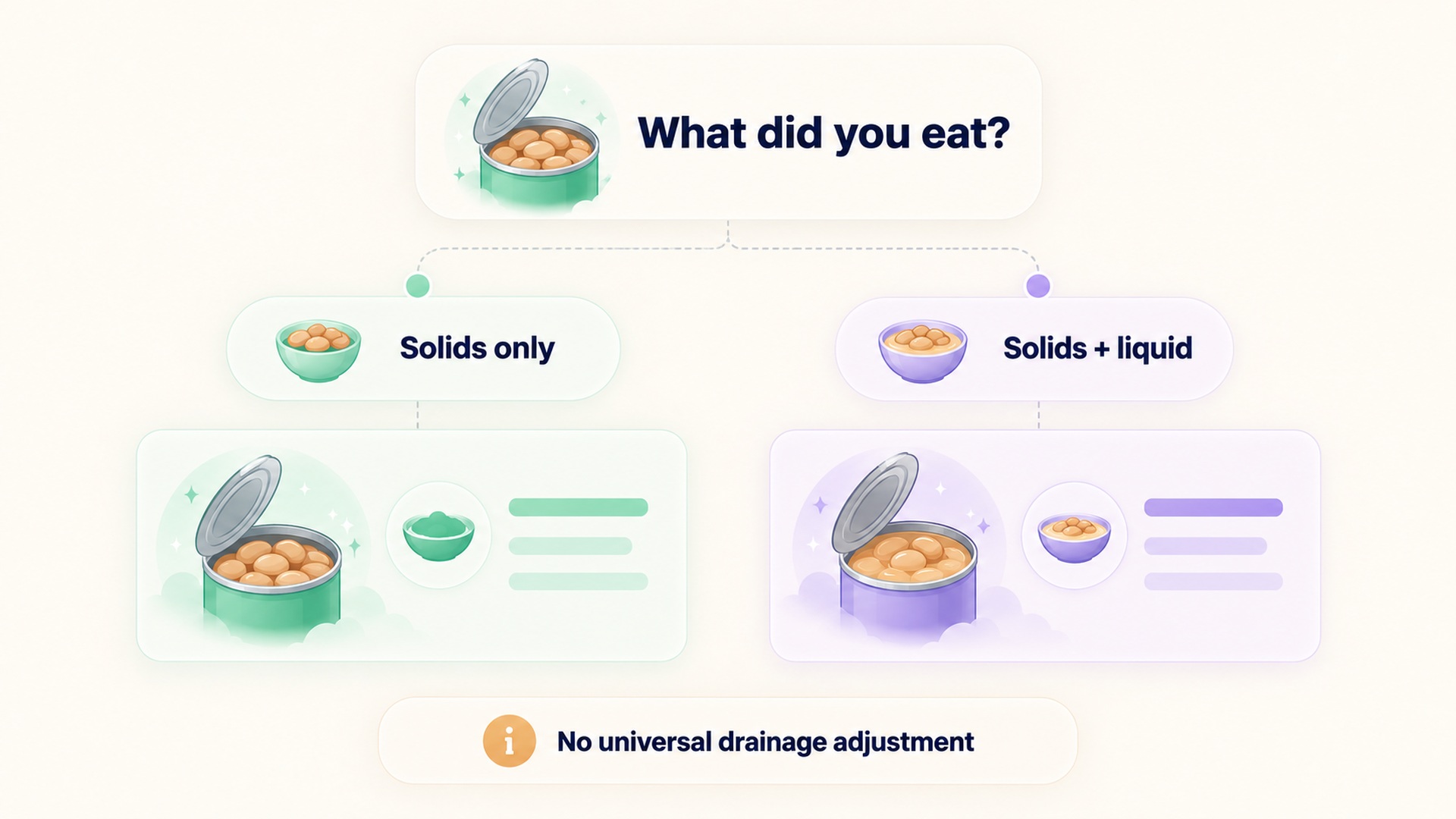
If the packing liquid was discarded, use an entry for drained solids when one is available. If it was eaten or incorporated into the dish, use an entry that includes the liquid or record the solids and liquid separately if the app supports it. If part of the liquid was kept, the package’s whole-can figures may no longer describe the consumed amount. Avoid treating “drained” as a binary state when the preparation was somewhere between fully drained and fully packed.
For a measured portion, weigh the food in the form it was consumed and choose a database entry expressed on the same basis. A drained-solids entry paired with a drained weight is different from an entry for the food plus liquid. If the record is expressed per a household serving, confirm that the serving description also says whether it is drained. A correct number attached to the wrong state will produce a misleading total.
The label’s serving size is another separate check. The serving-size guidance explains how package nutrition information relates to the stated serving. A package can have multiple servings, and the listed amount may be based on a specific household or metric measure. The serving size does not answer whether your portion included the packing liquid; that comes from the food form and the amount actually eaten.
Do not invent a universal drainage adjustment
A common mistake is to subtract a fixed amount or percentage for liquid whenever a food is drained. That shortcut can be wrong because cans differ in food, liquid, fill, and label convention. It can also be wrong for a specific portion if the draining method differs from the one used for the package’s drained-weight declaration. The purpose is to preserve the right form, not create a generic estimate.
The draining method is part of the definition. Federal guidance for industry on household measure equivalents describes a standardized procedure for foods whose packing liquid is not normally consumed: draining on a specified sieve for a set period before weighing or measuring. That guidance is for determining label equivalents; it is not a universal home-preparation rule. It shows why a drained quantity depends on a defined method. A quick pour at a kitchen sink may not reproduce the same result, so an entry should not imply that it does.
For ordinary logging, follow the package’s own stated basis when it provides one, and describe the form you actually ate. A product with a stated drained weight and a database entry for drained solids may provide a useful pairing. If the label gives only the total contents, the total does not reveal the mass of solids left after a person drains the can. The guidance on measuring household equivalents offers a direct explanation of how a standardized drained measurement can be defined.
If the exact drained entry is absent, consider whether the package gives a drained weight and whether the app allows a manual entry. Use a verified source for the nutrient values and make clear which portion basis was used. If neither the database nor package describes the drained portion, choose a close record only if the limitations are acceptable for the purpose of the log. Do not silently present an approximation as an exact measurement.
A food database can be searched for entries with terms such as “drained solids,” but the description still needs review. The official food-database search provides access to food records; the selected record should match the product and state rather than merely the broad food category. A search result is a candidate, not a quality mark for the individual package.
The can itself may also contain more than the nutrient panel can clarify. A label can provide serving information and net contents while leaving a preparation detail to the reader. When a drained weight is listed, preserve the exact label wording in a note if the app allows it. When it is not listed, do not infer it from the drained weight of a different product.
Build a record someone else can interpret
A useful entry records the food, the amount, and the form. A brief note such as “solids after draining” can distinguish it from a future entry for the same food eaten with its liquid. This is especially helpful when reviewing several days or comparing a home-prepared portion with a packaged serving. The note is not a substitute for accurate nutrient data, but it identifies the basis of the measurement.
Keep the label, database record, and preparation separate in your reasoning. The package identifies the product and any stated drained amount. The database supplies nutrient values for a described food form. The kitchen measure estimates the portion actually consumed. If one of those pieces is missing, the result may be approximate. That is not a reason to abandon the log; it is a reason to describe it clearly.
For another practical distinction between package information and the amount recorded, see checking servings per container before logging a whole package. A whole can, a labeled serving, drained solids, and solids plus liquid are four descriptions that may overlap but should not be assumed to mean the same thing. A transparent record keeps those differences available for later review.
FAQ
Should I log a can by its net weight or its drained weight?
Use the weight that matches the form you consumed and the database entry you selected. Net weight may include packing liquid; a stated drained weight refers to the solids after draining under the label’s convention. They are not substitutes for one another.
Does rinsing canned food use the same entry as draining it?
Not necessarily. Rinsing changes the preparation and may remove some liquid or surface material, but an entry labeled only “drained” may not describe a rinsed product. Match the closest documented form and note the preparation when it matters.
What if the app has no drained-food entry?
Check whether the package provides a drained weight and whether manual entry is supported. Otherwise choose a close documented record only if its limits are acceptable, and mark the form as approximate. Do not apply a universal drainage percentage.
*This article is for informational purposes only and is not a substitute for professional medical advice, diagnosis or treatment.*
Sources:
U.S. Food and Drug Administration·USDA FoodData Central·U.S. Food and Drug Administration·U.S. Food and Drug Administration·USDA FoodData Central·U.S. Food and Drug Administration
Related articles

Check the current label after scanning a food barcode
A barcode scan is a useful starting point, but the food record still needs to match the package in hand. Check the current label, serving basis, and amount eaten before accepting the entry.

Food weight ounces and fluid ounces require different entries
Ounces by weight and fluid ounces measure different quantities. Match the entry to the scale, measuring cup, package label, and food form before logging a portion.

Stable body weight does not rule out inadequate fueling for training
A steady body-weight trend does not show whether food intake supports training and normal body functions. Learn why scale readings need training, recovery, and health context, and when to seek individualized advice.

Carbohydrate replenishment and a normal recovery score are different signals
A normal recovery score does not show whether muscle glycogen has been replenished after exercise. Learn how to read training, food, and autonomic signals as separate pieces of context.

A beverage log does not capture all sources of dietary water
A drink tracker may omit water that comes from food, and an intake total does not establish hydration status. Learn how to label beverage entries, food moisture, and uncertainty separately.

Track digestive tolerance when dietary fiber increases
A nutrient total cannot show how a fiber change felt. Learn how to log food details, digestive symptoms, and uncertainty separately without assuming every symptom came from fiber.

Daily protein totals can hide how intake is distributed
A daily protein total does not show how intake was spread across meals. Learn how to preserve meal-level entries, interpret research limits, and keep recorded patterns separate from nutrition targets.

Short-term weight changes do not identify how much body fat changed
A scale measures total body mass, which combines water, fat, lean tissue, and digestive contents. Learn why a short-term change cannot isolate body-fat change or replace a composition assessment.

Drug allergy and medication intolerance need distinct record fields
A medication reaction does not automatically establish a drug allergy. Learn which record fields preserve the reaction, its source, timing, and uncertainty for professional review.

Lower appetite does not reveal how much energy was consumed
Appetite is a sensation, while intake is the food and drink consumed. Learn why a lower hunger rating cannot fill in a food record or establish an energy target.