Why your wearable says you're stressed when you feel fine
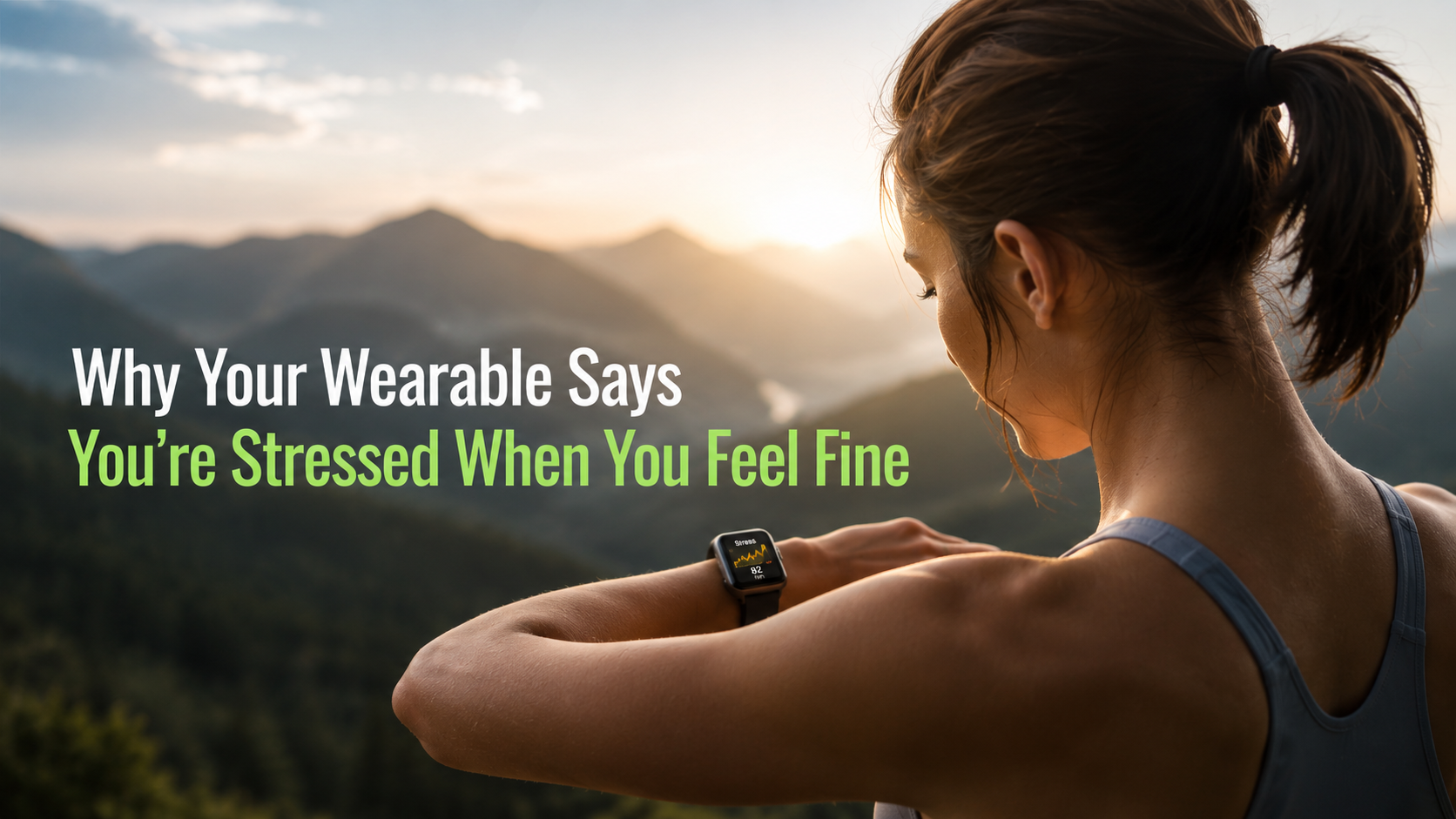
A while back I sat down at seven in the morning with a coffee and a long document to review. Quiet room, no deadline pressure, one of those tasks I actually enjoy. Forty minutes in, my wrist buzzed to tell me I was experiencing elevated stress. I remember looking at the notification and thinking the sensor had finally lost the plot.
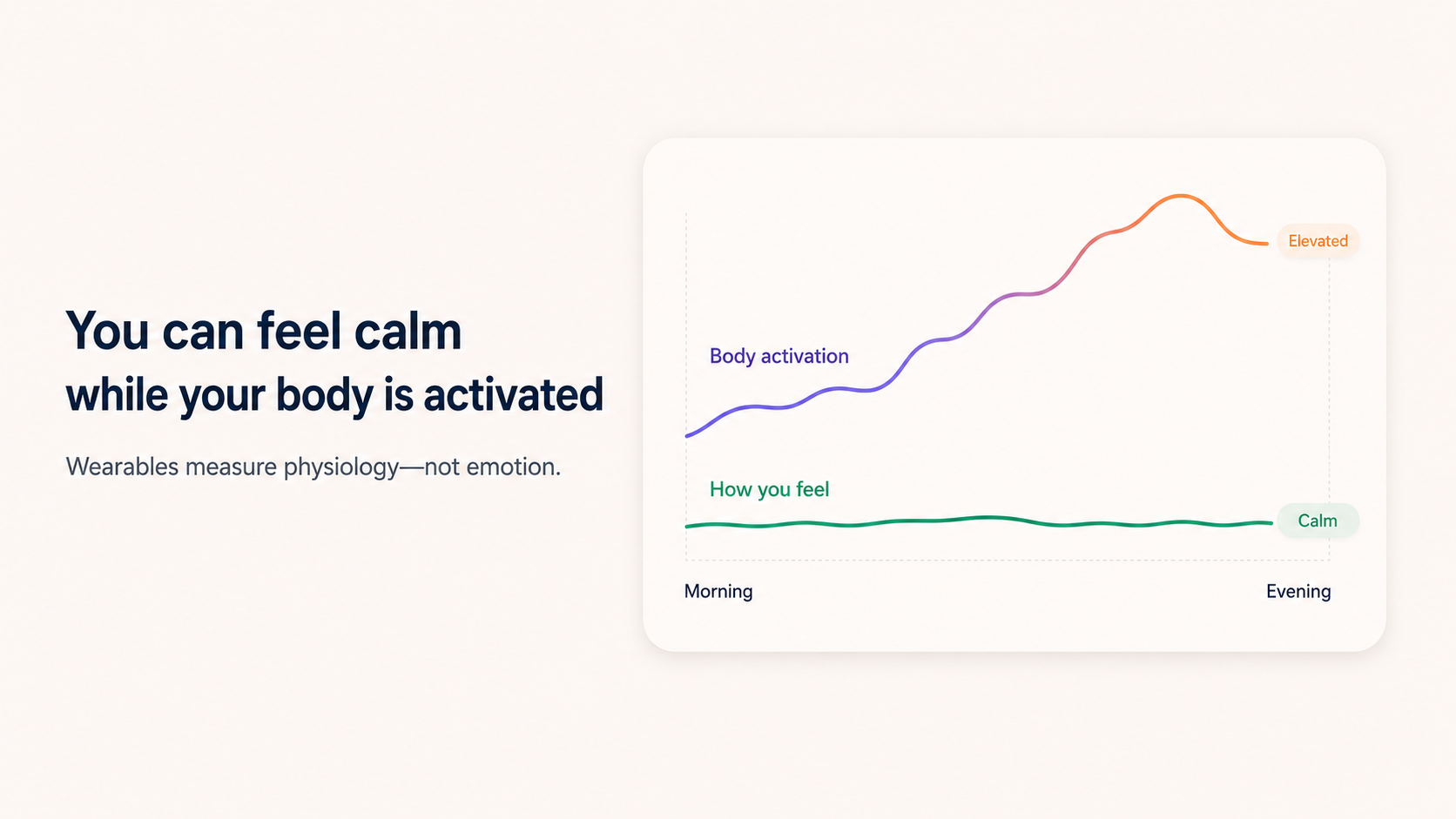
It hadn't. It was answering a question I wasn't asking. The watch was reporting something narrow: my body was running in a more activated state than usual. That overlaps with feeling stressed often enough for the label to stick, and diverges often enough that people end up searching why does my watch say I'm stressed while they feel perfectly fine.
What a stress score actually measures
Almost every wearable stress score is built from the same raw material. The device tracks the tiny gaps between consecutive heartbeats and calculates heart rate variability from them. A relaxed body under parasympathetic control produces gaps that wander a little. When the sympathetic branch takes over, the gaps become more uniform and HRV drops. Add heart rate compared with your own baseline, accelerometer data showing whether you're moving, and on some devices breathing rate or skin temperature, and you have a stress score.
Notice what is missing. There is no input for what you're thinking about, whether the activation is welcome, or whether you're worried at all. The device sees physiology and infers emotion. Researchers comparing how stressed people say they feel with what their cardiovascular measures do in daily life keep finding that the agreement between the two is partial at best, and that it depends on which measure you use and how you ask the question. Your watch is doing a narrower job than the word "stress" suggests.
The day my numbers peaked while I was enjoying myself
I gave a technical presentation last year to an audience of about eighty people, and I was curious to see how badly the data would spike while I was on stage. The talk came back as moderate arousal, roughly what a brisk walk produces. The highest reading of the day arrived ninety minutes later, while I sat eating lunch and feeling relieved it was over.
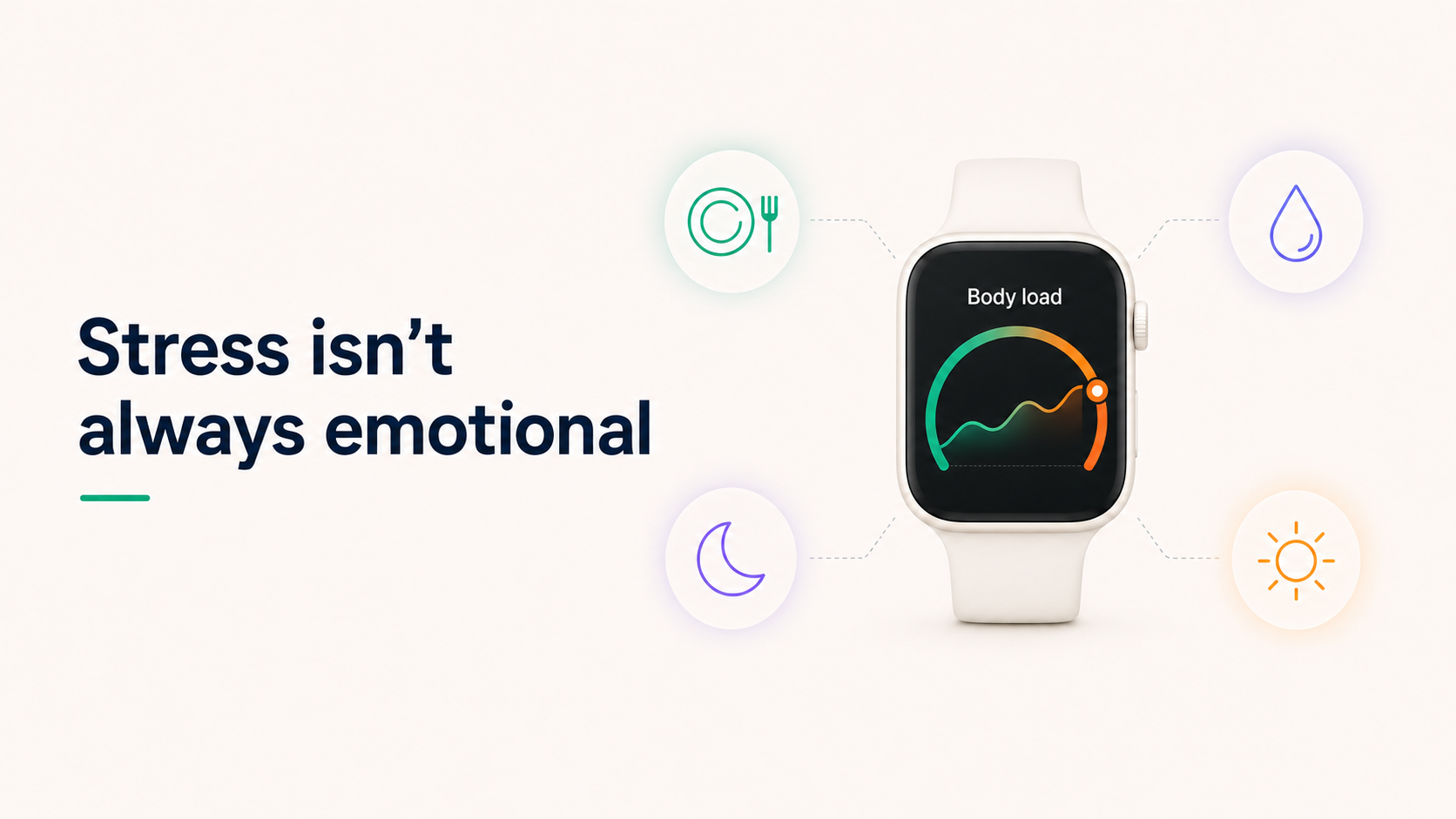
Two ordinary things were happening at once. The first is that concentrated mental work does not need to feel unpleasant to register. In one study where participants worked through a demanding switching task, most HRV measures dropped sharply while heart rate and blood pressure stayed unchanged, with the largest change in the first fifteen minutes. Absorbed problem-solving looks much like strain from the outside, and so does the settling period afterwards.
The second is digestion. A meal shifts blood toward the gut, raises cardiac output, and reduces vagally mediated HRV for a couple of hours. In one controlled trial, high frequency HRV fell measurably two hours after eating regardless of what the meal contained. If you eat a large lunch and then sit still, your smartwatch says stressed with real conviction while you are, physiologically speaking, just busy digesting.
The ordinary things that push the number up
Caffeine is the first thing most people suspect, and the research is messier than you would expect. It raises heart rate and sympathetic activity in most people, but the HRV picture is inconsistent, and a meta-analysis of trials in active adults found that caffeine taken before exercise did not change HRV recovery afterwards. My own pattern, from six weeks of writing a perceived stress rating each afternoon next to what the app reported, is that a second coffee after two shows up clearly and a first coffee at seven does not. Yours may differ, and that is worth testing rather than assuming.
Fluid balance matters more than most people credit. Losing even a small percentage of body water reduces plasma volume, so the heart beats faster to move the same amount of blood, and acute hypohydration also increases sympathetic activity and impairs blood pressure regulation. One afternoon I spent four hours in a warm room finishing a set of edits, barely moving, with no water within reach. The score stayed high and I felt fine. I drank half a litre, walked around the block, and the next reading was unremarkable.
Heat does the same through a different route, since the body pushes blood toward the skin to shed warmth. Illness does it earlier than you would like. Two winters ago my resting heart rate climbed by six beats and stayed there for two days before a sore throat arrived. That was the tracker being useful, even though the label said stress rather than immune activation.
Short sleep is one of the more reliable drivers. When researchers restricted healthy volunteers to three hours of sleep for three nights, HRV and the shape of the underlying pulse waveform both deteriorated, pointing to reduced parasympathetic activity. A hard training session does something similar for a day or two afterwards, which is the mechanism working exactly as designed even though the word on screen is unhelpful. So does sitting still for three hours, which lowers heart rate variability in a way that some algorithms read as tension rather than as stagnation.
Poor sensor contact explains more than you would think
The least interesting explanation is often the correct one. Optical sensors work by shining light into the skin and reading what comes back, so anything that disturbs the contact between the sensor and your wrist disturbs the signal. Cold hands reduce peripheral blood flow. A loose band lets the device shift. A band worn too tight distorts the waveform in its own way. This is not a marginal effect: engineers working on the problem note that poor skin contact can distort PPG signal morphology even when you are sitting perfectly still, which is precisely when the device is trying to establish your resting baseline.
I lost most of one winter's data this way. I wore the watch under a shirt cuff, loose enough that it wouldn't mark my wrist, and the readings were erratic. Moving it a finger's width above the wrist bone and tightening it one notch fixed nearly all of it.
A troubleshooting order that saves time
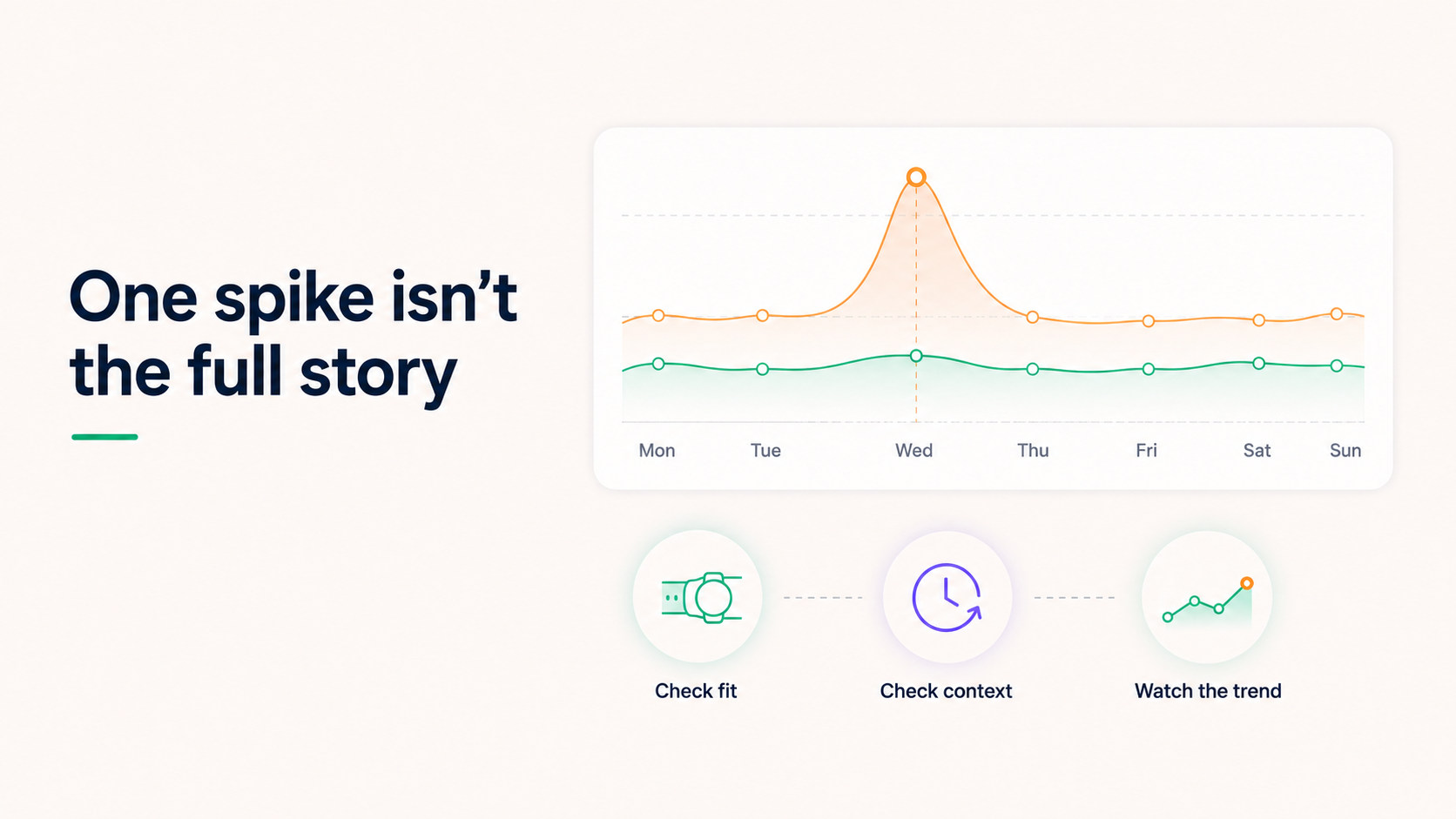
When a high stress score watch reading doesn't match how I feel, I work through the same short list before treating the number as meaningful.
- Check the fit and position of the device, and whether my hands were cold at the time.
- Look at what happened in the previous two hours: a meal, coffee, a hot room, a long stretch of sitting.
- Check last night's sleep duration, not just the sleep score.
- Check whether I trained hard in the previous 48 hours.
- Check when I last drank water.
- If none of those explain it, look at resting heart rate over the past week rather than at today's stress reading in isolation.
That last step carries the most information. A single elevated day tells you almost nothing, while a resting heart rate sitting three or four beats above normal for five days, with poor sleep and no obvious cause, is worth a conversation with a clinician.
Responding without letting the number run your day
The trap with any stress tracker is that a false alarm can create the thing it reported. You feel fine, the app says otherwise, you start scanning your body for evidence, and a few minutes later you have manufactured real tension. I have done it myself.
The way out is to treat the score as a prompt to look at your day, not as a verdict on it. If you check and find a plausible physical cause, log it mentally and carry on. If you check and find nothing, take two or three minutes of slow breathing with a longer exhale than inhale, which raises vagal activity in most people, and then get on with what you were doing. Either way the number gets a few minutes of your day and nothing more.
I also stopped opening the app before breakfast. Reading a number about your nervous system before you have had water, food, or daylight is a poor way to start a morning, and that reading is among the least reliable of the day. The data is more useful weekly than hourly.
HRV stress tracking works better once you accept what it does. It measures load on the body from every source at once and then reports all of it under one emotional label. Stop expecting it to know how you feel and it becomes a fair record of what your body has been handling.
Frequently asked questions
Can a stress score be wrong?
It can be inaccurate about your emotional state while still being accurate about your physiology. The sensor reading itself can also be wrong if the device was loose, sitting over the wrist bone, or on a cold arm. If the reading contradicts how you feel and you can point to a physical cause such as caffeine, a meal, heat, or short sleep, the number is probably right about your body and wrong about your mind.
Why does my stress score go up when I'm sleeping or resting?
Sleep is when the body does most of its recovery work, and that work is visible. A late or heavy meal, a warm bedroom, illness, or a hard training session earlier in the day will all raise overnight arousal. Position matters too, since lying on the arm wearing the device disturbs the sensor contact and produces artifacts that some algorithms interpret as arousal.
Should I do anything when my wearable says I'm stressed?
Check for a physical explanation first, because most of the time you will find one and no further action is needed. If nothing explains it, a few minutes of slow breathing is a reasonable response. Checking the number repeatedly through the day is not worth doing, since it tends to increase anxiety without changing anything. Watch multi-day patterns instead, and speak to a clinician if elevated readings persist alongside changes in your resting heart rate or sleep.
*This article is for informational purposes only and is not a substitute for professional medical advice, diagnosis or treatment.*