A raised CRP result cannot identify the source of inflammation
By Mr.Apps · Oct 26, 2026
Category:Energy

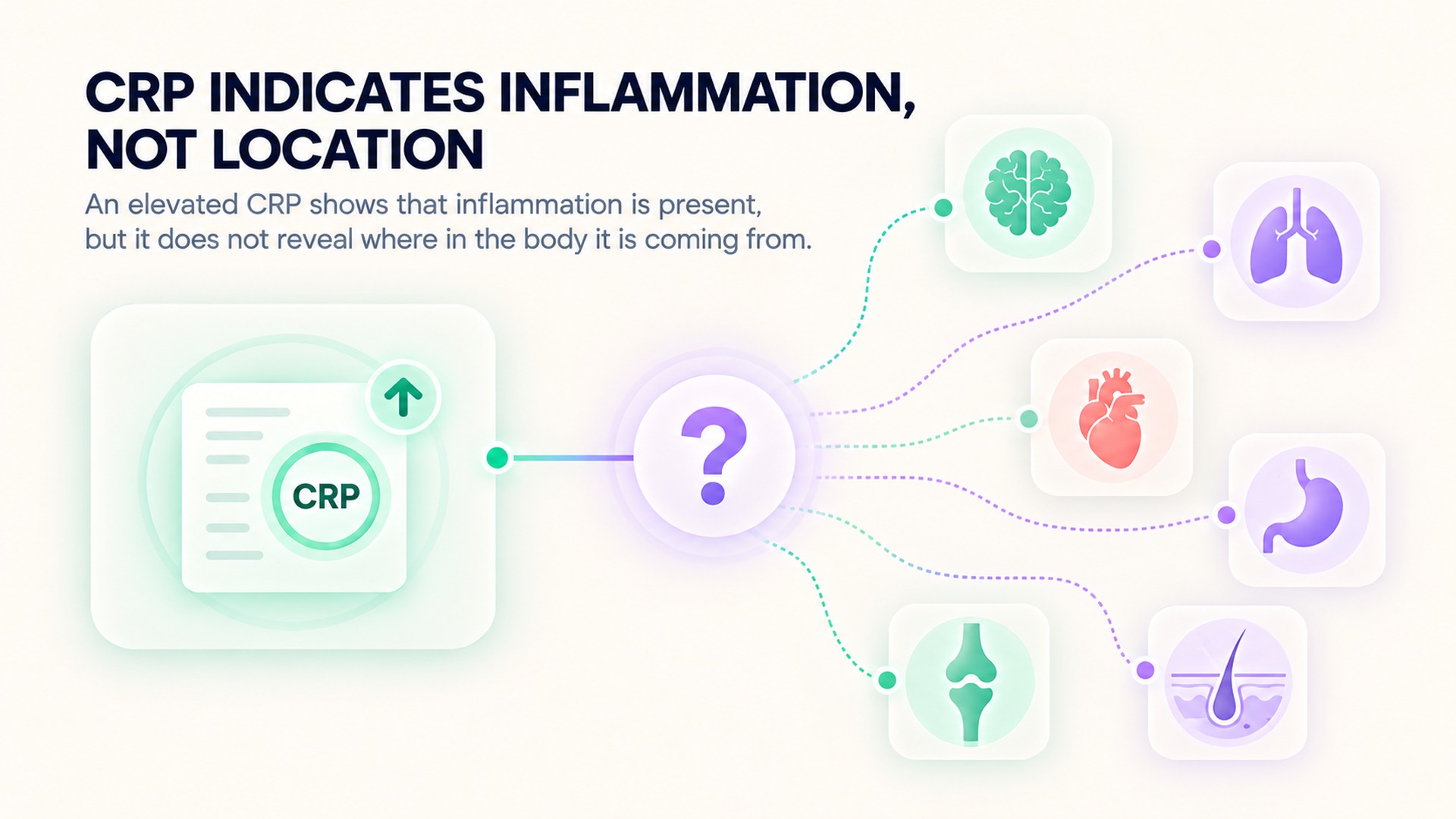
C-reactive protein (CRP) is a blood marker that can rise when inflammation is present. A raised result can tell a clinician that the body's inflammatory response may be active, but it cannot identify where the process is occurring or what caused it. Infection, inflammatory conditions, injury, and other circumstances can affect the value. The number is one clue in a larger assessment, not a location marker or a diagnosis.
This distinction becomes especially important when someone sees a result in an app or patient portal and tries to connect it to a recent workout, poor sleep, a meal, or a wearable score. The timing may be worth mentioning, but an association does not prove a cause. A clinician considers symptoms, the reason for testing, the degree and duration of change, other laboratory findings, medicines, and medical history. The purpose of this article is to clarify what CRP can and cannot say, including how a standard CRP test differs from a high-sensitivity test.
What a standard CRP test measures
CRP is produced in response to signals associated with inflammation. A standard CRP blood test measures how much of the protein is present in a sample. When the result is higher than expected, it can support the finding that inflammation is occurring somewhere in the body. The CRP test overview explains that the result cannot show the cause or location on its own and should be interpreted with symptoms, history, and other tests.
The test is useful because it can add information to a clinical picture and, in some situations, help follow an inflammatory process over time. It is not specific to one disease. A raised result does not tell whether the source is in a joint, lung, skin, bowel, or another system. It also cannot distinguish an infection from every noninfectious cause. More than one condition can produce a similar laboratory signal, so the next question is not “Which diagnosis does this number name?” but “What does this result mean with the findings in this particular case?”
A CRP value may be compared with a prior result, but the comparison is strongest when the same test type, units, laboratory method, and clinical circumstances are understood. A value collected during an acute illness is not directly equivalent to a later value obtained during a different clinical question. Record the test date, the displayed unit, the laboratory interval, and any comments on the report. The clinical explanation of CRP describes it as a general inflammation test rather than a test that pinpoints a cause.
Why a raised value is not a map
CRP is a systemic marker. It reflects a response in the body, not a tagged signal from a single organ. A clinician uses symptoms and examination to narrow the possibilities. If there is a fever, localized pain, a rash, shortness of breath, or another change, those observations may guide what should be considered next. The blood result can contribute, but the test itself does not supply those details.
The size of the result may matter, but it does not make the test specific. A higher value can still have multiple explanations. A low value also does not rule out every inflammatory condition or establish that no further evaluation is needed. Interpretation depends on the sensitivity of the method, when the sample was collected, and the clinical question. A number should not be converted into a severity label without knowing how the test is being used.
A nonspecific test can still be valuable when it is used to answer a focused question. It may help a care team assess whether an inflammatory signal is changing, compare findings over time, or decide whether more targeted evaluation is appropriate. Its usefulness comes from being interpreted with other evidence, not from naming a condition. A chart that preserves the exact assay, date, units, and accompanying symptoms helps retain that role. Removing those details and displaying only a red “high” badge can make the result appear more conclusive than it is.
The body can also respond to more than one process at once. An underlying condition, recent illness, medication, or injury could coincide with a new symptom. A recent exercise session might be part of the record, but it should not be used to dismiss an abnormal result automatically. The same caution applies to sleep disruption, stress, or a device estimate. Context helps a clinician decide what may be relevant; it does not let a person infer the cause from timing alone. A laboratory reference describing the high-sensitivity CRP assay distinguishes its cardiovascular risk use from the standard CRP assay used to assess inflammatory disorders. This distinction is about the test purpose, not about assigning a diagnosis to one reading.
Standard CRP and high-sensitivity CRP answer different questions
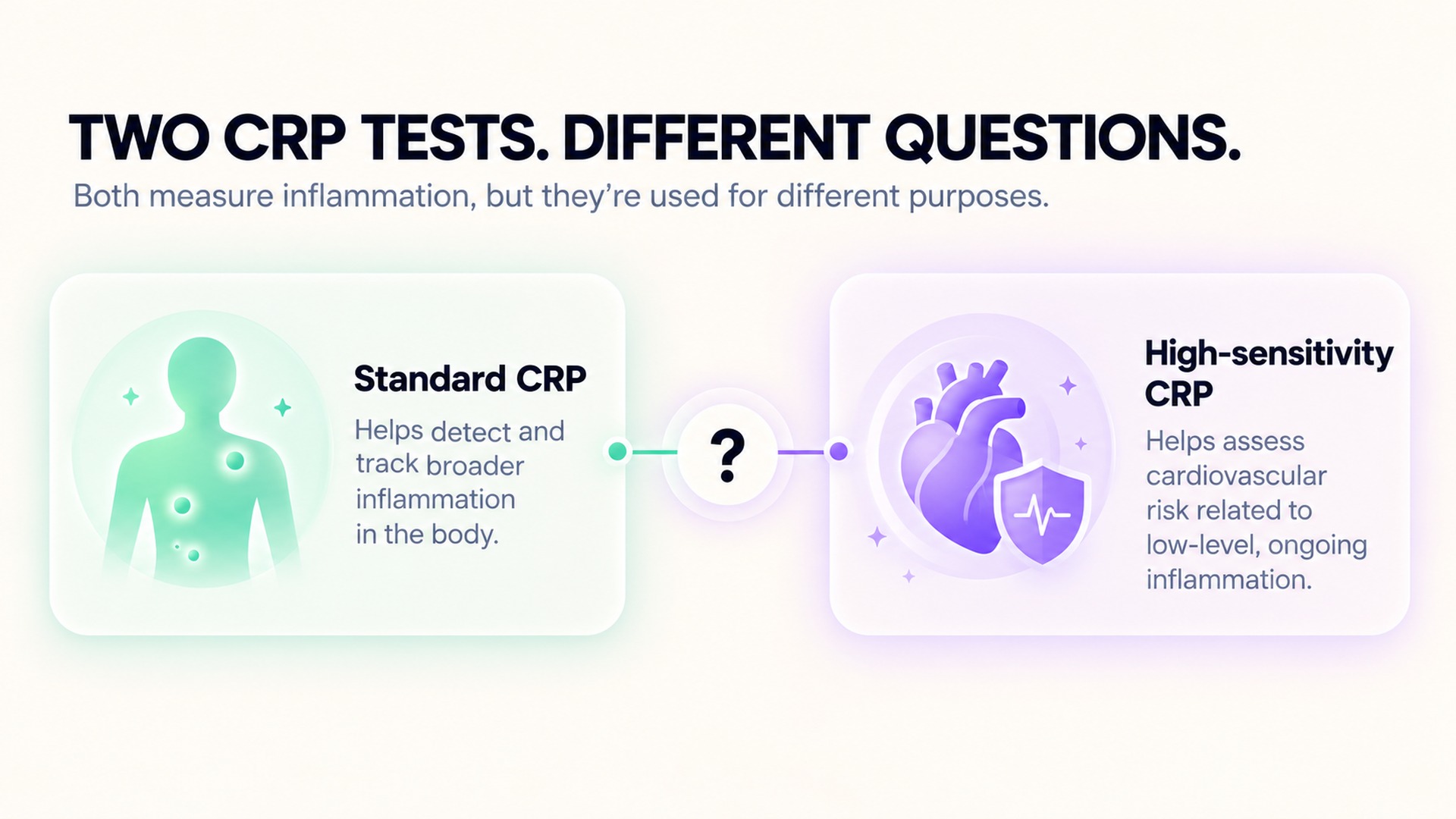
A standard CRP assay is generally used to evaluate inflammation or monitor a known inflammatory condition. A high-sensitivity CRP (hs-CRP) assay measures lower concentrations more precisely and may be used as one part of cardiovascular risk assessment in selected situations. Both tests measure the same protein, but they are designed for different clinical uses. The guide to understanding laboratory results explains why values should be read against the specific test and its reference interval.
An hs-CRP result is not a diagnosis of cardiovascular disease and is not a general-purpose measure of whole-body health. It is one possible risk marker considered with other factors. The primary prevention guideline describes hs-CRP as a risk-enhancing factor in selected people when measured. That does not make the test appropriate for everyone or mean that a single value determines treatment. The decision to use it depends on the broader risk discussion and clinical circumstances.
Because the purposes differ, check the exact test name on the report before comparing results. A standard CRP and an hs-CRP result may use different reporting ranges and clinical interpretations. If the report only says “CRP,” ask the ordering clinician which assay was used and what question it was meant to answer. Do not use an hs-CRP result to locate inflammation, and do not use a standard CRP value as a personalized cardiovascular forecast.
Put the result beside symptoms and timing
A useful record starts with the exact report. Keep the result, units, laboratory reference interval, date, and test name together. If there are multiple values, preserve each one instead of writing only “high” or “normal.” A simple timeline can show whether the test was collected before or after a symptom began, during an acute illness, after a medicine changed, or at a planned follow-up. That history can help a clinician judge whether a repeat test or additional evaluation is useful.
Describe symptoms in plain terms. Note where they occur, when they began, whether they persist, and what has changed. Avoid attaching a diagnosis to the description. For example, a note can say that a joint became swollen on a given day; it should not call the cause autoimmune unless a clinician has established that. The goal is to preserve observations that guide assessment, not to turn a marker into a self-made diagnosis.
Medicines and supplements can also be relevant to the testing plan. Give the care team an accurate list and ask whether any preparation instructions apply. Do not stop a prescribed medicine because a CRP result is elevated, and do not start an anti-inflammatory treatment based on the number alone. If a clinician has requested follow-up, confirm when the test should be repeated and whether the same assay should be used. Consistency makes trends easier to compare.

Keep app scores separate from laboratory interpretation
A wearable may record sleep, heart rate, activity, or other estimates. Those data can provide context about routine and timing, but they cannot measure CRP or identify inflammation. A lower recovery score after a hard session does not prove that exercise caused a raised result. A normal score does not establish that inflammation is absent. Each measure has a different purpose and level of evidence.
A broader discussion of why health app biomarkers need context is available in this overview of interpreting health measurements. For CRP, retain the laboratory report and ask the clinician what the result means in relation to the reason it was ordered. The value may help guide the next question, but it cannot answer that question by itself. A second clinical CRP test explanation likewise describes the marker as nonspecific and says that follow-up depends on the clinical picture.
Questions people ask
Does a raised CRP result identify an infection?
No. CRP may rise with inflammation from several causes. The result does not identify the source or establish an infection. A clinician interprets it with symptoms, examination, medical history, and other tests.
Is high-sensitivity CRP the same as a standard CRP test?
They measure the same protein but are used for different questions. A standard test is commonly used to assess inflammation, while a high-sensitivity assay can be used in selected cardiovascular risk discussions. Ask which test was ordered before comparing values.
Should an elevated CRP be explained by recent exercise?
Not automatically. Recent activity may be worth recording, but timing alone cannot prove the cause. Share the exercise date and symptoms with the clinician and follow the recommended evaluation.
*This article is for informational purposes only and is not a substitute for professional medical advice, diagnosis or treatment.*
Sources:
National Library of Medicine·National Library of Medicine·National Library of Medicine·American College of Cardiology and American Heart Association·Mayo Clinic Laboratories·Testing.com
Related articles

When a vitamin B12 result needs a methylmalonic acid check
Learn why a clinician may consider methylmalonic acid when a vitamin B12 result leaves a question unresolved. See how kidney function, symptoms, medicines, and other tests shape interpretation.

Reading TSH and free T4 together in a fatigue review
Learn what TSH and free T4 contribute to a fatigue review and why the two results need clinical context. See how symptoms, medicines, timing, and prior results help keep a lab value in its proper role.

Why Metabolic Energy Efficiency and Daily Energy Are Different Concepts
Metabolic energy efficiency describes processes involved in handling fuel, while a daily energy score is usually a separate app estimate about patterns such as sleep, activity, and recovery. Similar wording does not mean the two measures track the same thing.

Why a Monthly Metabolic Trend Cannot Explain One Meal
A monthly metabolic trend summarizes signals across a longer window and cannot identify what one meal did to glucose or insulin. Read it as a broad estimate, keep meal notes in their proper context, and use clinical testing for medical questions.

How Charging Gaps Break a 24-Hour Energy Timeline
Removing a wearable to charge creates a period when the device may not record the signals used by an energy model. A 24-hour timeline should mark that gap instead of treating it as neutral or connecting the surrounding values as continuous measurement.

How to Compare Energy Drain Across Days With Different Starting Scores
The ending value alone can hide how much an energy score changed during the day. Compare the start, decline, timing and data coverage on the same scale before interpreting differences between days.

Why Missing Hours Need to Be Visible on an Energy Timeline
Connecting two known points across an unmeasured interval can invent a smooth story about the day. An energy timeline should mark missing hours clearly so estimates, observations and unknown periods remain distinct.

How to Tell Recharge From Reduced Drain in an Energy Timeline
A flatter energy curve can mean that the model estimates slower decline, while a rising curve suggests modeled recharge. Check the timeline’s direction, update timing and inputs before deciding which interpretation fits the display.

Why a Full Morning Energy Score Can Fall Quickly
A high morning energy score is a starting estimate, not a guarantee that the rest of the day will decline slowly. The later curve depends on what the model tracks, which inputs arrive and how the score represents changing demand.

How to Read a Predicted Energy Peak That Never Arrives
A predicted energy peak is an estimate of timing, not a promise that the day will follow a script. When it fails to appear, check coverage, update timing and changed inputs before deciding what the miss means.