Why Evening Screens Can Leave You Wired but Tired
By Mr. Apps · Jul 10, 2026
Category:Sleep
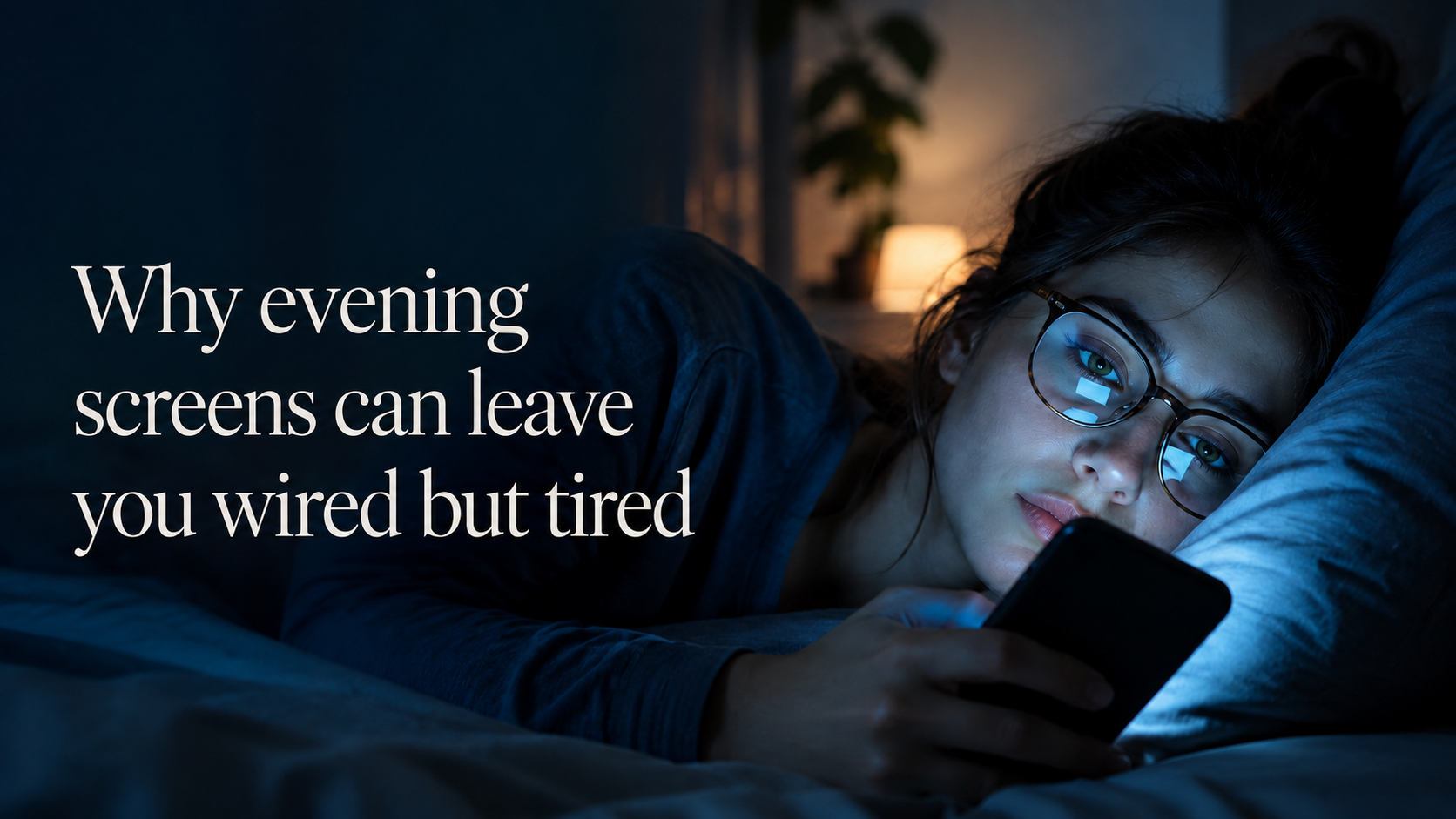
For years I repeated the same tidy thing about screens before bed. Blue light suppresses melatonin, melatonin is what makes you sleepy, so the phone is the problem. Turn on the warm filter, dim the display, and you have handled it. I believed it completely, and I passed it along to anyone who asked.
Then I started paying attention to my own nights, and the story fell apart.
I keep a small paper notebook on my bedside table, a habit I picked up in my twenties while learning to sleep on trains during long research trips. On nights when I read from a physical book by a warm lamp, I fell asleep quickly and woke feeling fine. On nights when I answered a couple of "quick" work emails from the same warm, filtered screen, I lay there with my heart going a little too fast, eyes closed, brain refusing to shut the door. Same light. Same warm tone. Completely different night. The filter was not the variable that mattered.
If you have ever put the phone down feeling exhausted and then found yourself staring at the ceiling, alert and irritated, this is for you. The "wired but tired" state is real, and blue light is a smaller part of it than most of us were led to believe.
Blue Light Versus Stimulation: What Actually Matters
Blue light does something. That part is not a myth. Short-wavelength light hits receptors in your eyes that feed straight into the clock in your brain, and under the right conditions it can push back the timing of melatonin. The catch is that phrase, "under the right conditions." Many of the alarming numbers came from labs where people stared at maximum-brightness screens for four or five hours in an otherwise dark room. That is not a person checking messages in bed for twenty minutes.
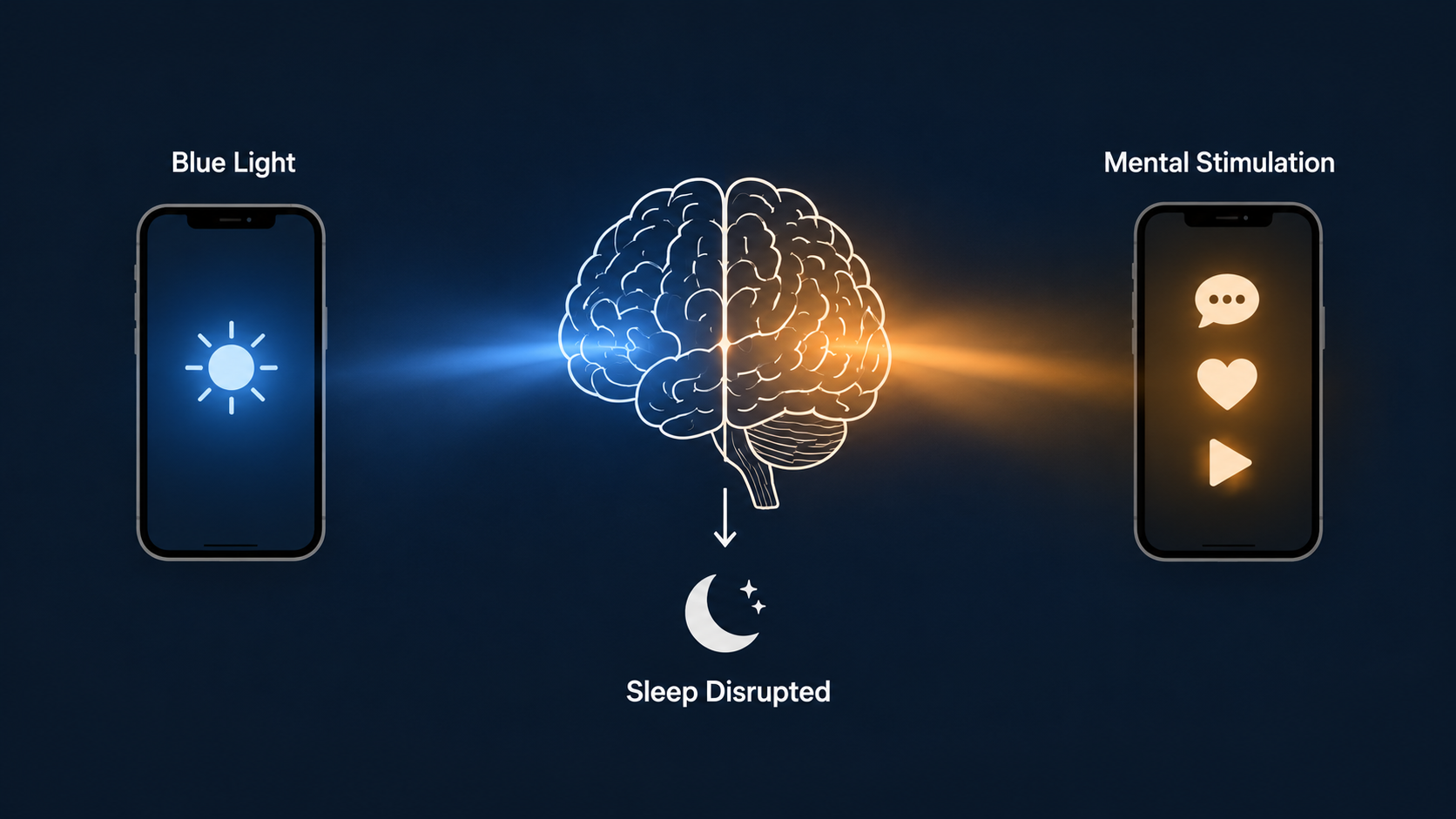
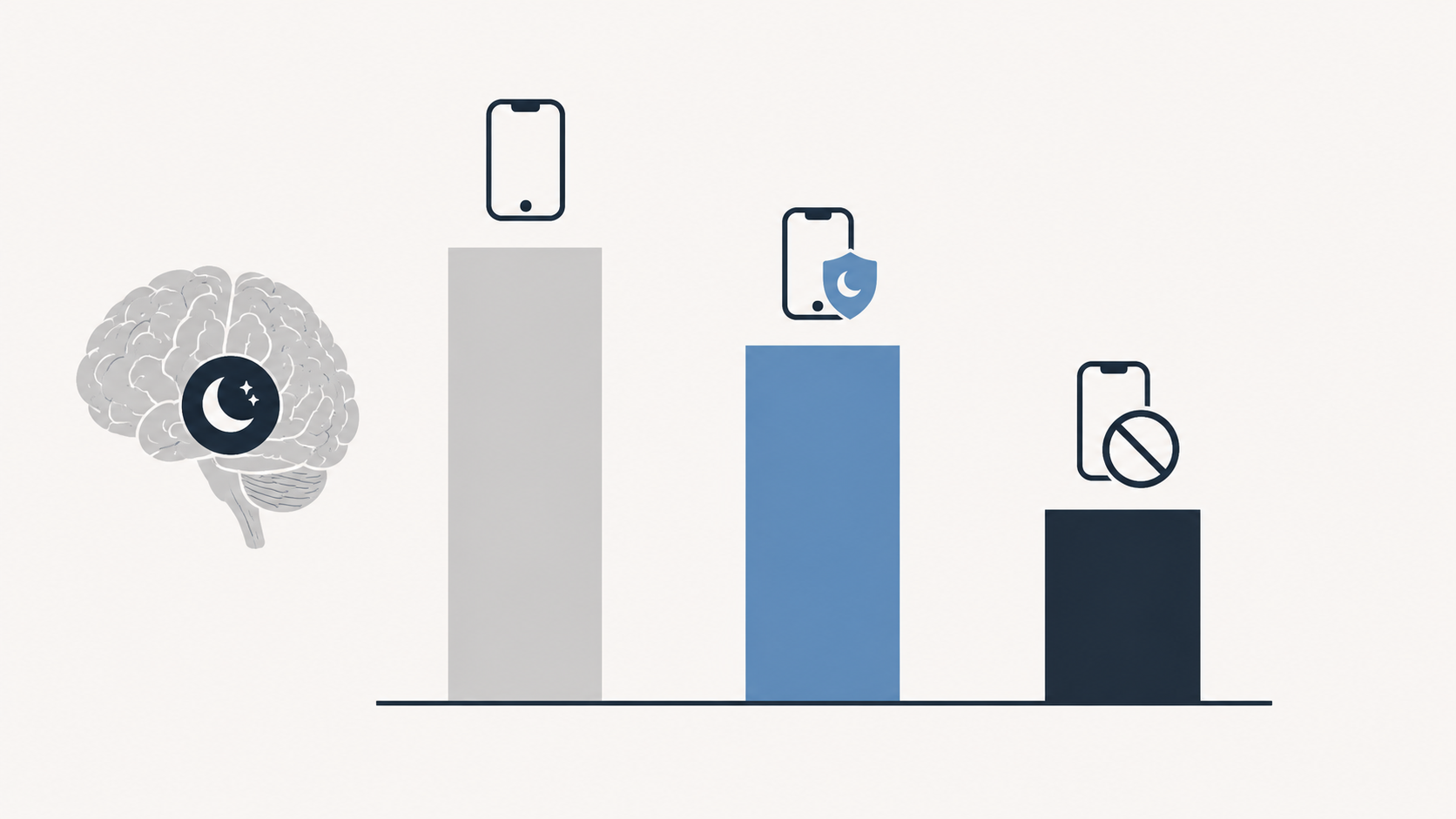
When researchers tested the fix everyone recommends, the results were awkward. One controlled experiment that compared phones with a night mode, phones without it, and no phone at all found the color-shifting made no measurable difference to sleep. The only group that slept slightly better used no phone before bed, and even that edge appeared only among people already getting decent sleep. The researchers made a point I have not been able to un-hear: screen light is only one slice of what a phone does to you. The texting, scrolling, and posting are stimulation of a different kind, and no filter touches them.
The melatonin picture has softened too. A review of a dozen studies found most showed no clear link between blue light and worse sleep, and one large sleep organisation concluded there was not enough evidence to say screen light before bed reliably impairs sleep. People also vary wildly. In one study, the most light-sensitive person needed forty times less light to suppress melatonin than the least sensitive person in the same room. The effect is real, but modest, uneven, and easily drowned out by everything else you do with the device.
None of this means light is irrelevant. Brightness counts more than colour. Work on melanopic irradiance, the measure of how strongly a screen stimulates those clock-connected receptors, shows the effect is dose-dependent: the brighter the light reaching your eyes, the more it delays sleep. That is why turning the display far down helps more than turning it orange. But if you dim the screen and still feel wired, the light was never the main culprit.
Why "I'm Tired but Not Sleepy" Happens
Here is the distinction that finally made my notebook make sense. Tired and sleepy are not the same thing. Tired is your body being depleted. Sleepy is your brain being ready to hand over control. You can be profoundly tired and nowhere near sleepy, and evening screens are very good at engineering exactly that split.
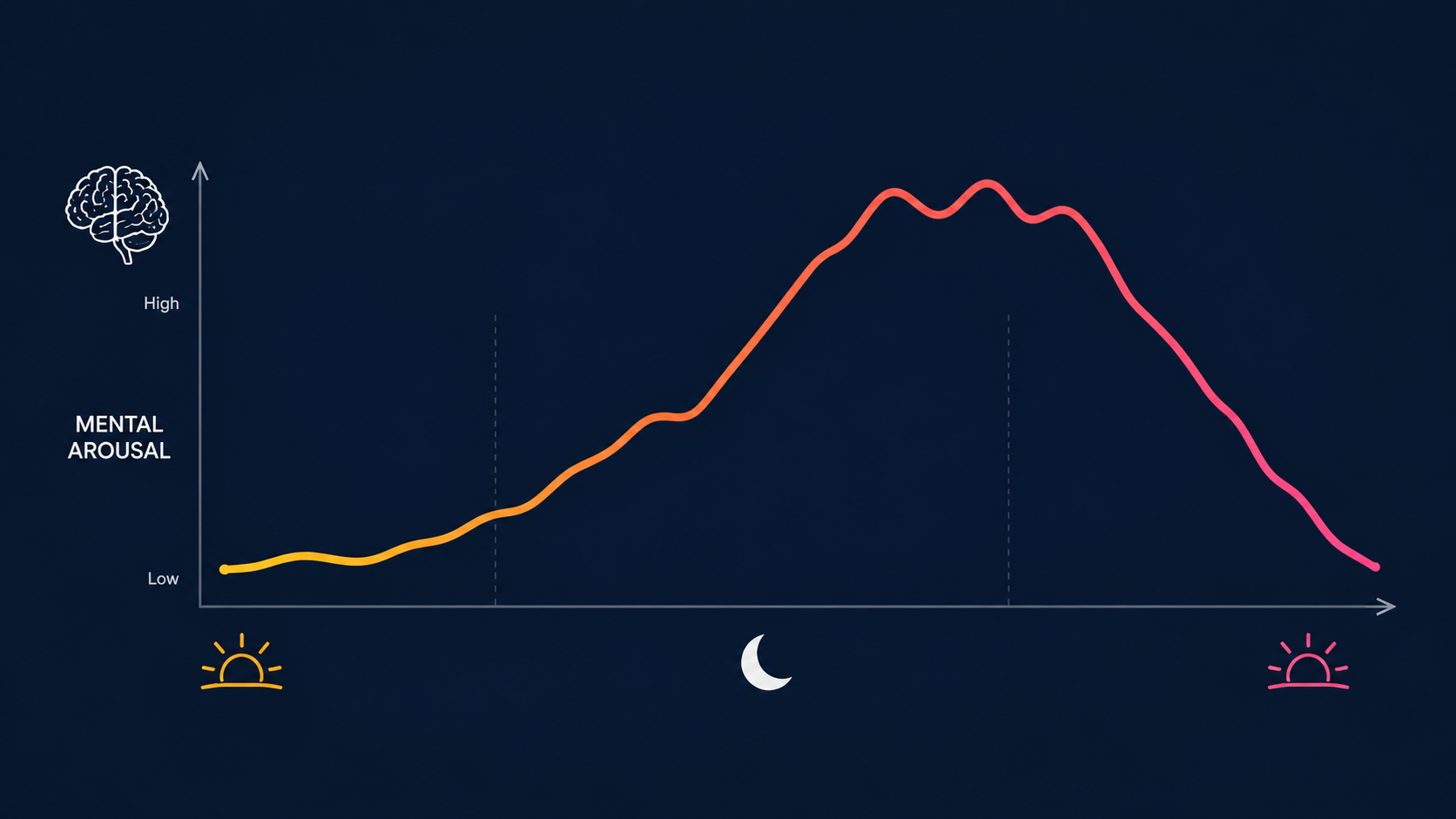
The mechanism has a clinical name: pre-sleep cognitive arousal. When you feed your brain emotionally charged material right before bed, whether distressing news, a heated comment thread, or a work message that lands like a small emergency, it stays in a heightened, processing state instead of powering down. The lights are off, your body is still, and your nervous system behaves as though something urgent is happening, because as far as it can tell, something just did.
Doomscrolling earns its reputation here, and not only because the content is grim. There is a self-feeding quality to it. You scroll to feel better, the material makes you feel worse, the worse feeling makes it harder to stop, and the loop keeps your arousal switched on. I once caught myself doing this for the better part of an hour after a conference where a talk had rattled me. I was not enjoying a second of it. I was managing anxiety by pouring more anxiety on top, then wondering why sleep would not come.
There is a quieter version that has nothing to do with fear. I have a stubborn habit of "just finishing" one more thing at night: a paragraph, a reply, a plan for tomorrow. That is not blue light either. That is bedtime procrastination, which researchers frame as a failure of self-regulation rather than a lack of tiredness. People who struggle to stop an evening activity go to bed later than they meant to, not because they are not sleepy, but because putting the device down takes a small act of will that gets harder as the night wears on. The phone is built to make stopping feel unnatural, and willpower is lowest exactly when you need it.
One detail genuinely surprised me. In a lab study, reading on a smartphone actually lowered people's sense of sleepiness even while it disturbed other sleep measures. So the device can make you feel less sleepy in the moment while quietly degrading the sleep you eventually get. That is the trap in one sentence. It masks the very signal you are waiting for.
Realistic Digital Cut-Offs That People Can Keep
I am not going to tell you to bin your phone at 8pm and read poetry by candlelight. I have given advice like that and watched people ignore it, correctly, because it does not fit a real life with real obligations. The goal is not purity. It is to protect the last stretch before sleep from the two things that do the damage: stimulation and lost time.
The rule I have kept for a couple of years is not about light at all. It is about content. In the last stretch before bed I allow the phone for genuinely low-arousal, finite tasks. Calm reading that ends. Never anything with a feed, because a feed has no bottom. Never work email, because work email is a machine for generating small emergencies at the worst possible time. The difference between three pages of a novel on a dim screen and an open messaging app is not the light. It is whether the thing can reach into tomorrow and grab you.
A few specifics that survived contact with reality:
Put a hard edge on the arousing stuff, not the device. I stop opening anything with a feed or an inbox about an hour before I want to be asleep. The phone itself can stay. The doomscrolling and late email get the curfew.
Move the charger. Mine lives across the room now, and that one change did more than any filter setting ever did. When picking up the phone means standing up, the "just one more" loop loses most of its power.
Dim aggressively. If you are going to use a screen, brightness is the lever that matters most, so turn it far below what feels normal. The warm filter is fine, it just is not doing the heavy lifting you were promised.
Give yourself a landing task. Part of why people scroll is that stopping leaves a vacuum, and a vacuum fills with tomorrow's worries. A boring, repeatable wind-down gives the brain somewhere to go that is not the feed.
Notice the difference between tired and sleepy, and act on the second one. If you are wired but not sleepy, more screen will not fix it and usually makes it worse.
I find it quietly encouraging that the field is starting to measure this properly. Recent work on estimating your circadian phase in near real time from a wearable, using light exposure and movement rather than a full clinical setup, hints at a future where a device could tell you when your own body is genuinely ready for sleep, instead of you guessing. That is a long way from a warm filter a marketing team promised would fix everything.
For now, the takeaway is simpler than the one I used to give. Screens before bed are not mainly a lighting problem. They are a stimulation problem and a stolen-time problem wearing a lighting problem's clothes. Treat the wired feeling as information. It is telling you your brain is still switched on, and no colour temperature will switch it off. What you put down matters far more than the light it was giving off.
My notebook, for what it is worth, agrees.
Frequently Asked Questions
Do blue light glasses or night mode actually help me sleep?
Only a little, and probably less than you have been told. Warm filters and blue-blocking glasses reduce the short-wavelength light reaching your eyes, but controlled studies of phone night modes found no meaningful improvement in sleep compared with using the phone normally. If you want a light lever that works, brightness matters more than colour, so dim the display hard. The bigger issue is usually what you are doing on the screen, not the wavelength coming off it.
Why do I feel exhausted but can't fall asleep after using my phone?
That is the difference between being tired and being sleepy. Emotionally engaging content, from distressing news to a stressful work message, triggers pre-sleep cognitive arousal, which keeps your brain active even after the lights go out. Your body is depleted, but your nervous system has not stood down. Scrolling can even lower your sense of sleepiness in the moment while still worsening the sleep you get, which is why you can feel wired and wrecked at once.
What's a realistic screen cut-off if I can't give up my phone at night?
Target the content, not the device. Stop opening anything with a feed or a work inbox about an hour before bed, since those spike arousal and quietly steal the time you meant to spend asleep. Calm, finite reading on a dimmed screen is far less disruptive than a bottomless feed. Moving your charger across the room helps more than most people expect, because it raises the small effort needed to reach for the phone at the moment your self-control is weakest.
*This article is for informational purposes only and is not a substitute for professional medical advice, diagnosis or treatment.*
Sources:
New Atlas·Advisory Board·Nature (Communications Biology)·Sleep.com·Frontiers in Psychology·PMC
Related articles
Your Bedroom May Be Too Warm for Good Recovery
For two summers, I lived in a bedroom that never quite cooled down after dark, and a heart rate tracker I was wearing for something else entirely showed me exactly what that was costing me overnight. It turns out a warm room doesn't just make sleep less pleasant. It measurably raises heart rate, lowers heart rate variability, and cuts into the recovery your body is supposed to get while you're asleep. Here's what the research says about why, who's most affected, and the small changes that actually help.
Why a regular sleep schedule may matter more than an extra hour in bed
Why Am I Still Tired After 8 Hours of Sleep?
You slept 8 hours and still feel wrecked? Here's why sleep quality beats duration, what a dropping sleep score really means, and how to wake up with energy.