Why a regular sleep schedule may matter more than an extra hour in bed
By Mr.Apps · Jul 1, 2026
Category:Sleep

Sleep consistency, social jetlag, and why an irregular sleep schedule can leave you feeling off even when you technically got enough sleep.
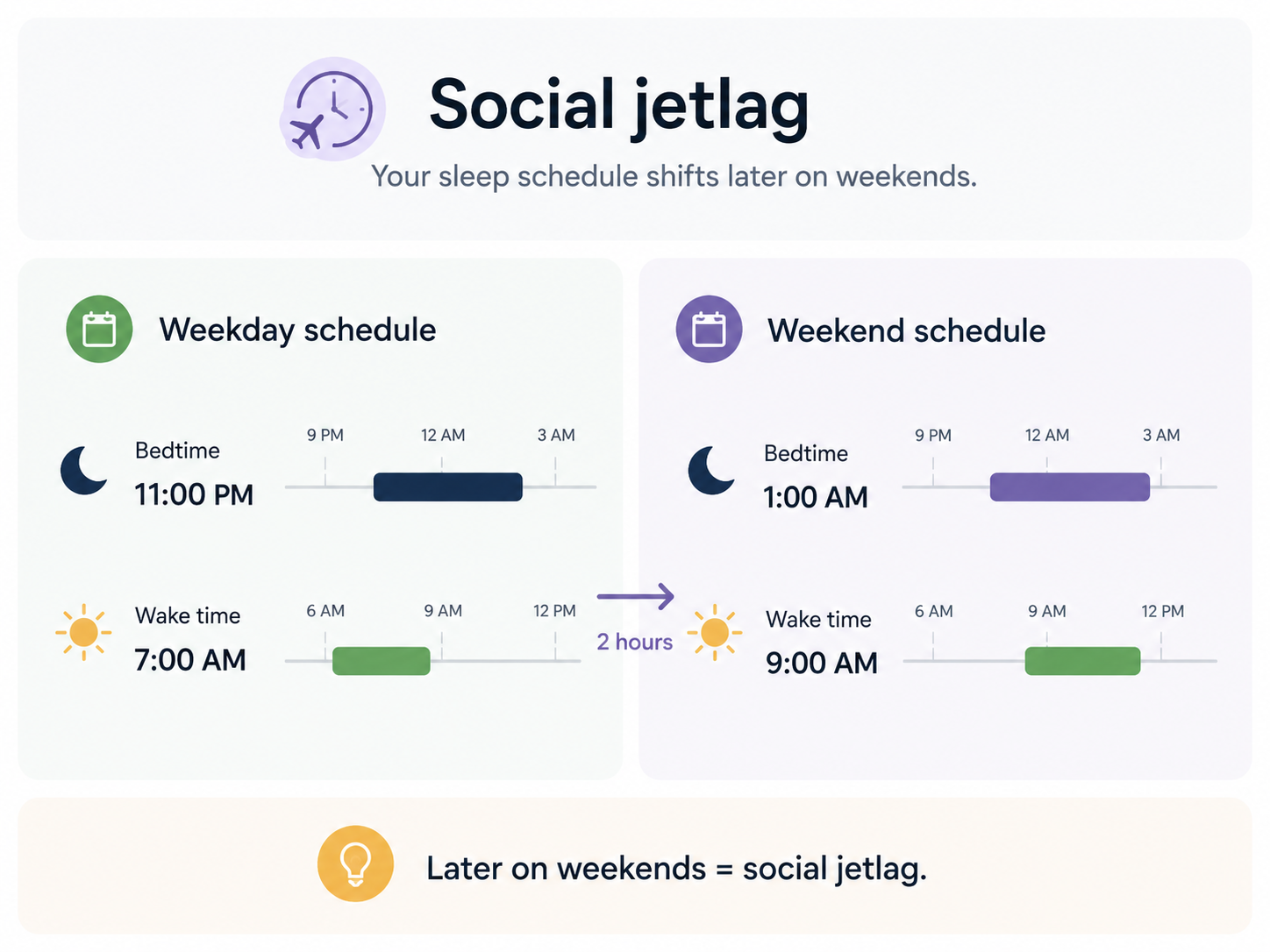
The first time I really noticed this pattern, it did not feel like sleep deprivation. It felt stranger than that. There had been a decent amount of sleep on paper, but Monday still felt like walking through glue. The weekend had included sleeping later, going to bed later, and generally “catching up.” It looked harmless. It even looked healthy. But the body clearly had a different opinion.
That is the basic problem this article is about.
A lot of people think sleep is mostly about total hours. Get seven or eight, and the job is done. But CDC guidance on sleep makes it clear that healthy sleep is not only about quantity. It is also about quality and habits. And the American Heart Association’s 2025 scientific statement on multidimensional sleep health goes even further: consistent bedtime and regularity are part of healthy sleep too.
That matters because many tired people are not simply underslept. They are inconsistent.
One common example is the classic weekday-weekend swing: up at 6:45 on workdays, asleep by 11:00, then suddenly asleep at 1:30 on Friday and Saturday and waking at 9:30 or 10:00. It feels like recovery. In practice, it can act a lot like mild jet lag.
That pattern has a name: social jetlag.
What social jetlag actually means
Social jetlag sounds technical, but the idea is simple. It is the gap between your body’s usual rhythm and the schedule you keep because work, school, parenting, commuting, or social life pushes you around.
In plain language, social jetlag happens when your sleep timing on free days is very different from your sleep timing on workdays.
It is not the same as getting on a plane. But it can feel similar. The body likes rhythm. When bedtime and wake time keep moving back and forth, the internal clock has to keep adjusting. That can leave people feeling foggy, flat, irritable, or oddly tired, even when the total number of hours across the week looks okay.
This is why sleep consistency matters so much.
A person can sleep 6.5 hours during the week, 9 hours on Saturday, 9 hours on Sunday, average it all out, and still feel rough. The average might look fine. The rhythm does not.
That is an important distinction because so much of sleep advice still gets reduced to “just sleep more.” More sleep can help, obviously. But if the schedule is swinging wildly, the body may still feel out of sync.
And there is a growing reason to take that seriously. Research summarized in the American Heart Association statement suggests sleep health includes timing and regularity, not just duration. In other words, sleep timing is not a side detail. It is part of the main story.
Why an irregular sleep schedule can make you feel worse than you expect
This is the part many people miss.
An irregular sleep schedule can make you feel as if something is wrong with your motivation, your mood, or your recovery, when the real issue is simply that the body never knows when “night” really starts.
That can show up as:
- morning grogginess even after enough hours in bed
- a sluggish or anxious feeling on Mondays
- bigger afternoon crashes
- inconsistent workout recovery
- worse focus
- worse mood
- feeling tired at the wrong times and awake at the wrong times
The CDC’s sleep guidance notes that good sleep supports mood, attention, memory, heart health, and metabolism. So when the sleep pattern is irregular, it makes sense that energy, mood, and performance start to feel unreliable too.
There is also longer-term evidence that irregular sleep is not just annoying but potentially important for health. In a large UK Biobank study published in the Journal of the American Heart Association, greater night-to-night variation in sleep duration was linked with higher risk of future cardiovascular disease. Another JAHA study from the MESA cohort found that irregular sleep duration and irregular sleep timing were associated with markers of subclinical atherosclerosis, including coronary artery calcium and carotid plaque.
That does not mean one late Saturday will wreck your arteries. It does mean sleep regularity is probably more meaningful than many people assume.
Why your wake time matters as much as bedtime
If there is one anchor that tends to matter most, it is usually wake time.
That is the part many people resist, because sleeping in feels like the reward. But from a body-clock perspective, the wake time is often what sets the rhythm for the rest of the day. Light exposure, appetite, alertness, and sleep pressure all key off that morning start.
This is why same wake time is such a useful concept.
The American Academy of Sleep Medicine’s healthy sleep habits guidance says to get up at the same time every day, even on weekends or during vacations. That advice sounds boring, but it is incredibly practical. If wake time drifts by two or three hours every weekend, bedtime usually drifts too, and then Sunday night becomes a fight.
People often focus only on bedtime because it feels more “sleep related.” But bedtime is partly a consequence of when the body got up, how much light it got in the morning, how active the day was, and how much sleep pressure built by evening.
So if someone wants to improve sleep timing without obsessing over every minute, the cleanest place to start is usually not “force the perfect bedtime.” It is “pick a wake time you can defend most days.”
That does not have to mean military-level rigidity. It usually means keeping wake-up time within a reasonable window, roughly 30 to 60 minutes when possible.
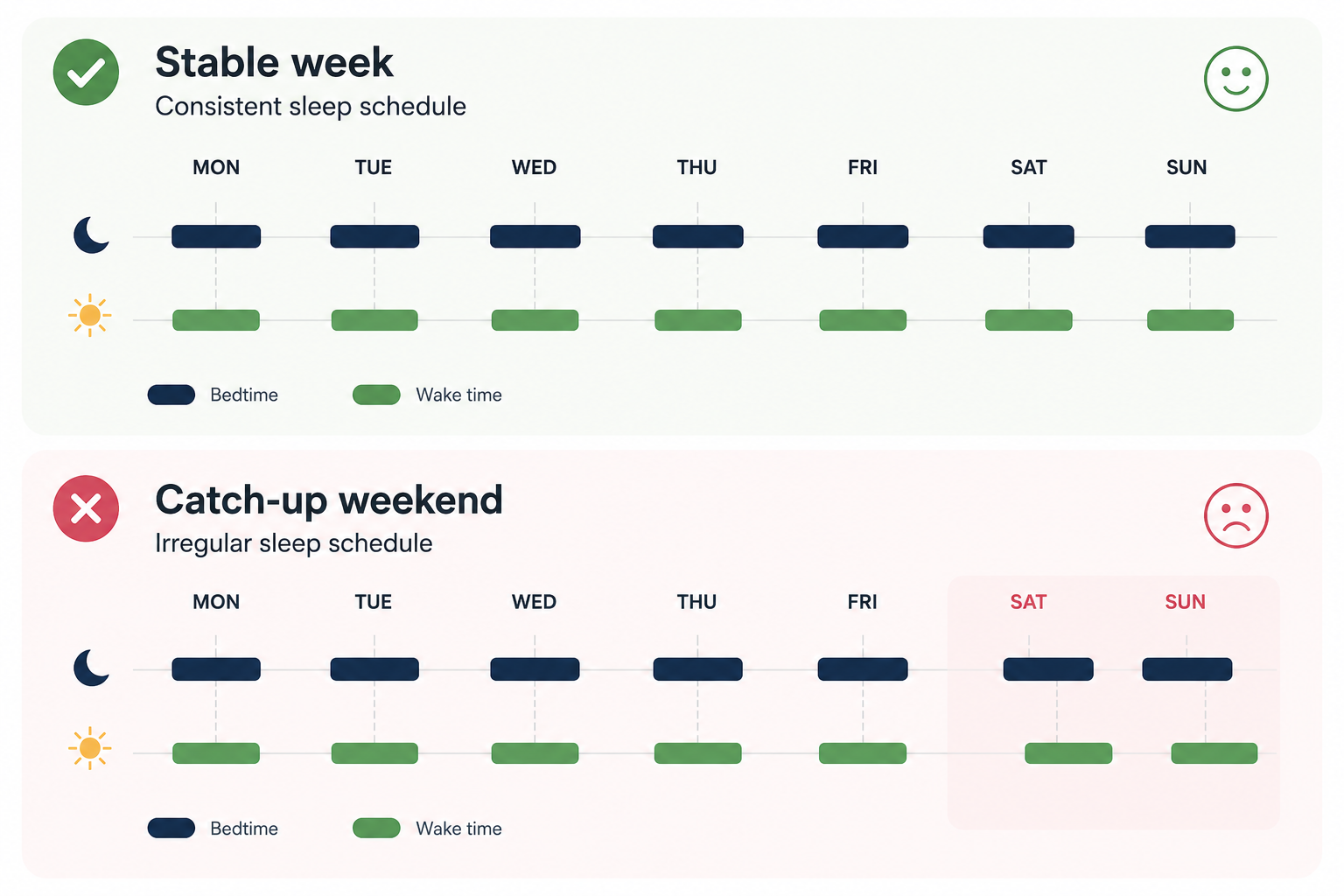
Stable week vs catch-up weekend: what actually happens
Imagine two people.
Stable week
- Monday to Friday: asleep around 11:15 PM, up around 7:00 AM
- Saturday and Sunday: asleep around 11:45 PM, up around 7:45 AM
This is not perfect sameness, but it is close enough that the body clock stays fairly steady.
Catch-up weekend
- Monday to Friday: asleep at 11:00 PM, up at 6:30 AM
- Friday and Saturday: asleep at 1:30 AM, up at 9:30 AM
- Sunday night: trying to sleep at 10:45 PM again
That second pattern is common. It also tends to create the Sunday-night problem: not sleepy when you need to sleep, then groggy when Monday arrives.
This is where the phrase social jetlag becomes useful. The body has effectively been nudged into one time zone for the weekend and then told to come back immediately for the workweek.
And even if the person technically got “more” sleep on the weekend, the irregularity itself may still leave them feeling off.
Why this matters for mood, energy, and recovery
People usually notice the short-term consequences first.
Energy feels less predictable. Mood gets thinner. Recovery from stress or training feels slower. Focus slips. Small frustrations feel bigger than they should.
There is also some evidence that variability in sleep may relate to brain health and cognition. In a 2023 paper in Brain Communications, less variability in sleep duration and sleep efficiency was associated with lower beta-amyloid burden and better cognition. That study was in older adults with early mild cognitive impairment, so it should not be overstated. But it does support the broader point that night-to-night consistency may matter in ways people do not fully see in the mirror on Monday morning.
For everyday life, the takeaway is simpler: if energy, mood, and recovery feel weirdly unstable, do not just ask “am I sleeping enough?” Also ask “am I sleeping at roughly the same times?”
That question catches more problems than people expect.
How to tighten your weekly routine without becoming rigid
This is where most advice becomes unrealistic, so it helps to keep it practical.
The goal is not to become a sleep monk. The goal is to reduce the size of the swings.
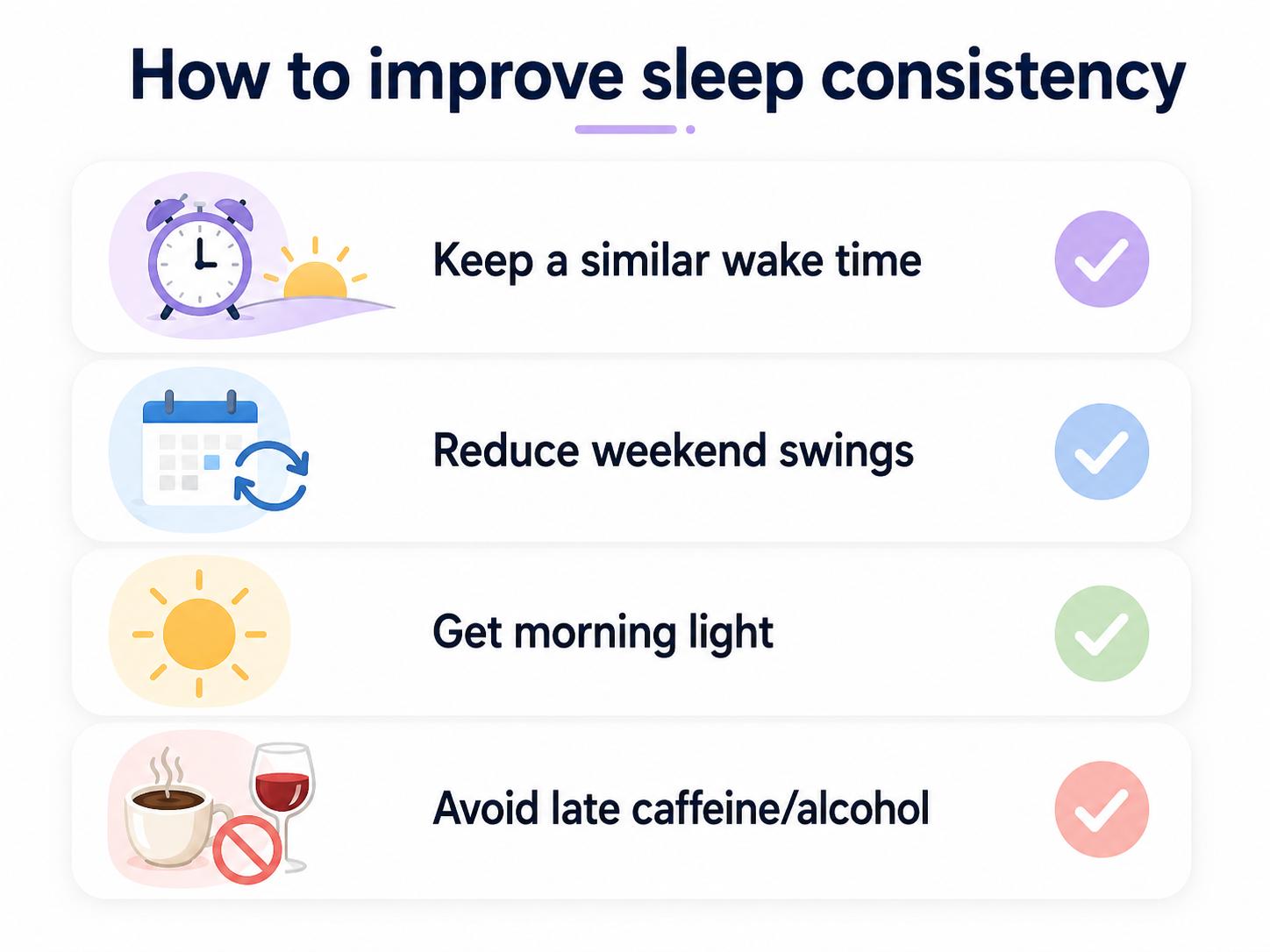
1. Protect wake time first
If only one thing gets stabilized, make it the wake time. Try to keep it within about an hour across the week. This single habit often improves sleep consistency more than obsessing over bedtime.
2. Reduce the weekend gap
If weekdays start at 6:45, waking at 10:15 on Saturday is a big jump. Pulling that back even to 8:00 or 8:30 can make a noticeable difference. It still feels like extra rest, just without the full schedule whiplash.
3. Let bedtime follow naturally
Instead of forcing sleep, create conditions that make it easier: dimmer light, less scrolling, a calmer wind-down, less caffeine late in the day, and less alcohol close to bed. The CDC specifically recommends habits like avoiding caffeine in the afternoon or evening and avoiding alcohol before bed.
4. Use morning light as a tool
Getting outside or at least into bright light soon after waking helps reinforce the body clock. It is one of the simplest ways to support better sleep timing.
5. Do not rely on “catch-up sleep” as a full solution
Weekend recovery sleep can feel helpful, and sometimes it is. But the sleep regularity consensus statement makes the broader point that daily regularity matters for health and performance. Catch-up sleep is not a magic eraser for a chaotic weekly routine.
6. Aim for better, not perfect
A 30- to 60-minute difference is very different from a 2- to 4-hour difference. The goal is progress, not perfection. Parents, shift workers, students, and hybrid workers do not need idealized advice. They need something workable.
What a better routine can actually look like
A realistic version might be this:
- Weekdays: bed around 11:00 PM, wake around 7:00 AM
- Saturday: bed around midnight, wake around 8:00 AM
- Sunday: bed around 11:15 PM, wake around 7:30 or 8:00 AM
That is still real life. It still leaves room for dinner out, family life, or a late film. But it avoids the huge swing that makes Monday feel like punishment.
For students, parents, and hybrid workers, the same principle applies. A flexible life does not need a chaotic sleep schedule. Even a modest amount of structure can make the whole week feel easier.
When irregular sleep is worth paying more attention to
Sometimes the problem is just routine. Sometimes it is more than that.
It is worth talking to a healthcare professional if sleep is consistently poor, if fatigue feels extreme, if there is heavy snoring or choking at night, if insomnia keeps repeating, or if mood and concentration are suffering despite trying to improve the basics.
The CDC notes that people who regularly have problems sleeping should speak with a healthcare provider, and that sleep disorders like insomnia or sleep apnea may need proper evaluation.
Final take
A lot of people assume they need more sleep when what they really need is steadier sleep.
That is why a regular sleep schedule may matter more than an extra hour in bed.
If the body is constantly being pushed between one timetable during the week and another on the weekend, it can leave people feeling tired, moody, foggy, and off, even when the total hours look respectable. That is the trap of social jetlag. It hides inside an otherwise normal-looking life.
The most useful fix is not perfection. It is rhythm.
Keep the weekly swing smaller. Protect the morning anchor. Respect sleep timing, not just sleep duration. For a surprising number of people, that alone is enough to make energy feel more stable again.
FAQ
What is social jetlag in simple terms?
Social jetlag is the mismatch between your workday sleep schedule and your free-day sleep schedule. In plain language, it usually means going to bed and waking up much later on weekends than during the week.
Is sleep consistency really that important?
Yes. Research and professional guidance increasingly suggest that healthy sleep includes regularity, not just total hours.
Why does same wake time matter?
Wake time helps anchor your internal clock. When wake time shifts a lot, bedtime and sleep quality often shift too.
Can I still sleep in a little on weekends?
Usually yes. The bigger issue is not sleeping a little later. It is turning the weekend into a totally different time zone.
What is considered an irregular sleep schedule?
There is no single everyday cut-off, but a repeated 2- to 4-hour shift in bedtime or wake time between weekdays and weekends is a common real-world example.
*This article is for informational purposes only and is not a substitute for professional medical advice, diagnosis or treatment.*
Sources:
CDC·American Heart Association·UK Biobank·MESA study·Brain Communications·American Academy of Sleep Medicine·Sleep Health
Related articles
Evening Stress and Why Your Brain Won't Settle Down Before Sleep!
Falling asleep fast isn't the same as your brain settling down. What evening stress does to your sleep onset, and how to wind down when your mind won't.
The morning light habit that can improve sleep without changing your bedtime
Most sleep advice focuses on the evening, dim the lights, put the phone away, but that's only half the equation. A few minutes of daylight soon after waking helps set your body clock earlier, making it easier to fall asleep at a reasonable hour that night, no bedtime changes required. Here's why it works, what actually counts as "morning light" in a real schedule, and when the habit alone isn't enough.

Why Am I Still Tired After 8 Hours of Sleep?
You slept 8 hours and still feel wrecked? Here's why sleep quality beats duration, what a dropping sleep score really means, and how to wake up with energy.

How to protect your sleep when your job keeps changing the clock
Shift work doesn't fail because people lack discipline. It fails because the body was never built to run a factory schedule. Here's what actually helps between rotating shifts, why "just going to bed earlier" doesn't work, and when persistent fatigue stops being normal and starts being something worth getting checked out.
When "poor sleep" may be more than stress: red flags for sleep apnoea
Loud snoring gets dismissed as a quirk, morning headaches get blamed on stress, and daytime fog gets chalked up to a heavy calendar. Taken together, though, these signs can point to something a GP should know about: obstructive sleep apnoea. Here's what the real red flags look like, what home screening tools can and can't tell you, and when it's time to ask for a proper referral.
Why Evening Screens Can Leave You Wired but Tired
We're told blue light is why screens ruin our sleep, so we dim the display and turn on the warm filter. But if you've ever put the phone down exhausted and then lay there wide awake, the light was never the real problem. Here's what is.

Your Bedroom May Be Too Warm for Good Recovery
For two summers, I lived in a bedroom that never quite cooled down after dark, and a heart rate tracker I was wearing for something else entirely showed me exactly what that was costing me overnight. It turns out a warm room doesn't just make sleep less pleasant. It measurably raises heart rate, lowers heart rate variability, and cuts into the recovery your body is supposed to get while you're asleep. Here's what the research says about why, who's most affected, and the small changes that actually help.