Remembering a dream does not measure how much REM sleep occurred
By Mr.Apps · Oct 19, 2026
Category:Sleep
Waking with a vivid dream does not tell you how long you spent in rapid eye movement sleep. Dream recall is a memory report made after waking. REM duration is a sleep-stage estimate based on signals recorded during sleep. Those two things can be related in some research settings, but one remembered dream cannot calculate a stage total or confirm a wearable’s graph.
I would record memory as a recollection and the stage estimate as a device output, because they are different kinds of observations. The same caution applies when no dream comes to mind. Forgetting a dream does not prove that REM sleep was absent. A person may wake without a clear memory, remember only a fragment, or recall a dream after a different stage. If an app treats “remembered a dream” as evidence of more REM, it has gone beyond what the journal entry can establish.
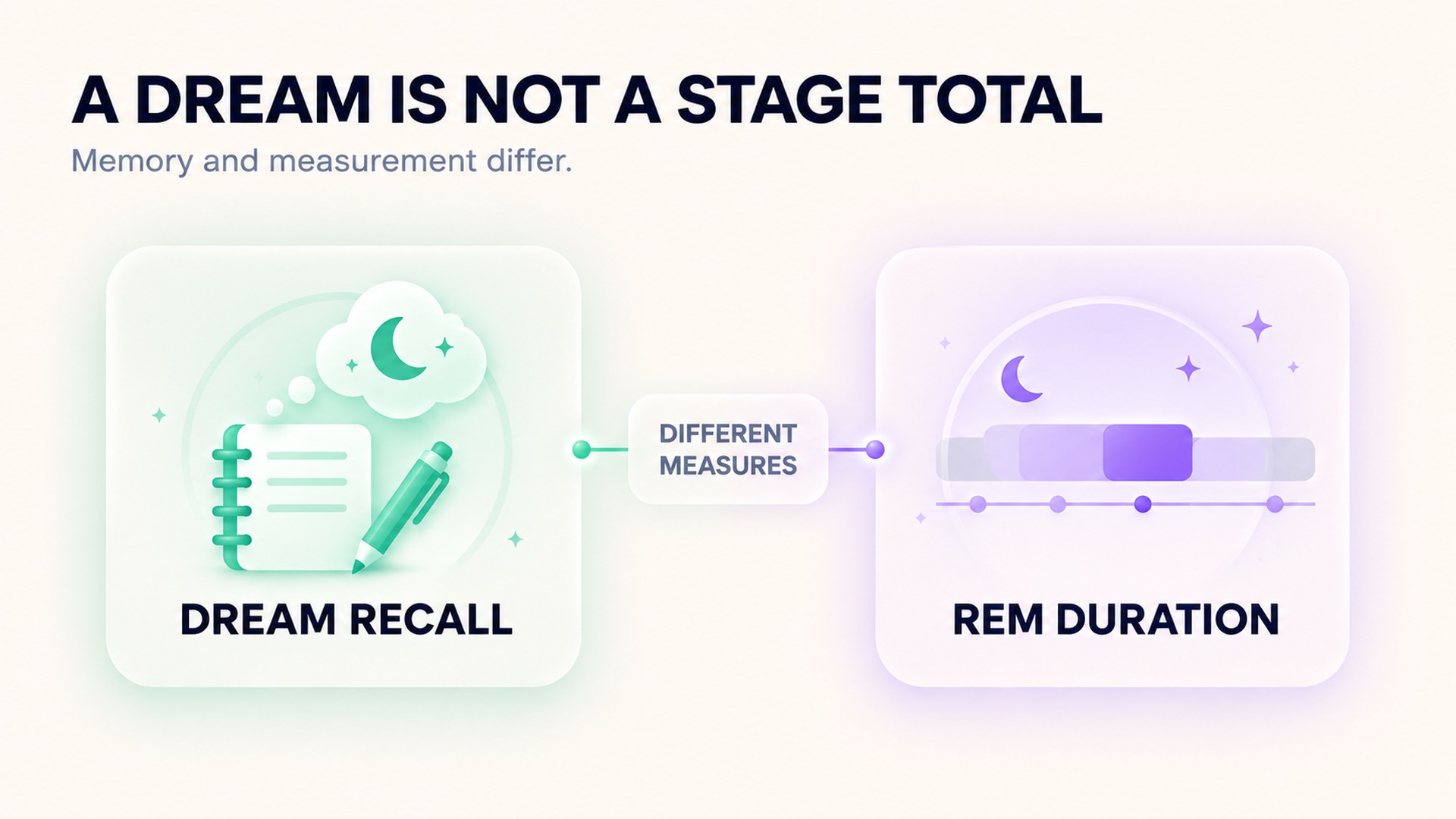
Dream experience and dream memory are different events
A dream can occur during sleep without being retained as a detailed memory after waking. The recollection depends on what was experienced, whether an awakening occurred, how close waking was to the experience, and what remained accessible by the time the person recorded it. Memory can fade or become mixed with thoughts formed after waking. A morning note is useful as a record of what the person remembers, not as a direct sensor reading of the brain during the night.
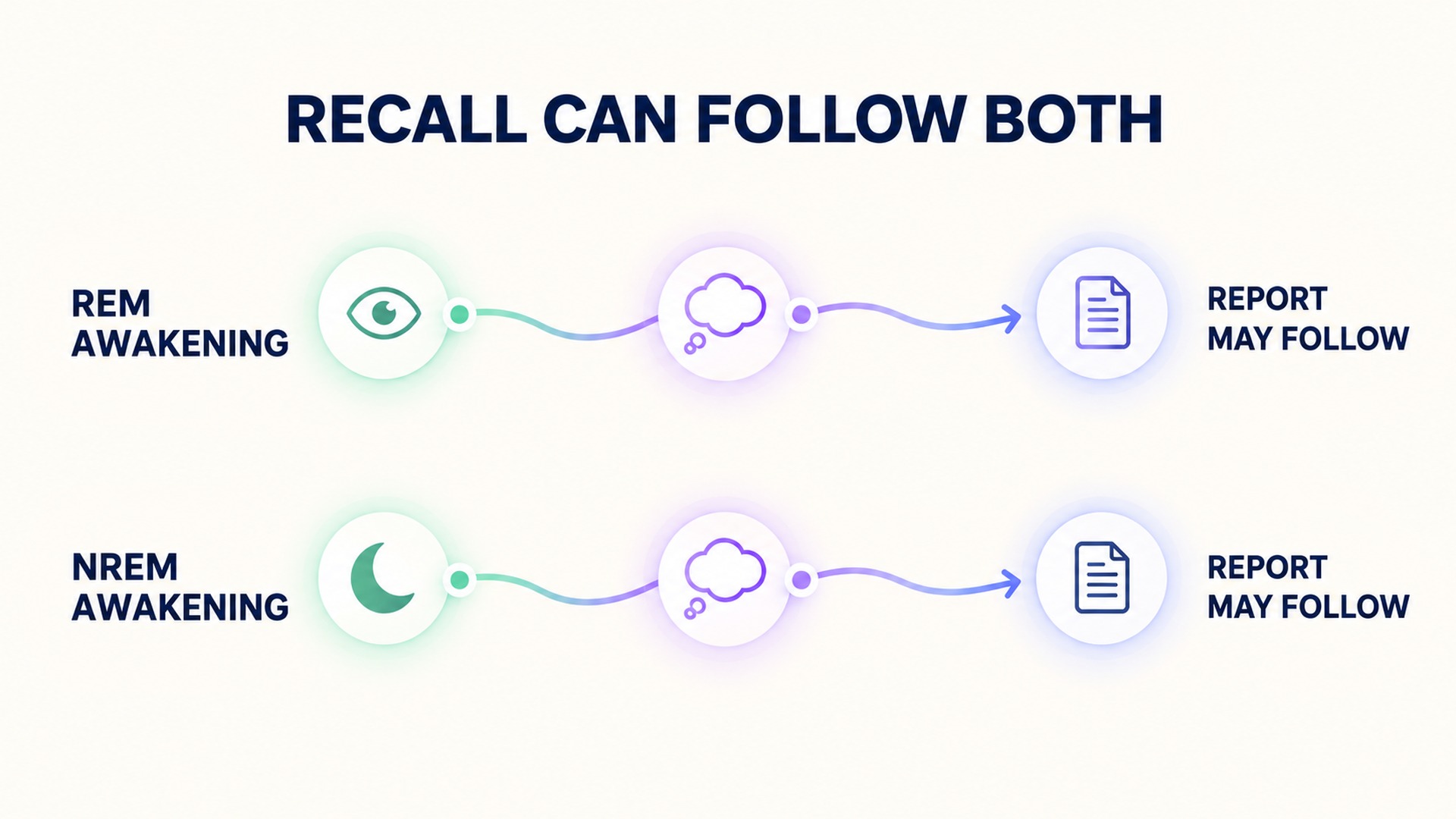
Dream recall is often more likely after awakenings from REM sleep in laboratory studies. That association does not make every recalled dream a REM marker. Researchers also collect dream reports after awakenings from non-REM sleep. A polysomnography study of dream reports across sleep stages found reports after awakenings from both REM and non-REM sleep. The study used planned or natural awakenings and asked people to report mental activity just before waking. That differs from relying on a single spontaneous morning recollection at home.
Other lab research has examined recall after waking from non-REM sleep. A study of older adults after non-REM awakenings shows why a dream report is not exclusive to REM. A separate study of dream recall following REM and stage-two non-REM sleep examined brain activity associated with whether participants later recalled a dream. These studies concern controlled recordings and recall reports. They do not provide a formula for estimating an individual’s nightly REM minutes from a diary entry.
A review of sleep-awakening studies and dream recall notes that recall varies with the way a person is awakened, the sleep environment, and other study conditions. That evidence helps explain why a recall rate from a laboratory protocol cannot be copied directly into a personal tracker. A morning journal uses a different procedure and samples a different moment. It can preserve an experience, but it cannot measure the stage totals that preceded it.
The act of remembering can also be selective. A fragment may be clear while its timing is uncertain. A person might recall a scene but not know whether it happened before a brief awakening or near the end of the night. A tracker may label the surrounding interval as REM, but the dream recollection alone cannot verify that label. To assess sleep stages, researchers use recorded physiological signals and scoring rules; a narrative does not substitute for those data.
Why one memorable dream is not a stage total
A sleep stage is a category assigned across recorded epochs using the signals available to the scorer or algorithm. A stage total adds together intervals that meet a scoring rule during the recording. It does not count remembered stories. If a report says a device estimated a certain proportion of REM sleep, that statement refers to its algorithmic classification, not a count of dreams. If the method is not clear, keep the number labeled as an estimate and avoid reading a vivid recollection back into it. REM is not simply “the time when dreams happen.” Dreams and dream-like mental activity can be reported from other stages, and REM sleep can occur without a vivid story being remembered later. A single dream therefore cannot show when an episode began, how long the stage lasted, or how much REM occurred elsewhere in the night.
Even a detailed dream journal has a different purpose. It can help someone preserve recurring themes, note whether a dream was remembered on waking, and describe how rested they felt. It cannot reveal the full sleep architecture. If the journal says “remembered a dream,” the entry records recall. If it says “no dream remembered,” it records the absence of recall. Neither is a direct observation of the stage sequence.
Researchers sometimes wake study participants at planned points, record the stage immediately before waking, and ask what was in mind. That method can compare reports with the measured stage around an awakening. It still does not let a person at home infer a full night’s stage totals from memory. The method deliberately alters the night with awakenings and uses measurement equipment that is not present in ordinary journaling.
REM timing also varies over a night. A recalled dream in the morning does not tell you whether the person had earlier REM periods, how long each lasted, or whether the device classified them correctly. A remembered scene may have occurred after a brief waking or during a transition. The person generally cannot determine those details from the story alone.
What a wearable can and cannot add
A consumer device may estimate sleep stages from movement, pulse, or other signals. Its output can be useful for observing a broad pattern if the method remains consistent, but estimates are not equivalent to laboratory staging. The device may smooth or summarize its data, and its result can change when the wear conditions or algorithm change. A vivid dream does not validate the REM estimate, just as a dream-free morning does not invalidate it.
One study comparing dream-recall patterns after different sleep-stage awakenings examined repeated awakenings under laboratory conditions. Its setup was designed to study relationships between recorded brain activity and recall, not to validate consumer trackers. That boundary matters when a product turns an association into a personal score. Evidence from a group study does not show that a wearable can infer an individual’s stage total from remembered content.
A practical journal can keep the fields separate: “dream remembered,” “woke during the night,” “device estimate,” and “morning restedness.” If the app offers only one combined score, use a note to explain what you actually observed. Do not label a night “more REM” simply because you remember a dream. Do not label it “no REM” because you do not.
The review of dream recall across sleep stages discusses the relationship between awakenings and recall. The evidence is about probabilities and research methods, not a direct conversion from memory to stage duration. A related guide to showing confidence beside sleep-stage estimates explains why a consumer stage percentage should be treated as an estimate. The journal and the device output should remain separate observations.
If a sleep score changes, check the underlying fields and the time window before drawing a conclusion. Compare nights recorded with the same device and similar wear conditions. A few nights can show that an estimate varies; they cannot confirm that a recalled dream caused the change. If sleep quality, daytime functioning, or a recurring symptom concerns you, describe it directly rather than asking the dream count to stand in for a clinical assessment.
A careful way to record dream recall
Keep a short entry soon after waking if remembering dreams is useful to you. Write what you recall without interpreting it as a stage. Note whether you woke during the night or remembered the dream only in the morning. If the details are unclear, say so. The record does not need to be long to preserve the observation.
You can also keep the wearable estimate in a separate field, including which device produced it and whether the night had missing data. This makes it possible to compare the two records without treating them as equivalent. If a pattern appears, describe it neutrally: “dream recall occurred on several nights with higher estimated REM.” That statement reports a coincidence. It does not say that one caused or measured the other.
Avoid changing a sleep routine to chase a particular stage estimate or to produce a more memorable dream. A consumer chart is not a diagnosis or a treatment target. If you have persistent sleep problems or significant daytime symptoms, discuss those directly with a qualified professional. The relevant evaluation depends on the symptoms and clinical question, not on whether a dream came back to mind.
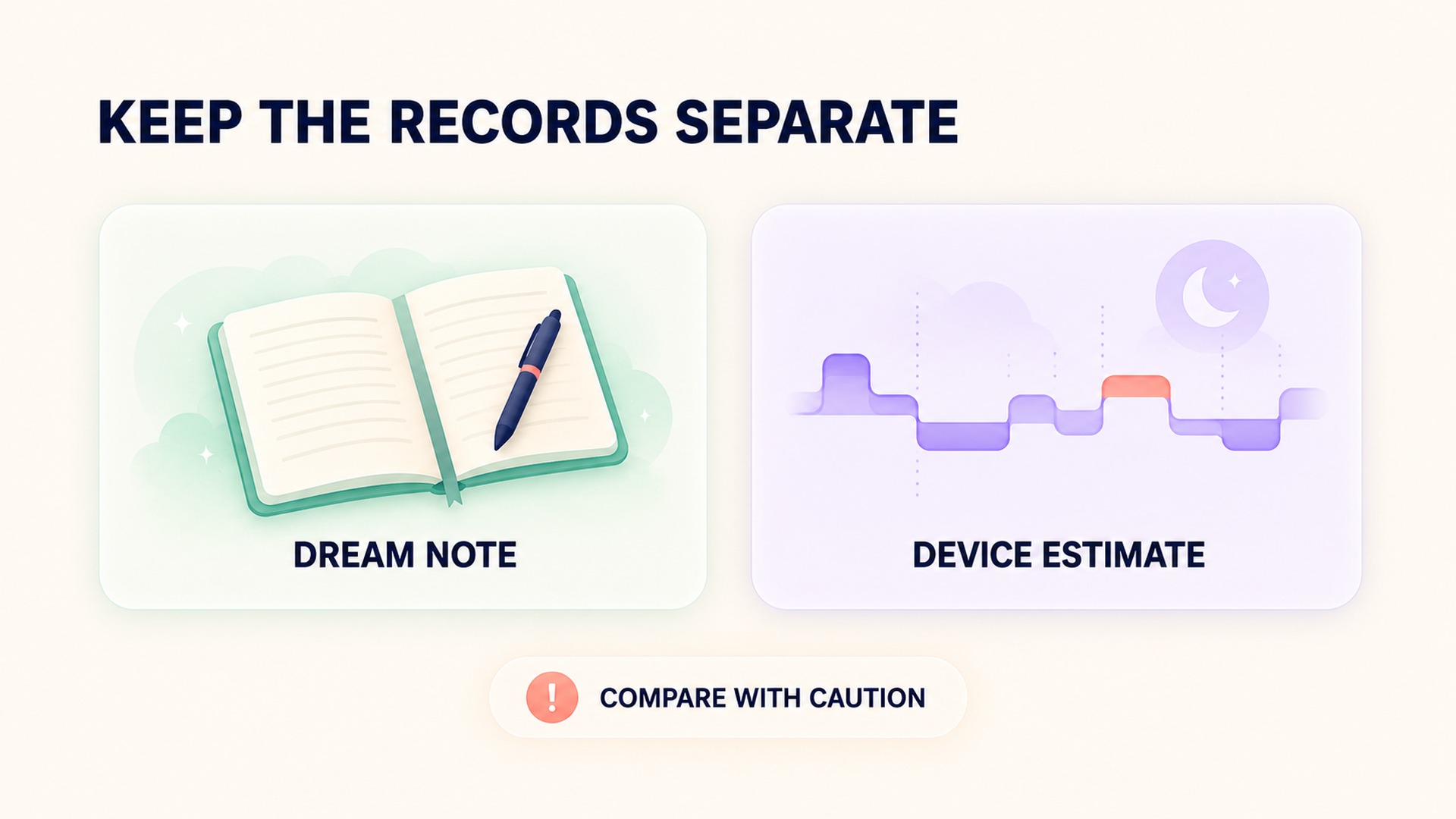
A remembered dream is evidence that you recall a dream, not a measurement of REM duration. Keep the journal entry, the device estimate, and your daytime experience as separate records. That makes each observation easier to interpret and avoids asking memory to answer a question it was not designed to measure.
FAQ
Does remembering a vivid dream prove I woke from REM sleep?
No. Dream recall is more common after some REM awakenings in laboratory research, but dreams can also be reported after other stages. A remembered story does not identify the stage by itself.
Does forgetting my dreams mean I had little or no REM sleep?
No. A lack of recall is not a measurement of stage duration. You may not retain a dream even when REM sleep occurred.
Can I use a dream journal to check my wearable’s REM estimate?
A journal can record what you remember, while the device provides an estimate from its sensors. Keep them separate; one cannot validate the other.
*This article is for informational purposes only and is not a substitute for professional medical advice, diagnosis or treatment.*
Sources:
PLOS ONE·Brain Sciences·Journal of Neuroscience·Nature and Science of Sleep·Frontiers in Human Neuroscience·Nature and Science of Sleep
Related articles

Keeping prescribed breathing treatment separate from a sleep score
Sleep score and prescribed breathing treatment answer different questions. Learn how to keep the records separate and what to bring to a clinical follow-up.

Why a laboratory sleep study can differ from a usual night at home
A laboratory sleep study records sleep under conditions that can differ from home. Learn how to discuss an unusual test night without dismissing the clinical findings.

How to Read a Sleep Graph When Deep Sleep Appears in Short Bursts
Short deep-sleep blocks on a wearable graph can reflect stage estimates, chart resolution, or missing sensor intervals. Read the time scale and coverage notes alongside the total sleep window before interpreting the pattern.

Why Sleep Stage Percentages Need a Confidence Indicator
A sleep-stage percentage can look precise even when the tracker has limited evidence for part of the night. A confidence indicator should explain whether it refers to signal coverage, classifier uncertainty, or validation against a reference method.

How to Tell Whether Zero Deep Sleep Is a Data Gap or a Classification Result
Zero deep sleep in a wearable graph can reflect an incomplete record or a classification that assigned no eligible interval to that stage. Check the full timeline, coverage notes, and the app’s stage method before interpreting the value.

Why Main Sleep and Naps Need Separate Breathing Analysis
Main sleep and naps can differ in timing, duration, sensor coverage, and how a tracker identifies each interval. A breathing summary should show which session it analyzed and keep a nap separate unless the product explains how both periods enter the same calculation.

Why a Percentage of Optimal Breathing Needs a Clear Denominator
A percentage of optimal breathing can look exact even when its denominator is unclear. Learn why a tracker should state which sleep minutes count, how it treats sensor gaps, and whether its method stays consistent across nights.

Why Bedtime Consistency Scores Can Misread a Deliberate Time Shift
A bedtime consistency score compares clock labels, but a deliberate schedule shift can make familiar sleep timing appear unusually variable. Check the score’s time frame, observation window, and treatment of transition nights before reading the result as a change in sleep quality.

Why a Sleep Tracker Needs a Time-Shift Mode
A time-zone change can alter the way a sleep tracker labels a night without showing when the body’s internal clock has adjusted. A temporary time-shift mode should preserve original timestamps, mark the transition, and pause comparisons that assume a steady schedule.

Why a Time Shift Should Pause Schedule-Based Coaching
A time shift can make schedule-based sleep advice compare local bedtimes against a different clock reference. A tracker should preserve each sleep record, pause stale coaching, and explain what observations it needs before the comparison resumes.