What a change in skin temperature on your wearable might actually mean
By Mr. Apps · Jul 31, 2026
Category:Apps
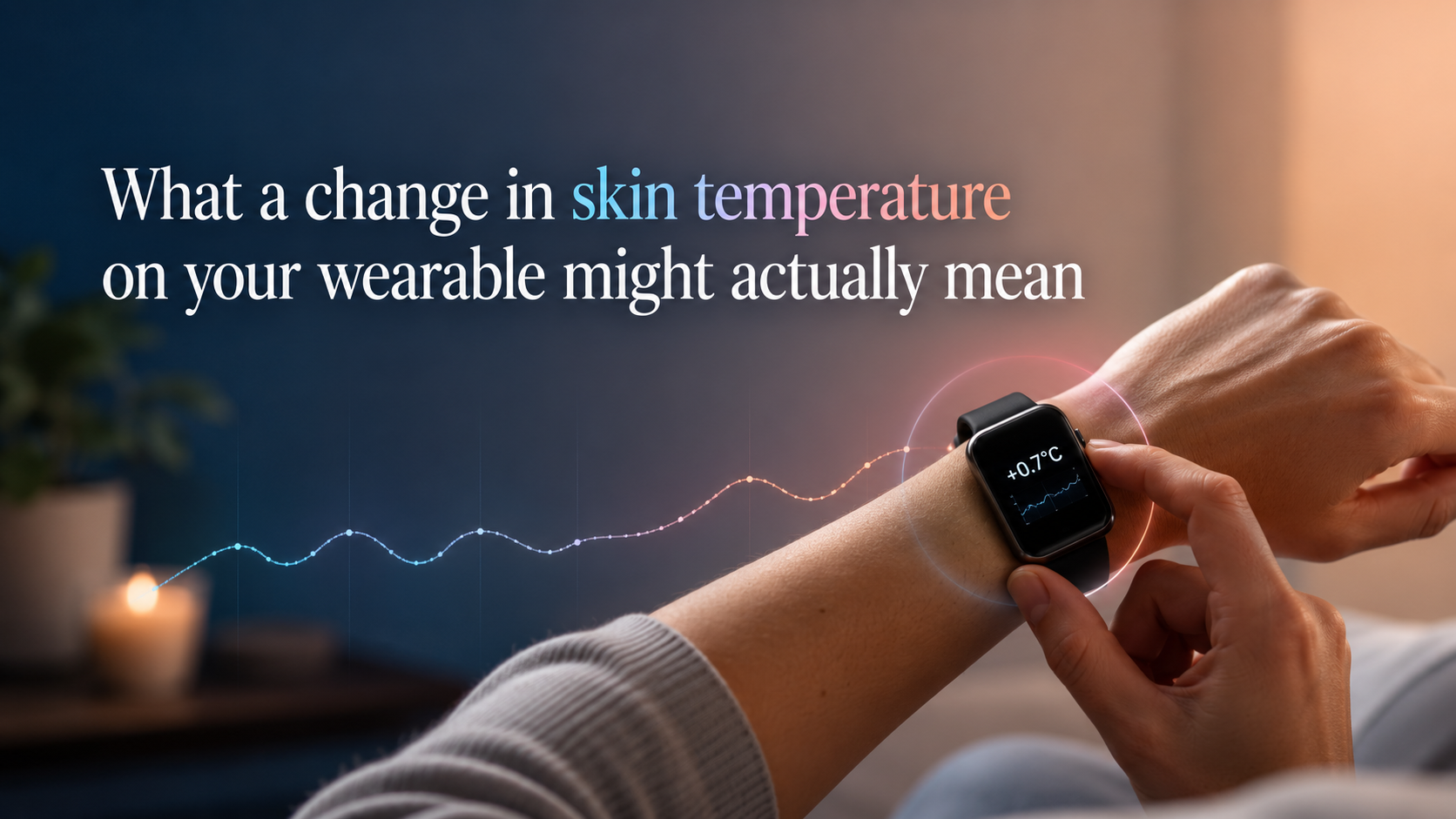
The temperature graph gets more questions from readers than any other metric I write about, and I think I know why. A resting heart rate of 58 is just a number. A red arrow next to "skin temperature, plus 1.2 °C above baseline" reads like a diagnosis. People wake up, see it, and start planning their sick day before they've even had breakfast.
Most of the time, nothing is wrong. Something in the room changed, or something in the evening changed, and the sensor did exactly what it was built to do. Reading that number well is mostly a matter of knowing what it is measuring and what else could have moved it.
What the sensor on your wrist is actually measuring
A skin temperature wearable measures the surface of your skin, not the temperature inside you. Those two values are related, but loosely. Skin sits at the end of the heat exchange system, so its temperature depends heavily on how much blood your body is sending to the periphery at that moment. Researchers who have tried to estimate core temperature from wrist sensors have needed algorithms that combine skin temperature with heart rate, ambient conditions, and personal characteristics, and even then the error margins are wide enough that no serious lab treats a wrist reading as a clinical measurement.
This is also why the number behaves strangely at night. As you get sleepy, the blood vessels in your hands and feet open up and dump heat into the room. Skin temperature at the extremities climbs while your core temperature falls. That heat loss isn't a side effect of falling asleep, it's part of the mechanism: the degree of dilation in the hands and feet turns out to be the strongest physiological predictor of how quickly someone falls asleep, better than core temperature or heart rate.
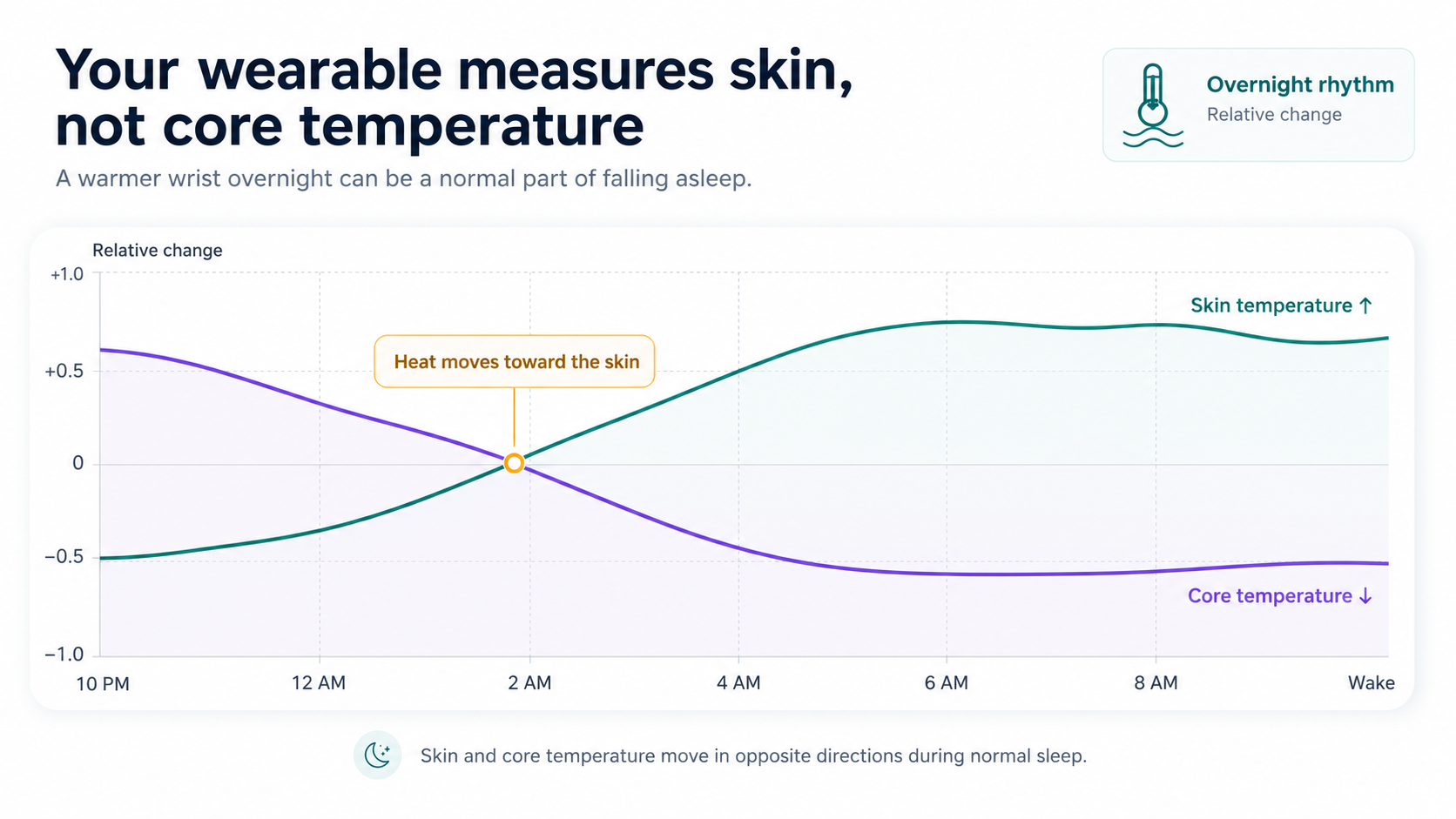
So a rise in skin temperature while sleeping is normal. It is supposed to happen. The question is never whether your skin got warmer overnight. It's whether it got warmer than your own usual pattern.
Why deviation beats the absolute number
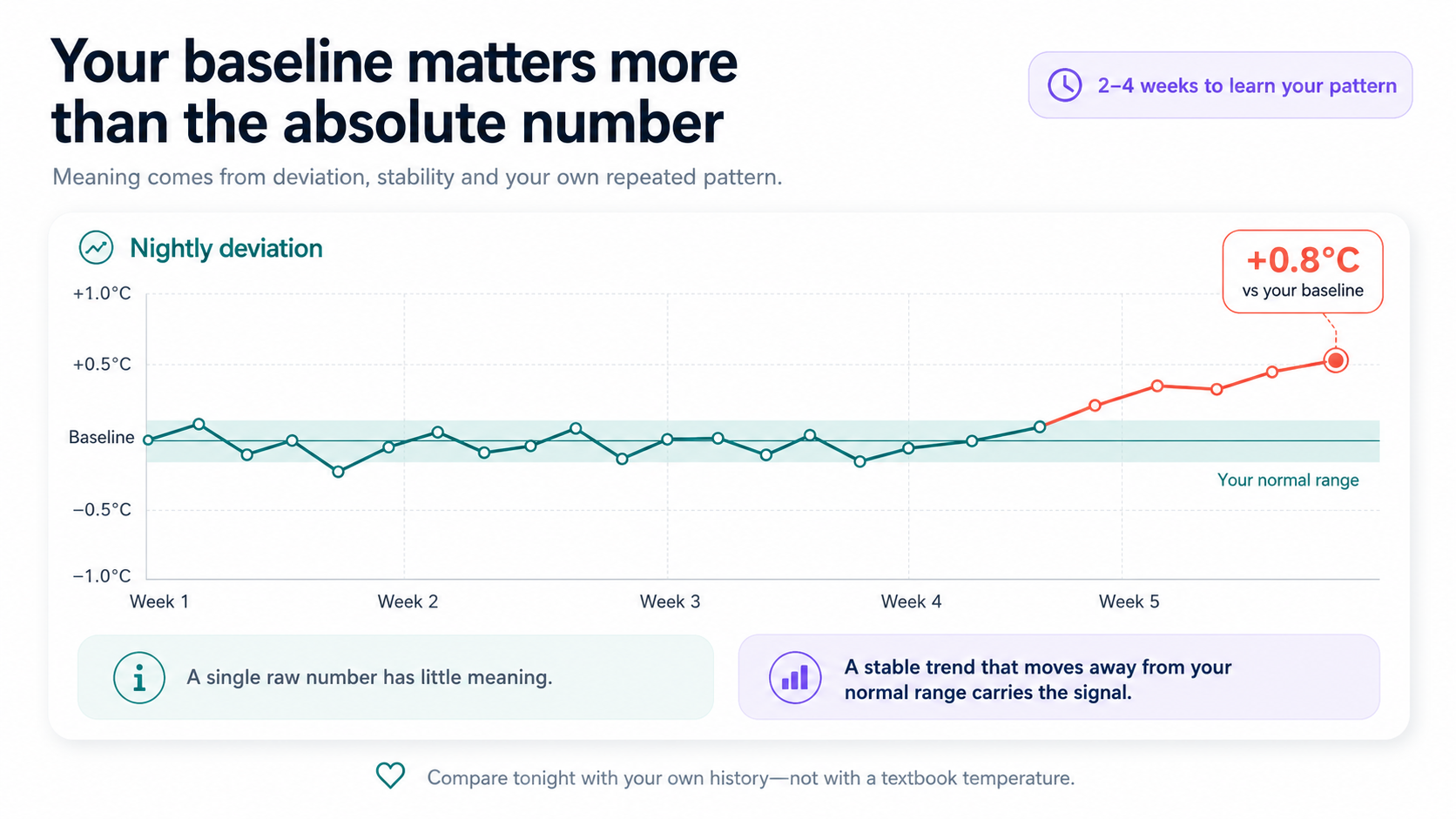
Almost every device reports body temperature deviation rather than a raw figure, and that design choice is the correct one. My nightly average sits well below what a thermometer would show under my tongue, and yours probably does too. Comparing that raw value to 36.6 °C tells you nothing.
What carries information is the shape and the stability of your own curve. In a study of more than two thousand adults wearing sensors for a week, people whose distal skin temperature rhythm was more regular and had a larger day to night swing slept more efficiently and spent less time awake in bed. The rhythm mattered. The absolute reading didn't.
Practically, that means a new device needs two to four weeks of consistent wear before its baseline is worth anything. Judging a flag from week one is like judging a training plan from a single session.
The week my data looked alarming and wasn't
A few winters ago I moved into an older apartment and my temperature curve went odd almost immediately. Nothing dramatic at bedtime, but every night the last two hours before waking showed a sharp climb. Four nights running. My sleep score dropped, my wake count went up, and I started mentally drafting a post about early illness detection.
Then I found the timer on the radiator in the bedroom. The previous tenant had set it to fire at four in the morning, presumably so the room would be warm by seven. My skin was reading the building's heating schedule, not my immune system. I moved the timer, and the curve flattened out the same night.
That episode changed how I read the graph. Before I ask what my body is doing, I ask what the room is doing.
Environmental or physiological
The two categories tend to leave different fingerprints, and once you know the tells they're fairly easy to separate.
| Signal | Looks environmental | Looks physiological |
|---|---|---|
| Timing of the rise | Tied to a clock event, like heating switching on | Spread across the whole night |
| Onset | Starts the night something changed in the room | Builds over one or two nights |
| Other metrics | Mostly unchanged | Resting heart rate up, HRV down |
| Recovery | Resolves the moment you fix the room | Takes several days to return to baseline |
| How you feel | Fine, maybe a bit sweaty | Off, foggy, sore, unusually thirsty |
Neither column is a rule. But if the temperature moved and nothing else did, environment is the better first guess.
What moves the number, roughly in order of how often I see it
Room temperature is the big one. In a study that tracked bedrooms and sleep together across nearly eleven thousand nights, sleep was most efficient between 20 and 25 °C, with a meaningful drop as the room got hotter. The individual variation in that study was large, which is another argument for trusting your own data over a published range.
Bedding does more than most people expect. Researchers looking at duvet thickness found that people using a heavier duvet stayed comfortable across a much wider span of room temperatures than people using a thin one. Swapping a summer duvet for a winter one in October will shift your baseline, and the device has no idea you did it. Same for a partner returning from a trip, or a pet deciding your legs are the warmest spot in the house.
Illness is the reason people watch the metric, and it does show up, often a night or two before symptoms. It rarely arrives alone, which matters for the cross-check below.
Hard training late in the evening leaves a mark. Analysis of more than four million nights from active adults found that later and harder sessions were associated with delayed sleep onset, higher nocturnal resting heart rate, and lower heart rate variability. Your temperature curve usually joins that party.
Alcohol raises skin temperature through peripheral vasodilation, which is exactly the sensation of feeling flushed and warm. It's one of the most reliable single night spikes you'll see.
Travel across time zones shifts the timing of the whole curve rather than its height. For a few nights the rise arrives at the wrong clock hour, which some devices interpret as a deviation.
A short or fragmented night gives the algorithm less clean data to average. Fewer hours asleep, noisier reading.
Device fit is the one people forget. A ring worn loose after a long day, or a watch strap that slid up the forearm, changes the contact between skin and sensor. If a single night looks wild and everything else is boring, check the fit before you check your immune system.
Cross-check before you react
One metric alone is a rumour. Three metrics agreeing is information.
When researchers trained a model to spot self-reported fever from wearable data across hundreds of thousands of nights, temperature deviation from the night before was the most useful feature, with respiratory rate close behind. The signal came from the combination, not from temperature on its own.
My own sequence takes about ten seconds:
- Did resting heart rate rise too? An elevated overnight heart rate alongside warmth is the pairing worth respecting.
- Did HRV drop below its usual range for me? A single low night is noise. Two in a row with warmth is a pattern.
- Did respiratory rate creep up by half a breath or more per minute? It's a quiet metric that moves early.
- Do I have symptoms? A sore throat outranks any graph.
- What changed in the room, the bed, or my evening?
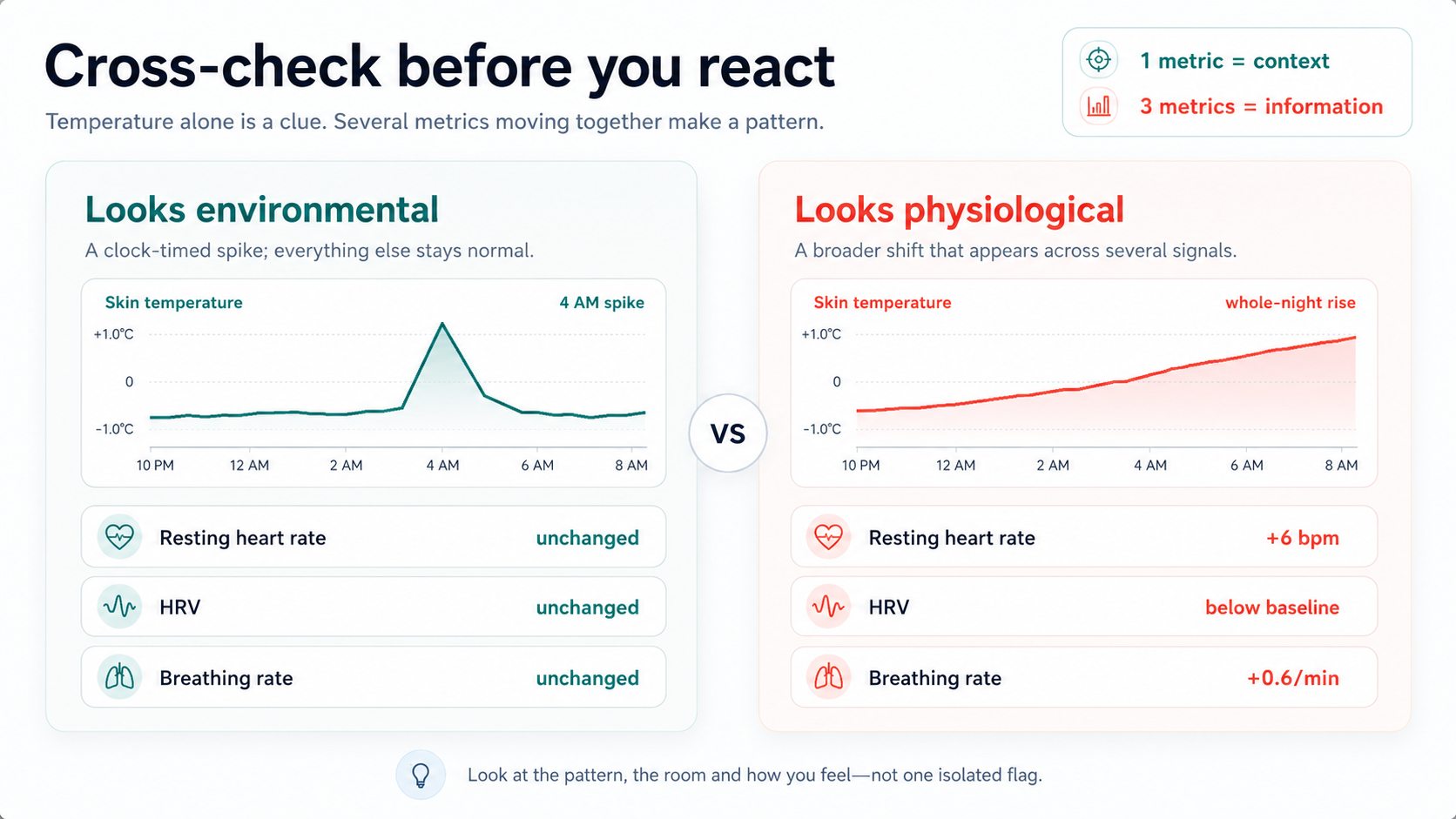
If only the temperature moved, I change nothing about my day. If temperature, heart rate, and breathing all moved together and I feel slightly off, I treat it as a signal to keep the day easy and skip the interval session. That's the entire decision. No thermometer panic, no cancelling the week.
The habit worth building
Treat the temperature graph as context rather than a verdict. It's a sensitive instrument pointed at a system with a lot of inputs, and it can't tell the difference between a fever and a duvet. You can. Give it a few weeks to learn your baseline, note the nights when something in your environment changed, and read it next to your other metrics rather than on its own.
The people who get value from this number aren't the ones who check it hardest. They're the ones who know what their normal looks like.
FAQ
Why is my skin temperature high at night but I don't have a fever?
Because they measure different things. Skin temperature rises overnight as blood flow to your hands and feet increases and your body sheds heat, which happens whether or not you're ill. A warm room, heavy bedding, a late workout, or alcohol can all push it higher. If you actually want to know whether you have a fever, use a thermometer.
How long before a wearable temperature reading is meaningful?
Give it two to four weeks of regular wear, worn the same way, so the device has enough nights to build a personal baseline. Before that, deviations are being measured against a moving target. Nights with very short sleep, poor sensor contact, or a missing charge cycle are also worth mentally discounting.
Should I do anything differently when my temperature is flagged as elevated?
Only if something else agrees with it. Check resting heart rate, heart rate variability, respiratory rate, and how you actually feel. If temperature is the only thing that moved, look at your room and your bedding first. If several metrics shifted together and you feel run down, reduce training load for a day or two and reassess in the morning.
*This article is for informational purposes only and is not a substitute for professional medical advice, diagnosis or treatment.*
Sources:
PubMed Central·American Physiological Society·American Academy of Sleep Medicine·Elsevier·Sleep Foundation·Springer Nature