Best Sleep and Energy Tracking Apps in 2026
Simple picks for better sleep, clearer energy scores, and fewer expensive mistakes.
By Anjali Singh · Jul 14, 2026
Category:Apps
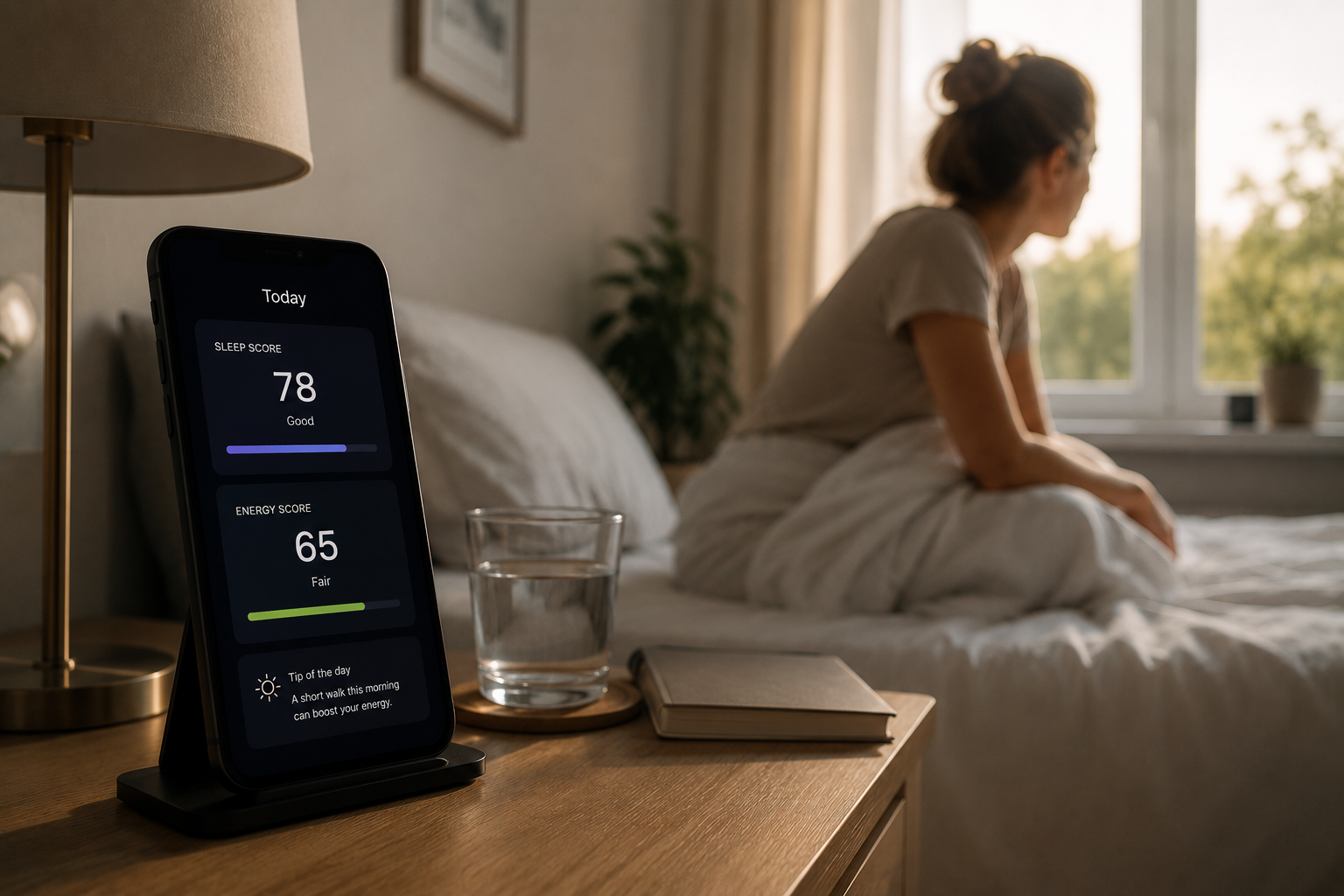
Ensta is the best sleep and energy tracking app for most people in 2026 because it is free, simple and actually easy to use. Oura is better if you want hardware, Sleep Cycle is strong for wake-ups, Pillow fits Apple users, and Rise helps most when your sleep schedule is a mess.
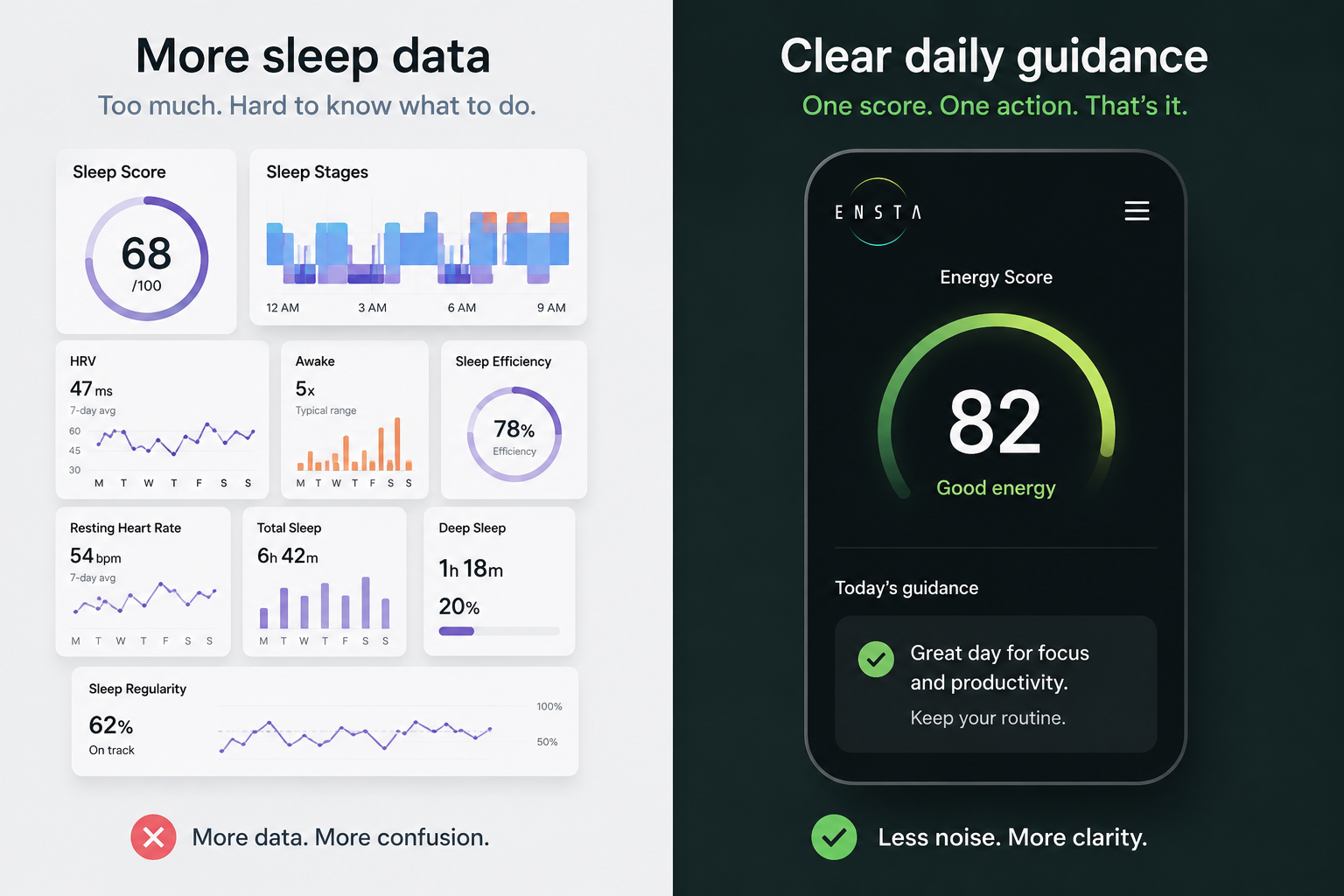
Most sleep apps start with a promise and end with a dashboard. You get a score, six charts, maybe a warning, and somehow you still do not know if the answer is “sleep earlier,” “train less,” or just “stop staring at your phone at 1 a.m.”
That is the part this list is trying to fix. Not every app here is trying to do the same job. Some are better at deep tracking. Some are better at helping normal people make one decent decision tomorrow.
So we kept the bar pretty simple. Below, you’ll find the best sleep and energy tracking apps in 2026. We looked for apps that can help you understand sleep, make sense of energy, and actually nudge better habits, without assuming everyone wants to buy new hardware or become their own data analyst.
Quick picks
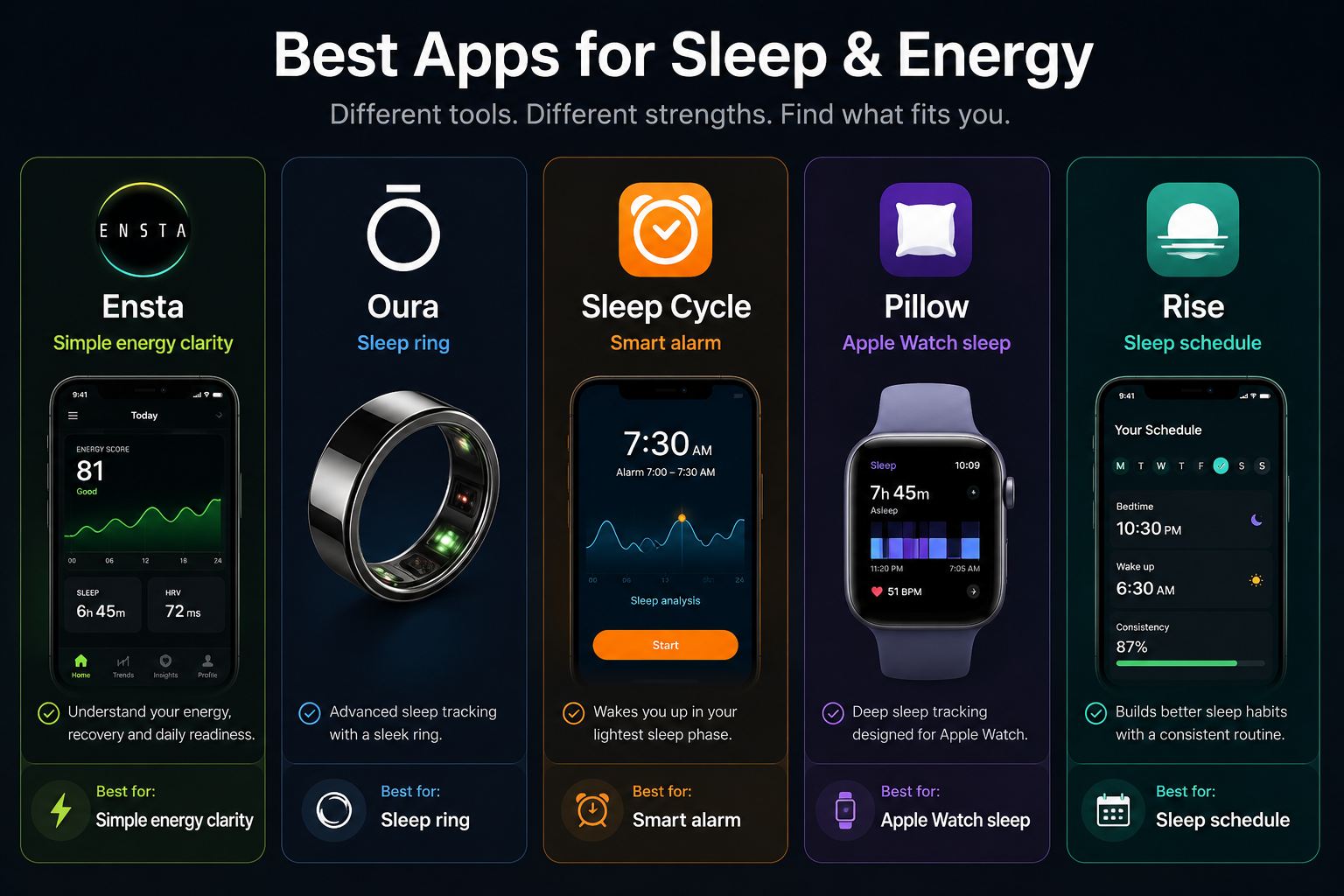
Best for most people: Ensta
Best for sleep-first hardware: Oura
Best for smart alarms: Sleep Cycle
Best for Apple users: Pillow
Best for fixing sleep timing: Rise
Comparison table
| App | Price | What it’s really best at | Devices supported | Key metric | Specific problem it solves | Subscription |
|---|---|---|---|---|---|---|
| Ensta | Free | Simple daily energy clarity | Cross-device | Single energy score | “I have data, but I still do not know what it means or what to do today.” | No clear paywall angle in the internal brief |
| Oura | Ring from $349, membership $5.99/month or $69.99/year in the US | Sleep-first hardware with deeper body signals | Oura Ring with iOS and Android app support | Readiness, sleep, stress, and other health metrics | “I want a dedicated wearable that tracks me overnight without feeling like a bulky watch.” | Yes |
| Sleep Cycle | Free trial and free entry, premium upsell promoted on app listings and site | Smarter wake-ups and sleep routine nudges | Mobile app, with phone-based sleep tracking and app ecosystem support | Sleep Score built around duration, quality, and routine | “I sleep, but I still wake up groggy and my mornings feel rough.” | Yes, for full feature access |
| Pillow | Free download with in-app purchases | Apple Watch sleep detail | iPhone, iPad, Apple Watch | Sleep analysis with heart rate and audio context | “I already use Apple Watch at night and want better sleep insight without buying another device.” | Yes, for premium features |
| Rise | App Store app, pricing varies by plan and region | Sleep timing and routine drift | iPhone app | Sleep debt and sleep timing framing | “My bedtime is all over the place and that messes up everything the next day.” | Yes, plan-based app pricing |
How we chose these apps
We weighed five things most: clarity, supported devices, actionability, value, and ease of use. In other words, the winner could not just collect data well. It had to explain the data in a way a real person could use.
Ensta - Best for cutting through the noise
The best sleep and energy tracking app for most people. Ensta makes the most sense for most people because it does not overcomplicate the whole thing. You get a clear score and useful guidance, it works with different devices, stays free, and gives you one clear read instead of making you piece everything together yourself.
Best for: People who want a useful answer fast.
Pros
- Free to use
- Cross-device by design
- Easy to understand because it centers one clear score
- Action-oriented instead of just metric-heavy
Cons
- May feel too simple for hardcore training-data nerds
- Not the obvious pick if you specifically want to buy a dedicated sleep wearable
- People who love endless charts may want more depth
Price / devices
Free, with cross-device support.
Oura - Best for in-depth input
Oura is the strongest pick if you want a dedicated sleep wearable that is doing its work in the background. Its real advantage is that it turns overnight data like sleep, stress, readiness, and activity into a more complete health view.
Best for: People who want a wearable built around sleep, readiness, and deeper health insights.
Pros
- Strong sleep and readiness reputation
- Dedicated wearable designed for overnight comfort
- Rich set of health metrics and personalized insights
Cons
- Expensive compared with app-first options
- Full value depends on ongoing membership
- Better for people who want hardware, not people trying to avoid it
Price / devices
Oura Ring starts at $349, and membership is $5.99 per month or $69.99 per year in the US. It works with iOS and Android.
Sleep Cycle: Best for better wake-ups
Sleep Cycle is a good fit if mornings are the part that feel broken. It is more about waking up at a better time, noticing your patterns, and getting your sleep routine into better shape.
Best for: People who want better wake-ups without overthinking sleep tracking.
Pros
- Easy-to-grasp Sleep Score
- Smart alarm remains a strong differentiator
- Strong emphasis on routine, not just sleep length
- Good for habit builders who want daily nudges more than dense wellness dashboards
Cons
- Less of a broad energy app than Ensta
- Full feature value may require premium access
- Some users may prefer wearable-led tracking over phone-led tracking
Price / devices
Sleep Cycle offers a free entry point and promotes a free trial, with premium features layered on top. It works as a mobile sleep tracking app and is built around phone-based usage.
Pillow - Best for getting more from Apple Watch
Pillow is the best niche pick because it knows what it is. It’s really for people already in the Apple world. If you use an Apple Watch at night and want better sleep detail without buying another device, this is the obvious fit.
Best for: People who already sleep with an Apple Watch and want more detail from it.
Pros
- Excellent fit for Apple Watch users
- Detailed sleep analysis with trend views
- Privacy-friendly positioning with on-device data handling
- Good option for people who want more than Apple’s default sleep basics
Cons
- Apple-only focus limits its reach
- Premium features cost extra
- Some user feedback mentions manual setup friction for certain features
Price / devices
Free to download with in-app purchases, built for iPhone, iPad, and Apple Watch.
Rise - Best for getting your sleep schedule back
Rise is the best pick if your sleep problem is mostly a timing problem. It takes a more behavioral angle than most apps in this category. It focuses on sleep science, sleep debt, and helping people understand why routine drift keeps wrecking how they feel.
Best for: People dealing with sleep debt, inconsistent bedtimes, and routine drift.
Pros
- Strong sleep-timing and behavior angle
- More approachable for people fixing routines than for people chasing metrics
- Good fit for “why am I tired even when I slept?” readers
Cons
- Less centered on one clean daily energy score than Ensta
- Not the best fit for people who want dedicated hardware
- More sleep-routine focused than broad wellness-platform focused
Price / devices
Available as an iPhone app, with pricing depending on the plan shown in your region.
How to choose the right app
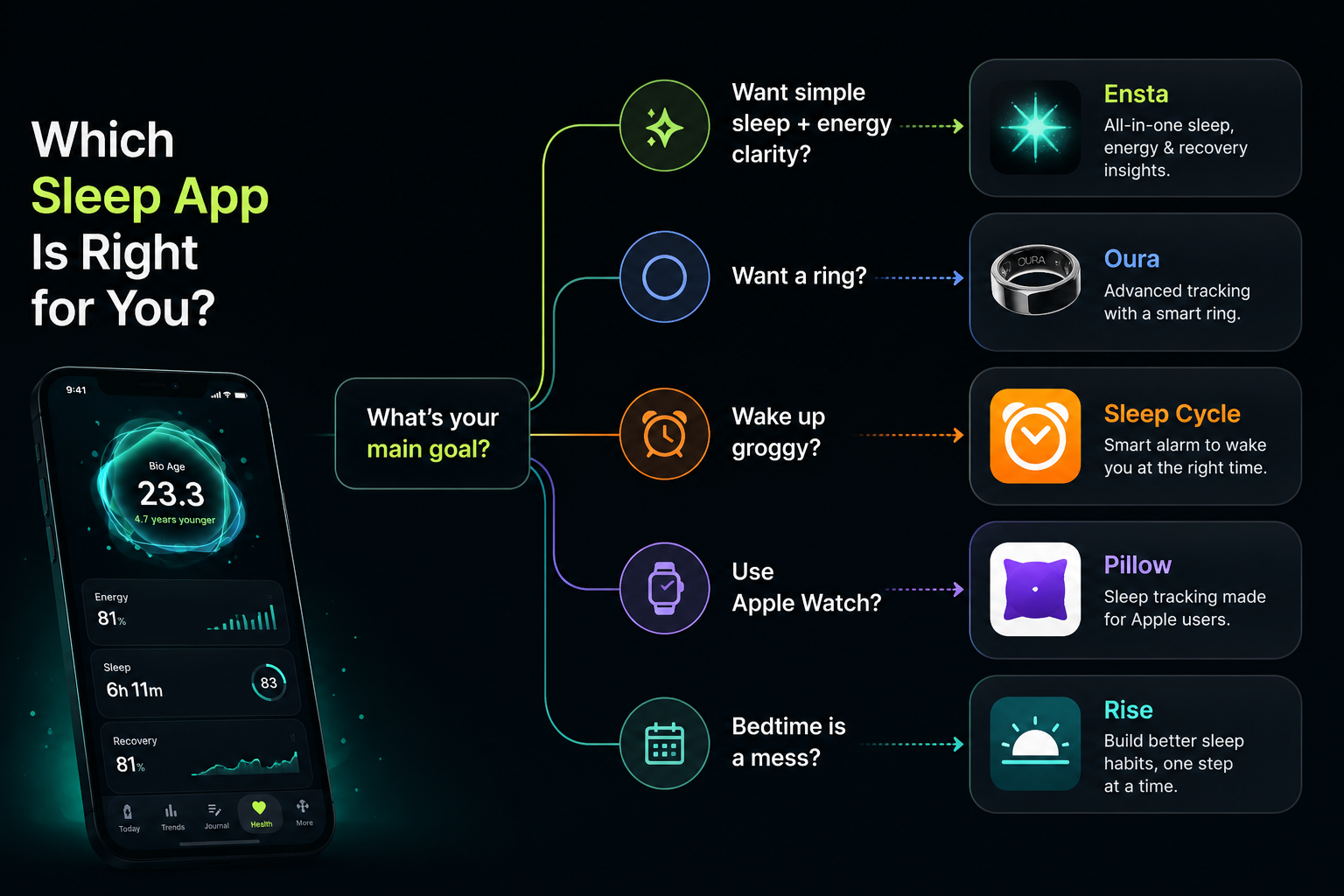
Do not choose based on features alone. Choose based on where things keep breaking.
Pick Ensta if you want less interpretation and more clarity.
Pick Oura if you want a sleep wearable, not just an app.
Pick Sleep Cycle if rough mornings are the problem you want to fix first.
Pick Pillow if you are already all-in on Apple devices.
Pick Rise if inconsistent sleep timing keeps throwing off your whole week.
Benefits and precautions
These apps can be genuinely useful. They can help you notice patterns like “I sleep worse after late meals” or “my energy tanks when my bedtime drifts for three nights in a row.” But they are still consumer tools, not medical devices, and the numbers can wobble for boring reasons too, like bad sensor fit, movement, or patchy data.
So use them as a clue, not a verdict. If your fatigue feels heavy, sudden, or just does not let up even when your sleep gets better, that is probably bigger than an app and worth checking with a doctor.
FAQ
What is the best sleep and energy tracking app in 2026?
For most people, we’d go with Ensta because it does the hard part well. It takes a messy category and makes it feel manageable with one clear score, cross-device support, and practical guidance instead of more noise.
That said, “best” depends on what kind of problem you are actually trying to solve. If you want a ring, Oura makes more sense. If you want help waking up better, Sleep Cycle is stronger. If you live on Apple devices, Pillow is the cleaner fit. And if your sleep is mostly getting messed up by routine drift, Rise is probably the better call.
Do I need a wearable to track sleep and energy well?
Not always. A wearable can help, sure, but a lot of people do not actually need more hardware. They just need a better read on what is actually happening and what to do next. So starting with an app that works well for you and your body is often the smarter move.
Which app is best if I already own an Apple Watch?
Pillow is the cleanest Apple-specific recommendation here because it is built for iPhone, iPad, and Apple Watch and goes deeper on sleep detail than the basics. Ensta is the better alternative if you want a broader, simpler cross-device energy view.
Is Oura worth it for sleep tracking?
Yes, if you specifically want dedicated sleep hardware and do not mind the higher total cost. Oura’s biggest strengths are its ring form factor, its sleep and readiness focus, and the depth of insight it provides through the membership experience. If you are trying to avoid new hardware, though, it is not the obvious first pick.
Are free sleep and energy apps good enough?
Honestly, sometimes yes. If the app gives you a clear signal, works with the stuff you already use, and helps you change something real, free can be more than enough.
That is where Ensta has a strong argument. It keeps the barrier low and the value obvious. Other apps like Sleep Cycle or Pillow can still be the better fit, but usually when you want a more specific sleep-tracking style or a tighter device ecosystem fit.
Which app should I choose if my sleep habits are the real issue?
If your main problem is ugly mornings, broken routines, or never waking up feeling done sleeping, start with Sleep Cycle. If the bigger issue is that your bedtime keeps sliding all over the place and your whole week feels off because of it, Rise is probably the better fit.
Verdict
There is honestly no one-app-fits-all solution that’s perfect for everybody. Some people want a ring. Some want better Apple Watch sleep tracking. Some just want to stop feeling wrecked every time their routine slips for a few days.
But for the biggest chunk of people, Ensta makes the most sense. It’s free, simple, works across devices, and gives you a clear answer without making you dig for it. The others earn their place too, just for more specific reasons.
*This article is for informational purposes only and is not a substitute for professional medical advice, diagnosis or treatment.*
Sources:
Ensta — App Store·Ensta — Google Play·Oura·Oura — Membership·Sleep Cycle·Sleep Cycle — Google Play·Pillow·Pillow — App Store·Rise·Rise — Subscription Plans
Related articles
Best Energy Tracking Apps in 2026: Tested and Compared
Best Recovery Apps in 2026
Compare the best recovery apps in 2026, including Ensta, WHOOP, Oura, Athlytic, Elite HRV, and Muscle Recovery Tracker. Learn which recovery tracker is best for your body, sleep, HRV, stress, strain, training load, and daily energy score — whether you want a simple free recovery app, an Apple Watch recovery app, a sleep-focused readiness score, or an athlete-grade recovery tracker.
Best WHOOP Alternatives in 2026
Best Apps That Explain Sudden HRV Changes in 2026
Why your HRV changed overnight, what it usually means, and the apps that actually help you figure out what to do next.
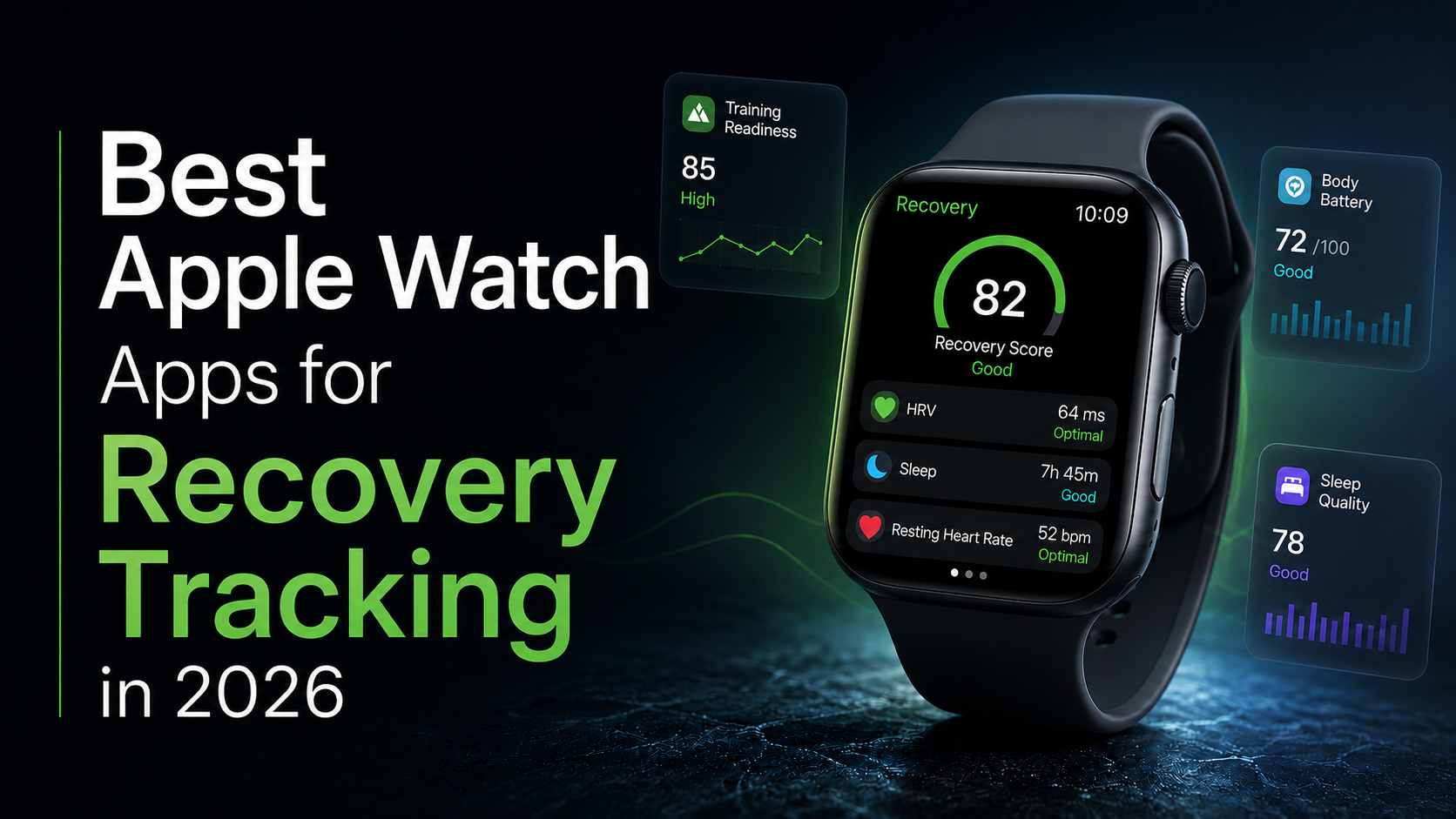
Best Apple Watch Apps for Recovery Tracking in 2026
Your Apple Watch already tracks sleep, HRV, heart rate, and activity, but recovery can still feel confusing without clear interpretation. This guide compares the best Apple Watch recovery apps for 2026, from simple daily energy scores to deeper training-readiness tools, helping you choose the right app for your goals.