The morning light habit that can improve sleep without changing your bedtime
By Mr. Apps · Jul 2, 2026
Category:Sleep
A couple of winters ago I ended up with an office that turned out to be an interior room with no direct window, the space had already been assigned by the time I moved in. I didn't think much of it at first. Then a few weeks in, a colleague asked why I looked so worn down for someone who claimed to be sleeping eight hours a night. I was. I just wasn't waking up feeling like it. I tried the usual fixes: no screens before bed, a cooler room, magnesium, the works. None of it moved the needle much. What actually changed things, almost by accident, was starting my mornings with a walk before I sat down at that desk, coffee in hand, instead of driving straight in.
That's a small, almost boring habit, and I want to be upfront that it's not a miracle fix. But the mechanism behind it is well studied, and once I understood why it worked, I stopped treating it as a nice-to-have and started treating it as infrastructure, the same way I think about brushing my teeth.
How light sets the body clock
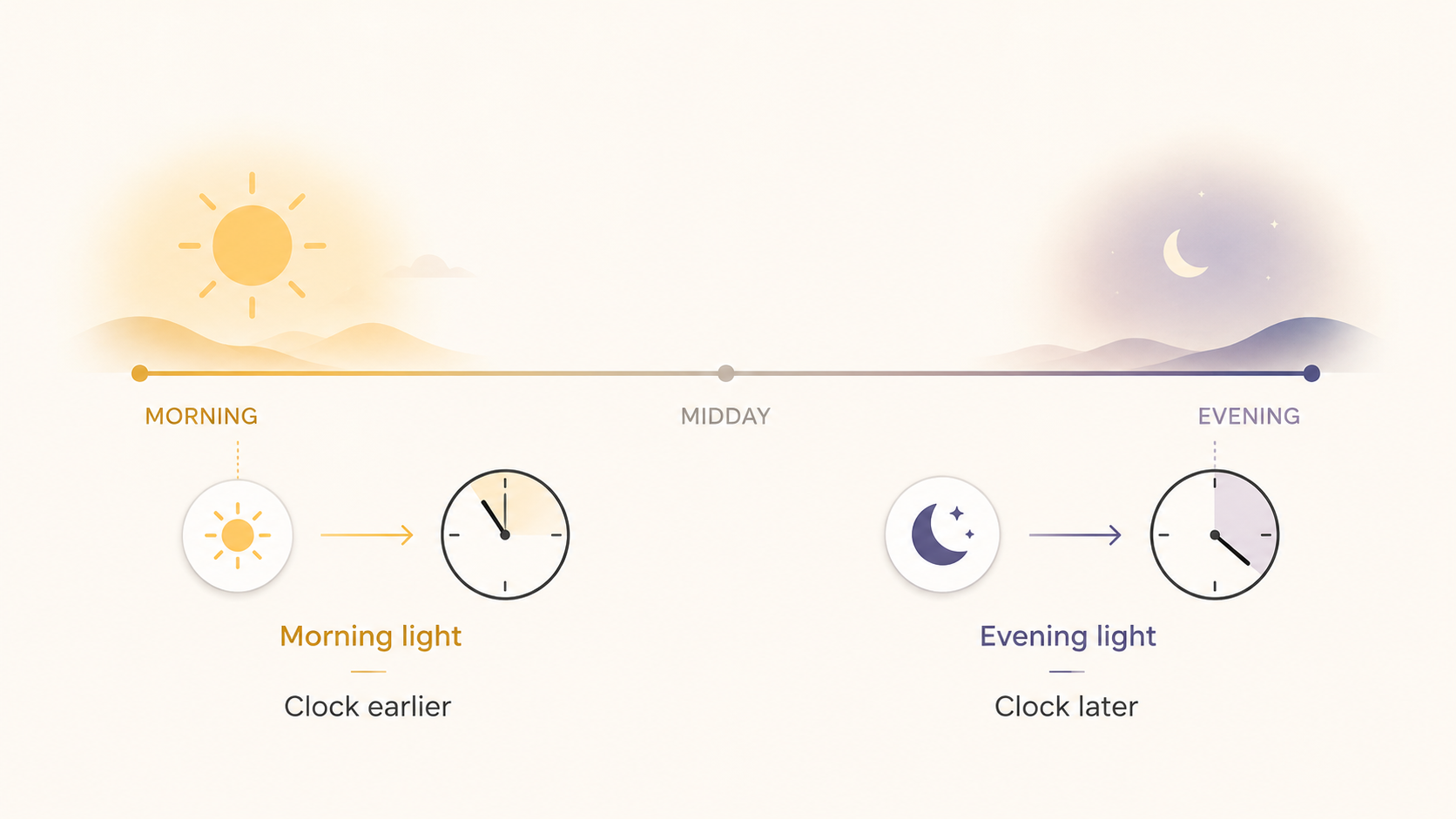
Your body runs on a roughly 24-hour internal clock, mostly controlled by a cluster of neurons in the brain called the suprachiasmatic nucleus. That clock isn't perfect on its own; left in constant dim light, most people's internal day drifts to be a bit longer or shorter than 24 hours. Light is the main signal that keeps it locked to the actual day-night cycle, and morning light in particular nudges the clock earlier, which makes it easier to feel sleepy at a reasonable hour that night.
This isn't just theory. A 2023 study in the Journal of Pineal Research tracked university students across the seasons and found that daytime light exposure predicted how much their sleep and circadian timing drifted from one season to the next, more so than the researchers expected given how much artificial light we're surrounded by. In other words, even people living under electric lights and screens all day are still meaningfully influenced by how much daylight they get, and when they get it.
What I find interesting is that this isn't about light in general. Evening light pushes your clock later, which is part of why doom-scrolling at midnight makes the next night worse too. Morning light does the opposite. Same input, opposite direction, depending entirely on timing. That's why sleep advice that only talks about the evening, dim the lights, put the phone away, is only telling half the story. You can do everything right at 10 p.m. and still be fighting a clock that never got the memo it was supposed to start earlier that morning.
What counts as "morning light" in real life
Here's where most advice gets impractical. People hear "get morning light" and picture standing in a field at sunrise, which nobody's schedule actually allows. The real bar is much lower, but it does help to know the numbers, because they explain why standing near a window often isn't enough.
Outdoor light, even on an overcast day, typically runs somewhere in the low thousands of lux. A well-lit office or living room, by comparison, usually sits well under a thousand lux, often closer to a few hundred. According to engineering lighting reference charts, a spot near a building's windows might only reach around a tenth of what you'd get standing just outside, and the middle of a room can drop far lower still. That gap is why "I sat by the window" often doesn't produce the same effect as "I stepped outside."
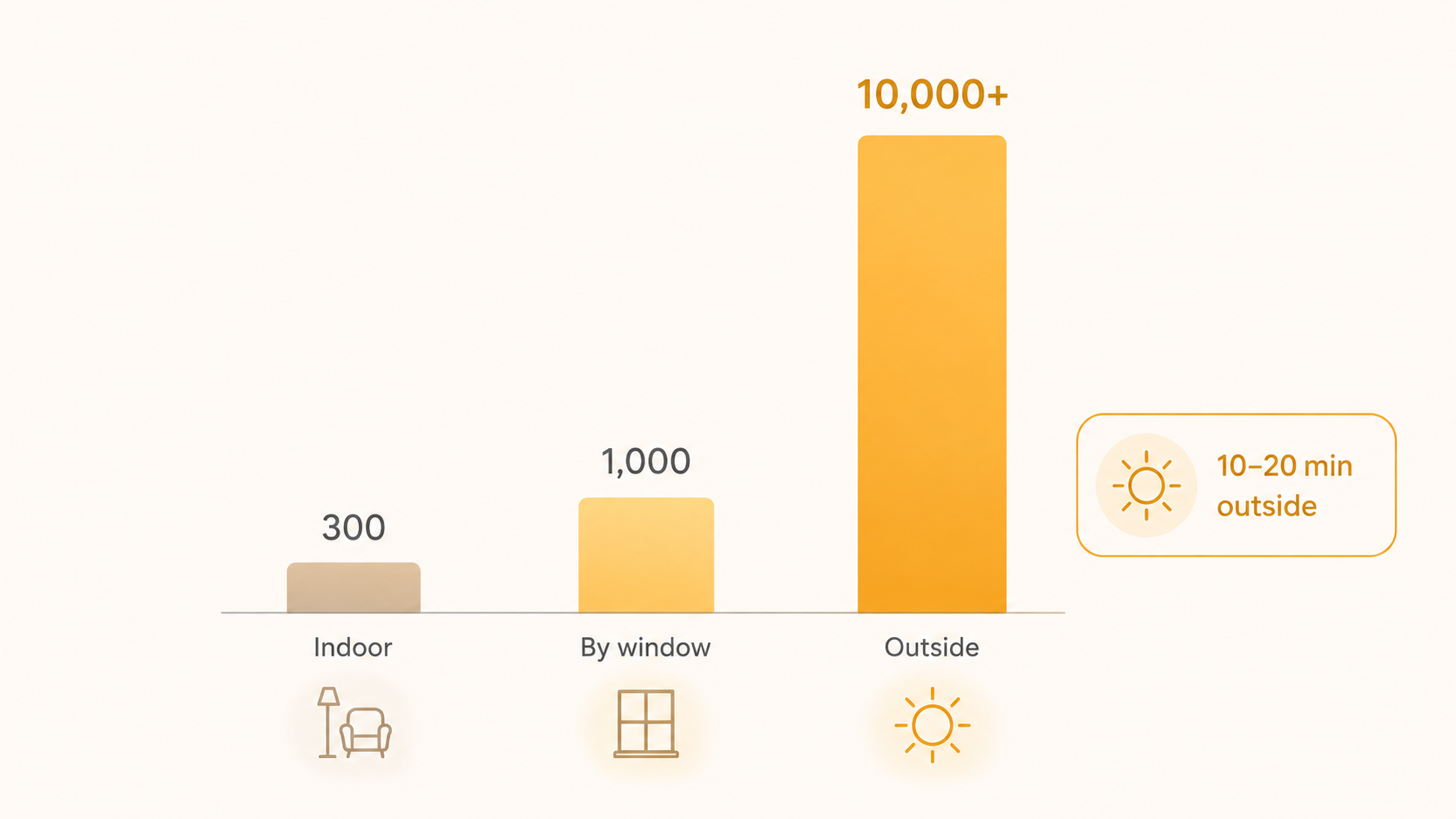
In practice, what worked for me was genuinely unglamorous: a ten-to-twenty-minute walk before I opened my laptop, sunglasses off, phone in my pocket instead of in front of my face. On a bright day it takes less time; on a grey one it takes a little longer, which tracks with the difference in outdoor lux between sunny and overcast conditions. I've had mornings where I skipped it entirely because of rain, and I did not notice a dramatic difference from one missed day. This is a cumulative habit, not a single dose of medicine.
My team and I got curious enough to run a small informal experiment last winter. A handful of us wore consumer wearables for two weeks and logged when we got outside. Worth noting: the reliability of these devices is still developing. A comparison of commercial wearables against research-grade equipment found that watch-derived rhythm data correlated well with lab measurements overall, though the fit varied by device and by which signal, activity, heart rate, or temperature, was used. I'd treat any wearable's "circadian score" as a rough sketch, not a diagnosis. Still, our small group matched what the research predicts: earlier outdoor time was followed by earlier, less effortful sleep onset that night.
One colleague initially resisted the whole idea because she works nights three days a week and assumed the advice didn't apply to her. It turns out timing matters more than the label "morning." For her, the equivalent move was getting bright light shortly after waking, whatever hour that happened to be, and dimming her environment in the hours before her intended sleep. The clock responds to when light happens relative to your wake time, not to the number on a clock face.
Why consistency matters more than intensity
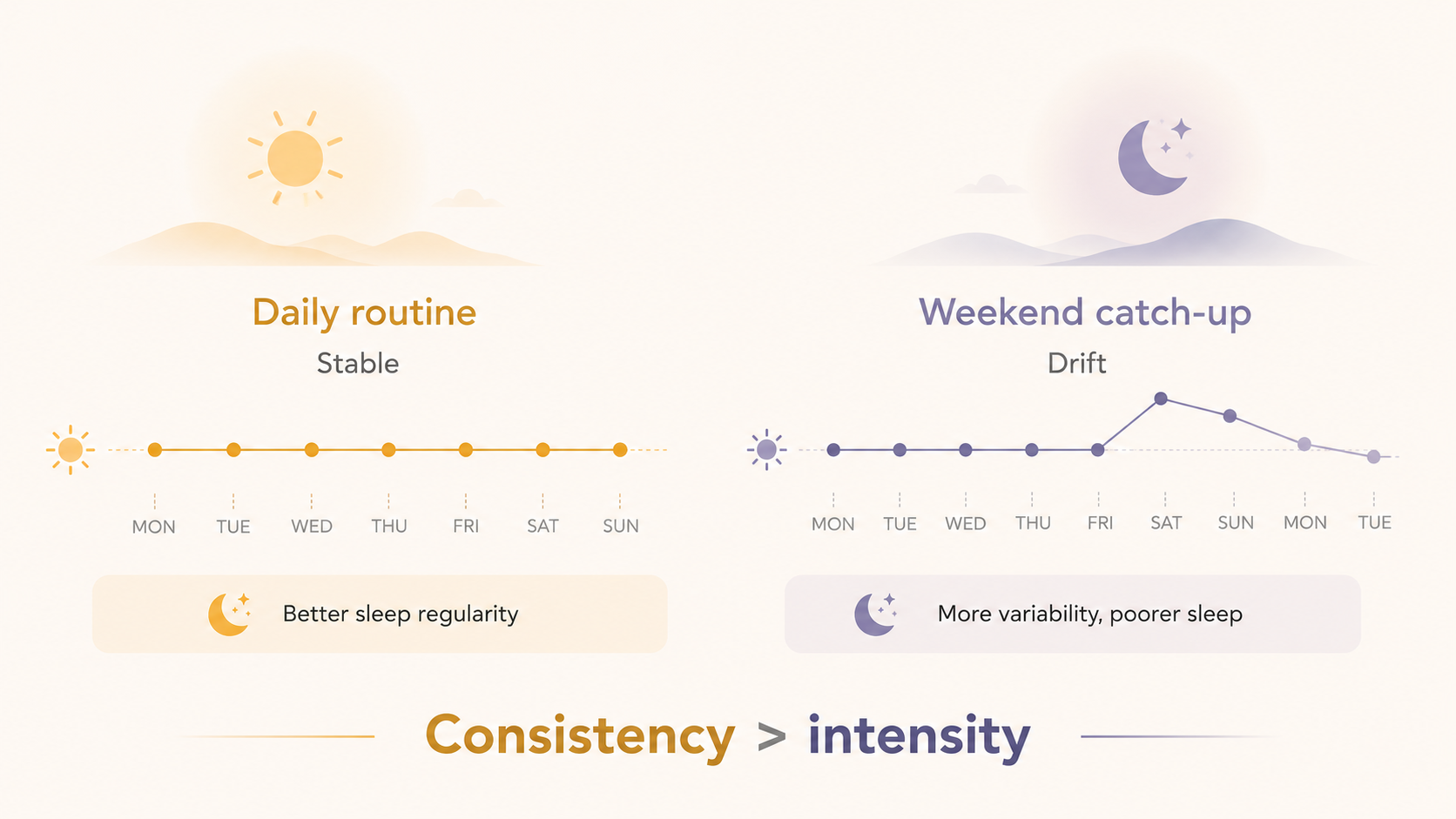
This is the part that's easy to skip past, and it's probably the most important section in this whole piece. A recent mathematical modeling paper looking at nighttime sleep disruption found that irregular light schedules, especially the classic weekend pattern of staying up late and sleeping in, were a bigger driver of sleep problems than the researchers initially expected. The model showed that delayed light exposure on weekends could throw off overnight sleep consolidation even when total light exposure across the week looked fine on paper.
I think that finding generalizes past children pretty directly. I've noticed the same thing in myself: one Saturday of blackout curtains and a 10 a.m. wake-up does more damage to my Sunday and Monday nights than a whole week of slightly-too-little daylight on weekdays. The habit isn't "get bright light sometimes." It's "get light at roughly the same point in your day, most days," a less exciting sentence but a more accurate one.
This is also where I'll admit something the wellness-industry version of this advice tends to skip: none of this requires special equipment. When we were prototyping an early feature for Ensta's sleep tracking, we genuinely debated whether to recommend a light box before landing on "just go outside if you can, it's free and it works about as well for most people." That's the whole pitch. A lamp helps if you truly can't get outside, but it's a substitute for daylight, not an upgrade to it.
When light alone is not enough
I want to be careful not to oversell this, because I've seen people get frustrated when a genuinely useful habit doesn't solve a problem it was never designed to solve. Morning light is a nudge to a system that's already working; it's not a treatment for a system that's stuck.
If you've been consistent with morning light and a regular wake time for several weeks and you're still falling asleep hours later than you want, or waking up feeling like it's the middle of the night regardless of when you went to bed, that's a different situation. It may be worth looking into delayed sleep-wake phase disorder, a circadian condition where the internal clock runs persistently later than a person's desired schedule. The American Academy of Sleep Medicine's clinical practice guideline recommends structured, precisely timed light therapy, sometimes alongside strategically timed melatonin, and that kind of treatment tends to work better when calibrated by a professional rather than guessed at. A sleep specialist can also rule out conditions that look similar on the surface but aren't circadian at all, like obstructive sleep apnea, which self-directed light exposure won't touch.
The honest version of this advice: morning light is a low-cost, well-supported tool for people whose clock is basically fine but a little loose, not a cure for a clock that's genuinely misaligned. Most people fall into the first group. If you're in the second, that's useful information too, and it's worth getting a real diagnosis rather than doubling down on a habit that isn't built for the problem you actually have.
I still take that walk most mornings before I open my email, same as I did the winter I worked out of that windowless office. It hasn't fixed everything about my sleep. But it fixed the one thing I actually needed fixed, which was falling asleep at a decent hour without white-knuckling my way through an earlier bedtime. Sometimes the boring habit is the one that sticks around because it's the one that actually does something.
FAQ
Does this work if I can only get outside on weekends? Some is better than none, but consistency research suggests it won't do as much as a shorter daily habit. The clock responds to a steady daily signal, not an occasional strong one. If weekdays are genuinely impossible, even two or three minutes near an open window or doorway most mornings beats a long walk once a week.
Do I need to look directly at the sun? No, and please don't. The relevant cells in your eyes respond to ambient brightness, not to staring at a light source. Being outside with your eyes open, sunglasses off if comfortable, is enough. Staring directly at the sun can damage your eyes and offers no extra benefit.
How long until I notice a difference? Most people I've talked to, myself included, notice something within one to two weeks of doing it daily. The bigger factor is usually consistency rather than the exact number of days. If you've been reasonably consistent for three or four weeks with no change at all, that's a signal to look at other factors, or talk to a doctor, rather than push the habit harder.
*This article is for informational purposes only and is not a substitute for professional medical advice, diagnosis or treatment.*
Sources:
Dunster, G.P. et al. (2023)·Illuminance·Cleveland Clinic.·American Academy of Sleep Medicine
Related articles
Why a regular sleep schedule may matter more than an extra hour in bed
Evening Stress and Why Your Brain Won't Settle Down Before Sleep!
Falling asleep fast isn't the same as your brain settling down. What evening stress does to your sleep onset, and how to wind down when your mind won't.
Why Am I Still Tired After 8 Hours of Sleep?
You slept 8 hours and still feel wrecked? Here's why sleep quality beats duration, what a dropping sleep score really means, and how to wake up with energy.
How to protect your sleep when your job keeps changing the clock
Shift work doesn't fail because people lack discipline. It fails because the body was never built to run a factory schedule. Here's what actually helps between rotating shifts, why "just going to bed earlier" doesn't work, and when persistent fatigue stops being normal and starts being something worth getting checked out.