Why jet lag hits harder after some flights and how to recover faster
By Mr.Apps · Jul 8, 2026
Category:Recovery

I've lost count of how many time zones I've crossed over the years, but I still can't predict, on any given trip, how bad the next 48 hours will be. Sometimes an eight hour shift barely registers. Other times a six hour one leaves me useless for a presentation I'd rehearsed for weeks. For a long time I assumed this was random, or maybe just poor planning on my part. It isn't. The direction you fly changes almost everything about how your body copes, and once you understand why, the recovery plan becomes a lot less mysterious.
Why eastward travel often feels worse
Your internal clock doesn't run on exactly 24 hours. Left alone, without alarms or sunlight cues, most people drift to a day closer to 24.2 hours. That small difference means it's naturally easier for your body to stretch a day longer than to compress one. Flying west adds hours to your day, which lines up with what your clock already wants to do. Flying east removes hours, and your body has to fight its own tendency to fall asleep and wake up later. The CDC's guidance for clinicians on jet lag disorder describes this asymmetry plainly: shifting your sleep earlier, which is what eastward travel demands, is simply harder to do than shifting it later.
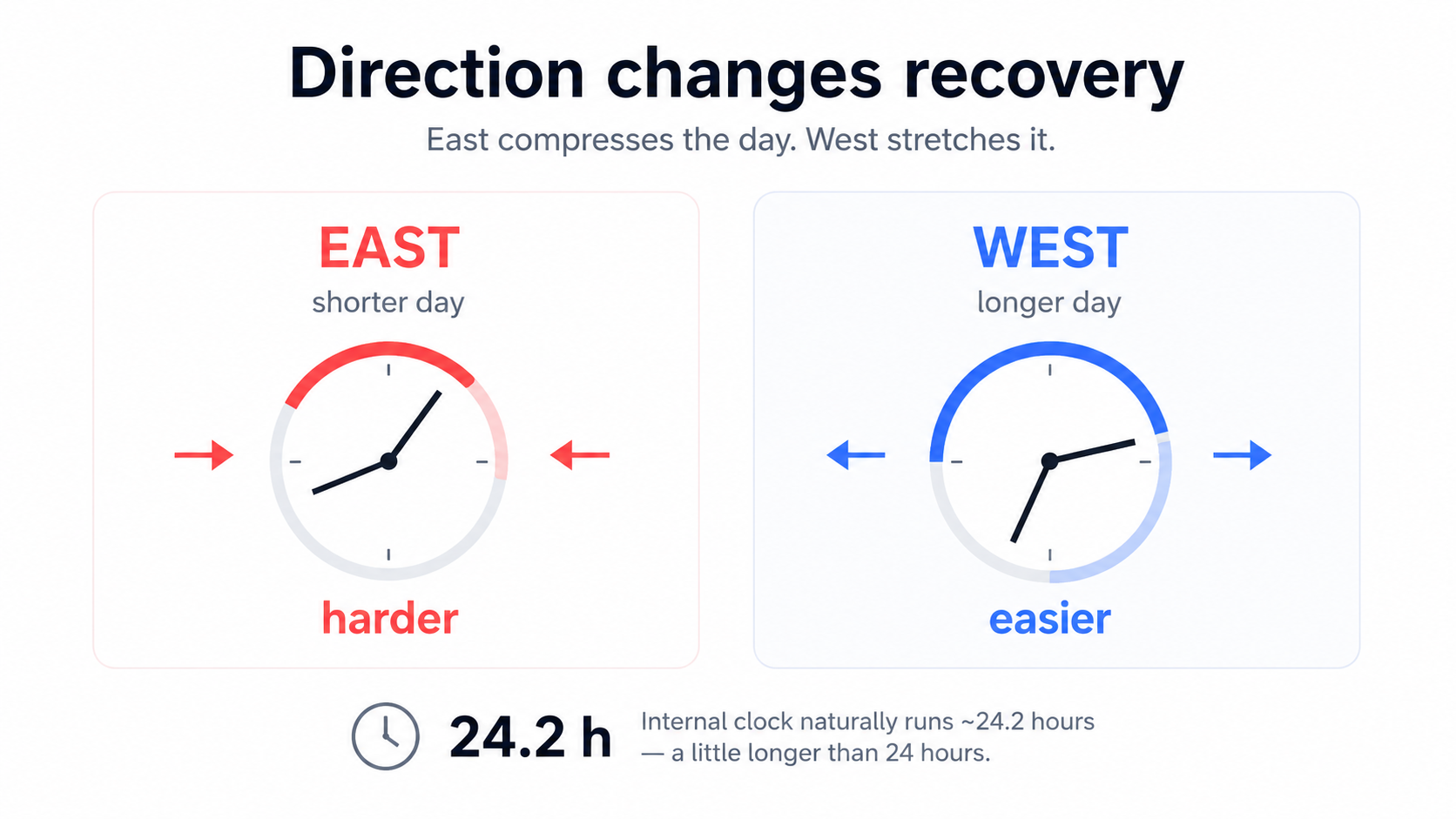
Light is the reason. Exposure at the wrong moment can nudge your clock in the wrong direction entirely, which is what the phase response curve describes: morning light nudges your rhythm earlier, evening light pushes it later, and getting the timing backward can add a day or two to your recovery instead of shortening it. I found this out the hard way on a trip where I stepped outside for fresh air right after landing from an overnight eastbound flight, feeling proud of myself for "getting ahead of it." I'd actually done the opposite. That early, bright light hit at exactly the wrong point in my cycle and pushed my clock later instead of earlier, so I spent the next three nights wide awake at 3 a.m. wondering why my supposedly disciplined approach had backfired.
This isn't just a personal theory. A 2025 study out of the Centre for Sleep and Cognition, built on 1.5 million nights of wearable sleep data across roughly 60,000 long-distance trips, found that eastward travel consistently disrupted sleep more than westward travel of the same distance. Onset was delayed, sleep was more fragmented, and both deep and REM sleep took a hit. It's one of the first times this has been shown at scale, in real travelers, rather than in a lab with a handful of volunteers.
What usually recovers first, and what takes longer
Here's the part that trips people up, myself included for years: feeling "caught up" on sleep is not the same as being caught up on time zone. The wearable study above found that total sleep duration tends to bounce back within a couple of nights. You get tired, you sleep, the hours add up again fairly quickly. But sleep timing and sleep architecture, meaning when you fall asleep and how much time you spend in deep and REM stages, take considerably longer to realign.
I track my own sleep with a ring, mostly out of curiosity, and this pattern shows up every single time I fly a long way east. By night two after landing, my total sleep hours look completely normal on paper. But I'm often waking at an hour that would have made sense at home and doesn't make sense anymore, and my deep sleep percentage stays low for the better part of a week. On paper I look recovered. In a meeting at 9 a.m. I very much do not feel recovered, and I've learned not to trust the "hours slept" number as evidence that I'm fine.
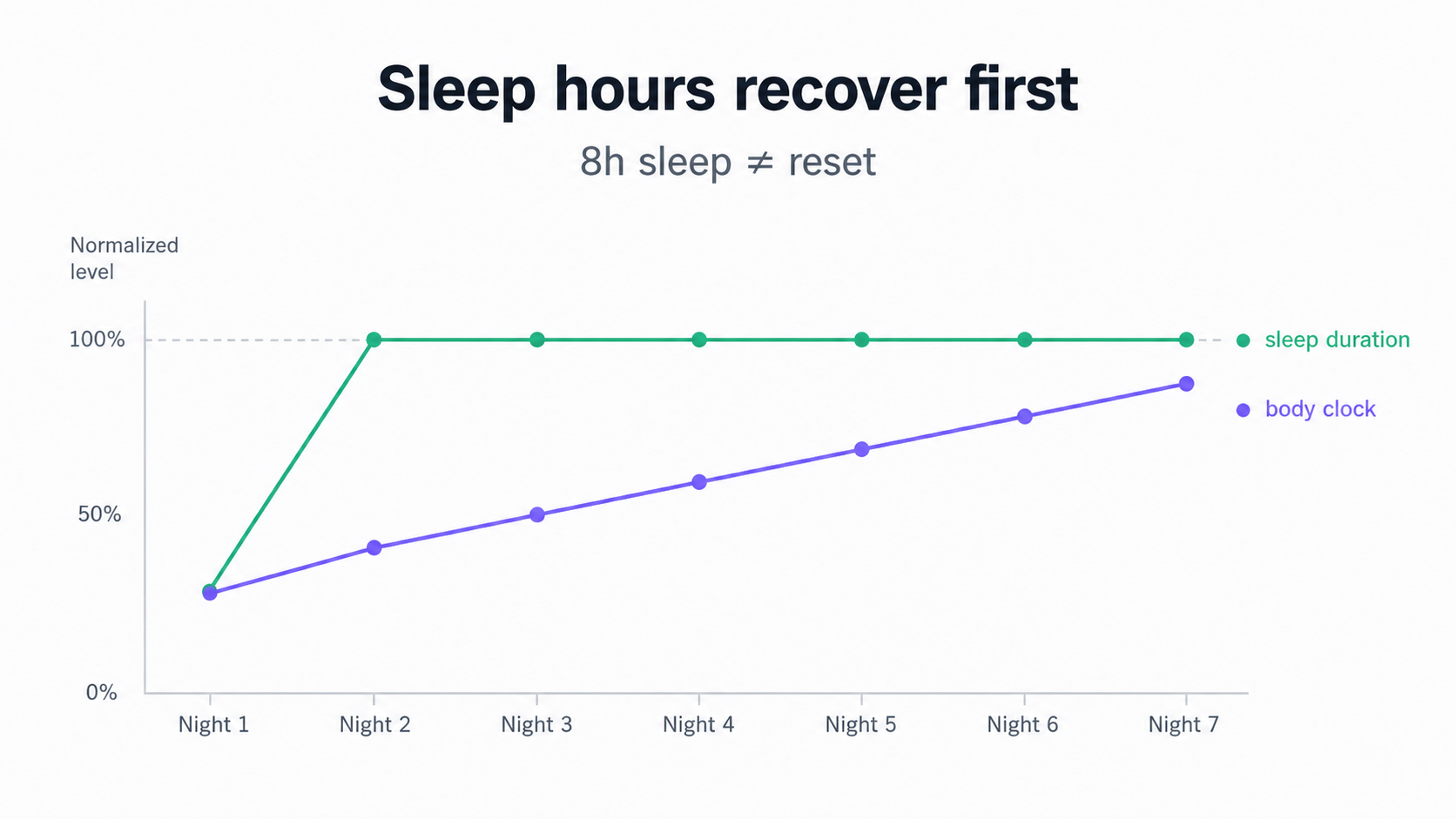
This mismatch explains a lot of the confusion around travel fatigue. People assume that once they're sleeping a full night again, the jet lag is over, then can't understand why concentration, mood, and digestion still feel off. The Mayo Clinic's overview of jet lag lists irritability, difficulty concentrating, and stomach trouble alongside the more obvious sleep complaints, and in my experience those symptoms often outlast the sleep problems themselves. A useful mental shift here is separating "did I sleep enough hours" from "is my clock actually reset," because those two questions have different answers and only one of them matters for how sharp you'll feel walking into a room.
Research comparing recovery strategies for eastward versus westward flights backs this up too: the interventions that help are direction specific, not generic. What speeds up recovery after a westbound flight can actively slow it down after an eastbound one, which is exactly why so many "just push through it" tips fail without warning.
This is where remote work and international family life complicate things further, because your obligations don't wait for your clock to catch up. If you're dialing into a standup at an hour that's morning for your team but the middle of your night, or trying to read a bedtime story over video call at a time your body thinks is mid-afternoon, you're layering a second schedule conflict on top of the one your circadian system is already fighting. I've had weeks where the flight itself was the easy part, and the harder adjustment was a household running on one clock while my body insisted on another. Recognizing that these are two separate problems, one biological and one logistical, has helped me stop blaming poor recovery on a lack of willpower when really it was just two schedules pulling in opposite directions.
A practical first 48 hours recovery plan
None of this calls for a complicated ritual, and I'd be suspicious of anyone selling you one. It comes down to managing three things deliberately: light, timing of small habits, and your own expectations for how you'll feel.
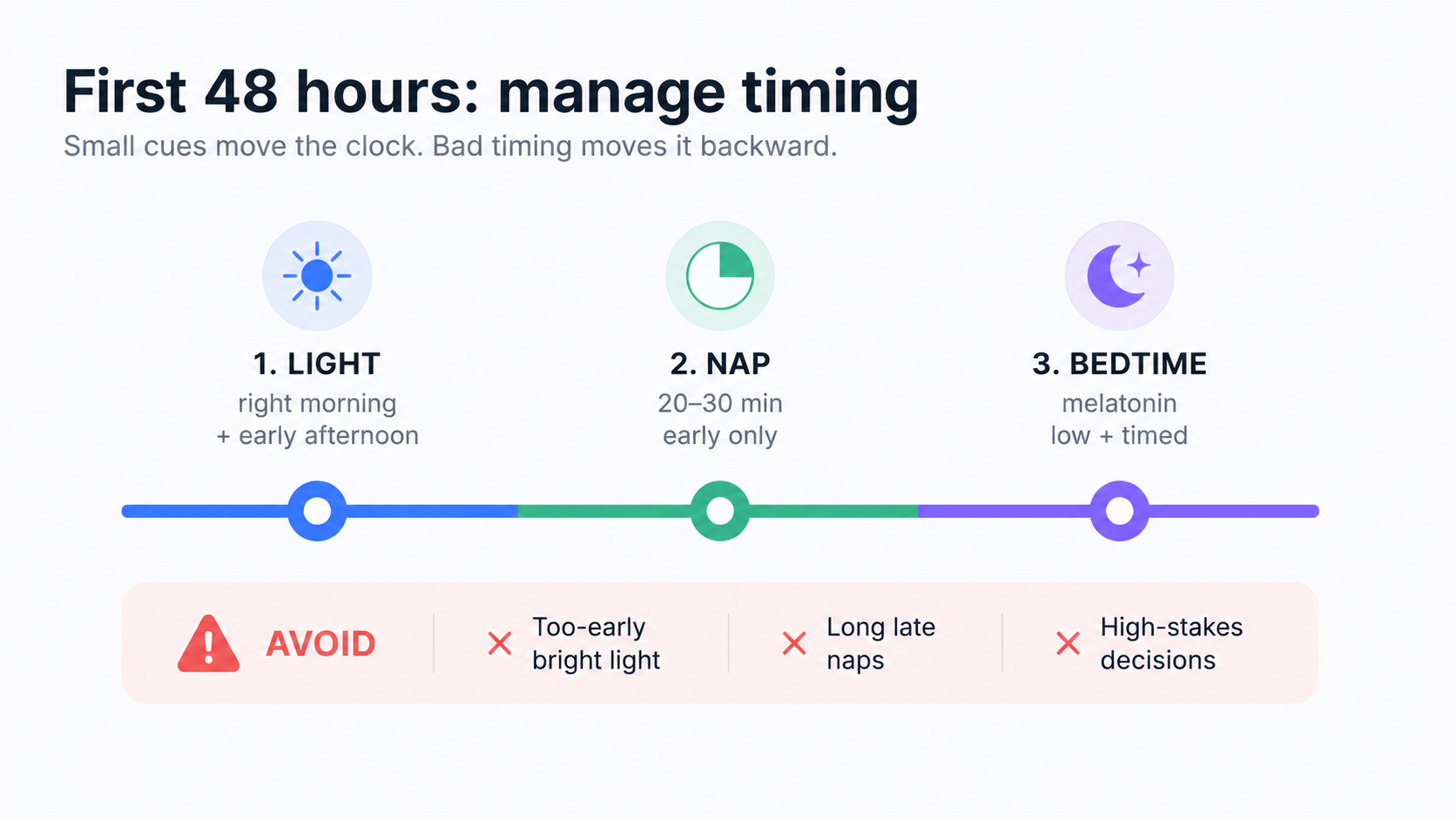
On light, the goal after eastward travel is to get bright light in the late morning and early afternoon at your destination, and to actively avoid it for the first hour or two after you'd normally still be sleeping back home. That sometimes means wearing sunglasses on a bright morning, which feels ridiculous standing in an airport arrivals hall, but it works. The Sleep Foundation's practical guidance on this is worth reading before a big trip rather than after, since the timing only helps if you plan for it in advance instead of improvising once you're already exhausted.
On naps, keep them short and early. Twenty to thirty minutes in the early afternoon can take the edge off without eating into the pressure that builds up to help you sleep that first night. A long nap, especially a late one, will feel wonderful in the moment and cost you three more days of misaligned sleep.
On melatonin, timing matters more than dose. A systematic review of melatonin trials covering travelers found that low doses taken close to the target bedtime at the destination reduced jet lag after flights of five or more time zones, particularly eastward ones. Taken at the wrong time, though, it can make the misalignment worse rather than better, so this is one case where more research beforehand pays off more than more supplement afterward.
The expectations part is the one people skip. I've made it a rule not to schedule anything that requires sharp judgment, difficult negotiation, or a first impression on the day I land after a six hour or larger eastward shift. Not because I can't function, but because I now know my baseline that day is genuinely lower, and pretending otherwise has cost me more than once. Building in a quieter first day, even a half day, tends to save more time than it costs.
None of this is about eliminating jet lag entirely. Some disruption after a big time zone change is simply the cost of getting somewhere fast. But understanding why eastward trips hit harder, why your sleep hours can look fine while your clock is still catching up, and which small habits genuinely move the needle, makes the whole experience a lot less baffling. That, more than any single trick, is what's made travel easier for me over time.
FAQ
How long does jet lag usually last? As a rough guide, your circadian clock adjusts by about one time zone per day, so a nine hour shift can take the better part of a week to fully resolve. Sleep duration typically recovers faster than that, often within a couple of nights, which is part of why people underestimate how long the underlying misalignment really lasts.
Is jet lag really worse flying east than west? For most people, yes. Your internal clock naturally runs slightly longer than 24 hours, so it adapts more easily to a longer day, which is what westward travel creates, than to a shorter one, which is what eastward travel demands. Large-scale sleep data backs this up, showing more disrupted sleep timing and architecture after eastward trips than after westward ones covering the same distance.
Does melatonin actually help with jet lag recovery? For flights crossing five or more time zones, taken at the right time, low-dose melatonin has reasonably strong evidence behind it, particularly for eastward travel. The timing is the part that matters most. Taken at the wrong point in your cycle, it can work against you instead of helping, so it's worth understanding the direction and size of your specific trip before deciding when to take it.
*This article is for informational purposes only and is not a substitute for professional medical advice, diagnosis or treatment.*
Related articles
Best Apple Watch Apps for Recovery Tracking in 2026
Your Apple Watch already tracks sleep, HRV, heart rate, and activity, but recovery can still feel confusing without clear interpretation. This guide compares the best Apple Watch recovery apps for 2026, from simple daily energy scores to deeper training-readiness tools, helping you choose the right app for your goals.
Recovery Score, Energy Score, Readiness, Body Battery — What Actually Matters
What recovery score means, how energy and readiness score differ, and body battery vs recovery — plus which numbers actually deserve your attention.