Normal oxygen saturation does not establish a normal hemoglobin level
By Mr.Apps · Oct 26, 2026
Category:Energy
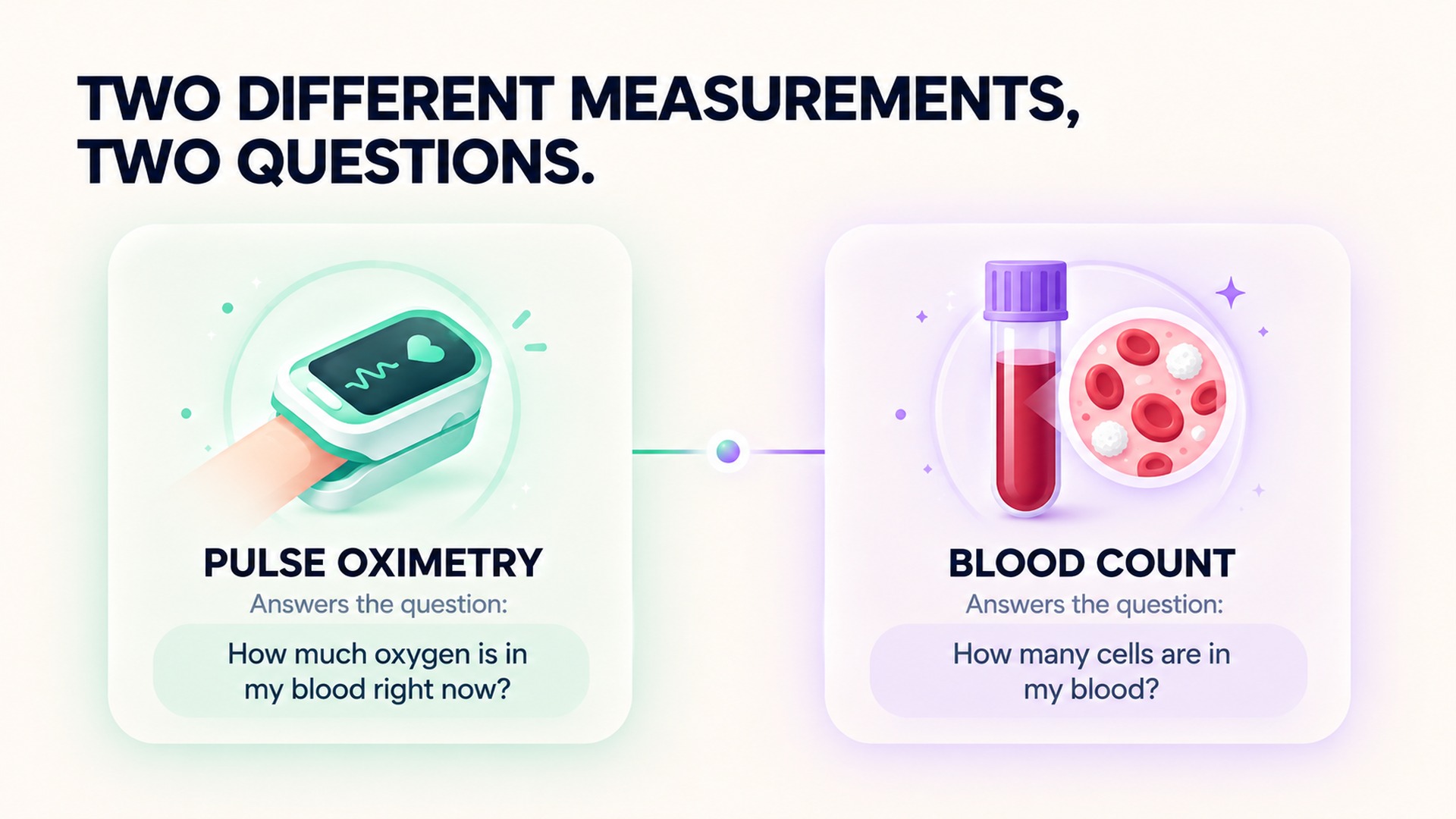
A pulse oximeter can show a reassuring oxygen saturation while a separate question about hemoglobin remains unanswered. The two measurements describe different properties of blood. Oxygen saturation estimates the share of hemoglobin binding sites carrying oxygen at the time of measurement. Hemoglobin concentration estimates how much of the oxygen-carrying protein is present in a given volume of blood. A normal percentage therefore does not establish that the total amount of hemoglobin is normal.
This distinction matters when fatigue, reduced exercise tolerance, weakness, or other symptoms lead to a clinical review. A wearable or fingertip sensor cannot substitute for a blood count, and a blood count does not explain every symptom by itself. Each result adds a different piece of information. I treat a pulse-oximeter reading as one observation about oxygenation, not as a general certificate that the blood can carry an adequate amount of oxygen or that anemia is absent.
What oxygen saturation measures
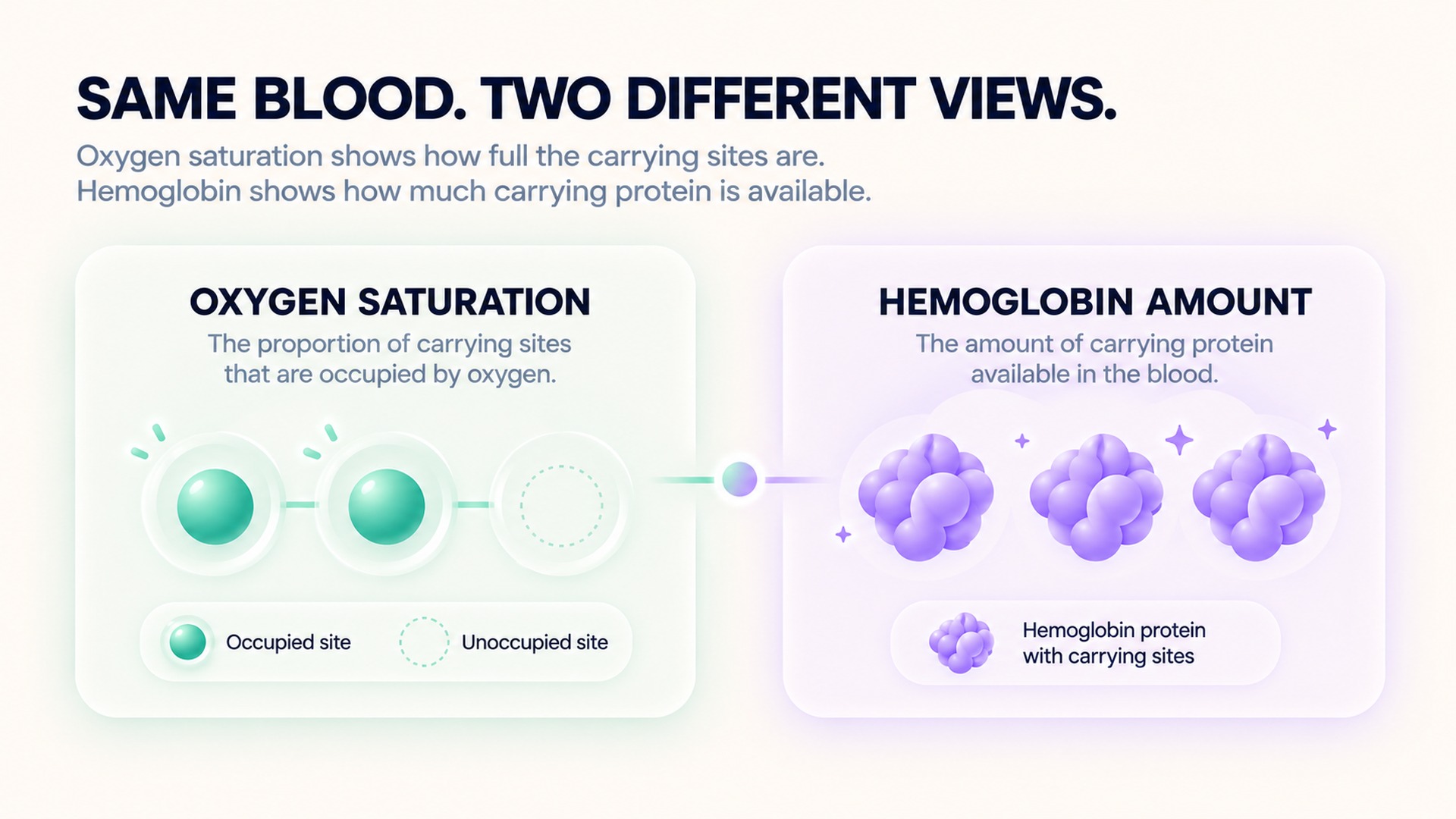
Hemoglobin contains sites that can bind oxygen. A pulse oximeter shines light through a tissue area and estimates what proportion of arterial hemoglobin is oxygenated. The number is a percentage. It does not count hemoglobin molecules, measure the hemoglobin concentration in a blood sample, or directly assess how much oxygen reaches every tissue. The pulse oximetry overview describes the test as a way to estimate oxygen saturation and notes that readings have limitations.
The distinction between proportion and total quantity is familiar in other settings. A container can be nearly full of a substance while the container itself is small; the proportion and the total amount are different questions. In blood, a high share of available hemoglobin may be carrying oxygen even if the overall hemoglobin concentration is low. The saturation can therefore appear within an expected range while the amount of carrying protein deserves separate evaluation.
A pulse oximeter is also an estimate, not a direct laboratory count. Movement, circulation, temperature, skin characteristics, nail products, device quality, and other conditions can affect its accuracy. The reading should be interpreted with the person's symptoms and the way it was collected. A single result should not overrule concerning symptoms or delay appropriate care. The clinical review of oxygen saturation explains why a normal saturation does not guarantee normal oxygen delivery in every circumstance, including when hemoglobin is substantially reduced.
What hemoglobin concentration measures
A hemoglobin blood test measures the amount of hemoglobin in a specified volume of blood. Hemoglobin is the protein in red blood cells that carries oxygen. A low concentration may be part of an anemia evaluation, but its interpretation depends on factors such as the laboratory range, age, pregnancy status, altitude, hydration, and the broader medical history. The hemoglobin test overview describes the measurement and its use in evaluating blood health.
A complete blood count reports hemoglobin alongside other information, often including red blood cell count, hematocrit, and measures of cell size. These values are related but not interchangeable. Hemoglobin is not a direct measure of oxygen saturation, and saturation is not a replacement for hemoglobin. A blood count may help identify a pattern that warrants follow-up, but it cannot on its own reveal every cause. The complete blood count guide explains the separate components that may appear on a report.
Why a normal saturation cannot rule out anemia
The arithmetic is straightforward: saturation is a fraction, while hemoglobin concentration is an amount per volume. If fewer hemoglobin molecules are present, a large proportion of those that remain can still bind oxygen. The percentage may look ordinary because the sensor estimates how many binding sites are occupied, not how many sites exist in total. This is why a normal reading cannot establish a normal hemoglobin level.
Oxygen delivery also depends on more than saturation. It is influenced by the amount of hemoglobin, the share carrying oxygen, blood flow, and the body's ability to use oxygen. A fingertip reading does not measure all of those elements. The oxygen bound to hemoglobin is only one part of a larger physiological process. This explanation does not mean that a normal saturation is meaningless; it means the result answers a narrower question than many people assume.
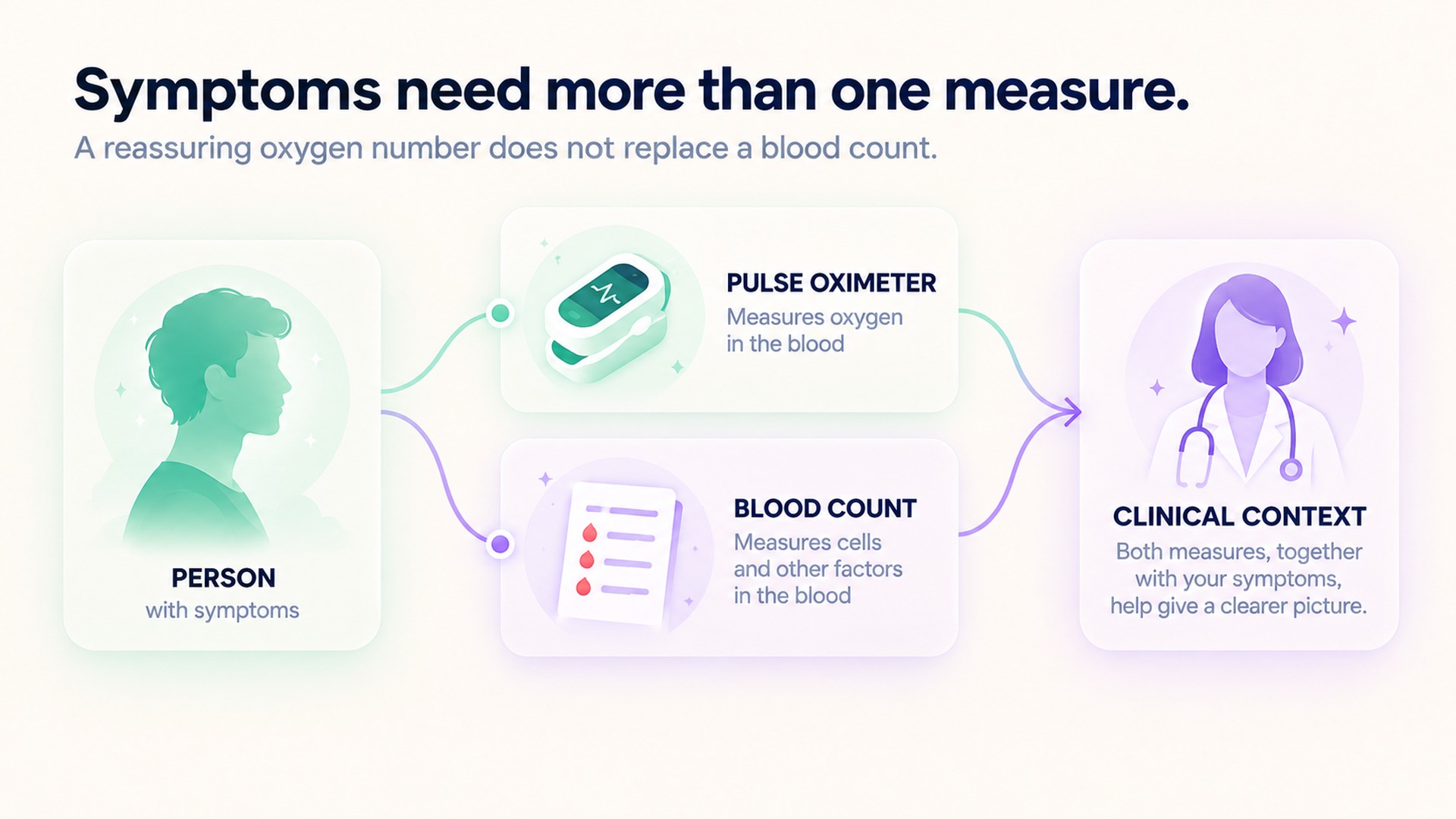
Symptoms can be relevant but are not specific. Fatigue, shortness of breath with activity, lightheadedness, or reduced stamina may have many explanations. Anemia is one possibility among others. The absence of a symptom does not interpret a laboratory result, and the presence of fatigue does not prove a blood disorder. A clinician considers how symptoms began, what else changed, the blood count, medical history, and additional tests when appropriate. The overview of anemia describes anemia as a condition involving too few healthy red blood cells or insufficient hemoglobin, with multiple possible causes.
A broad public-health explanation of anemia also emphasizes that diagnosis depends on clinical and laboratory assessment. The anemia fact sheet describes the condition and the role of blood testing. These references do not make a home oxygen reading a diagnostic test for anemia. They show why a blood count and a clinical review answer a different question from an oxygen saturation estimate.
The label on a report also matters. A consumer device may display an estimate of peripheral oxygen saturation, while a clinical blood gas may report oxygen saturation using a different method and sample. Neither label should be silently converted into a hemoglobin result. If a chart imports a percentage without preserving whether it came from a fingertip device or a laboratory test, it can make unrelated values look comparable. Keep the source and measurement name visible whenever results are copied or summarized.
Concentration can also be influenced by the amount of fluid in the bloodstream. A measurement may appear higher or lower when plasma volume changes, even though the total red-cell mass has not changed in the same way. This is another reason a clinician considers the full blood count and circumstances rather than treating one number as a fixed description of the body's total oxygen-carrying capacity. The laboratory report, hydration context, recent illness, and earlier results can all shape the interpretation.
The distinction is useful even when both measurements are within their respective reference ranges. A normal saturation does not answer whether a person has enough hemoglobin, and a hemoglobin result does not show how much of it is carrying oxygen at a particular moment. The tests are complementary when a clinical question calls for both. They should not be combined into a single score or treated as interchangeable evidence simply because both relate to oxygen transport.
Put the measurements in the same record
When discussing fatigue or exercise tolerance, keep the original pulse-oximeter reading and the blood count as separate entries. Include the date and time, the device or test type, the units, the laboratory's reference interval, and the circumstances that may have affected the reading. Do not copy only the percentage into a chart labeled “blood oxygen” if the original report used a different term. Clear labels help prevent a proportion from being mistaken for a concentration.
If the reading was collected during symptoms, note what was happening and whether the measurement was repeated. Avoid repeatedly checking a consumer sensor to settle a clinical question it was not designed to answer. If symptoms are severe, sudden, or worsening, follow appropriate medical guidance rather than waiting for a device to cross a threshold. This article does not set a universal sensor value for seeking care.
For a clinical appointment, preserve the full blood count report rather than just the hemoglobin line. Other values may help the clinician decide whether further evaluation is needed. Bring a record of relevant symptoms and any previous test results. If a result seems inconsistent with how someone feels, that mismatch is a reason to ask how the tests fit together, not to conclude that one measurement must be wrong.
Keep consumer readings in their role
A wearable may track activity, sleep, or estimated oxygen-related metrics, depending on the device. Those features do not measure hemoglobin concentration and cannot confirm or exclude anemia. A reassuring nightly trend may be useful context about the device's estimate, but it cannot replace a laboratory measurement. Likewise, a low energy score is not evidence that hemoglobin is low.
A broader explanation of how health app measurements should be read is available in this overview of interpreting health biomarkers. The practical distinction remains simple: saturation estimates the proportion of hemoglobin carrying oxygen; a blood count measures hemoglobin amount and other cell characteristics. When fatigue is being reviewed, those results should be interpreted alongside symptoms and clinical history.
Questions people ask
Can a normal pulse-oximeter result rule out anemia?
No. The percentage estimates how much available hemoglobin is carrying oxygen. It does not measure the total hemoglobin concentration. A blood test is needed to assess hemoglobin concentration.
Does low hemoglobin always cause fatigue?
No. Symptoms vary, and fatigue has many possible causes. A clinician interprets the blood count with the person's history, symptoms, and other findings rather than using fatigue alone to assign a diagnosis.
Should an oxygen reading replace a blood count?
No. Pulse oximetry and a blood count answer different questions. Keep both measurements labeled with their dates and units, and ask a clinician how they relate to the concern being evaluated.
*This article is for informational purposes only and is not a substitute for professional medical advice, diagnosis or treatment.*
Sources:
National Library of Medicine·National Library of Medicine·National Library of Medicine·StatPearls Publishing·National Heart, Lung, and Blood Institute·World Health Organization
Related articles

A raised CRP result cannot identify the source of inflammation
A raised CRP can signal inflammation, but it cannot identify where the process is or what caused it. Learn why standard CRP and high-sensitivity CRP serve different purposes and need clinical context.

When a vitamin B12 result needs a methylmalonic acid check
Learn why a clinician may consider methylmalonic acid when a vitamin B12 result leaves a question unresolved. See how kidney function, symptoms, medicines, and other tests shape interpretation.

Reading TSH and free T4 together in a fatigue review
Learn what TSH and free T4 contribute to a fatigue review and why the two results need clinical context. See how symptoms, medicines, timing, and prior results help keep a lab value in its proper role.

Why Metabolic Energy Efficiency and Daily Energy Are Different Concepts
Metabolic energy efficiency describes processes involved in handling fuel, while a daily energy score is usually a separate app estimate about patterns such as sleep, activity, and recovery. Similar wording does not mean the two measures track the same thing.

Why a Monthly Metabolic Trend Cannot Explain One Meal
A monthly metabolic trend summarizes signals across a longer window and cannot identify what one meal did to glucose or insulin. Read it as a broad estimate, keep meal notes in their proper context, and use clinical testing for medical questions.

How Charging Gaps Break a 24-Hour Energy Timeline
Removing a wearable to charge creates a period when the device may not record the signals used by an energy model. A 24-hour timeline should mark that gap instead of treating it as neutral or connecting the surrounding values as continuous measurement.

How to Compare Energy Drain Across Days With Different Starting Scores
The ending value alone can hide how much an energy score changed during the day. Compare the start, decline, timing and data coverage on the same scale before interpreting differences between days.

Why Missing Hours Need to Be Visible on an Energy Timeline
Connecting two known points across an unmeasured interval can invent a smooth story about the day. An energy timeline should mark missing hours clearly so estimates, observations and unknown periods remain distinct.

How to Tell Recharge From Reduced Drain in an Energy Timeline
A flatter energy curve can mean that the model estimates slower decline, while a rising curve suggests modeled recharge. Check the timeline’s direction, update timing and inputs before deciding which interpretation fits the display.

Why a Full Morning Energy Score Can Fall Quickly
A high morning energy score is a starting estimate, not a guarantee that the rest of the day will decline slowly. The later curve depends on what the model tracks, which inputs arrive and how the score represents changing demand.