Running pace and running speed use reciprocal units
By Mr.Apps · Nov 3, 2026
Category:Training

Pace and speed describe one run in opposite directions
Running pace and running speed are reciprocal ways to describe distance over time. Pace tells how much time a runner takes to cover one unit of distance, such as minutes per mile or minutes per kilometer. Speed tells how much distance is covered in one unit of time, such as miles per hour or kilometers per hour. Both can describe the same movement, but they use different units and respond differently to a change in performance.
I keep the source value and its converted form in separate labeled fields.
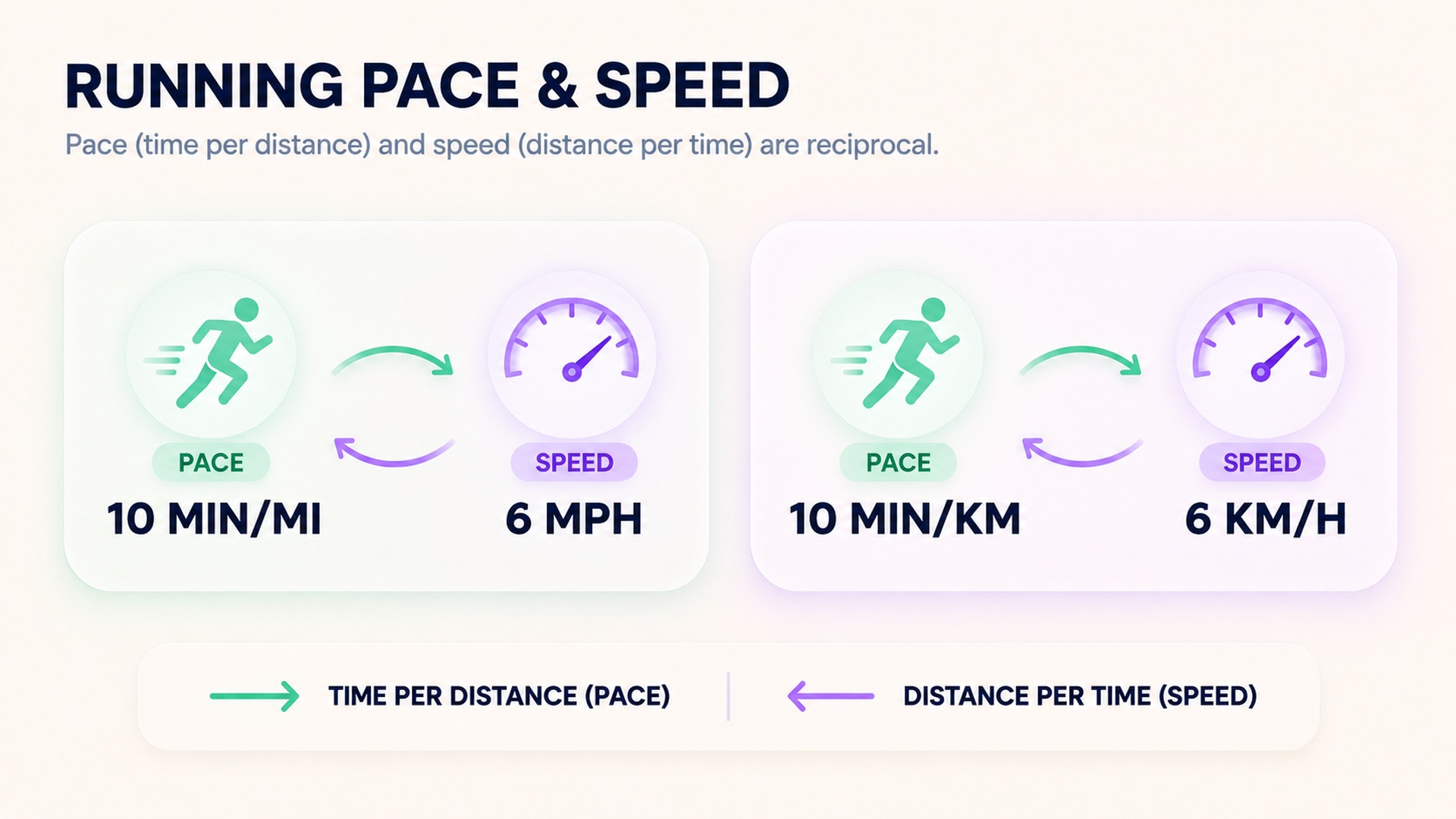
If a watch shows 10 minutes per mile, the corresponding speed is 6 miles per hour because 60 minutes divided by 10 minutes per mile equals 6 miles per hour. If the display shows 10 kilometers per hour, the corresponding pace is 6 minutes per kilometer. The international unit reference on speed treats speed as distance divided by time; pace reverses that ratio. Keeping the unit visible prevents a pace number from being read as a speed number.
How the reciprocal conversion works
When pace is expressed in minutes per mile, divide 60 by that pace to get miles per hour. When pace is minutes per kilometer, divide 60 by that pace to get kilometers per hour. The number 60 represents minutes in one hour. The distance unit stays the same throughout the conversion, so minutes per mile becomes miles per hour and minutes per kilometer becomes kilometers per hour.
For example, a pace of 8 minutes per mile converts to 7.5 miles per hour: 60 ÷ 8 = 7.5. A pace of 5 minutes per kilometer converts to 12 kilometers per hour: 60 ÷ 5 = 12. These are arithmetic examples, not performance standards. They do not suggest that a particular pace is easy, hard, safe, or appropriate for any individual.
The reverse calculation uses the same relationship. Divide 60 by miles per hour to get minutes per mile, or divide 60 by kilometers per hour to get minutes per kilometer. At 8 miles per hour, the pace is 7.5 minutes per mile. A decimal fraction of a minute must be converted to seconds: 0.5 minute equals 30 seconds. The pace is therefore 7 minutes 30 seconds per mile, often written 7:30/mi.
Convert distance units before comparing pace
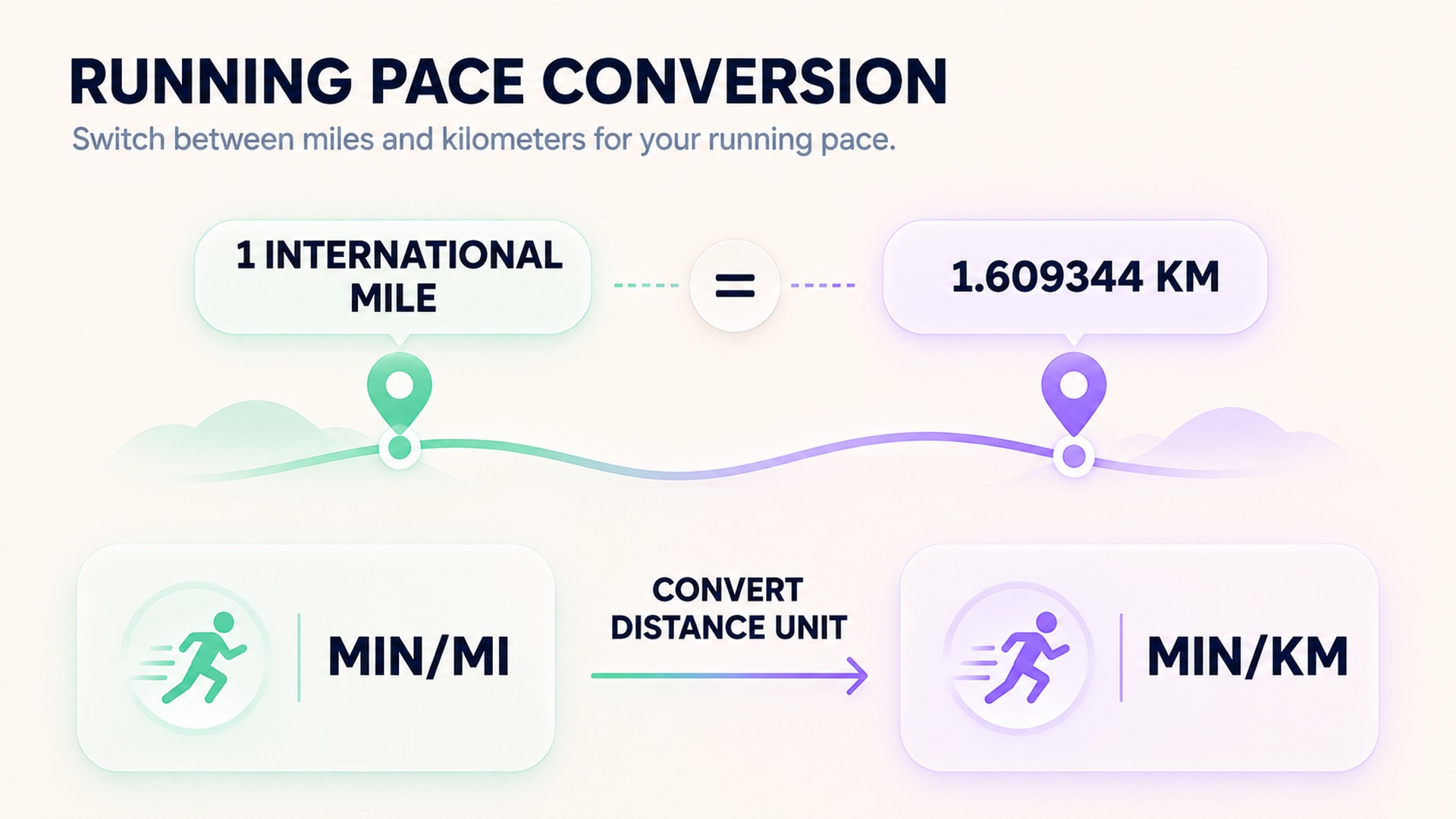
Pace in minutes per mile and pace in minutes per kilometer use different distance units. The same duration per mile cannot be compared directly with the duration per kilometer. The conversion reference for mile and speed units lists the conversion between miles, kilometers, and miles per hour. One international mile is 1.609344 kilometers, so a pace of 8 minutes per mile is about 4 minutes 58 seconds per kilometer.
To convert minutes per mile to minutes per kilometer, divide the min/mile figure by 1.609344. To convert min/km to min/mi, multiply by 1.609344. The conversion table for miles, hours, and meters lists the related distance and time factors. Keep the original pace, converted pace, and units together if both are useful. Rounding may make two displays look slightly different even when they represent the same underlying value.
Do not substitute a survey mile or nautical mile unless the source specifically uses one of those units. Running displays normally use the common international mile or kilometer. The conversion table distinguishing international and survey miles distinguishes the international mile from the U.S. survey mile. For ordinary running logs, the distinction is small, but a source's stated unit remains the safest basis for an exact calculation.
Preserve the original time and distance
The pace-speed conversion is only as clear as the distance and time inputs. A watch may report elapsed time, moving time, lap time, or a smoothed interval. The pace calculated from each can differ. If a runner stops briefly, a moving-time pace may omit that pause, while elapsed time includes it. The article about moving time in pace charts explains why the time basis belongs beside the displayed pace.
Distance can also come from different sources. A GPS estimate, foot pod, treadmill belt, and manually entered distance may not agree exactly. If the distance changes, the calculated pace changes even if the recorded time remains constant. Keep the original device distance and source visible rather than replacing it with a second value whose origin is unclear.
If the purpose is to compare two runs, retain the same distance unit, time basis, and interval definition where possible. A lap pace for one mile is not directly comparable with an instantaneous pace reading taken at a moment. A total-run average can also conceal variations across hills or intervals. Pace and speed conversions do not remove those differences; they only re-express one chosen distance-time ratio.
Use conversions carefully in workout displays
A watch or treadmill can switch between pace and speed in its settings. Check the unit on the screen after changing the display, especially if a workout was entered in one format and exported in another. Some devices show pace as minutes:seconds per mile; others show decimal minutes, minutes per kilometer, or distance per hour. A number without its unit is incomplete.
When setting a workout, use the unit in the written plan. If a training plan calls for a speed in miles per hour and the treadmill is set to minutes per mile, convert it before starting. Do not interpret a faster speed number as a faster pace number; in pace notation, a smaller time per mile means faster movement. The running pace and distance guidance for an exercise monitor describes device settings that affect how pace and distance are shown when GPS is unavailable. One watch manual's speed settings let users choose kilometers per hour or minutes per kilometer. These are device-specific display references, not a universal guarantee that all indoor distance estimates match.
An entry could record “8:00 min/mi average, moving time” or “7.5 mph treadmill speed, 30 minutes.” The labels keep the measurement interpretable. If a device stores a pace as seconds per kilometer but a spreadsheet expects minutes per mile, the conversion should be visible in the formula or notes. Keep unrounded source values if exact calculations matter.
Avoid false precision when rounding
Conversions can create many decimal places, but the source measurement may not justify them. A watch that rounds pace to the nearest second per kilometer does not support reporting a highly precise miles-per-hour result. Round the converted value to a level consistent with the original display and purpose. Preserve the unrounded calculation in a separate field only when the input precision supports it.
Rounding order also matters. Convert the underlying value first, then round the final output. Rounding a pace early and converting the shortened number can create a small additional difference. For everyday training summaries, a second or one decimal place may be sufficient, but the chosen precision should not suggest a measurement accuracy the device did not provide.
Keep pace and speed separate from effort claims
Pace and speed describe movement over distance and time. They do not directly measure perceived effort, heart rate, terrain, temperature, or physiological response. Two runs with the same pace can feel different because the route and conditions differ. A conversion does not make those sessions equivalent. It changes the unit used to express the same distance-time relationship.
If a runner compares a treadmill display with an outdoor watch, preserve both source and activity type. Treadmill belt speed may be calibrated differently from GPS-derived outdoor speed. Foot pod and watch algorithms can also smooth or filter values. The unit conversion will be mathematically correct for the values entered, but the input values may come from different measurement systems.
A reliable conversion record
For a converted result, record the original pace or speed, original unit, distance and time basis, conversion formula, and rounded output. For example: “source 8:00 min/mi; 60 ÷ 8 = 7.5 mph.” This makes it possible to review the calculation and identify whether a later value changed because of units, time basis, or source distance.
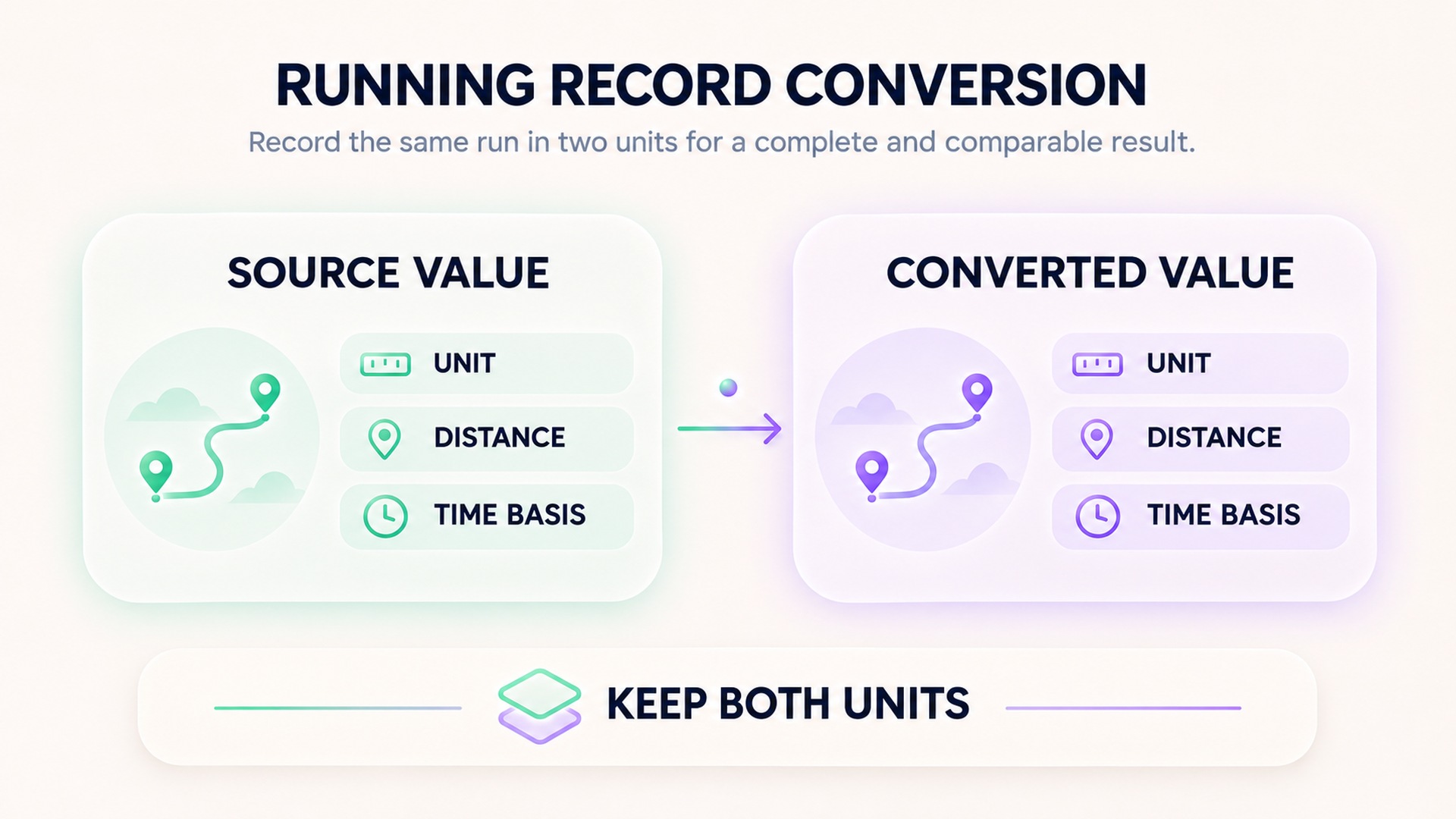
If a workout platform changes its display preferences, update the label, not the meaning of the historic data. A 5:00 min/km entry remains a pace value even if a newer watch face displays speed in km/h. Keep the original data and use a separate converted field when needed. The reciprocal relationship is simple once units are explicit: pace is time per distance; speed is distance per time.
Frequently asked questions
How do I convert minutes per mile to miles per hour?
Divide 60 by the pace in minutes per mile. For example, 10:00 per mile corresponds to 6 mph. Keep the pace's unit and rounding visible.
Is a smaller pace number faster or slower?
A smaller time per distance is faster. For instance, 7:00 per mile is faster than 8:00 per mile because less time is used to cover the same distance.
Why can my converted pace differ slightly from a watch display?
The watch may round the source value, use a different time basis, or estimate distance differently. Convert from the original time and distance when possible, and retain the source unit.
*This article is for informational purposes only and is not a substitute for professional medical advice, diagnosis or treatment.*
Sources:
National Institute of Standards and Technology·National Institute of Standards and Technology·National Institute of Standards and Technology·National Institute of Standards and Technology·Garmin Support·Polar
Related articles

Single-sided cycling power relies on a symmetry assumption
A single-sided power meter measures one leg and may double that value to estimate total cycling power. Preserve which side and device produced the number so an estimate is not mistaken for a bilateral measurement.
Power meter zero offset needs its own setup record
A power meter zero offset records the sensor's unloaded baseline at a particular time. Keep the meter identity, procedure, conditions, and returned status separate from training targets and workout power values.

Handrail support changes the context of a treadmill session
Treadmill handrail use can change the movement task even when speed and incline stay constant. Record whether support was light, intermittent, or sustained so session comparisons do not assume the machine measured details it missed.
Treadmill incline percentages are not angles in degrees
Treadmill grade percentages and angles in degrees describe the same slope through different relationships. Preserve the machine's displayed unit and source so a workout setting is not mistaken for a measured angle.