Tattoos can affect optical heart rate readings differently from skin tone
By Mr.Apps · Oct 21, 2026
Category:Wearable
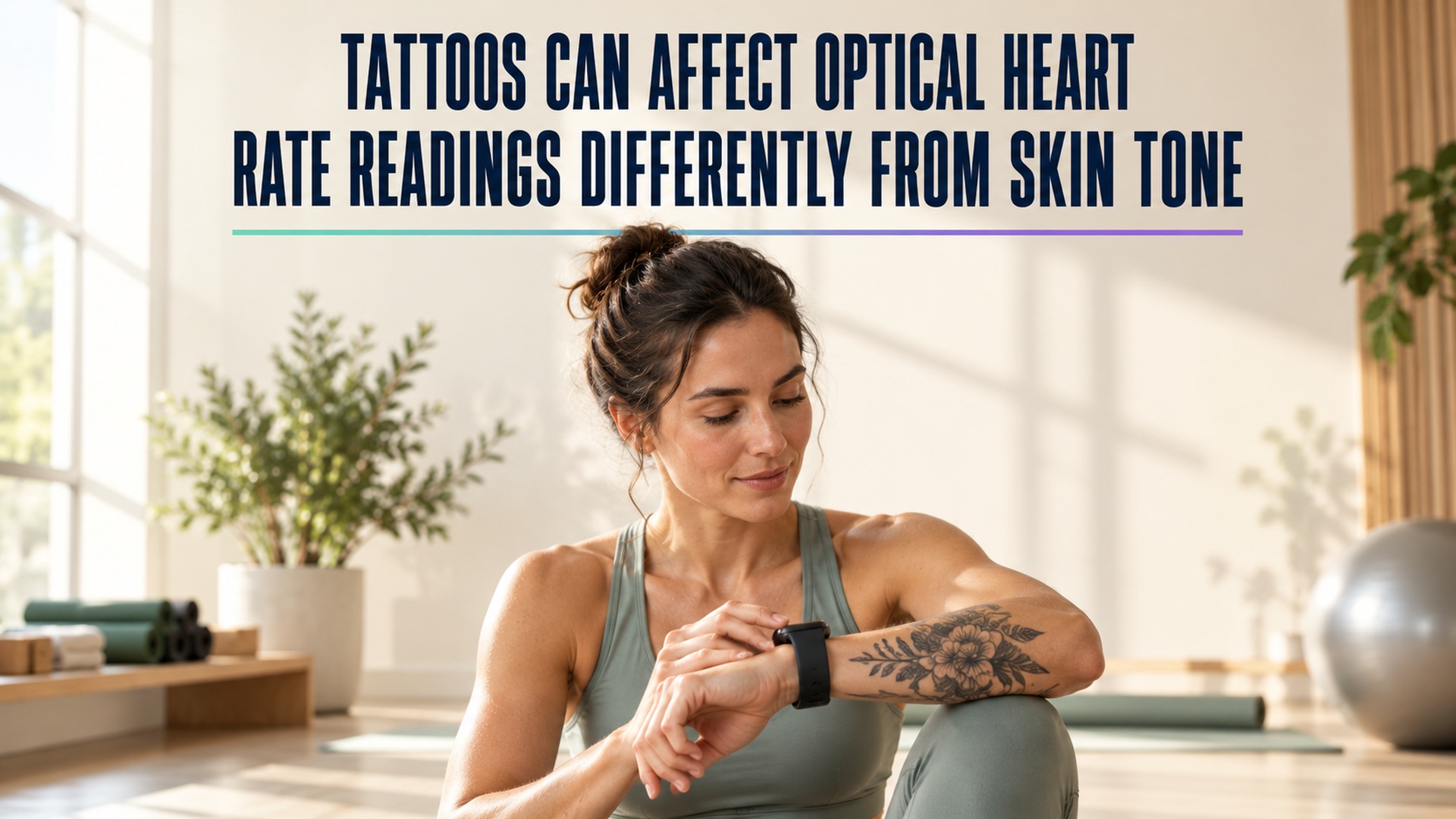
An optical heart-rate reading depends on the light signal a device can detect at the skin. A tattoo can alter that signal where the sensor sits, so some devices may show gaps, erratic values, or no reading over tattooed skin. That is a different measurement question from whether a device performs differently across natural skin pigmentation, and the two should not be treated as interchangeable.
The practical response is to check the exact sensor and placement rather than assume that every tattoo causes a problem or that a reading difference has one universal explanation. Optical sensors vary in their light sources, detector geometry, contact, algorithms, and placement. Research findings about one armband or wrist device do not establish the result for every wearable, tattoo design, skin tone, or activity.
How an optical sensor estimates pulse
Many wearables use photoplethysmography, often shortened to PPG. Small light emitters shine into the skin and a detector measures changes in reflected light associated with blood volume near the surface. The device's algorithm uses that changing optical signal to estimate pulse rate. It does not directly count electrical heartbeats in the same way as an ECG chest sensor.
For the estimate to work, the returning signal has to be strong and consistent enough for the device to separate pulse-related changes from movement, ambient light, and other variation. Fit, contact, motion, local blood flow, sensor design, and the body's position can affect the signal. Ink in the measurement area can also change how light reaches and returns from the tissue. The device guidance on optical measurement factors describes tattoos as one possible factor for a specific wrist-worn product; it is not a universal statement about every sensor.
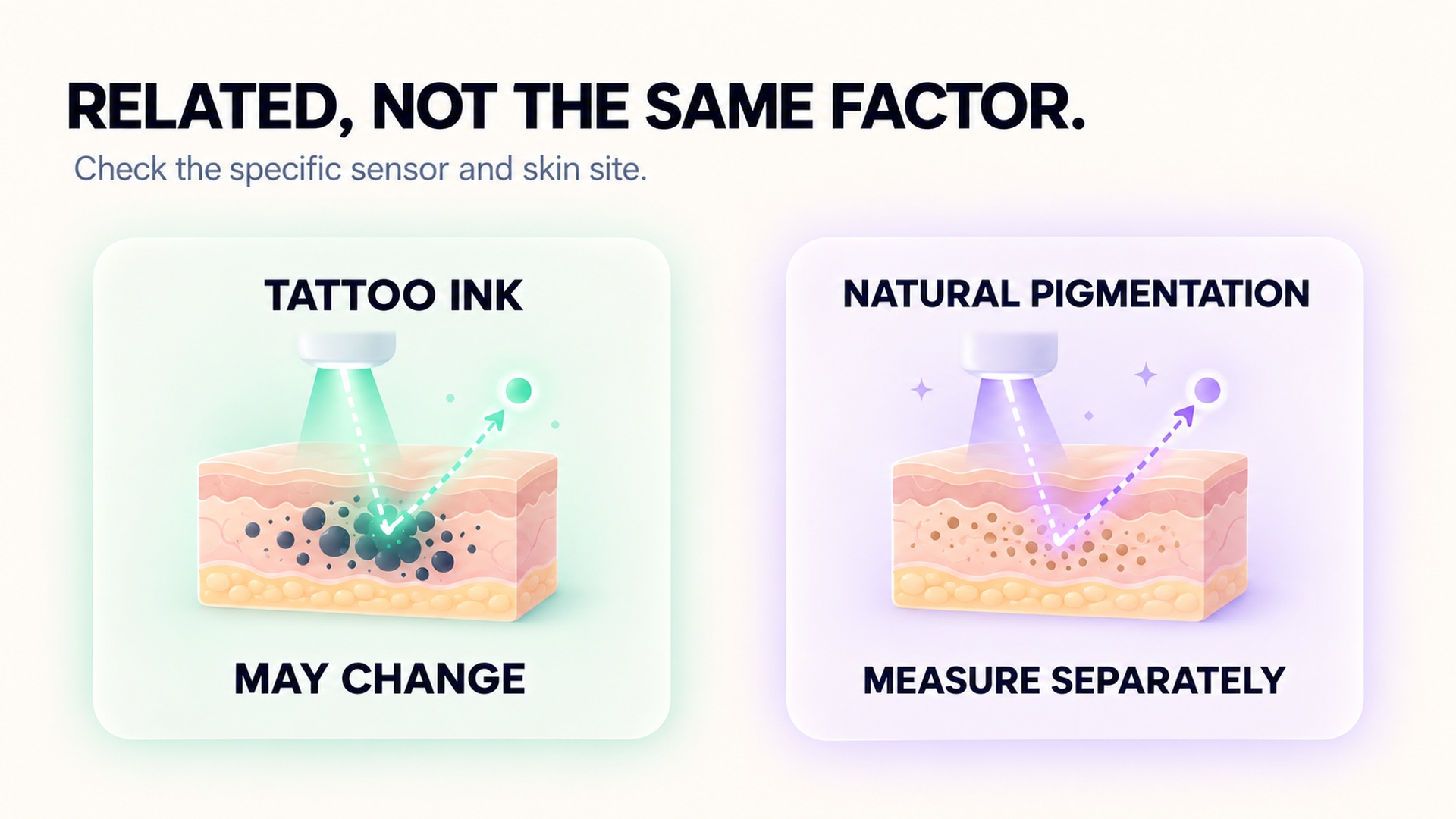
A tattoo and natural pigmentation are not the same variable
Tattoo ink is deposited pigment in the skin. Natural skin pigmentation is largely associated with melanin in the epidermis. Both can affect light interacting with skin, but they differ in distribution, composition, depth, pattern, and the specific area covered. Treating “dark skin” and “dark tattoo” as one category hides important differences in what is being measured and can lead to careless conclusions about accuracy.
Device makers and researchers may evaluate these characteristics separately. A study can compare a sensor on tattooed and non-tattooed areas of the same participant, examine natural skin pigmentation across participants, or test both factors in a particular sample. Those designs answer related but distinct questions. The systematic review of wrist-worn heart-rate measurement across skin tones found mixed results across the studies it included and called for better evidence with more objective pigmentation measures. That evidence cannot be substituted for a tattoo-specific test.
Tattoo coverage itself is not a single uniform condition. Ink color, density, coverage, pattern, age, and placement can vary. A small design beside the sensor may not affect the measurement area, while a dense design directly under the optical window may. But visual appearance alone does not predict exactly how a particular device will behave. Different sensor wavelengths and algorithms may respond differently, and a device may still read reliably on one tattooed area while struggling on another.
What tattoo-specific testing can show
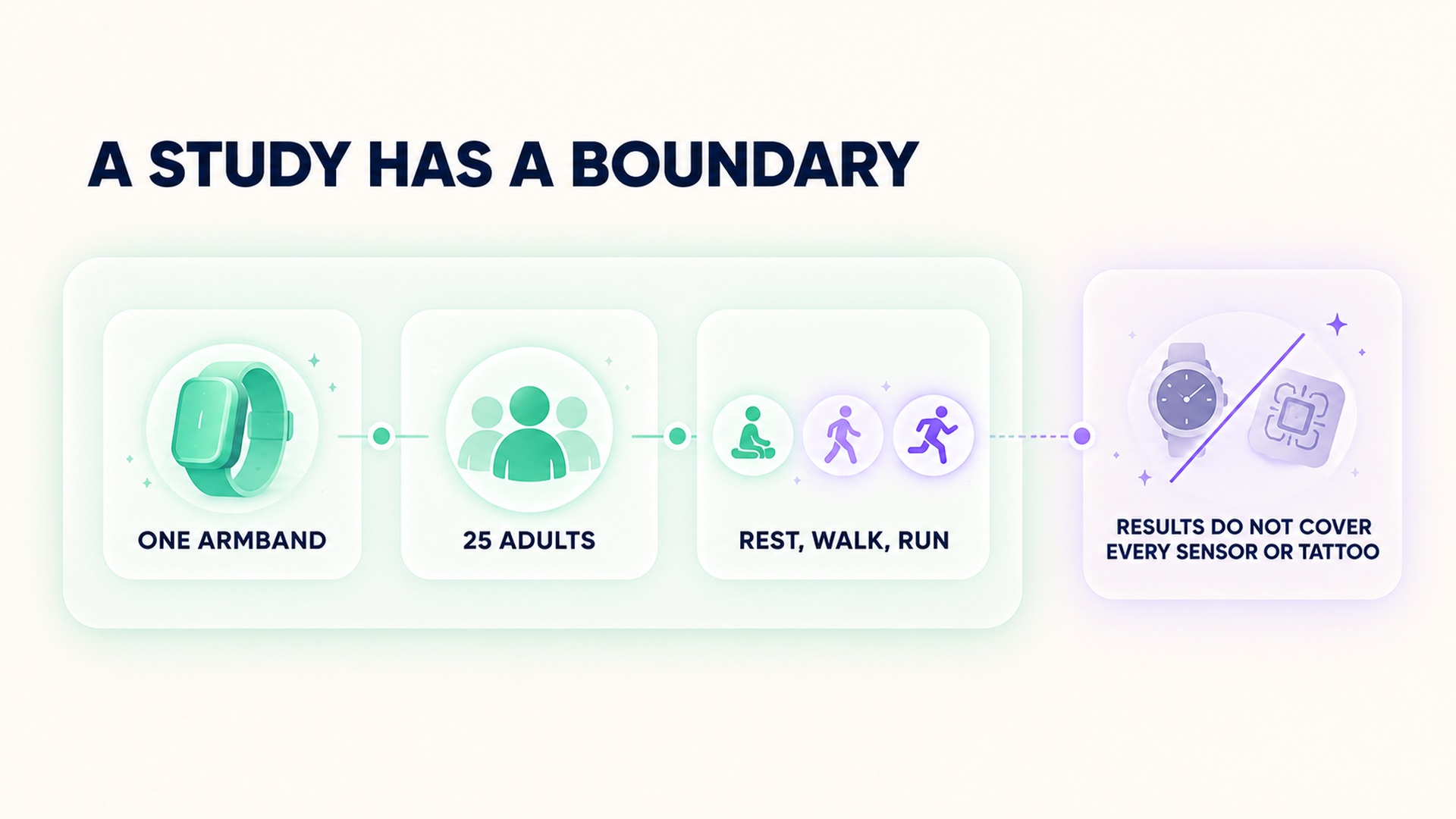
In one study, researchers compared an armband heart-rate monitor over tattooed and non-tattooed skin in 25 adults during rest, walking, and running, using a chest strap as the reference. The results found greater error over tattooed skin for that device and sample, particularly at rest. The authors did not find that the tattoo characteristics they evaluated statistically explained the errors, and they noted that more research is needed. The study record and its reported methods are useful for understanding the specific setup, not for predicting every wearable.
This distinction matters when applying a study result. A finding from an armband is not automatically a measured result for a watch worn on the wrist. An observed average error is not a guarantee that every individual reading is wrong by that amount. A limited sample cannot describe all tattoo designs, skin pigmentation, body locations, movement patterns, or device generations. The result supports checking sensor placement and data quality; it does not support declaring that all tattooed users get inaccurate readings.
Evidence about natural skin pigmentation also has important limits and differences. Reviews have found that results vary by device, activity, study design, and how skin tone is classified. A review of skin pigmentation and wearable pulse-rate accuracy examined a small number of wearable pulse-rate studies alongside a much larger set of pulse-oximetry studies. Those are not identical measurement conditions: wrist pulse-rate estimation and oxygen saturation measurement have different tasks and error criteria. Do not transfer a result for one endpoint to another.
Read the trace, not just the daily summary
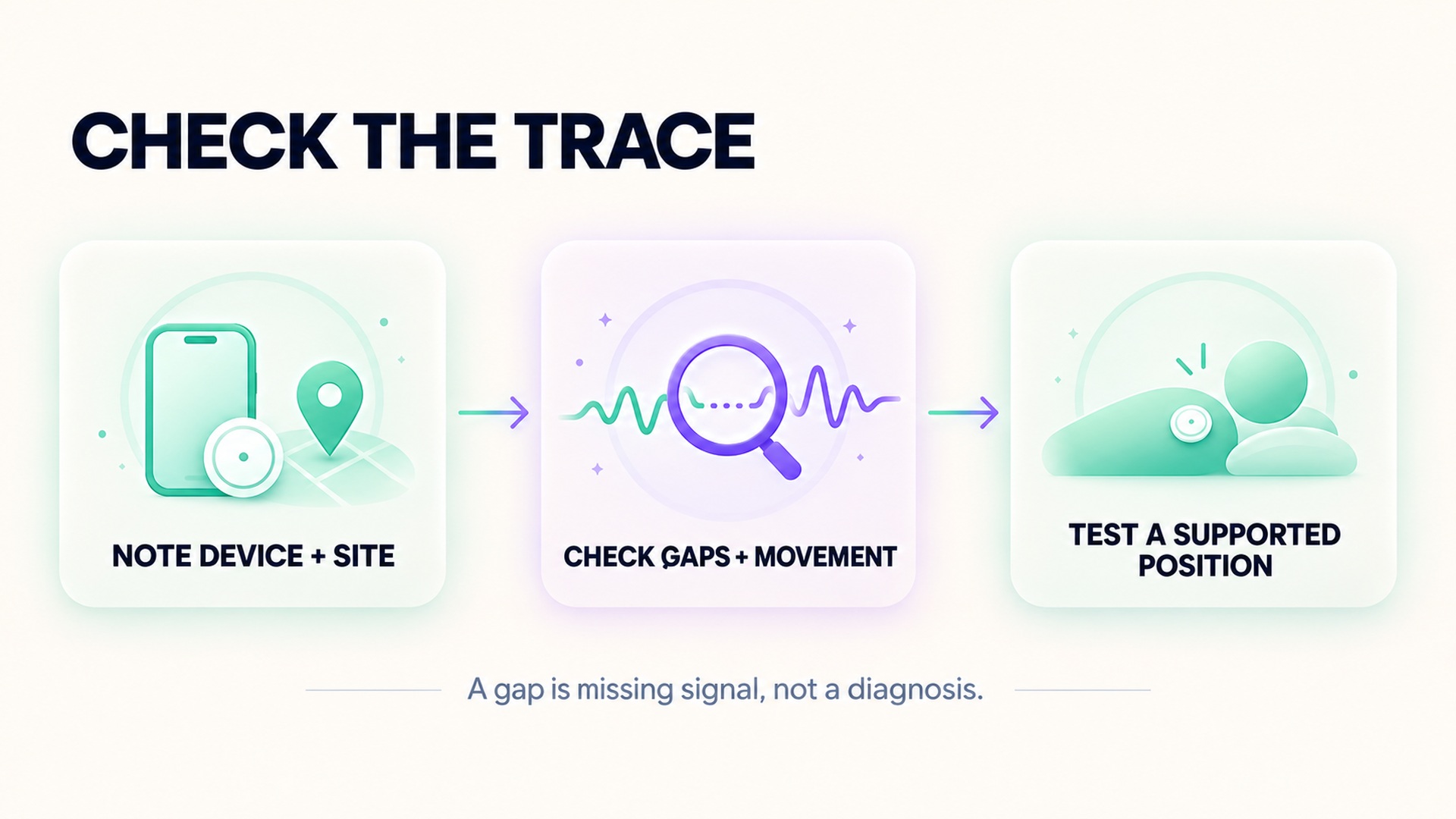
If a wearable reading seems inconsistent, check whether the chart contains missing segments, sudden jumps, repeated flat values, or differences that occur when the device moves. Compare a short interval under similar conditions, and note where the sensor sat in relation to a tattoo. A summary number can conceal gaps or smoothing, so the underlying trace and the device's signal-quality indicators may provide more useful context.
Keep the check simple. Wear the device according to its instructions, make sure it sits firmly without cutting off comfort, and try a nearby skin area that is not covered by ink if the device permits another position. If the result changes when placement changes, that points to a measurement-site or signal issue worth noting. It does not establish a health problem or a defect in the person's skin.
Some devices allow a band to be worn at a different location, but a new location may have different fit and motion conditions. Follow the product's stated placement guidance and avoid assuming that a reading obtained at the upper arm is directly comparable to a wrist reading. If the device offers a compatible electrical sensor, that uses a different signal pathway and may help answer a workout-monitoring question. It still does not turn consumer readings into a diagnosis.
Research into sources of inaccuracy in wearable optical heart-rate sensors has examined differences across devices, participants, and activity conditions. It reinforces why an unexpected value should be interpreted in its measurement context. The sensor's contact, movement, and signal processing may matter alongside the skin area under the sensor.
Keep skin-tone evidence accurate
Research on natural skin pigmentation is important because measurement systems should work across diverse users. But the responsible way to describe that evidence is to report what was tested, how the participants were grouped, which devices were used, and what outcome was measured. Race, self-described skin tone, objective pigmentation, and tattoo coverage are not interchangeable variables. A small or mixed result should not be turned into either a universal claim of bias or a claim that no issue exists.
The clinical overview of consumer wearable technology discusses common factors that can affect PPG signals, including skin characteristics and movement. Those factors can combine. A reading gap during vigorous movement on an inked sensor location may have several plausible contributors. The available chart alone may not tell you which one caused a specific miss.
If a heart-rate trace is used to guide an activity, pay attention to how the device behaved during that activity and whether the data were present. A blank area is missing information, not a low pulse. An abrupt change may be a genuine rate change, a delayed estimate, or signal interference. Use perceived exertion, the workout context, and other available evidence rather than treating one consumer trace as a complete account. The same care applies when reading standing heart-rate patterns from a wearable.
When to use another measurement route
If a wrist optical reading repeatedly drops out at a tattooed site, first check the sensor placement instructions and troubleshoot the contact and fit. If the manufacturer says ink or placement may interfere, try an allowed alternate position or use another supported sensor type for the task. For structured exercise, an external electrical chest sensor may provide a separate signal source, provided the app and sensor support the connection and the strap is worn as directed.
Record the device model, sensor location, activity, and the visible problem. This makes a support request more specific and helps distinguish a connection failure from missing optical samples. When comparing readings from two devices, make sure their time windows and sensor methods match closely enough for the question. A difference between two consumer estimates does not by itself reveal which one is correct.
For medical questions, seek an appropriate clinical assessment. Wearables can help people notice patterns, but a consumer wrist sensor is not a substitute for a validated clinical measurement when a health decision depends on accuracy. If symptoms are concerning, respond to the symptoms and get medical advice instead of trying to resolve the question from a wearable chart alone.
The useful distinction is straightforward: tattoo ink and natural pigmentation can each be relevant to optical sensing, but they are not the same factor and should not be collapsed into one explanation. Check the specific device, sensor location, activity, and data quality. State what the trace shows and what it cannot establish.
FAQ
Can a tattoo stop an optical heart-rate sensor from reading?
It can interfere with some device and placement combinations, but the effect is not universal. Check the product's guidance and the actual trace for missing or unstable sections, especially when the sensor sits directly over ink.
Are tattoos and darker natural skin pigmentation the same accuracy issue?
No. Tattoo ink and natural pigmentation differ in material, distribution, and measurement context. Research should describe each factor separately and avoid using evidence about one as a substitute for the other.
What can I try if my heart-rate chart has gaps over a tattoo?
Follow the device's fit instructions and test a supported nearby location not covered by ink, if available. Record when gaps occur and contact the manufacturer if they persist. A gap is missing signal, not a diagnosis.
*This article is for informational purposes only and is not a substitute for professional medical advice, diagnosis or treatment.*
Sources:
Apple Support·Sensors (Basel, Switzerland)·Journal of racial and ethnic health disparities·Journal of medical Internet research·NPJ digital medicine·Journal of the American College of Cardiology
Related articles
Check live sensor support separately from workout import support
A heart-rate graph arriving after a workout does not show whether an external sensor streamed data live. Check sensor pairing, app compatibility, active recording, and later import as separate steps.

A heart rate export may not contain beat interval data
A heart-rate export can contain many beats-per-minute samples without preserving the interval between each beat. Learn which fields to check before treating a file as suitable for HRV analysis.

Checking pool length before trusting a swimming distance record
Pool distance depends on both the configured pool length and the number of lengths detected. Learn how to check those inputs before accepting a swimming distance record.

Why a longest workout record is different from a fastest distance record
A longest-workout record describes duration, while a fastest-distance record uses a defined distance and time. Learn how pause rules and segment boundaries affect each result.

Why a cycling power record needs its effort duration
A cycling power record needs its averaging window to show whether it reflects a brief peak or sustained effort. Learn how duration, sensor source, and workout context affect comparisons.

Keeping transitions visible in a multisport workout record
Transition periods are part of a multisport event’s full timing record. Learn how to keep T1 and T2 separate from sport splits and verify how each activity was timed.

How much confidence to place in wearable vertical oscillation
Vertical oscillation is a device-specific movement estimate, not a universal efficiency score. Learn how to compare readings with attention to speed, sensor placement, and validation limits.

Reading ground contact time without chasing the lowest number
Ground contact time is affected by pace, surface, fatigue, and sensor method. Learn how to compare similar segments without treating a lower reading as a universal goal.

Why running cadence and running speed need separate interpretation
Cadence describes step frequency, while speed describes distance over time. See how pace, sensor method, and conditions change what the two running metrics can tell you.

When a pace chart uses moving time instead of elapsed time
Moving pace and elapsed pace use different time windows, so the same route can produce different averages. Learn what to check before comparing a pace trend.