What Resilience Means in a Health Tracker
By Mr.Apps · Sep 17, 2026
Category:Stress

Resilience is a model, not a personality label
I read resilience in a health tracker as a model of patterns over time, not as a score for a person's character. The app may combine estimated stress exposure, sleep, heart rate, HRV, activity, and recovery windows. It may then summarize how quickly or consistently those signals return toward a personal baseline.
That can be a useful question: after a demanding period, does the measured pattern settle, remain elevated, or become more variable? It is not the same as asking whether a person is strong, calm, happy, or mentally healthy. A dashboard should not turn a physiological estimate into a judgment about identity.


Wearable stress research explains why the distinction matters. The systematic review of smart devices and stress describes multiple signals and uneven validation across studies. A resilience score can organize observations while still carrying uncertainty about what the signal means.
What the score may be estimating
Some systems treat resilience as the relationship between exposure and recovery. A day with several elevated stress-like readings followed by consistent lower readings may be summarized differently from a day with one short peak and a long return to baseline. The exact method varies, so the user must inspect the app's explanation.
Look for the inputs, time window, baseline, and update schedule. Does the score use hours, days, or weeks? Does it count the number of peaks, the time spent above a threshold, sleep quality, or a model of recovery? Without these details, a target number has little meaning.
The personalized stress detection review emphasizes that biosignals vary between people and situations. Personal baselines may therefore be more useful than universal targets, but only if they are built from reliable and representative data.
Why the trend matters more than the number
A single resilience score cannot show whether a person has become more resilient in a broad psychological sense. A longer trend can show that the app is repeatedly observing shorter or longer recovery windows under similar conditions. That may help with planning sleep, activity, and workload.
Keep the trend attached to context. Note major schedule changes, illness symptoms, unusual exertion, and sleep disruption. Do not add a cause because two lines moved together. The purpose of the note is to explain what was happening when the signal changed.
The wearable stress management review shows how studies use HR, HRV, electrodermal activity, respiration, and other signals. A multi-signal model may capture more context, but it still does not observe every source of stress or every aspect of recovery.
Resilience is not mood
Mood is a lived experience. A resilience score is a computed summary. They may move together, but they can also diverge. A person may feel mentally steady while the device records unusual physiological strain. Someone may feel low while the measured signals remain close to a baseline.
Add a simple subjective note if the mismatch changes a decision. Use words such as settled, tense, tired, focused, or uncomfortable rather than translating the score into a diagnosis. If low mood, anxiety, sleep problems, or stress interfere with daily function, use appropriate mental health support rather than asking the wearable to resolve the problem.
The NIMH stress fact sheet provides a broader frame for recognizing stress and its effects. A wearable can support attention to patterns, but it cannot assess a person's mental health on its own.
Check whether the trend is trustworthy
Before celebrating a rising score or worrying about a falling one, audit the record. Check sensor contact, overnight wear, battery settings, sync timing, missing periods, and changes in measurement source. A change in data collection can look like a change in resilience.
Review whether the baseline includes an unusual period. If the comparison was built during illness, severe sleep disruption, or a major schedule change, today's value may be ordinary relative to that distorted window. A score cannot be more reliable than the record behind it.
If the app changed its calculation or display, save the date and treat the series as a possible break in continuity. Do not compare values across an unexamined change as if the method were identical.
Use resilience for decisions, not self-evaluation
The most practical use is to adjust a demand or a recovery opportunity. If the trend shows that stressful periods are followed by short recovery windows, protect sleep and reduce optional load. If the trend is stable, avoid inventing a problem because the number is not increasing. A good score is not a reason to ignore symptoms, and a low score is not evidence of personal failure.
The FDA guidance on software for general wellness distinguishes healthy-lifestyle functions from medical diagnosis and treatment. That boundary helps keep the score in its lane. It can support a low-risk planning choice while leaving clinical interpretation to an appropriate professional.
Avoid the target-number trap
Target numbers are easy to chase because they make a vague concept look concrete. The problem is that the number may reflect the algorithm's thresholds, not a universal state that must be reached. Chasing it can lead to unnecessary checking, changes in behavior that are hard to interpret, or false reassurance.
Use direction, consistency, and function instead. Is the trend becoming more stable? Are recovery windows appearing more often? Can ordinary tasks be completed comfortably? Are symptoms changing? These questions keep the score connected to life rather than making life serve the score.
Build a personal resilience record
A simple record needs only a few fields: date, sleep quality, major demand, the score or trend, and a brief note about function. Review it weekly or at another interval that is long enough to show a pattern. Avoid checking after every fluctuation.
When a change appears, compare similar periods before changing your plan. If the record is incomplete, label it incomplete. If a pattern persists and affects sleep, activity, mood, or normal function, bring the record to an appropriate professional. The value is in the organized context, not in pretending that the score answers more than it can.
A careful interpretation sequence
I ask:
- What inputs and time window build the resilience score?
- Is the baseline long enough and representative enough to use?
- Are the measurements complete and comparable?
- Does the trend match or differ from mood, symptoms, and function?
- What low-risk decision could the trend support?
Resilience in a health tracker is best understood as a changing estimate of measured stress and recovery patterns. It can help a person notice whether the data is settling after demand. It cannot grade character, diagnose mood, or replace care. Use the trend with context, keep the uncertainty visible, and let real function guide the response.
Use resilience as a question about recovery capacity
The word resilience can make a dashboard sound more certain than it is. I replace it with a narrower question: how does this person's measured pattern respond after demand, and how consistently does it return toward its usual range? That question can be tracked. It does not require a judgment about personality or mental strength.
The CDC guidance on managing stress places stress within everyday health and support, while a related ENSTA discussion of stress readings that conflict with lived experience reinforces the need to keep subjective experience visible. If the score and function disagree, record the mismatch. If distress, low mood, sleep problems, or reduced function persist, seek appropriate support rather than trying to improve the dashboard.
This narrower language makes the score more useful. It turns a vague target into an observation about data quality, recovery windows, and the next practical choice.
It also leaves room for an unchanged score. Stability can be useful when the inputs are complete and function is steady. There is no requirement to improve a number every day. The purpose of a longer trend is to notice meaningful shifts, not to create pressure for constant progress. If the score changes after a measurement or algorithm change, record that break before comparing the new values with the old ones.
A good interpretation also separates recovery from avoidance. A person may need a quieter period because demand is high, but avoiding every challenge is not the same as building capacity. The tracker cannot make that distinction from a number alone. Use the score to ask whether the current load and recovery opportunities are balanced, then bring values, obligations, symptoms, and professional advice into the decision when needed. This keeps the word resilience practical instead of turning it into a vague promise.
FAQ
Does a resilience score measure my mental strength?
No. It usually summarizes selected physiological and behavioral signals. It does not measure character, mood, or mental strength and should not be used as a personal judgment.
Is a higher resilience score always better?
Not necessarily. The score may depend on the app's baseline, inputs, and thresholds. Review the trend, data quality, context, symptoms, and function instead of chasing a universal target.
What should I do if the resilience trend stays low?
Check the data and baseline, review sleep and major demands, and make a low-risk adjustment such as protecting recovery time. Seek appropriate professional support when symptoms or changes in function persist.

*This article is for informational purposes only and is not a substitute for professional medical advice, diagnosis or treatment.*
Sources:
Centers for Disease Control and Prevention·National Institute of Mental Health·National Library of Medicine·National Library of Medicine·National Library of Medicine·Food and Drug Administration
Related articles

How to Read a Stress Score Across Several Hours
A stress score is easier to understand as a time pattern than as one daily high point. This guide shows how to read duration, repeated peaks, movement, and recovery windows without treating a wearable estimate as a diagnosis.

Can Paced Breathing Work Without Watching a Screen?
Paced breathing does not require constant visual attention. This guide compares audio and haptic pacing, explains what a wearable may observe, and sets realistic expectations for relaxation and HRV without promising a guaranteed result.

Why a Health App May Tell You to Rest and Move at the Same Time
A health app can recommend rest and movement in the same day without either message being technically wrong. This guide shows how to check update time, purpose, symptoms, and the demands of the day before choosing a response.

Can a Wearable Measure Cortisol? What Your Stress Score Is Actually Estimating
Most consumer wearables estimate physiological stress from signals such as heart rate, HRV, temperature, and movement rather than measuring cortisol itself. I explain how to read those scores without mistaking an algorithmic clue for a hormone test.
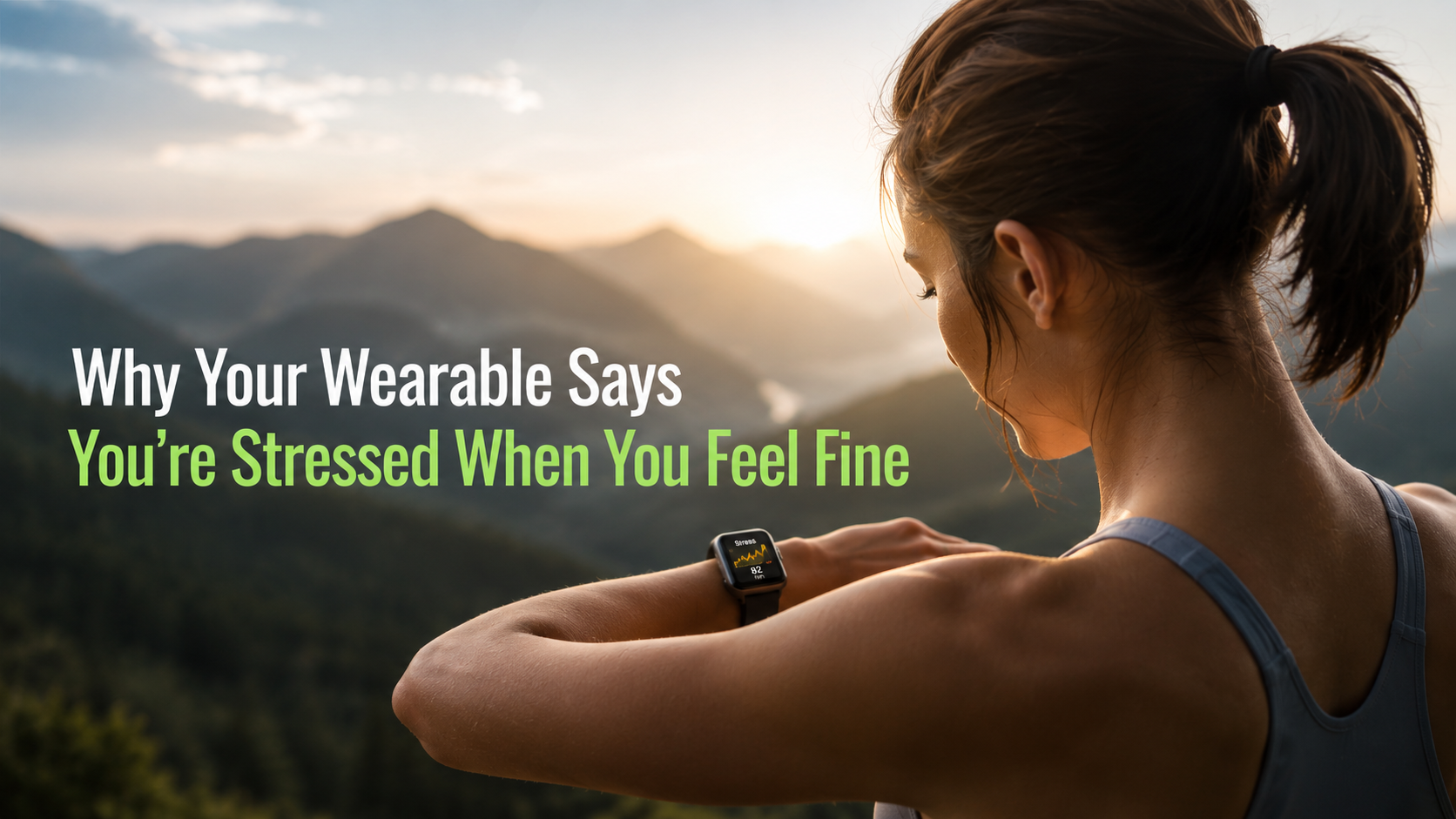
Why your wearable says you're stressed when you feel fine
Your watch measures physiological arousal, not worry. Caffeine, digestion, heat, short sleep, and a loose band can all push the score up while you feel fine.