When "poor sleep" may be more than stress: red flags for sleep apnoea
By Mr.Apps · Jul 7, 2026
Category:Sleep
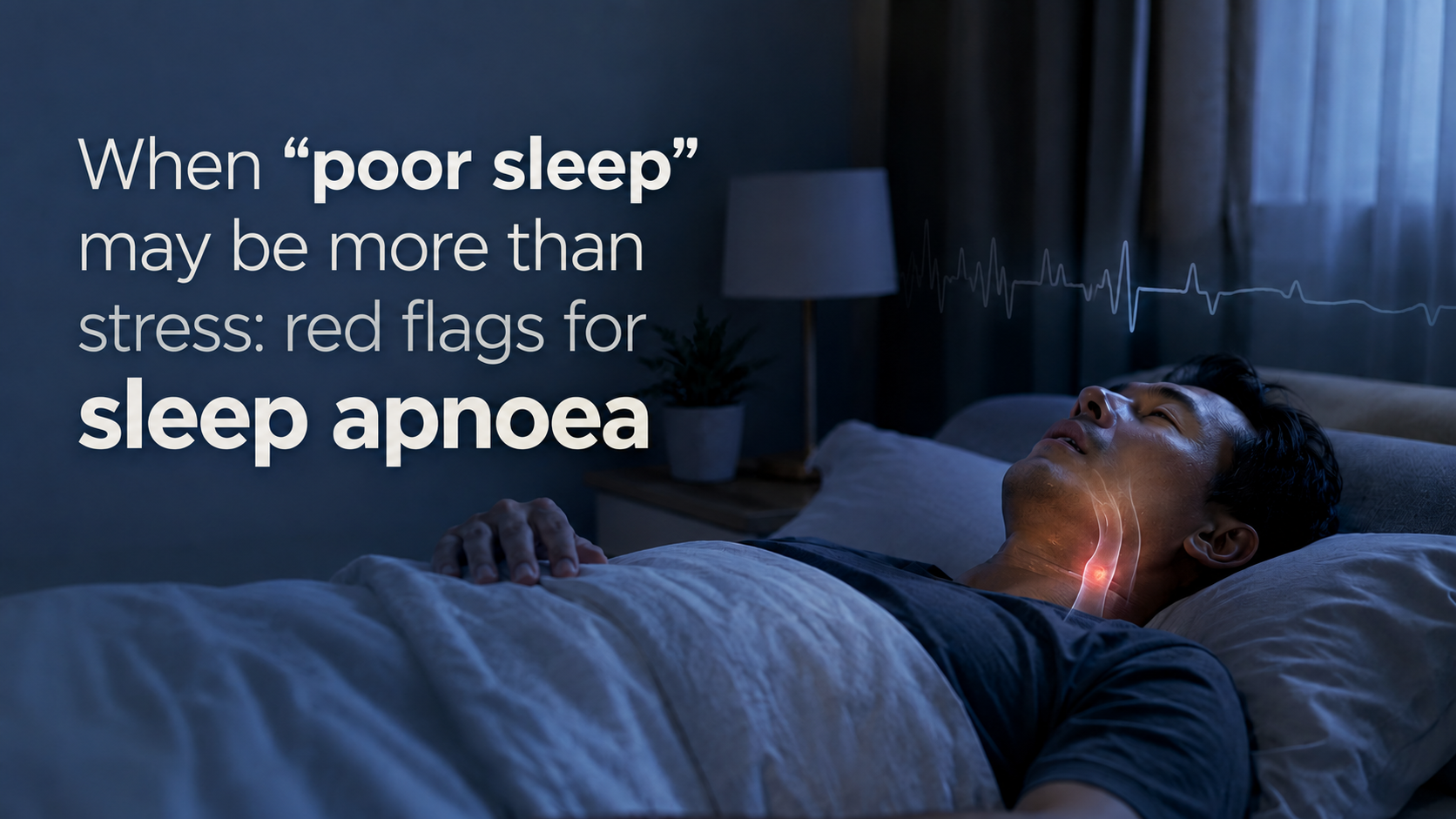
A few years ago, I watched a highly capable colleague, someone I have a great deal of respect for, nod off for a few seconds in the middle of a meeting he was chairing. He came to with a start, apologised, and carried on as if nothing had happened. When I asked about it privately afterward, he brushed it off: a long week, a demanding calendar, nothing more. He was adamant he'd slept a full eight hours the night before, and I believed him.
Except I kept noticing similar stories once I started paying attention. A friend mentioned, almost in passing, that her husband had gone quiet mid-breath for an uncomfortably long stretch one night, then gasped and rolled over as if nothing had happened. Another acquaintance described the same kind of daytime fog my colleague had shown, despite what looked, on paper, like perfectly reasonable sleep. None of them had connected the dots themselves. That pattern is what eventually pulled me into reading more seriously about obstructive sleep apnoea, a condition that hides in plain sight far more often than most people assume.
The sleep apnoea symptoms people explain away for years
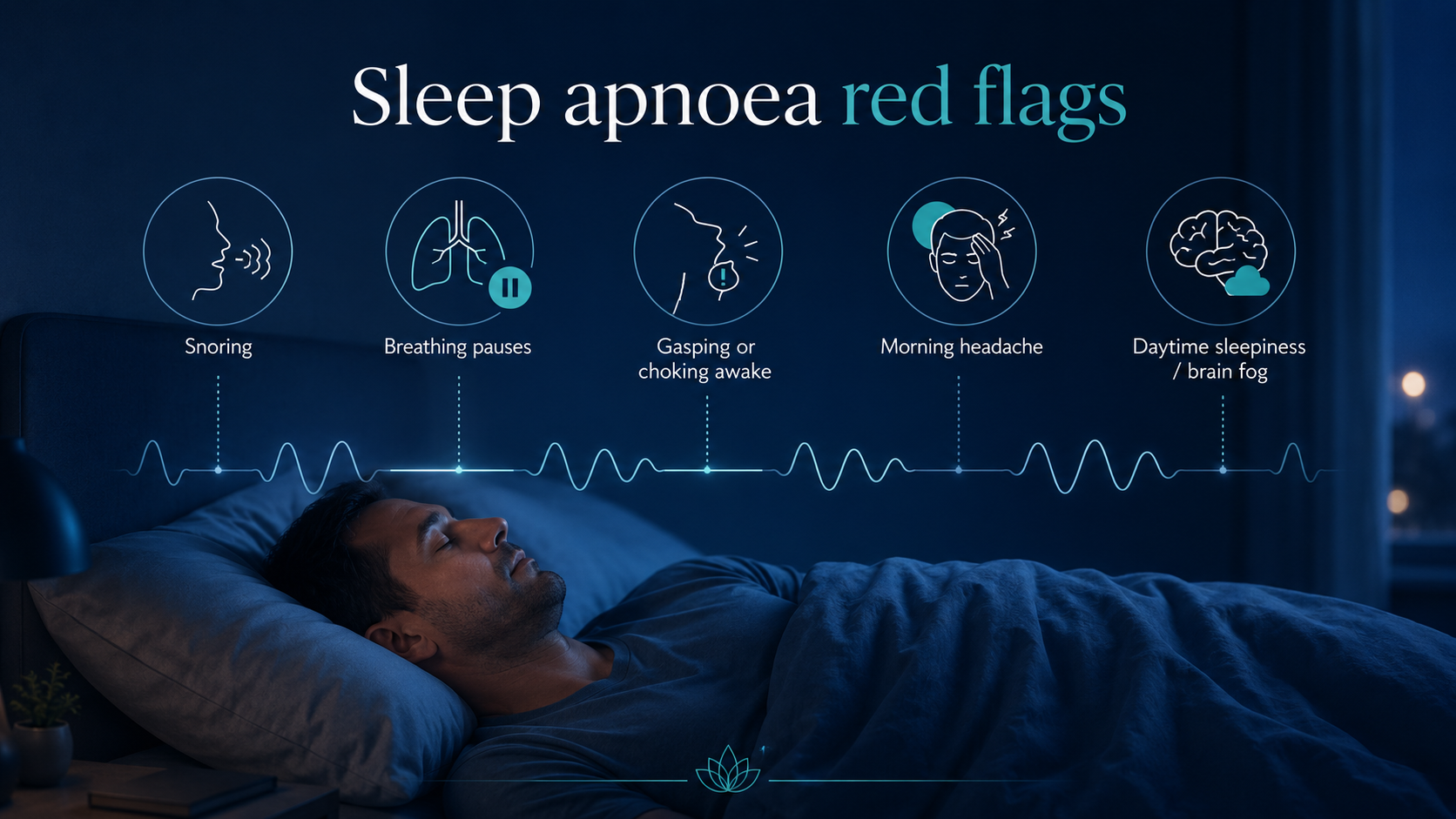
Loud snoring is the symptom most of us recognise, but it's rarely the one that sends someone to a doctor. It's usually paired with something else: a headache on waking that fades by mid-morning, a dry mouth, or the sense that eight hours in bed produced nothing like eight hours of actual rest. A good <a href="https://www.mayoclinic.org/diseases-conditions/obstructive-sleep-apnea/symptoms-causes/syc-20352090">clinical overview of obstructive sleep apnoea</a> lists exactly this cluster: loud snoring at night, then morning headaches, daytime sleepiness, and mood changes that show up hours later and get blamed on something else entirely.
That delay is part of what makes the condition so easy to miss. The breathing pauses themselves happen while a person is unconscious, so they rarely register that anything went wrong unless someone else happens to be awake to notice. Clinical guidance on the condition is fairly blunt about this: <a href="https://www.nhsinform.scot/illnesses-and-conditions/lungs-and-airways/obstructive-sleep-apnoea/">most people have no memory of the interrupted breathing at all</a>, which is exactly why it's so often a partner, not the person affected, who raises the alarm first. In every version of this story I've heard, that's precisely how it played out: a fairly matter-of-fact remark over breakfast, long before the person themselves considered that anything might be wrong.
That's part of why so many cases go unrecognised for years. One often-cited estimate suggests that as many as <a href="https://www.hopkinsmedicine.org/health/conditions-and-diseases/obstructive-sleep-apnea">nine in ten people with obstructive sleep apnoea don't know they have it</a>. I found that number almost hard to believe until I thought back through how many otherwise sharp, high-functioning people I know have described exactly this kind of daytime fog without ever once mentioning their breathing.
There's also a version of this condition that doesn't announce itself with snoring at all. Some people have disrupted breathing with barely a sound, or symptoms that look more like insomnia, frequent trips to the bathroom overnight, or waking with a racing heart for no obvious reason. That variability is part of why a detailed sleep history matters more than any single symptom taken on its own, and why <a href="https://pmc.ncbi.nlm.nih.gov/articles/PMC2813513/">clinical reviews recommend screening certain groups specifically</a>, including people with high blood pressure, heart disease, or diabetes, even when they don't fit the "classic" picture of loud snoring paired with a struggle with weight.
Why am I tired after sleep, if the hours add up?
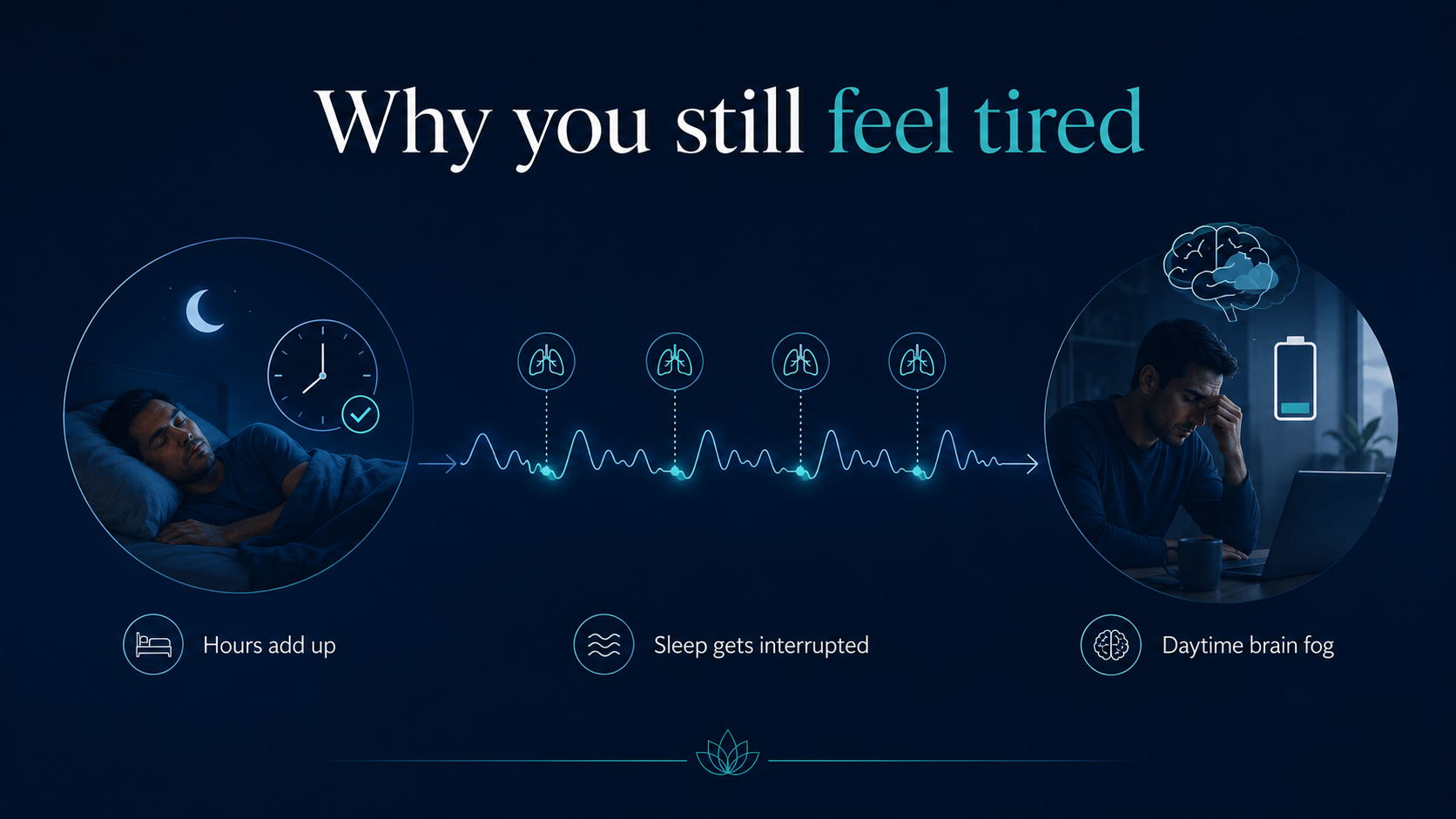
This is the part people tend to find genuinely confusing, and it was true of the colleague I mentioned earlier. He wore a sleep tracker faithfully for months and kept getting respectable scores most mornings, sometimes even flattering ones. Yet by mid-afternoon most days, he was visibly fighting to keep his attention on a screen or a conversation, and by early evening his patience for anything requiring sustained thought had more or less evaporated. Colleagues put it down to workload. He put it down to age. Neither explanation held up once the pattern was laid out across a few weeks instead of treated as one bad day after another.
The mismatch between "the numbers look fine" and "I feel dreadful" turned out to be the clue worth paying attention to, not the contradiction to explain away. When breathing stops at night, even briefly and repeatedly, the brain has to interrupt deep sleep to restart it. A person doesn't wake up in any way they'd remember, but they also never get the long, uninterrupted stretches of restorative sleep that a full night in bed is supposed to deliver. The result is a day that feels foggy in a specific way: not sleepy exactly, more like operating with reduced processing power and a shorter fuse. Irritability, a flatter mood, and a noticeable dip in concentration during meetings were the pattern I kept hearing described, and looking back, they were far more consistent than anyone gave them credit for at the time. It's easy to treat each bad afternoon as its own isolated event instead of noticing that it's, in fact, the same afternoon repeating itself.
What home screening can and cannot tell you
Curious about how much these consumer tools could actually tell you, I tried a few myself: a snoring app on my phone for a couple of weeks, a basic pulse oximeter clipped on overnight. It wasn't that I suspected anything in particular, I wanted to understand what the data would and wouldn't show before recommending any of it to someone else. Both gave me something to look at each morning, and both left me with almost as many questions as answers.
To be fair to the technology, it isn't useless. Consumer snoring apps have improved considerably, and <a href="https://formative.jmir.org/2025/1/e67861">one validation study of a smartphone snore-detection algorithm</a> found it compared favourably with other tools on the market, useful enough to flag people who might be worth a proper look. But flagging risk and confirming a diagnosis are different jobs. Home devices typically track airflow, oxygen levels, and effort, and nothing about brain activity or sleep stage, which is exactly what a full overnight study is built to capture.
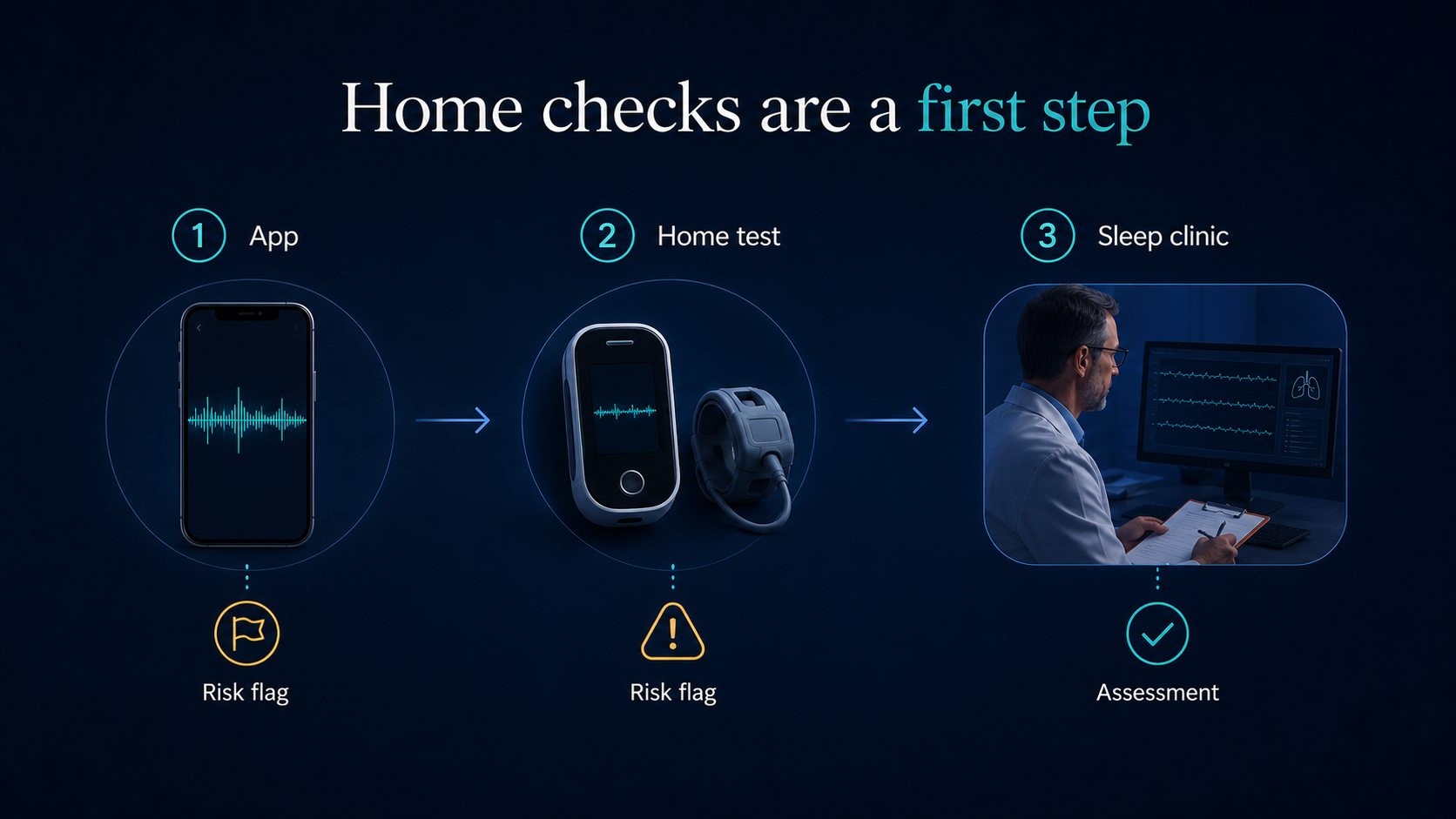
That gap matters more than it sounds. Research comparing at-home breathing monitors against lab-based studies has found meaningful rates of missed cases, including one analysis reporting a false negative rate high enough that <a href="https://www.ncbi.nlm.nih.gov/pmc/articles/PMC12907277/">professional sleep medicine guidelines recommend a follow-up lab study whenever a home test comes back inconclusive</a>. In practice, that means a clean result from a phone app or a home kit is reassuring, but it isn't proof of anything. A borderline or messy result is more useful than it looks: it's usually the signal to get a proper study, not a reason to give up on the question.
When to speak to a GP or a sleep clinic
I want to be careful here, because the point of writing this isn't to turn every snorer into a self-diagnosed patient. It's to describe the pattern worth raising with a doctor, since the sleep apnoea red flags tend to cluster rather than appear one at a time: loud, irregular snoring; witnessed pauses in breathing, not just suspected ones; waking up gasping or choking; daytime sleepiness severe enough to affect concentration, mood, or safety behind the wheel; morning headaches that fade within an hour or two of waking.
If two or three of those are showing up regularly, that's a reasonable moment to raise it with a GP rather than keep managing it with more coffee and an earlier bedtime. A typical pathway, at least in the system I'm most familiar with, starts with a GP assessment and, if the pattern fits, a <a href="https://www.nhs.uk/conditions/sleep-apnoea/">referral to a specialist sleep clinic for an overnight test</a> that measures breathing and heart rate properly rather than approximately. It isn't a fast process, and it isn't a dramatic one. It's closer to ruling things in and out methodically, which is precisely what a condition like this needs.
The colleague I mentioned at the start eventually saw his own GP, prompted mostly by his partner's insistence rather than his own concern. His overnight study confirmed exactly the pattern the accumulated evidence had pointed to. When we spoke about it afterward, he said the relief wasn't in having a diagnosis for its own sake. It was in finally having an explanation that matched the actual pattern, instead of a string of small excuses that never quite added up to anything coherent.
If any of this sounds familiar, either in yourself or in someone you sit across from at work, the useful next step usually isn't another app or another sleep tracker. It's a conversation with a GP, ideally armed with a plain description of what's actually been happening at night and during the day, with input from whoever shares that person's home. That combination tends to be far more informative than any single home test on its own.
FAQ
Can you have sleep apnoea without loud snoring? Yes. Some people have disrupted breathing with little audible snoring, especially if the obstruction is subtler or positional. Daytime sleepiness, morning headaches, and unrefreshing sleep can appear on their own, which is one reason a doctor will usually ask about the whole pattern rather than snoring alone.
Do home sleep tests replace an in-lab sleep study? Not reliably. Home tests can be a useful first step, particularly when symptoms are already fairly clear, but they capture less information than a full lab study and can miss milder or borderline cases. An inconclusive home result is generally followed by a proper in-lab or clinic-supervised study.
What actually happens at a first sleep clinic appointment? Expect questions about symptoms, sleep habits, and general health, sometimes alongside a short questionnaire about daytime sleepiness. Depending on how things look, the next step may be an overnight study, either at the clinic or with take-home monitoring equipment, before any treatment is discussed.
This article is for general information and does not replace individual medical advice. If you recognise several of these patterns in yourself or someone you live with, the right next step is a conversation with a GP or qualified sleep specialist.
*This article is for informational purposes only and is not a substitute for professional medical advice, diagnosis or treatment.*
Sources:
Related articles
How to protect your sleep when your job keeps changing the clock
Shift work doesn't fail because people lack discipline. It fails because the body was never built to run a factory schedule. Here's what actually helps between rotating shifts, why "just going to bed earlier" doesn't work, and when persistent fatigue stops being normal and starts being something worth getting checked out.
Why a regular sleep schedule may matter more than an extra hour in bed
Why Am I Still Tired After 8 Hours of Sleep?
You slept 8 hours and still feel wrecked? Here's why sleep quality beats duration, what a dropping sleep score really means, and how to wake up with energy.
Evening Stress and Why Your Brain Won't Settle Down Before Sleep!
Falling asleep fast isn't the same as your brain settling down. What evening stress does to your sleep onset, and how to wind down when your mind won't.