Why Your Resting Heart Rate Is Suddenly Higher Than Usual
By Mr.Apps · Jul 29, 2026
Category:HRV
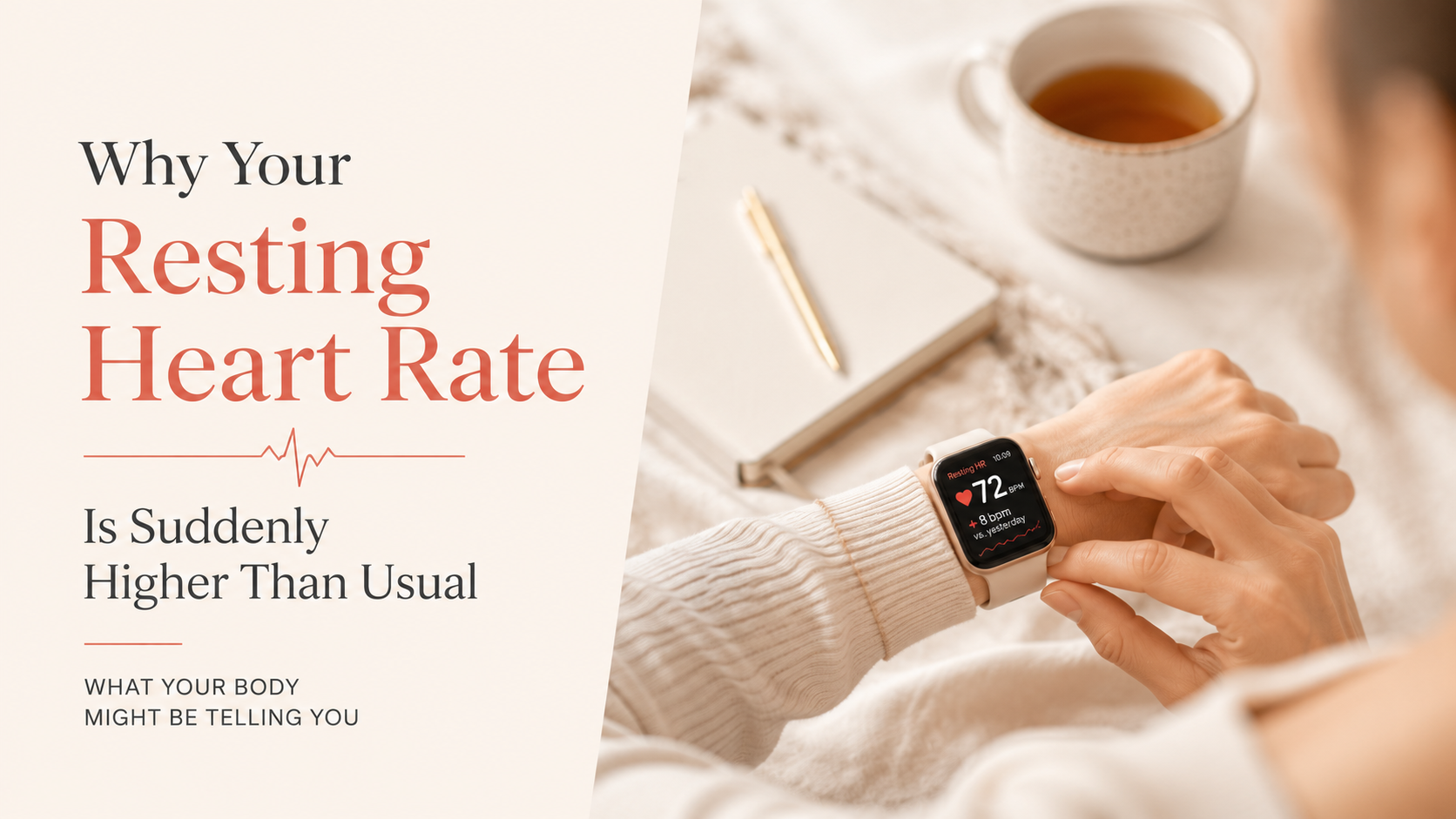
A few times a year my resting heart rate climbs five or six beats and stays there for several mornings. Nothing hurts, nothing feels wrong, and I still catch myself opening the app three times before breakfast.
So when someone asks me why is my resting heart rate high this week, I don't start with the heart. I start with the week. In almost every case I've looked at, my own included, a high resting heart rate that appears suddenly has a boring explanation attached: a short night, a warm room, a virus that hasn't announced itself yet, or a training block that got ambitious faster than the body agreed to.
Your own baseline beats the textbook range
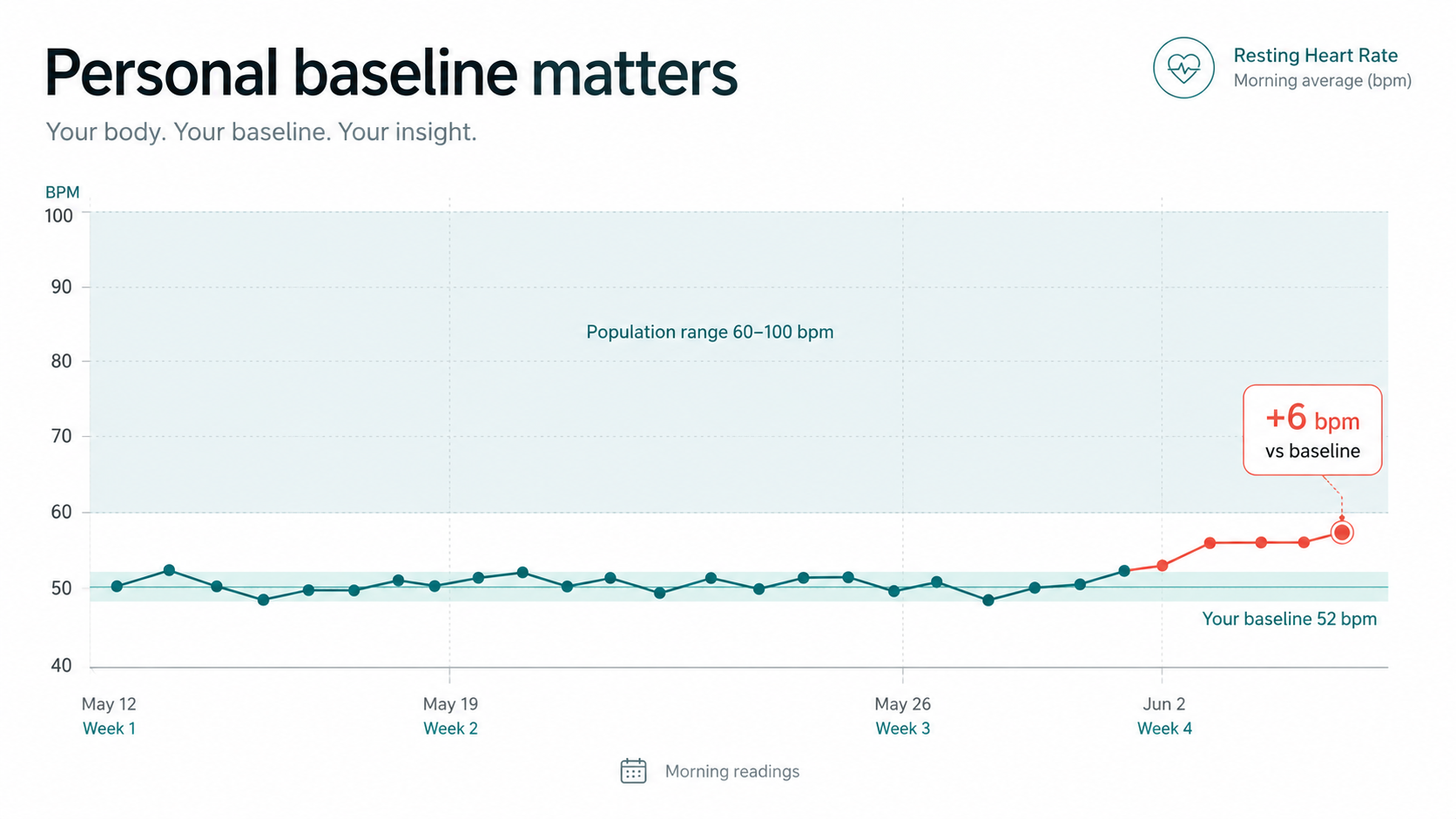
The number most people quote is 60 to 100 beats per minute. That range is real, but it's a population range, and it's wide enough to be nearly useless for a single person on a single Tuesday. Most healthy adults sit somewhere between 55 and 85, and where you sit inside that has a lot to do with age, fitness, genetics and how you measure.
What matters is your personal normal and how far today drifted from it. If you usually wake at 52 and you're at 58, that's a meaningful jump even though 58 looks perfectly healthy on paper. If you usually wake at 74 and you're at 76, that's noise. So the first thing worth building isn't a target. It's a baseline: two to four weeks of measurements taken the same way, so you have something honest to compare against.
Check the measurement before you troubleshoot the body
I once spent the better part of a week convinced something was off, then realised I'd changed how the number was being calculated. My previous setup reported the lowest sustained value overnight. The new one reported an average across the sleep window. Same body, same nights, four extra beats. There was nothing to investigate.
Before you treat an elevated resting heart rate as a signal, rule out the ordinary stuff:
- A strap that sits loose, or too high on the wrist, gives noisier optical readings.
- Different apps define "resting" differently. Lowest overnight value, average during sleep, and average of quiet daytime periods are three separate numbers.
- A reading taken during a dream-heavy stretch of sleep can look alarming and mean nothing.
Measure at the same point in your day, ideally before you get out of bed, with the same method. Consistency is worth more than precision here.
Short or broken sleep
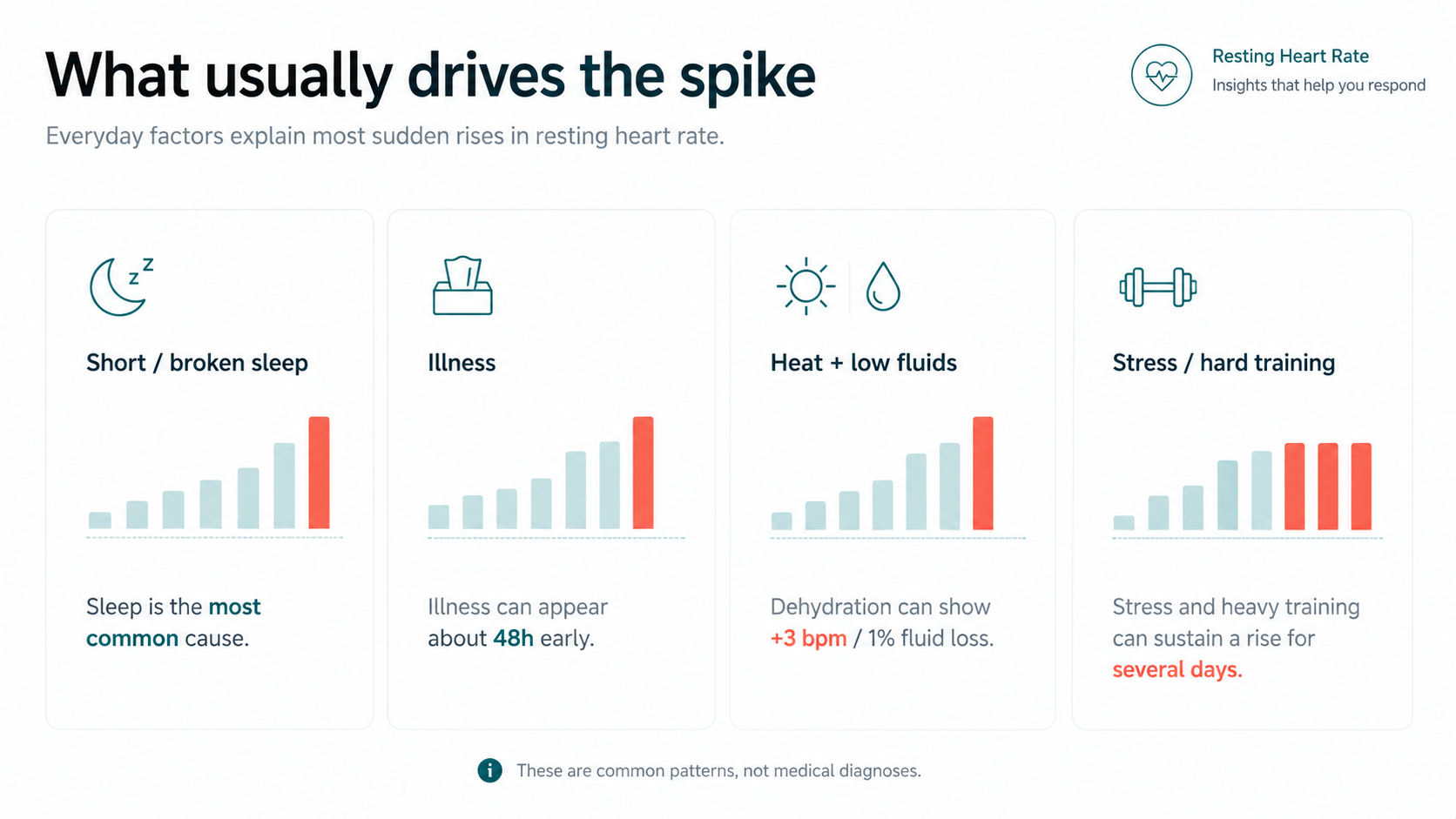
This is the most common answer and the least satisfying, because you usually already know it applies.
One rough night raises overnight heart rate. Several raise it and keep it there. What surprised me is how stubborn the recovery is: after a stretch of sleep restriction, a single long night is often not enough to bring heart rate and blood pressure back to where they started.
I saw this while preparing a forty-minute talk I'd agreed to give on ten days' notice. Three nights of five hours each, then a deliberate nine-hour night to fix it. The nine hours barely moved the number, and it took two more ordinary nights before my mornings looked like mine again. Sleep debt doesn't settle in one payment.
Something starting that you haven't felt yet
An elevated resting heart rate when sick is expected. What's less obvious is that the rise often arrives before the symptoms do.
Fever drives it directly. In one study of young men tracked through an acute infection and again after recovery, every degree Celsius added roughly 8.5 beats per minute, and the elevation held through sleep rather than settling at night. An immune response also costs energy, so even a low-grade infection with no measurable fever can push overnight heart rate up.
Two winters ago my number jumped seven beats on a Sunday. I felt fine, ran my usual session, and woke on Tuesday with a sore throat that lasted a week. The data was ahead of me by about forty-eight hours. Now a jump that size with no obvious cause makes the next two days provisional.
Fluid, salt and a warm room
Blood volume drops when you're dehydrated, so each beat moves less blood and the heart compensates by beating more often. The cost runs to about 3 beats per minute for every 1% of body mass lost to fluid deficit. A single busy day of coffee, one glass of water and a salty dinner can get you there without ever feeling thirsty.
Heat compounds it. Warm skin needs more blood flow for cooling, and that work shows up overnight. In one study of older adults monitored at home through summer, bedroom temperatures above 24 °C were associated with higher sleeping heart rate and disrupted overnight recovery, with the odds climbing as the room got hotter. I lived through a version of this while the cooling in my building was being replaced. My number was up four or five beats every morning that week, and the thermostat was the whole story.
Stress that you wouldn't call stress
Deadlines, difficult conversations, a decision you keep postponing. The link between resting heart rate and stress is less about drama than about anticipation, and it can run for days without you labelling it as anything.
The clearest example I have is a negotiation that dragged out over a month. My overnight heart rate sat three to four beats above normal for most of it, then came back down the evening it resolved, before I had slept a single restorative night. My nervous system had simply stopped bracing.
Late meals belong in this bucket too, in a mechanical sense. Digestion is metabolic work happening when your body expects to be winding down, and eating close to bedtime shifts autonomic activity into the night. Evening alcohol is one of the most reliable overnight heart rate raisers there is, if that's relevant to you. Caffeine late in the afternoon can do a quieter version of the same thing.
Training that's heavier than it feels
Hard training raises resting heart rate temporarily. That's normal and it's part of adapting. It becomes worth noticing when the number stays elevated across several days of easy work, especially alongside heavier legs, worse sleep or a drop in HRV.
I added two hill sessions a week during one build and watched my mornings creep up about a beat every three days. Nothing that felt like overreaching. Two genuinely easy days brought it straight back. Medication can cause a similar drift, particularly decongestants, some inhalers and thyroid treatment, so a new prescription that coincides with a new number is worth raising with whoever prescribed it.
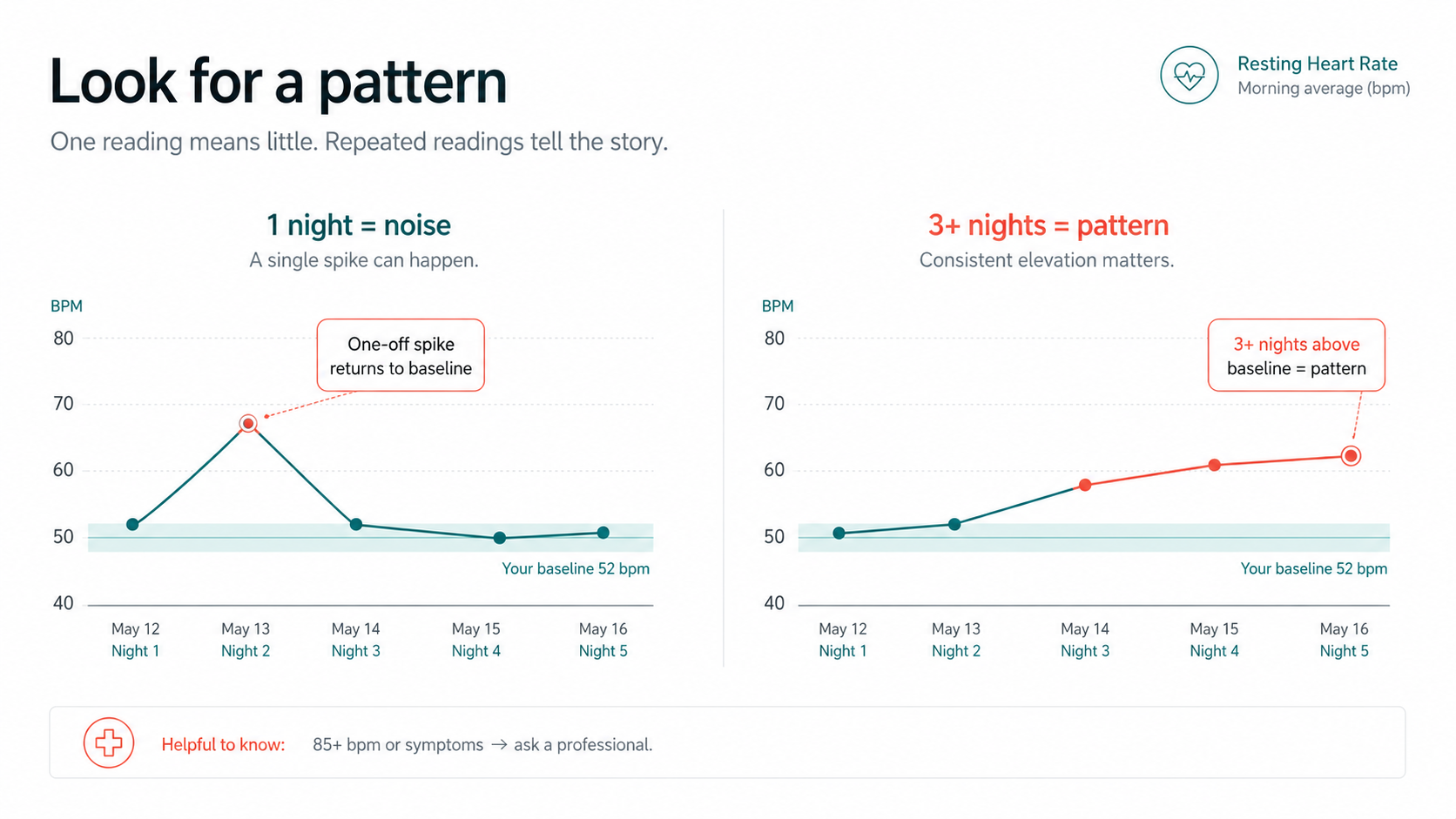
One reading means little. A pattern means something.
If there's one habit worth taking from this, it's the refusal to react to a single night. A late meal, a strange dream, a warm duvet and a mistimed measurement can all produce a number that looks like a signal and isn't.
What earns attention is a change that repeats: three or more consecutive nights meaningfully above your baseline, or a baseline that has drifted upward over several weeks with no obvious reason.
The path I follow when it stays high
- Confirm the measurement. Same device, same fit, same time, same definition of "resting".
- Look at the last 48 hours: sleep, fluids, alcohol, room temperature, travel, altitude, an unusually hard session, a new medication. Most elevations resolve here.
- Cross-check your other signals. HRV lower, skin temperature up, sleep more fragmented, breathing rate up. Several markers moving together point toward illness or accumulated strain rather than a measurement artefact.
- Check how you feel, honestly. Sore throat, chills, unusual fatigue, heavy legs, poor appetite. Symptoms outrank data.
- Choose one response and give it time. Hydrate and cool the room, take two easy days, move dinner earlier, protect sleep for three nights. Then measure again before changing anything else.
Most of the time step five ends it. The number returns within a few days and you go back to ignoring it, which is the correct relationship to have with this metric.
When to stop troubleshooting and ask a professional
Tracking is useful until it becomes a substitute for asking someone qualified. If your resting heart rate is consistently above 85, that's worth mentioning to your doctor even if it turns out to be normal for you. The same applies to an elevation that persists beyond a week or two with no explanation, or a baseline that has climbed steadily over months.
Some things skip the queue. Chest pain or pressure, breathlessness while sitting still, fainting, an irregular or pounding pulse, or a resting rate above 100 that won't settle are reasons to seek medical attention rather than another night of data. A wearable is a prompt to ask better questions, not a diagnosis.
FAQ
How many days does a high resting heart rate need to last before I worry?
Three consecutive nights above your normal range is where it stops being noise and starts being a pattern worth explaining. Even then, the explanation is usually sleep, illness, heat, fluid or stress. If it holds beyond a week or two with no cause you can identify, or symptoms come with it, that's a conversation with a clinician rather than another week of tracking.
Why is my overnight heart rate high when I feel completely fine?
Overnight heart rate responds to things you don't consciously feel: a room a few degrees too warm, a late dinner, mild fluid deficit, an immune response in its early hours, or low-level anticipatory stress. The body registers a load before you perceive it, which is what makes the metric useful and also what makes it easy to over-read.
Does a higher resting heart rate mean I'm getting less fit?
Not on a scale of days. Fitness changes slowly, so a jump this week is almost never a fitness change. Sustained aerobic training lowers resting heart rate over months, and detraining raises it over a similar timescale. A baseline that has drifted up over several months alongside less activity is a fitness signal. A five-beat jump on Thursday is a lifestyle signal.
*This article is for informational purposes only and is not a substitute for professional medical advice, diagnosis or treatment.*
Sources:
Harvard Health Publishing·PubMed Central·PubMed·Scientific Reports·BMC Medicine·Stress and Health
Related articles
Best Apps That Explain Sudden HRV Changes in 2026
Why your HRV changed overnight, what it usually means, and the apps that actually help you figure out what to do next.

Why VO2 Max and Race Predictors on Wearables Often Argue With Reality
Your watch never measured your VO2 max, it guessed it from heart rate. Here's why that number drops in summer, why the race predictor lies, and how to read both.

Why heart rate alone doesn't explain strength training
What Does an HRV Spike or HRV Drop Actually Mean?
An HRV spike isn't always good and a drop isn't always bad. Here's why your HRV changed overnight, and when low HRV is stress, sickness, alcohol, or just noise.