Acting out dreams needs a different review from restless sleep
By Mr.Apps · Oct 19, 2026
Category:Sleep

Restless sleep and acting out a dream are not the same observation. A person may shift position, kick briefly, or move while sleeping for many reasons. Dream enactment means a person appears to speak, reach, strike, or otherwise act out a dream. Repeated or forceful behavior deserves a different review from a general movement score, especially when someone could be injured.
I would keep the observer’s description separate from the sleeper’s recollection and from the device estimate. A wearable may record movement, but it cannot reliably tell what the movement meant or whether it matched a dream. If you notice an event, write down what was observed, when it happened, and whether anyone was hurt. Do not diagnose a sleep disorder from a movement count or from a remembered dream alone. A clinician can decide whether the behavior needs assessment and what kind of testing fits the history.
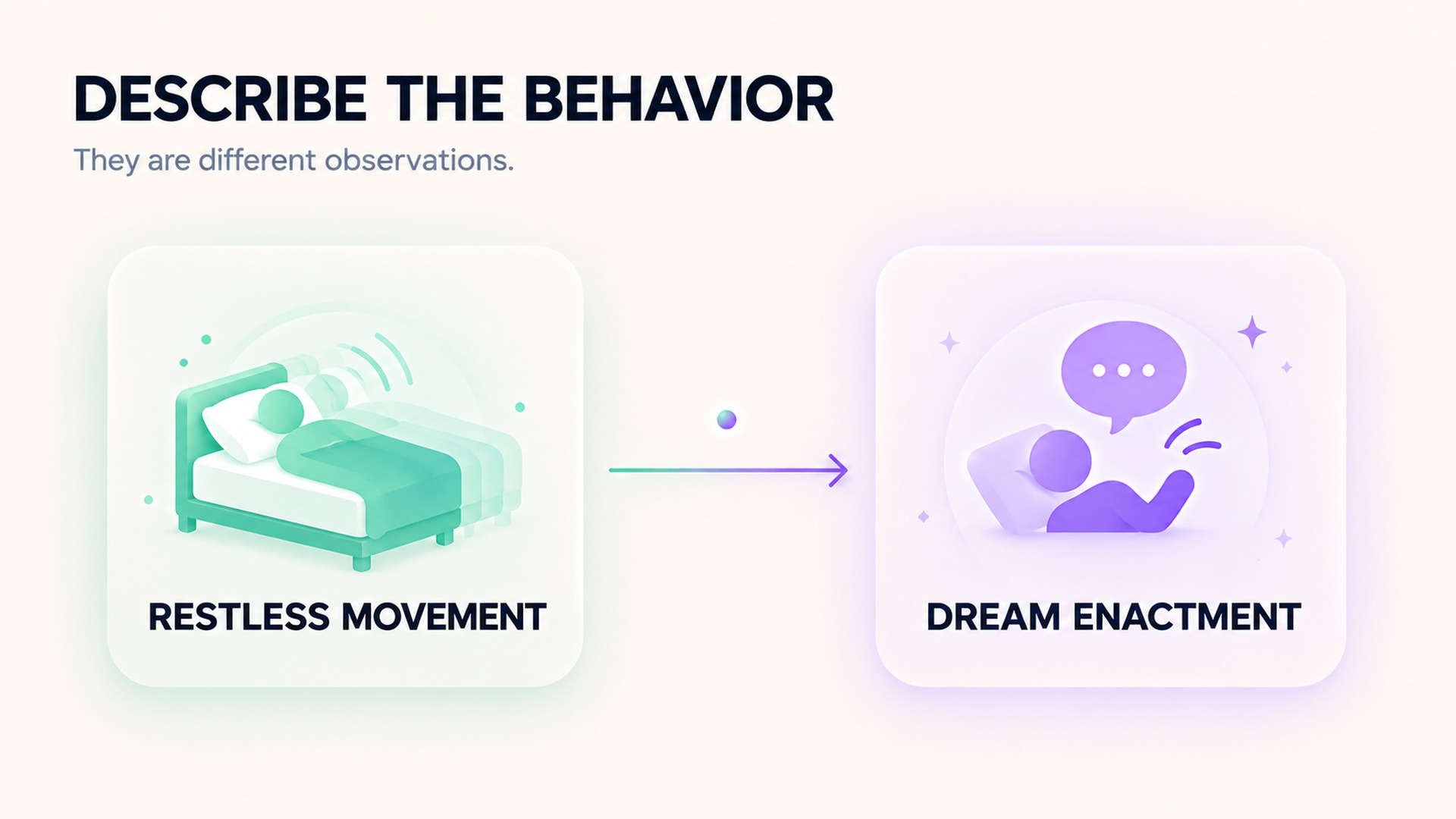
Describe the behavior before interpreting it
A useful record is specific and neutral. Note whether the person spoke, shouted, reached, kicked, or got out of bed. Record whether the event seemed brief or sustained, whether it happened once or repeatedly, and whether the person was easy to awaken. If another person observed it, distinguish that observation from what the sleeper remembers afterward. The two accounts may not be identical, and both can be useful.
Also record whether the movement created a risk of falling, striking a nearby person, or contacting furniture. Safety is a practical issue whether or not a diagnosis is eventually made. If there is an immediate risk of injury, reduce hazards in the sleeping area and seek appropriate medical advice. A device score cannot establish that the behavior is harmless.
The clinical review of dream-enactment behavior describes a range of possible causes and emphasizes the value of sleep history, context, frequency, and severity. Acting out a dream is associated with REM sleep behavior disorder in some cases, but the behavior can have other explanations. A history of movement is a reason to ask a better question, not enough by itself to identify the cause.
A clinical review of REM-related sleep phenomena also distinguishes dream enactment from nightmares and sleep paralysis. Remembering a frightening dream without moving is different from observed vocal or physical behavior. Temporary inability to move while waking is different again. A broad app label such as “restless sleep” can merge observations that require different follow-up questions.
Why movement counts are not a diagnosis
Wrist movement sensors can detect motion, but they do not directly measure dream content or the muscle activity used to evaluate sleep behavior. A short movement may be a position change. Several movements in a row may reflect a different event. The device generally cannot tell whether a person was responding to a dream, changing posture, adjusting bedding, or experiencing another sleep disturbance.
That limitation matters for both high and low movement scores. A high score does not prove dream enactment. A quiet graph does not rule it out, because the sensor may not capture the behavior, the person may be on the other arm, or an event may occur outside a sampled interval. The device record can be preserved as a separate estimate, but an observed event description is usually more helpful for a clinical conversation.
A diagnosis of REM sleep behavior disorder requires more than a wearable signal. The International RBD Study Group recommendations for video-polysomnography describe video-polysomnography as essential for confirming REM sleep behavior disorder. Testing records sleep physiology and video together so the clinician can assess whether behaviors occurred during REM sleep and whether the expected muscle atonia was present. This is different from classifying ordinary movement from an accelerometer.
The clinical practice guideline for REM sleep behavior disorder also emphasizes ongoing attention to behavior severity and injury risk in care. It is a treatment guideline for people assessed as having the disorder, not a checklist that lets someone diagnose themselves. The clinician considers history, examination, medication context, and testing where appropriate.
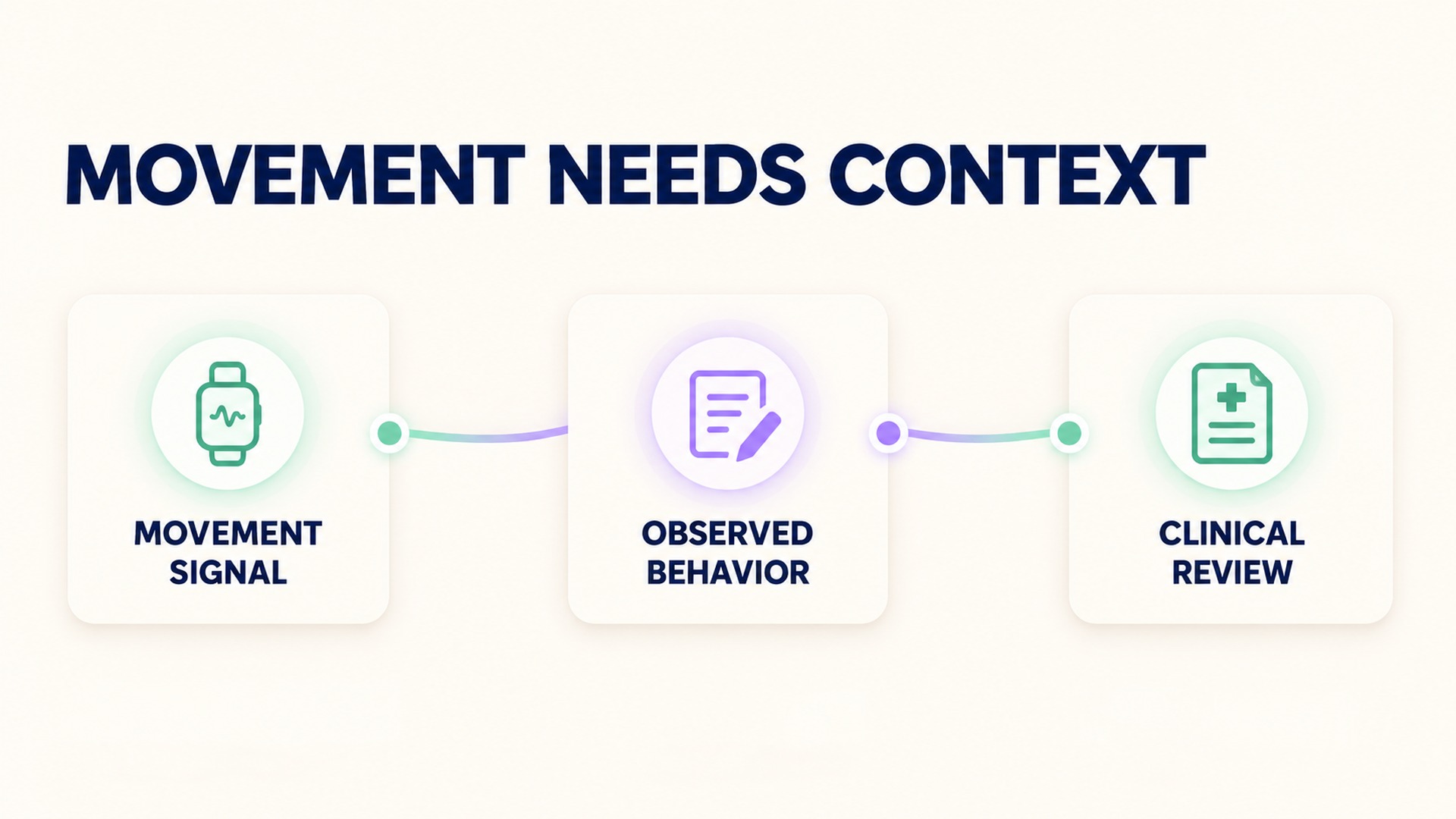
Behavior can have more than one explanation
Dream enactment is a description of behavior, not a conclusion about what caused it. Similar-looking movements can occur in different sleep contexts, and a person may move without recalling a dream. Conversely, someone can recall a dream without moving. A clinical overview of REM sleep behavior disorder explains that diagnosis relies on a history of relevant behavior together with confirmation of REM sleep without normal atonia on an in-laboratory sleep study with video. This kind of assessment prevents a movement count from being mistaken for a diagnosis.
The context also matters. A one-time event after an unusual night is different from a repeated pattern that is becoming more forceful or causing injury. The exact details can be difficult to reconstruct after waking, so write down what the observer actually saw rather than filling gaps with a likely story. If the sleeper later remembers a dream, record that in a second note. The two observations can be compared by the clinician without assuming that they match perfectly.
Keep event notes separate from sleep-stage estimates
A journal can preserve three different types of information: what someone saw or heard, what the sleeper remembers, and what a device estimated. Keep those in separate fields. For example, “observer heard shouting and saw arm movement” is not the same as “dreamer remembers being chased,” and neither is the same as “device estimated REM.” When these records are merged into a single score, an important distinction can disappear.
If you use a phone or wearable to note the timing, record the source of the timestamp and any uncertainty. Do not use a consumer stage label to decide that the behavior occurred during REM. The device may display a stage for the surrounding period, but it was not designed to confirm the sleep state during a brief complex behavior. A related explanation of why a sleep-stage percentage needs a confidence label discusses this broader limit of consumer staging.
A note should preserve the sequence rather than grade its seriousness. If the event began with speech and continued with a movement, write that order down. If the observer woke the sleeper, record that too, because the later recollection followed an awakening. If no one observed the event directly and the only clue is a device alert, label the source clearly. This helps the clinician decide which details are firsthand, which are remembered, and which came from an algorithm.
Try to keep the note short enough that it can be completed consistently. Include date, approximate time, the observed action, any potential injury, whether the event has occurred before, and any relevant recent changes the clinician asks about. Avoid adding an explanation such as “the tracker says I was dreaming” unless that is clearly labeled as a device estimate. If several people have different observations, keep their accounts distinct rather than averaging them into one story.
When to seek a clinical review
Bring the record to a health professional when dream-enactment behavior repeats, becomes forceful, causes injury, or creates concern for anyone sharing the sleeping area. A review is also reasonable when new behaviors occur alongside other changes in sleep or daytime functioning. The exact urgency depends on the circumstances. If an injury has occurred or the behavior creates immediate danger, use appropriate medical care rather than waiting to build a longer log.
A clinician may ask about timing, frequency, medications, alcohol or other substances, neurological symptoms, breathing problems, and other sleep behaviors. A concise record can be more useful than a long description that mixes observations with interpretation. If the observer is unsure whether a movement was deliberate, record that uncertainty instead of treating it as confirmed dream enactment. Keep the date, observer, movement, any remembered dream, and any consequence in separate entries. If the behavior changes over time, compare like periods and note when the change began. This does not determine cause, but it helps a clinician decide what follow-up questions or tests are relevant. Those details help separate possible causes. Do not start, stop, or alter prescribed medication based on an app or a general article. If a medicine or health condition may be relevant, bring that question to the prescriber.
The clinical overview of narcolepsy and related sleep symptoms provides general information about sleep-related symptoms, but it cannot identify the cause of a particular movement. The appropriate assessment depends on the behavior and the person’s history. If a clinician recommends video-polysomnography, the aim is to connect observed behavior with physiological signals, not simply to generate another consumer score.
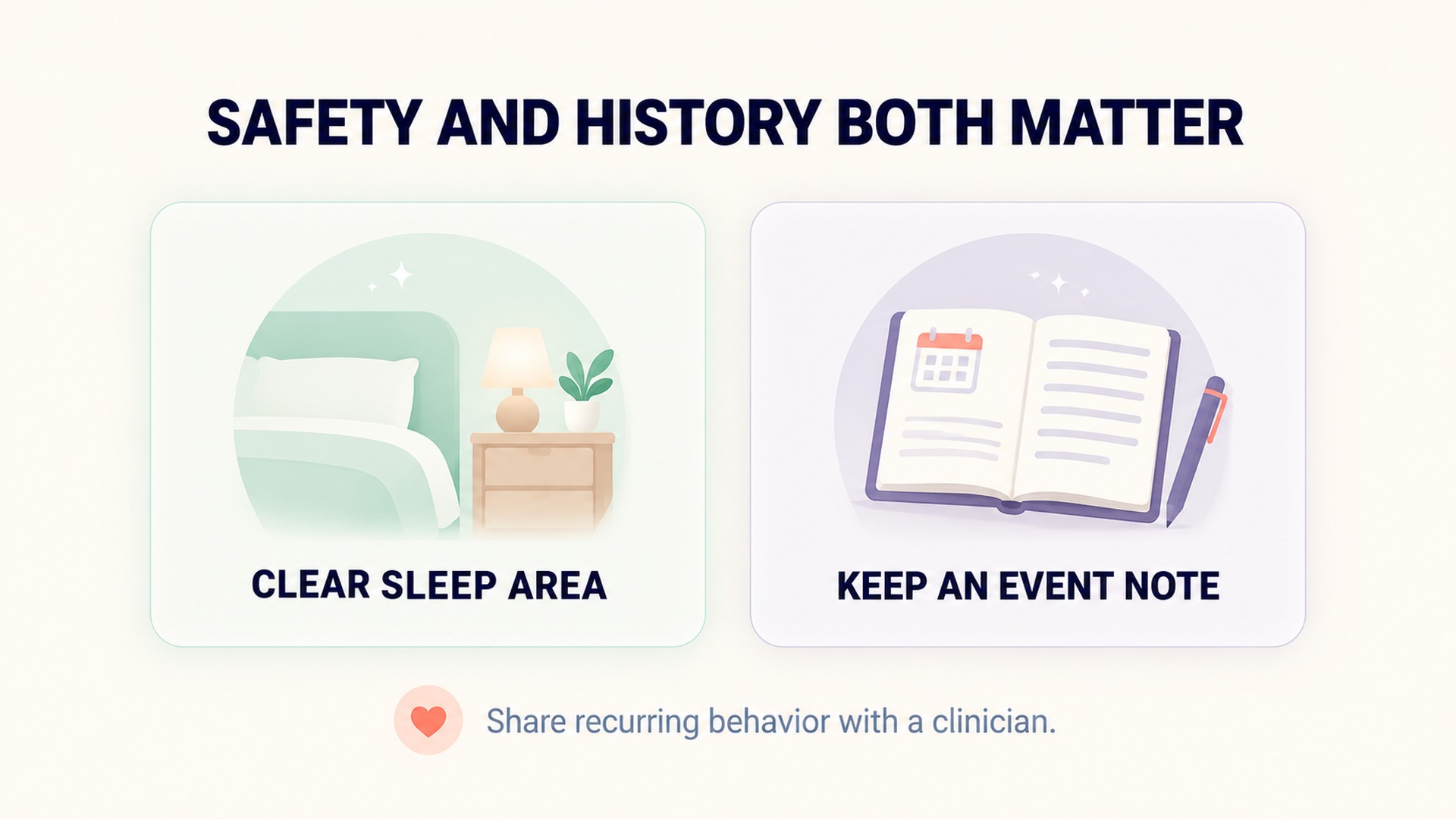
Restlessness is a broad description; dream enactment is a more specific behavior that may carry an injury risk and call for a different assessment. Record what was observed, what was remembered, and what the device estimated as separate facts. If the behavior repeats or causes concern, share that record with a qualified professional rather than relying on a movement total.
FAQ
Does a high movement score prove that someone acted out a dream?
No. A movement sensor cannot identify dream content or diagnose a sleep behavior. Describe any observed event separately from the device score.
Should I record an event if the sleeper does not remember it?
Yes, if someone else observed it. Label who saw or heard the behavior and keep that account separate from the sleeper’s memory.
When should dream-enactment behavior be discussed with a clinician?
Discuss recurring, forceful, injurious, or concerning behavior. Seek appropriate care sooner if someone is at immediate risk of injury.
*This article is for informational purposes only and is not a substitute for professional medical advice, diagnosis or treatment.*
Sources:
Journal of Clinical Sleep Medicine·Continuum·Sleep·Journal of Clinical Sleep Medicine·StatPearls Publishing·National Institutes of Health
Related articles
Remembering a dream does not measure how much REM sleep occurred
Dream recall is not a measure of REM sleep duration. Learn how to keep a dream journal and a device estimate separate.
Recording sleep paralysis without assigning it a sleep stage
Sleep paralysis happens around falling asleep or waking, and a wearable stage graph cannot diagnose it. Learn what details to record and when to discuss recurring episodes with a clinician.

Keeping prescribed breathing treatment separate from a sleep score
Sleep score and prescribed breathing treatment answer different questions. Learn how to keep the records separate and what to bring to a clinical follow-up.

Why a laboratory sleep study can differ from a usual night at home
A laboratory sleep study records sleep under conditions that can differ from home. Learn how to discuss an unusual test night without dismissing the clinical findings.

How to Read a Sleep Graph When Deep Sleep Appears in Short Bursts
Short deep-sleep blocks on a wearable graph can reflect stage estimates, chart resolution, or missing sensor intervals. Read the time scale and coverage notes alongside the total sleep window before interpreting the pattern.

Why Sleep Stage Percentages Need a Confidence Indicator
A sleep-stage percentage can look precise even when the tracker has limited evidence for part of the night. A confidence indicator should explain whether it refers to signal coverage, classifier uncertainty, or validation against a reference method.

How to Tell Whether Zero Deep Sleep Is a Data Gap or a Classification Result
Zero deep sleep in a wearable graph can reflect an incomplete record or a classification that assigned no eligible interval to that stage. Check the full timeline, coverage notes, and the app’s stage method before interpreting the value.

Why Main Sleep and Naps Need Separate Breathing Analysis
Main sleep and naps can differ in timing, duration, sensor coverage, and how a tracker identifies each interval. A breathing summary should show which session it analyzed and keep a nap separate unless the product explains how both periods enter the same calculation.

Why a Percentage of Optimal Breathing Needs a Clear Denominator
A percentage of optimal breathing can look exact even when its denominator is unclear. Learn why a tracker should state which sleep minutes count, how it treats sensor gaps, and whether its method stays consistent across nights.

Why Bedtime Consistency Scores Can Misread a Deliberate Time Shift
A bedtime consistency score compares clock labels, but a deliberate schedule shift can make familiar sleep timing appear unusually variable. Check the score’s time frame, observation window, and treatment of transition nights before reading the result as a change in sleep quality.