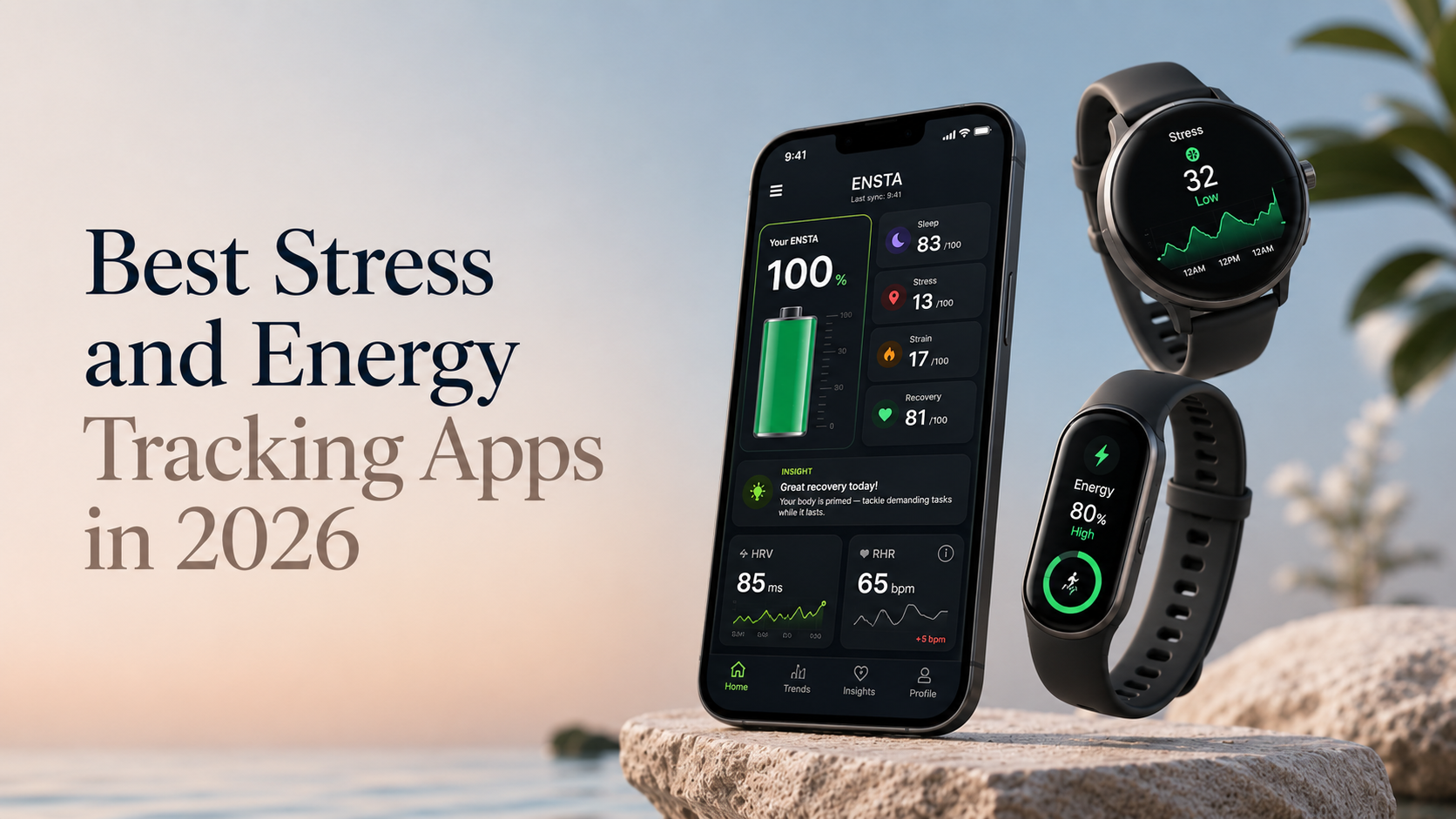
Best Free Energy Tracking Apps in 2026
The free apps are actually worth trying, what “free” really gets you, and whether you need a device at all.
By Anjali Singh · Jun 30, 2026
Category:Energy
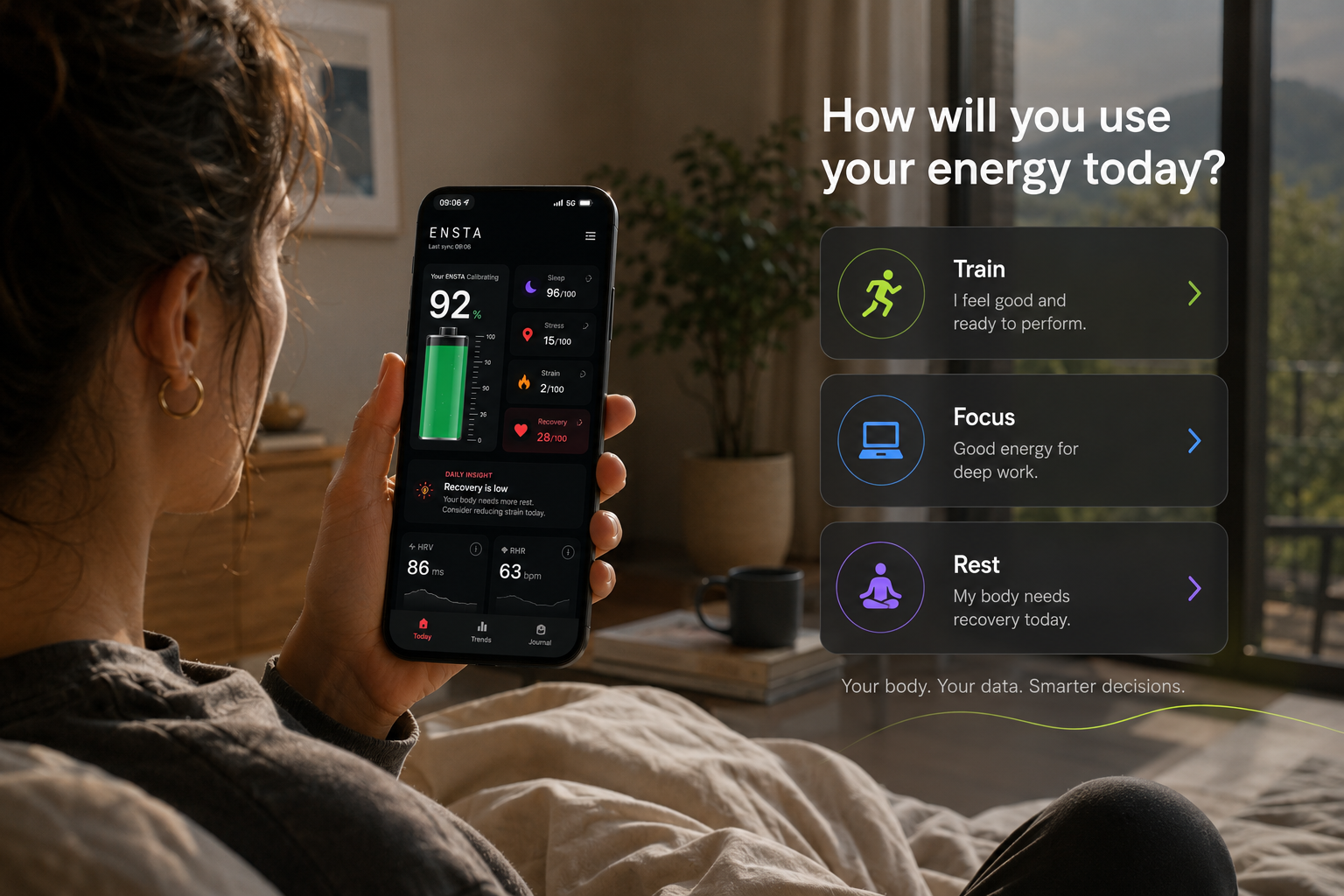
If you just want a free energy app that simplifies things, start with Ensta. It’s the best fit for most people and works with the devices you probably already use. Samsung Health is a good pick for Samsung users, Welltory is better for HRV-heavy insights, Visible is stronger for pacing, and Elara Health is useful for symptom tracking.
A lot of people searching for an energy app are not trying to become amateur sports scientists. They are just trying to stop feeling weirdly drained at 3 PM every day and maybe understand why that keeps happening.
That is why the “free” part matters so much here. Before anyone buys a ring, a band, or yet another monthly subscription, it makes sense to see what a good app can already tell you. Sometimes that is enough. Sometimes it is more than enough.
So this list stays pretty grounded. We did not want apps that just throw more numbers at you. The app had to help you understand what is going on, be useful without paying right away, and work without dragging you into a whole hardware purchase. If something was more niche but genuinely helpful, we kept it in.
Quick picks
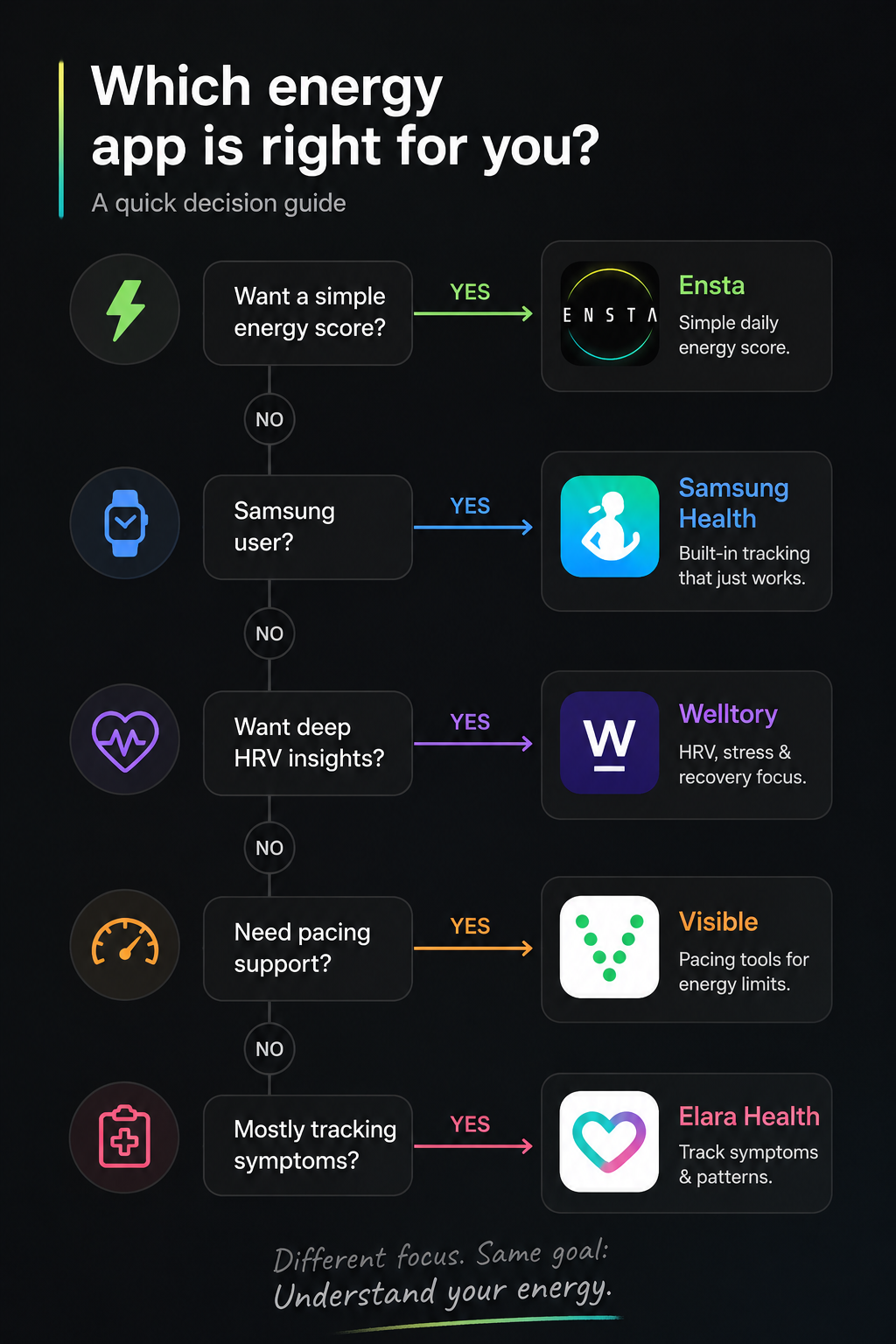
Best free option: Ensta.
Free to download, cross-device, and built around one clear Energy Score with practical guidance.
Best for Samsung users: Samsung Health.
Best fit if you already use Samsung devices and want Energy Score built into that ecosystem.
Best for HRV insights: Welltory.
Good for stress and energy tracking through HRV, with Apple Watch support and basic self-tracking after the trial.
Best for pacing: Visible.
Designed to help people manage energy and pace with more confidence, especially for energy-limiting conditions.
Best for symptom tracking: Elara Health. Best if you want to log energy, exhaustion, sleep, and symptoms in one place and look for patterns over time.
Comparison table
| App | Price / Free tier | Devices supported | Key metric | Standout feature | Subscription (Y/N) |
|---|---|---|---|---|---|
| Ensta | Free download | Phone and wearables you already use | Energy Score, 0 to 100 | Clear daily guidance across energy, sleep, stress, and recovery | N |
| Samsung Health | Free with Samsung Health | Samsung devices and Samsung Health ecosystem | Energy Score | Best built-in option for Samsung users | N |
| Welltory | Free 3-day Premium trial, then basic self-tracking remains | Apple Watch, Apple Health, phone-based inputs | Stress and energy via HRV | Strong HRV interpretation and personalized tips | Y |
| Visible | Free app | iPhone and Android app access, optional wearable pairing depending use case | Energy and pacing patterns | Especially helpful for pacing and energy-limiting conditions | N |
| Elara Health | Free app download | Android, Health Connect support | Energy, exhaustion, symptoms, sleep | Clear symptom and fatigue pattern tracking | N |
How we chose these apps
We kept the criteria pretty basic on purpose. Could you understand the main signal quickly? Was the free version actually useful, or just a teaser? Does it work with devices people usually already have? Did it help you do something useful with the information, or just dump another score on your screen? And could a normal person figure it out without spending half a day learning the app?
That was the lens for the whole list. We favored apps that felt clear, practical, and easy to stick with, especially if they gave you something useful before asking for money.
That also means this is not a list of the most famous wellness brands. It is a list of free or free-starting apps that can genuinely help people understand their energy better, including a few more niche options that are strong in specific real-life use cases.
Ensta - Best free option for simple daily energy tracking
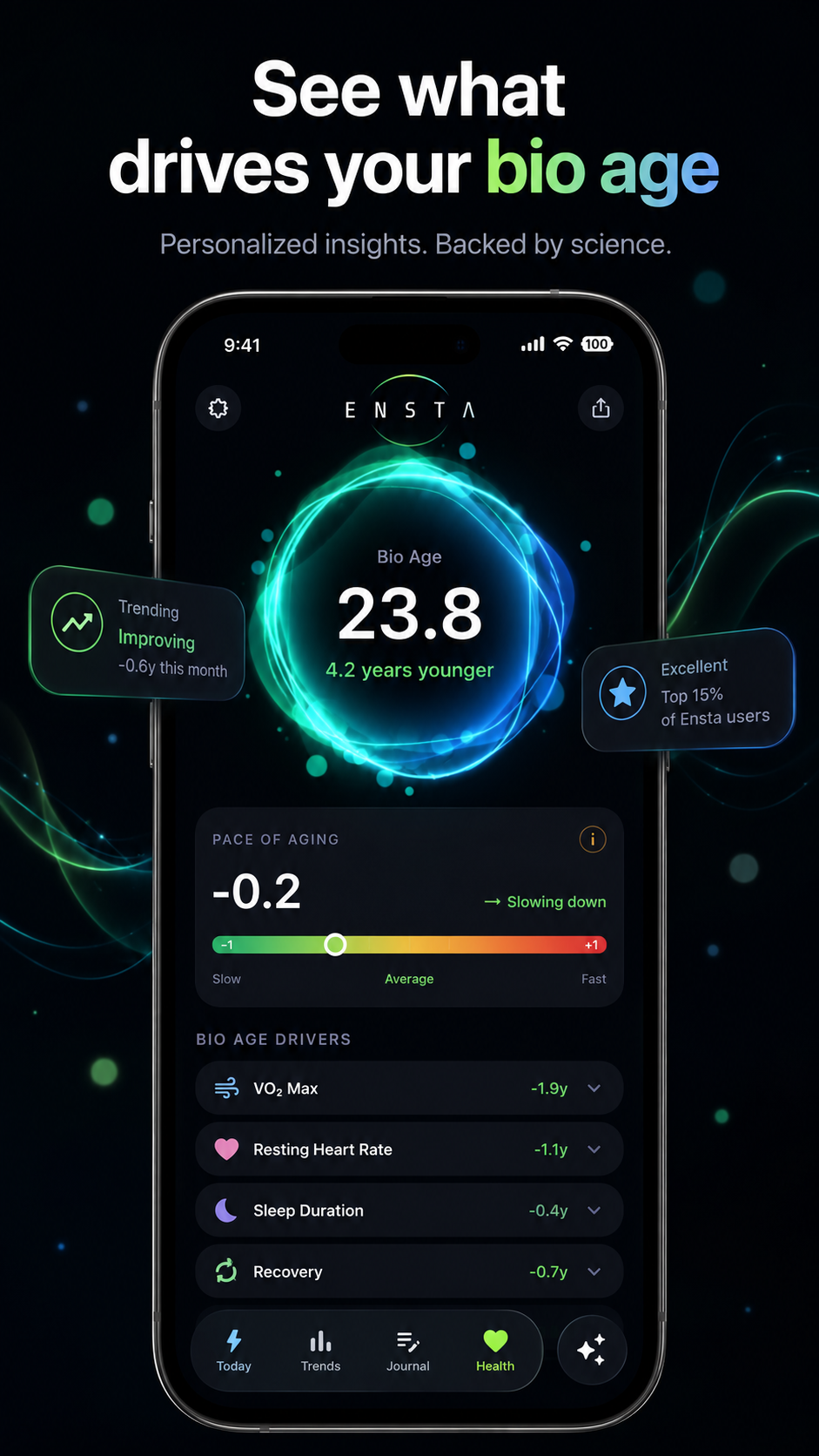
Ensta is the best free energy tracking app here for most people. It earns that label by keeping the signal simple and making the payoff obvious fast.
Best for: People who want one clear score and useful next-step guidance.
Pros
- Free to download and designed to give your first energy reading in minutes.
- Built around a simple 0 to 100 Energy Score instead of a pile of disconnected metrics.
- Pulls together sleep, recovery, stress, and energy in one clean interface.
- Includes an Energy Timeline, predictions, and explanations for why energy changed.
Cons
- Less ideal if your main goal is deep sport-performance breakdowns.
- People who enjoy tinkering with dense raw data may want more detail.
Price / devices: Free to download, and positioned around the devices you already wear.
Pick this if... you want an approachable free energy app that feels clear right away.
Samsung Health - The easy pick if you already use Samsung
Samsung Health is the obvious choice if you are already inside Samsung’s ecosystem. It is not the most universal option, but it does not need to be.
Best for: Samsung phone and watch users.
Pros
- Samsung offers Energy Score directly inside Samsung Health.
- The app benefits from built-in ecosystem convenience and familiarity.
- Strong pick for people who do not want a separate app stack.
Cons
- Best experience depends on being in the Samsung ecosystem.
- Less appealing if you use mixed devices.
Price / devices: Free within Samsung Health and tied closely to Samsung hardware.
Pick this if... you who already use Samsung and want the path of least resistance.
Welltory - Worth it if you care about HRV
Welltory is a good fit for people who like stress and energy insights through HRV (Heart Rate Variation), especially if they already use Apple Watch. It feels more interpretation-heavy than a basic tracker, which is the main reason it stands out.
Best for: HRV-based stress and energy insights.
Pros
- Interprets HRV data from Apple Watch and other sources to track stress and energy.
- Offers personalized tips and body-state guidance.
- After the free 3-day Premium trial, basic self-tracking features still remain available.
Cons
- The full experience pushes toward subscription.
- It can feel more detailed than some casual users want.
Price / devices: Free trial first, then basic self-tracking remains; supports Apple Watch and Apple Health connections.
Pick this if... you want a more detailed look at your data and interpretation than a standard health app usually gives.
Visible - Best for pacing and managing limited energy
Visible is more niche, but in a good way. It is one of the better picks for people whose energy problems are not about training harder but about pacing better. Unlike the rest of the apps here this one is designed for combating illness, not fitness.
Best for: People managing fatigue, pacing, or energy-limiting conditions.
Pros
- The app is explicitly built to help users understand their body, manage energy, and pace with more confidence.
- It is designed around real-world energy limits rather than generic fitness goals.
- Strong option for readers who feel ignored by standard performance-first wellness apps.
Cons
- More specific in audience than a broad consumer energy app.
- Not the best fit if your goal is athletic readiness or training optimization.
Price / devices: Free app access on major app stores.
Pick this if… you’re looking for a more compassionate, pacing-centered approach to energy tracking.
Elara Health - Helpful if fatigue is the main problem
Elara Health is another niche one, and that is exactly why it deserves space here. It is useful for people who want to connect fatigue, energy, sleep, and symptoms instead of looking at energy as one isolated number.
Best for: Symptom-led energy and fatigue tracking.
Pros
- Tracks energy, exhaustion, sleep, activity, and health patterns.
- Built to help users recognize overexertion earlier and manage energy more consciously.
- Offers daily, weekly, and monthly views plus Health Connect support.
Cons
- More condition-aware and symptom-led than broad lifestyle-focused.
- The interface and framing may feel more clinical than simple-score apps.
Price / devices: Free Android app with Health Connect integration.
Pick this if… you want a journaling-plus-patterns approach to fatigue and energy.
App vs device: which do you actually need?
This is where people split pretty quickly. One group wants an app that works with the phone or wearable they already own, while the other wants to buy dedicated hardware because they want tighter sleep, recovery, or training data.
For a “best free” query, the first path is usually the right one to start with. Ensta, Samsung Health, Welltory, Visible, and Elara Health all give you a way to learn something useful before turning energy tracking into a hardware purchase. That is the honest value of this category.
Is a free energy app good enough?
Usually, yes.
Most people do not need a huge stack of metrics to get something useful. They need a clear read on how they are doing, what probably pushed that number up or down, and what to do with the day in front of them. That is the real job.
A free app is good enough when it gives you that without making you dig for it. If it helps you spot the pattern between bad sleep, stress, overdoing it, and the way your energy crashes later, it is already doing something valuable.
Where free apps usually fall short is depth. You may get fewer long-term trends, fewer coaching layers, or fewer premium explanations. Welltory is a pretty normal example of that. You can still use it for basic self-tracking after the trial, but the fuller version lives behind Premium.
That is also why Ensta feels strong on a query like this. The point is not to win on complexity. The point is to make energy easier to understand in one glance, with a simple score and clear guidance from the start.
How to choose the right free energy app
Start with the question you actually want answered.
If your question is, “How am I doing today?” Ensta makes the most sense. It is built around one clear Energy Score instead of asking you to interpret a bunch of separate signals on your own.
If your question is, “Can I just use the stuff I already have on Samsung?” then Samsung Health is the easy answer. It already includes Energy Score inside that ecosystem, so there is less setup and less friction.
If your question is more like, “What is my HRV saying about stress and recovery?” then Welltory is the better fit. That is where it is strongest.
If the real issue is pacing, crashes, or managing limited energy more carefully, Visible is probably the better place to look.
If you want to track fatigue alongside symptoms, sleep, and exertion, Elara Health is the more useful pick.
The mistake is chasing the app with the most features. Most of the time, the better app is the one that gives you an answer you can actually use before noon.
Benefits and precautions
These apps can help, but they help in a pretty specific way.
They are good at showing patterns. You start noticing that a bad night, a stressful day, or pushing too hard tends to show up in the same way later. That kind of feedback is useful because it gives you a little more context than “I feel off today.”
They can also make health data feel less scattered. Ensta’s whole pitch is basically that most apps throw a lot of metrics at you, while one clearer signal can be easier to act on. That is a fair reason people use apps like this in the first place.
But they still have limits. They are consumer wellness tools, not medical devices, and they should help you pay attention, not convince you that an app can explain every bad day or symptom by itself. The Ensta content framework also treats that precaution as non-negotiable on health content.
FAQ
What is the best free energy tracking app in 2026?
For most people, Ensta is the best free place to start because it keeps the whole thing simple. It takes sleep, stress, recovery, and other body signals and turns them into one Energy Score, which is a lot easier to use than juggling a bunch of separate numbers. Samsung Health, Welltory, Visible, and Elara Health are also good picks, but for more specific use cases.
Is a free energy app accurate enough?
Accurate enough for patterns, yes. Perfect, no.
That is the better way to think about it. A free energy app can help you notice trends and make better daily calls, but it still depends on the data coming in and how the app interprets that data. These tools are better for context than certainty.
Do I need a wearable to track energy?
Not necessarily.
Some apps work with wearables you already own, and some are really about making existing health data easier to understand rather than asking you to buy new hardware on day one. That is part of why app-first options are appealing. They let you learn something useful before turning this into a bigger purchase.
Which free app is best for fatigue and pacing?
Visible is the strongest fit if pacing is the main issue. It is designed to help people understand their body, manage energy, and pace with more confidence, which is a different need from basic fitness tracking. Elara Health is also worth a look if you want more symptom logging alongside energy tracking.
Which free app is best for Samsung users?
Samsung Health. That is mostly because it is already where Samsung users are. It includes Energy Score inside the Samsung Health ecosystem, so it is the lowest-friction option if you do not want to stitch together a separate setup.
Final verdict
Ensta is the best free energy tracking app in 2026 for most people because it keeps the whole experience simple. It is built around one clear Energy Score, works with the devices people already use, and tries to answer the only question most people really care about, which is how their body is doing today and what to do next.
Samsung Health is the better pick if you are already all-in on Samsung. Welltory is stronger for HRV-led stress and energy insights. Visible is the one to look at for pacing and energy-limiting conditions. Elara Health makes more sense if your energy tracking needs to sit alongside fatigue, symptoms, and overexertion patterns.
*This article is for informational purposes only and is not a substitute for professional medical advice, diagnosis or treatment.*
Sources:
Related articles
Best Apps That Explain Sudden HRV Changes in 2026
Why your HRV changed overnight, what it usually means, and the apps that actually help you figure out what to do next.
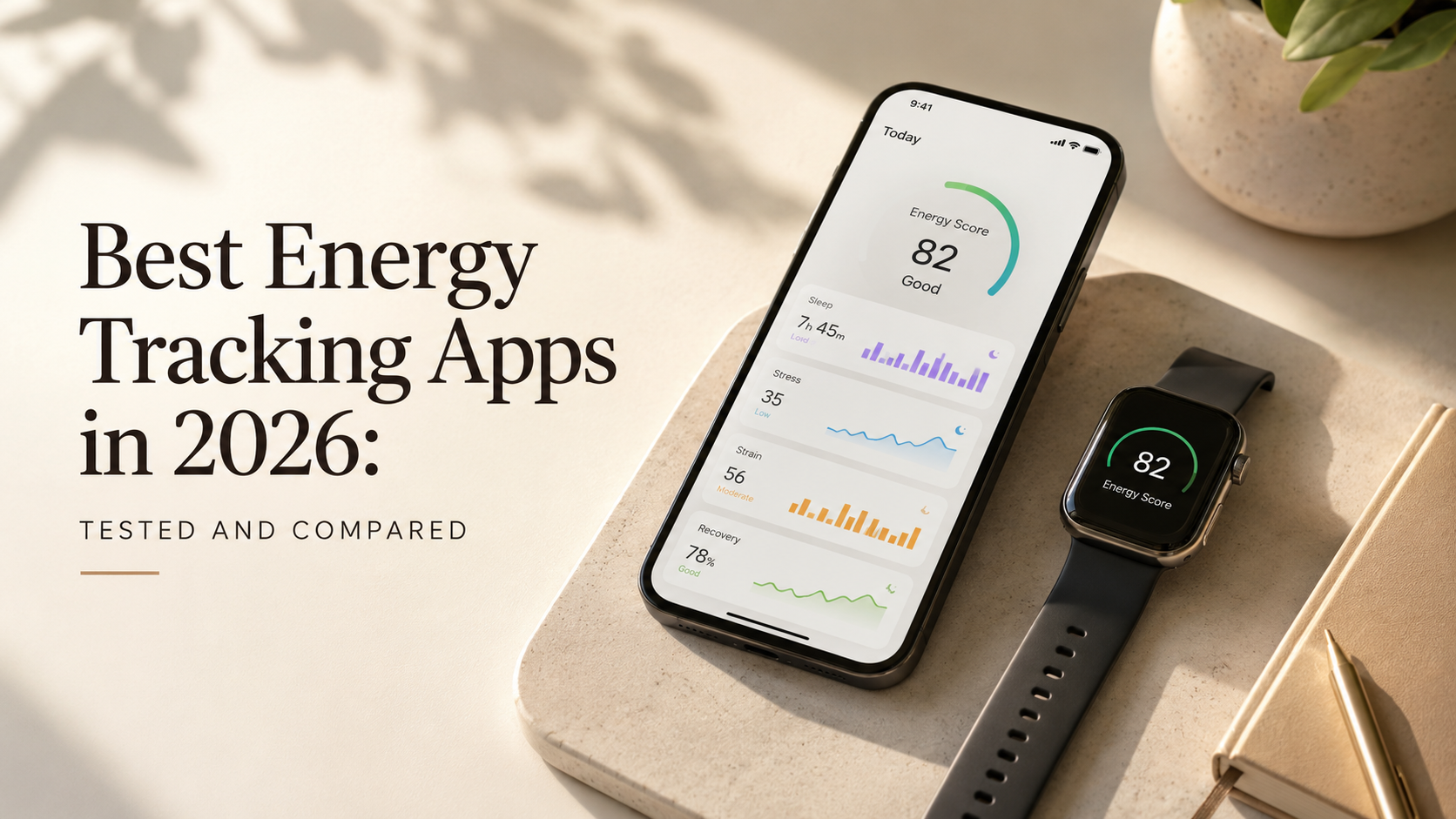
Best Energy Tracking Apps in 2026: Tested and Compared
Why your morning energy is decided the night before: coffee, alcohol, and dinner timing
Most bad mornings are decided the night before. How late coffee, alcohol, and dinner timing quietly drain your next-day energy, and how to fix it.
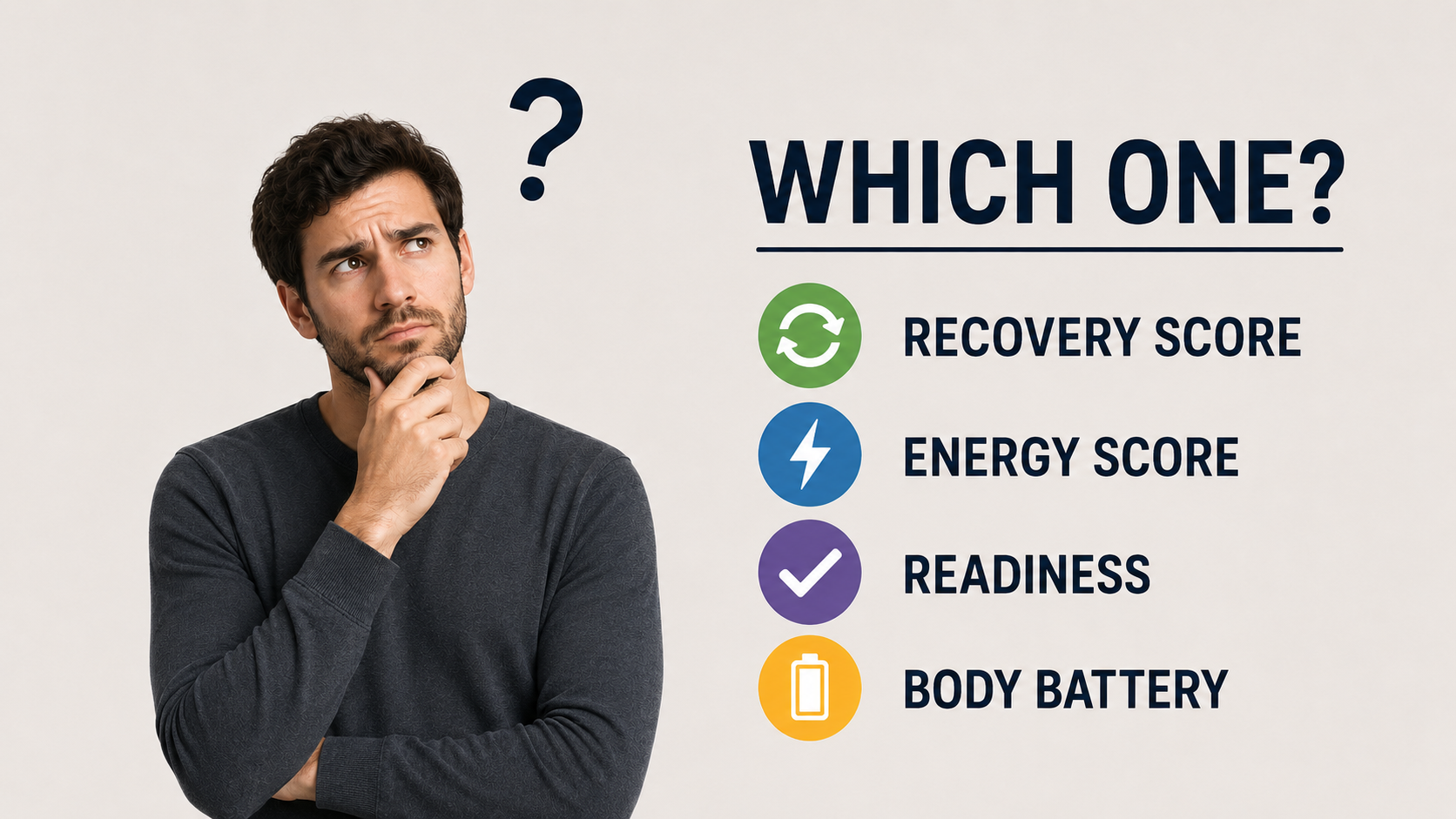
Recovery Score, Energy Score, Readiness, Body Battery — What Actually Matters
What recovery score means, how energy and readiness score differ, and body battery vs recovery — plus which numbers actually deserve your attention.