Creatine kinase after exercise requires symptoms and timing
By Mr.Apps · Oct 26, 2026
Category:Energy

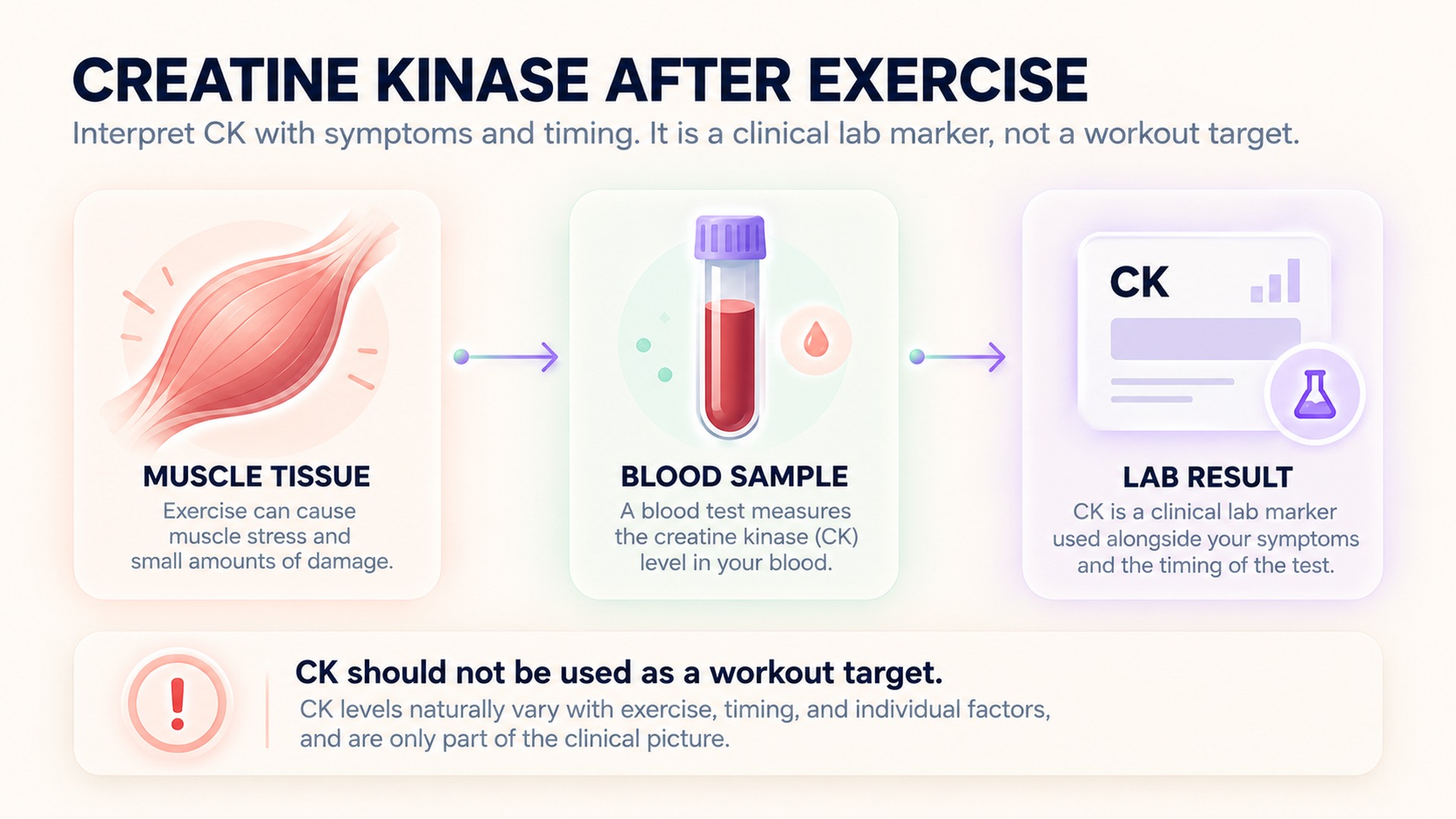
Creatine kinase (CK) is an enzyme found in muscle and other tissues. When muscle tissue is stressed or damaged, CK can enter the bloodstream, and a blood test can measure its level. Recent strenuous exercise can therefore be relevant when a CK result is reviewed. The exercise date, timing of the sample, symptoms, medicines, and reason for testing all matter. A CK value is a clinical laboratory marker, not a workout target or a direct measure of training quality.
The useful question is not whether a CK value is “good” for exercise. It is whether the result fits the clinical situation and whether it needs follow-up. Ordinary post-exercise soreness can occur after unfamiliar or intense activity, but severe pain, marked weakness, dark urine, or other unusual symptoms require prompt attention. A laboratory result should never be used to dismiss concerning symptoms or to clear someone to train. I treat CK as one piece of a clinical assessment that depends on both timing and how the person feels.
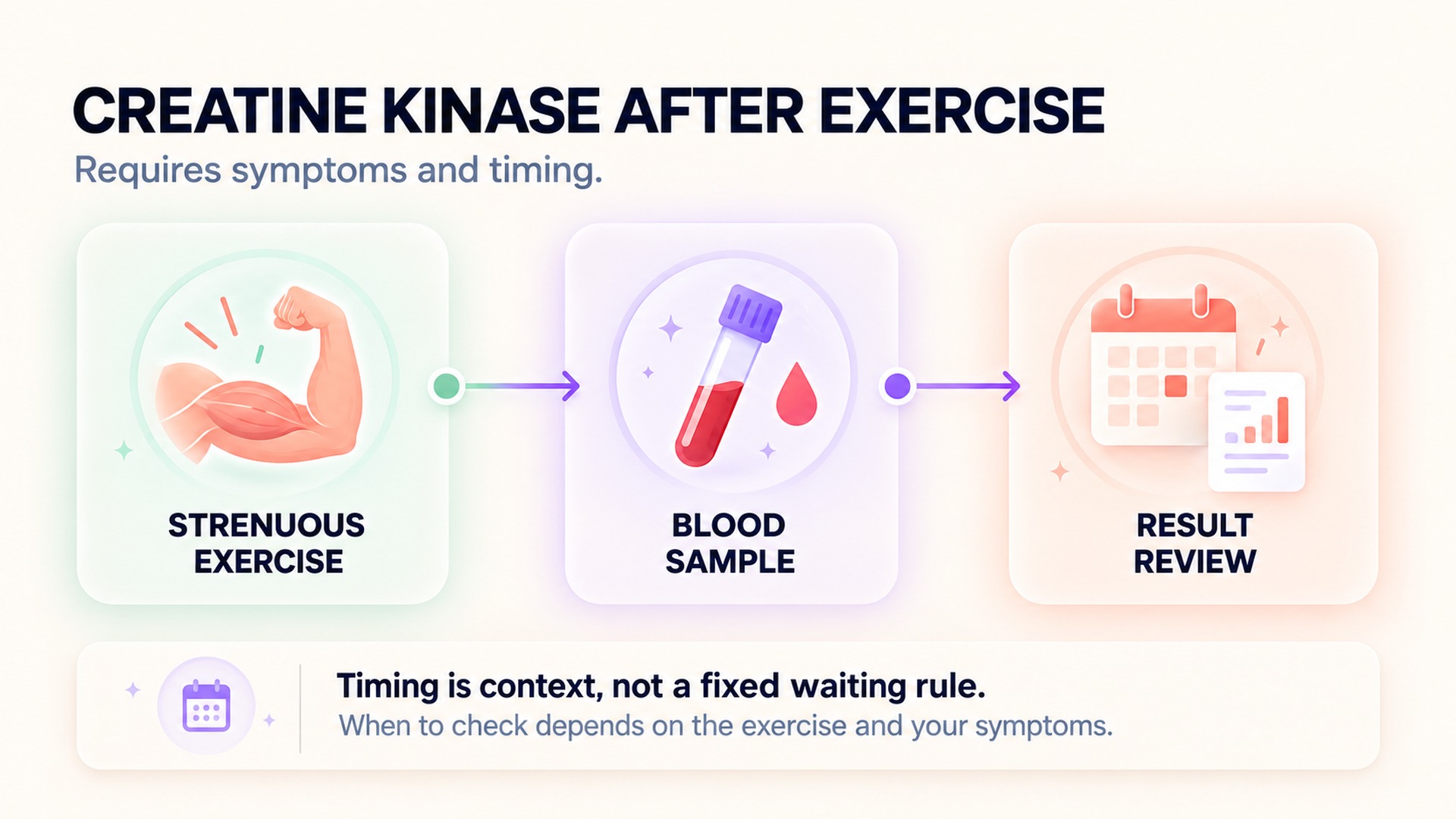
What the CK test measures
A CK blood test measures the amount of creatine kinase in a blood sample. The test may be ordered when a clinician is evaluating muscle symptoms, possible muscle injury, or a condition that can affect muscle tissue. The CK test overview explains what the test measures and why the result is interpreted alongside symptoms and other information.
CK can rise after strenuous exercise, but a single result cannot identify the exact activity that caused the change. Training intensity, the muscles involved, how recently the activity occurred, and individual factors can influence the context. Results also depend on the laboratory method and its reference interval. A value outside a printed range is a reason to discuss the finding with the clinician who ordered the test; it is not, by itself, a universal measure of injury or a signal to stop or resume training.
The timing of a blood draw matters because CK can change after muscle stress. A sample taken soon after exercise may not show the same level as a sample collected later. The pattern over time may matter more than a single measurement, particularly when a clinician is evaluating a possible acute problem. If repeat testing is ordered, the care team can explain when to return and whether exercise should be limited beforehand. There is no universal waiting interval that applies to every test and every person. The ordering clinician can decide whether a sample collected after activity is useful for the question being asked or whether a later measurement would add clarity.
Put recent activity beside the sample date
A clear activity record can make a laboratory discussion more useful. Note the date and approximate time of strenuous or unfamiliar exercise, the kind of activity, and whether it was a major change from the usual routine. Describe the body areas involved and whether soreness was expected, localized, improving, or worsening. Avoid converting the entry into a diagnosis such as “muscle injury” unless that has been established by a clinician.
Also preserve the blood draw date, the exact CK test name, the reported value, units, and reference interval. If the test was performed at a different laboratory from an earlier one, record that change. Keep CK separate from other muscle-related tests rather than assuming the values can be substituted for one another. The guide to understanding laboratory results describes why reference ranges are specific to tests and laboratories and why they must be read with the reason for testing.
Medicines, supplements, recent illness, heat exposure, hydration, and other health conditions can be relevant to the evaluation. Provide an accurate list to the care team and follow the laboratory's instructions. Do not stop prescribed treatment or begin a supplement because a CK number changed. If the clinician is checking for a potential muscle problem, ask whether any activities should be avoided before repeat testing and when symptoms should prompt another call.
Soreness and warning symptoms are not the same question
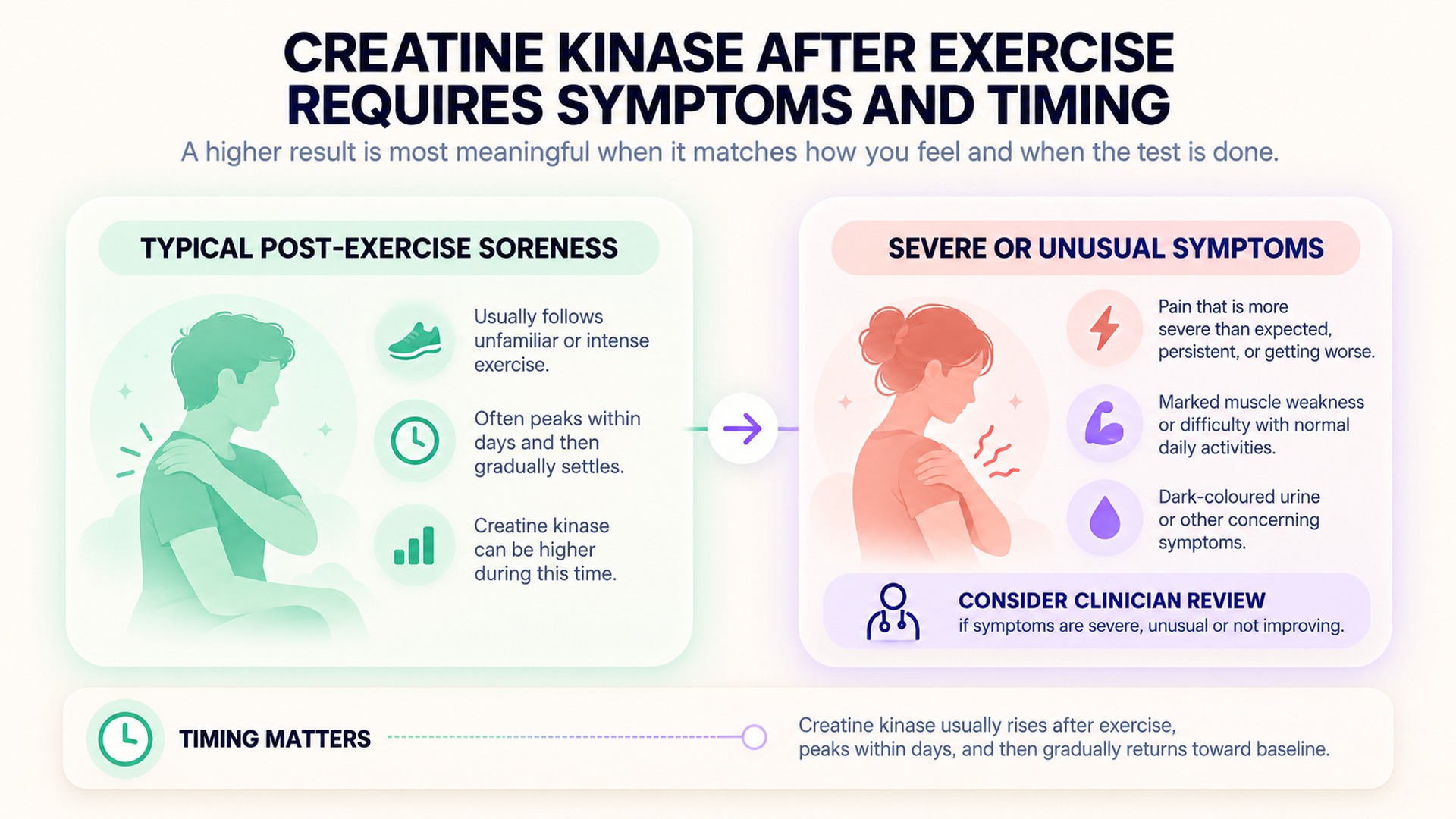
Typical soreness after exercise is often linked to unfamiliar or intense activity and may be localized to muscles that worked. It can develop after the session and improve over time. That pattern is not a diagnosis, and it does not guarantee that every symptom is harmless. People should not rely on a CK result to decide whether pain is ordinary or whether it is safe to continue a workout.
More severe or unusual symptoms deserve a different response. Muscle pain that is much worse than expected, persistent or worsening weakness, difficulty with usual tasks, dark-colored urine, or feeling unusually unwell can be signs of a serious problem. These symptoms can overlap with other conditions, so the appearance of one symptom does not prove a specific diagnosis. The symptom guidance for rhabdomyolysis advises seeking medical attention when concerning symptoms occur and explains that symptoms alone cannot confirm the condition. Symptoms may begin hours or days after muscle injury, so the timing of a change should be included in the record. The clinical overview of rhabdomyolysis symptoms describes why muscle pain, weakness, and dark urine should be taken seriously without treating any single symptom as a diagnosis.
A CK blood test may be part of an evaluation, and a clinician may repeat it to understand whether the level is changing. A result that is high after exercise should not be dismissed automatically, especially when severe symptoms are present. Conversely, a result on one day may not capture the full clinical picture. The care team considers symptoms, timing, other tests, and the person's history before deciding what the result means. The clinical discussion of CK and muscle assessment also describes how clinicians use CK with other information rather than as a stand-alone diagnosis.
Why the result is not a training score
A training score is designed to summarize performance or workload. CK is a blood measurement used in clinical assessment. They are not interchangeable. A higher CK value does not automatically mean a better training stimulus, and a lower value does not prove that recovery is complete. Treating the lab result as a target can encourage someone to exercise through symptoms or to compare results without regard to sample timing and individual context.
A clinician may ask about recent activity because it can affect interpretation. That does not mean exercise is always the explanation. The same laboratory result may be considered differently depending on whether the person has expected soreness, marked weakness, a recent illness, a medication change, or symptoms that are worsening. A useful record makes these facts visible without deciding the cause in advance.
A short timeline is often more useful than a long list of numbers. Record when the activity occurred, when soreness or weakness started, and when the sample was collected. Note whether the symptoms changed after the workout and whether daily tasks became harder. That detail helps a clinician decide whether the sequence is consistent with expected recovery or needs evaluation. It also keeps an app's daily summary from overshadowing the most important information: what the person noticed and when it changed.
If repeat testing is planned, follow the specific instructions from the clinician or laboratory. Do not invent a rest period or compare a new value with an earlier one collected under different conditions. Keep both the original numbers and their dates. If a result is surprising, ask whether the test should be repeated, which symptoms matter, and what activity guidance applies while the question is being evaluated.
Keep wearable data secondary
A wearable may record heart rate, workout duration, or activity estimates. It cannot measure blood CK and cannot diagnose muscle breakdown. A normal recovery score does not make severe pain or weakness safe to ignore. A lower score does not show that CK is elevated. Device trends may help document when activity changed, but they cannot replace a clinical assessment or a blood test.
The prevention guidance for exercise-related rhabdomyolysis emphasizes recognizing symptoms and reducing risk during physical activity. Its advice does not turn a consumer metric into a clearance test. For broader context about how app-based health measures should be interpreted, see this overview of health biomarkers. Keep observations and laboratory findings separate, then let the care team interpret them together.
Questions people ask
Can exercise raise CK?
Yes. Strenuous or unfamiliar exercise can affect CK, and the timing of the blood draw matters. The result still needs to be interpreted with symptoms, the laboratory reference interval, and the reason the test was ordered.
Does a high CK result mean someone has rhabdomyolysis?
Not by itself. CK is one part of an evaluation. Symptoms, timing, repeat results, and other clinical findings matter. Severe or unusual symptoms should be discussed promptly with a health professional.
Should someone wait for a wearable alert before seeking help for muscle symptoms?
No. A wearable does not measure CK and cannot rule out a serious muscle problem. Seek appropriate medical advice for severe pain, marked weakness, dark urine, or other concerning symptoms rather than waiting for an app score.
*This article is for informational purposes only and is not a substitute for professional medical advice, diagnosis or treatment.*
Sources:
National Library of Medicine·National Library of Medicine·Centers for Disease Control and Prevention·National Library of Medicine·Cleveland Clinic·Centers for Disease Control and Prevention
Related articles

Normal oxygen saturation does not establish a normal hemoglobin level
A pulse-oximeter percentage estimates how much available hemoglobin is carrying oxygen, while a blood count measures hemoglobin amount. Learn why one reassuring reading cannot replace the other test or a clinical review.

A raised CRP result cannot identify the source of inflammation
A raised CRP can signal inflammation, but it cannot identify where the process is or what caused it. Learn why standard CRP and high-sensitivity CRP serve different purposes and need clinical context.

When a vitamin B12 result needs a methylmalonic acid check
Learn why a clinician may consider methylmalonic acid when a vitamin B12 result leaves a question unresolved. See how kidney function, symptoms, medicines, and other tests shape interpretation.

Reading TSH and free T4 together in a fatigue review
Learn what TSH and free T4 contribute to a fatigue review and why the two results need clinical context. See how symptoms, medicines, timing, and prior results help keep a lab value in its proper role.

Why Metabolic Energy Efficiency and Daily Energy Are Different Concepts
Metabolic energy efficiency describes processes involved in handling fuel, while a daily energy score is usually a separate app estimate about patterns such as sleep, activity, and recovery. Similar wording does not mean the two measures track the same thing.

Why a Monthly Metabolic Trend Cannot Explain One Meal
A monthly metabolic trend summarizes signals across a longer window and cannot identify what one meal did to glucose or insulin. Read it as a broad estimate, keep meal notes in their proper context, and use clinical testing for medical questions.

How Charging Gaps Break a 24-Hour Energy Timeline
Removing a wearable to charge creates a period when the device may not record the signals used by an energy model. A 24-hour timeline should mark that gap instead of treating it as neutral or connecting the surrounding values as continuous measurement.

How to Compare Energy Drain Across Days With Different Starting Scores
The ending value alone can hide how much an energy score changed during the day. Compare the start, decline, timing and data coverage on the same scale before interpreting differences between days.

Why Missing Hours Need to Be Visible on an Energy Timeline
Connecting two known points across an unmeasured interval can invent a smooth story about the day. An energy timeline should mark missing hours clearly so estimates, observations and unknown periods remain distinct.

How to Tell Recharge From Reduced Drain in an Energy Timeline
A flatter energy curve can mean that the model estimates slower decline, while a rising curve suggests modeled recharge. Check the timeline’s direction, update timing and inputs before deciding which interpretation fits the display.