Adding nighttime reflux symptoms to a sleep review
By Mr.Apps · Oct 19, 2026
Category:Sleep

A sleep review can miss an important detail if it records only bedtime, awakenings, and a score. If you experience nighttime heartburn or fluid coming back into the throat, the timing and circumstances may matter. A symptom note can help describe what happened around an awakening. It cannot diagnose reflux or prove that reflux caused the entire night’s sleep disruption.
I would preserve the symptom timing as its own observation rather than fold it into the sleep score. Keep the symptom record separate from wearable signals. A rise in heart rate or a lower sleep score does not identify acid reflux. Those measurements can change for many reasons, and a device is not a digestive diagnostic test. A useful review connects the symptom, position, meal timing, and sleep interruption as observations, then leaves the clinical interpretation to a qualified professional.
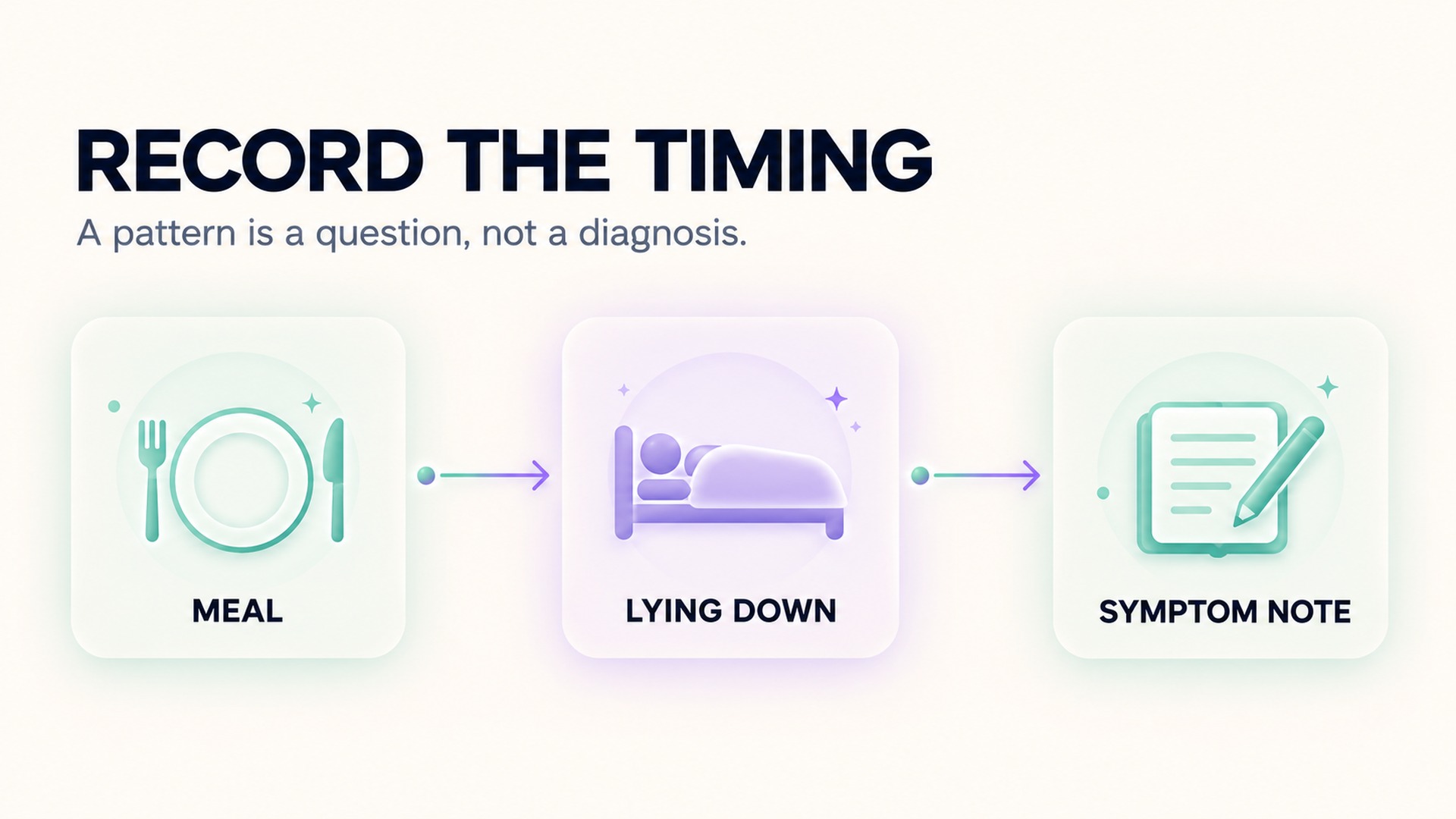
Record what you noticed and when
For each episode, write the date and approximate time, what sensation you noticed, whether you were lying down or had just awakened, and whether the symptom returned. A brief description such as “burning sensation after waking while lying down” is more useful than selecting a diagnosis from an app menu. If you are not sure whether the sensation was reflux, record the uncertainty rather than changing the wording to sound certain.
A food or meal note can add context. Include approximate meal timing and whether you lay down soon afterward if that is relevant to the episode. You do not need a detailed food diary unless a clinician asks for one. The purpose is to preserve timing, not to label a particular meal as the cause. Different foods affect different people, and an association in a short journal does not prove an individual trigger.
The official guidance on adult reflux describes common symptoms and how clinicians assess them. The related nutrition guidance for reflux symptoms at night or while lying down notes that meal timing may be relevant for some people. These general pages do not establish the cause of a particular awakening or prescribe one routine for everyone.
Keep medication entries factual as well. If you take a prescribed or over-the-counter medicine, record the name only if that is useful for the clinician and follow the existing instructions. Do not start, stop, or change a medicine because of a sleep chart or an article. A provider can review whether the timing or treatment plan should be adjusted based on your health history.
What sleep and reflux research can support
Reflux symptoms and sleep complaints can occur together, but a relationship does not settle which came first or whether one caused the other. A systematic review of sleep and gastroesophageal reflux found that the timing of reflux relative to stable sleep was not always clear in the available studies. Some episodes occurred around arousals or awakenings. That makes simple conclusions from a wearable timeline unreliable.
A review of interventions for nocturnal reflux symptoms examined research on approaches such as meal-to-bed timing and head-of-bed elevation, along with medical interventions. It also noted limits in the evidence for some strategies. The existence of a research review does not mean every option is suitable for every person. Discuss symptoms and treatment choices with a clinician, especially when they persist or worsen.
A clinical study of people with reflux symptoms and sleep disturbance assessed both symptom reports and esophageal measurements. It found an association between sleep disturbance and measures of nighttime acid exposure in that sample. The findings do not allow a consumer wearable to diagnose reflux or show that reflux explains an individual’s awakenings. Study participants and clinical measurements differ from a general app user’s nightly data.
Guidelines also separate clinical diagnosis from symptom tracking. The American College of Gastroenterology guideline for reflux evaluation and management describes assessment and treatment decisions that depend on symptoms, history, and other clinical considerations. A sleep diary can support that conversation by documenting when symptoms occurred. It cannot replace examination or testing if a professional thinks those are needed.
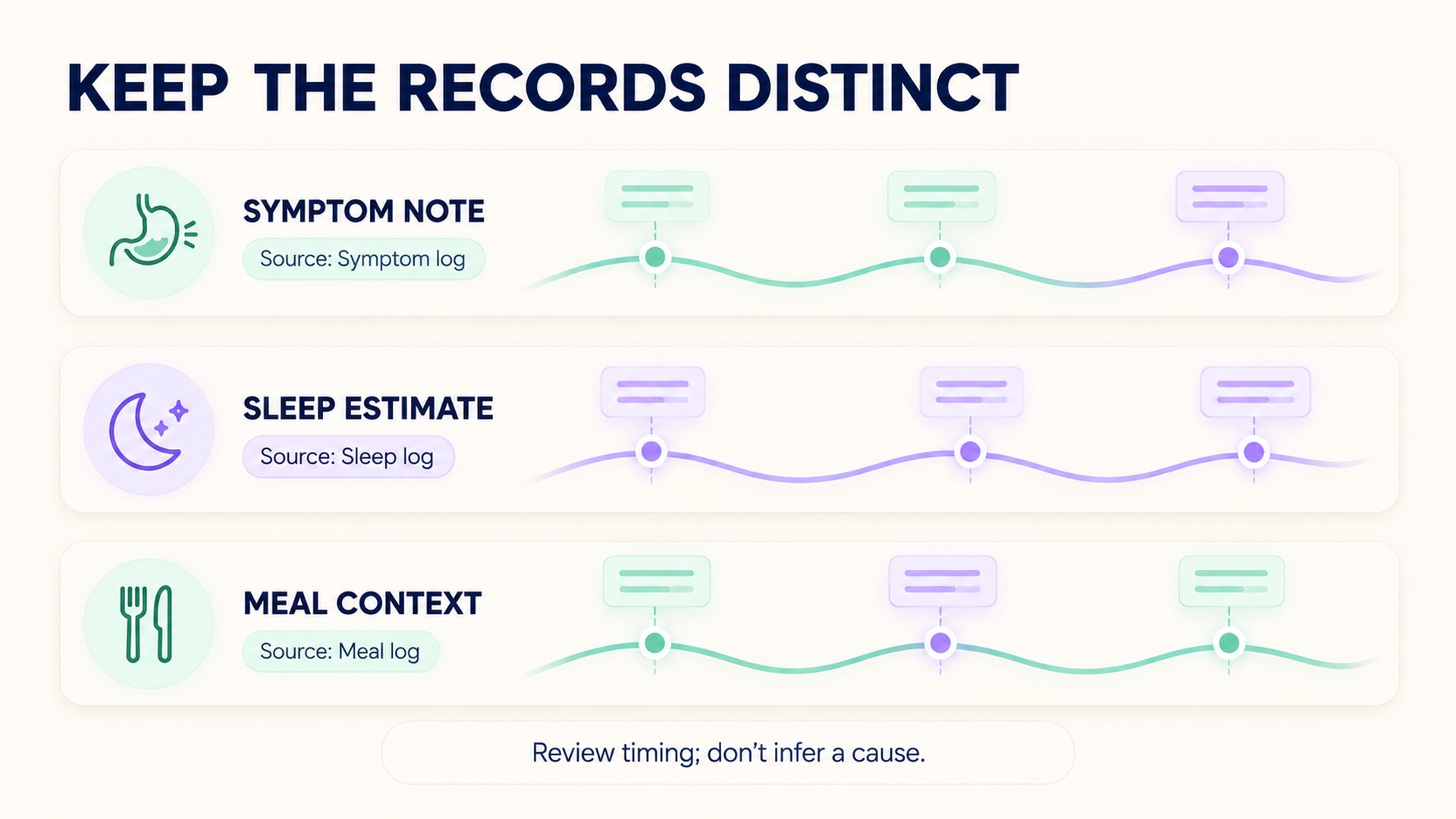
Keep the sleep record and symptom record distinct
A practical sleep review can use separate rows for estimated sleep, observed awakenings, reflux-like symptoms, meal timing, and relevant treatment notes. Add the source of each value. For example, a wearable estimate, a remembered awakening, and a clinician’s test result should not appear as though they were measured by the same method. If an entry is missing, leave it missing instead of entering “none.”
This structure helps avoid a false causal story. Suppose a lower score appears on a night when you also remember heartburn. The two observations occurred together. They do not show whether the symptom disrupted sleep, whether another factor contributed to both, or whether the score changed for an unrelated reason. Repeated timing may create a useful question for a medical visit, but it remains a pattern to review rather than a diagnosis.
Look at a consistent period rather than one striking night. A few dated entries can reveal whether a symptom was isolated, recurring, or associated with a particular position or routine. Avoid changing several habits at once just to improve a score; if a clinician recommends a change, follow that guidance and record what changed. If there is a clear care plan, use that plan rather than an app’s generic advice.
You can note how the next day felt, but keep that report separate from sleep-stage estimates. Feeling tired is real information about your experience; it is not a test of reflux severity. Similarly, a normal-looking score does not invalidate symptoms that woke you. A broader guide on why a regular sleep schedule matters beyond one sleep score covers another reason to keep daily context beside a nightly metric.
Avoid turning a pattern into a diagnosis
Sleep disruption can occur with many digestive and non-digestive symptoms. An awakening may follow a burning sensation, coughing, a need to use the bathroom, noise, discomfort, or no remembered trigger at all. The event itself is worth recording, but the cause is not always apparent. If you record only the wearable’s sleep score, you may lose the symptom that was most relevant to the awakening.
The order of events can also be hard to establish. Someone may wake first and then notice a throat sensation, or the sensation may be what caused the awakening. A journal written after the fact cannot reliably settle that timing. Use words such as “before,” “after,” or “uncertain” only when they reflect what you remember. Do not fill a gap by assuming that reflux began during a sleep stage shown on the app.
During sleep, the body’s response to reflux can differ from the awake period. A systematic review of sleep and reflux physiology notes that studies have examined acid exposure, clearance, and awakenings, but the timing of reflux relative to stable sleep has not always been measured precisely. This is one reason that a consumer graph cannot reliably identify a reflux event. Research measurements may combine esophageal pH monitoring and sleep recordings; a wearable does not provide those channels.
A journal can help you notice whether symptoms recur under similar circumstances, but it should not become a strict rule that every late meal or every awakening caused a reflux episode. Individual symptom patterns differ, and clinical recommendations depend on the diagnosis and overall context. If you are trying a change recommended by your clinician, keep the rest of the record steady where possible and note the date it began. That makes the conversation more useful without claiming that one night proves the change worked.
If the symptom is uncertain, record the actual sensation rather than labeling it heartburn or reflux. If you are confident about the symptom, still avoid assuming that it explains every other measure from the night. A sleep score and a symptom diary can describe different aspects of the same period. Their value comes from keeping both visible, not forcing them into a single conclusion.
When a symptom note needs medical follow-up
Contact a health professional if reflux-like symptoms are frequent, persistent, worsening, or interfering with sleep and daily life. Seek prompt care for severe or concerning symptoms, trouble swallowing, bleeding, unexplained weight loss, or chest discomfort that could have another cause. Do not rely on a sleep app to decide that chest pain is reflux. The right action depends on the symptom and the person’s health history.
Bring a concise record of dates, timing, positions, symptoms, and any treatment instructions already in place. If you have a previous diagnosis or test result, include that context. The clinician can decide whether the symptoms fit reflux, whether another cause should be considered, and whether any testing or treatment change is appropriate.
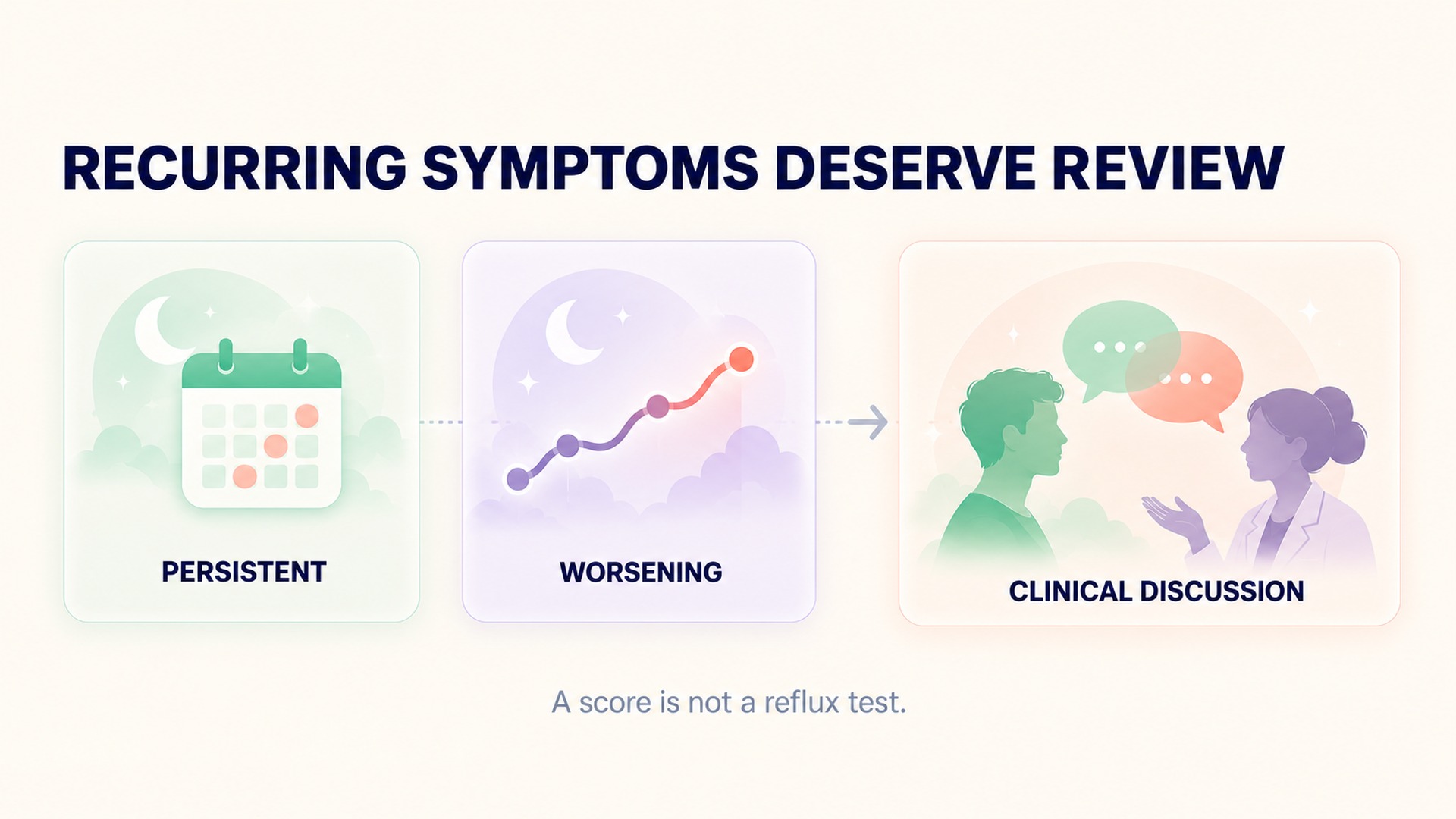
Nighttime reflux symptoms can be worth adding to a sleep review, but the record should describe timing rather than claim a cause. Keep symptoms, meal context, device estimates, and clinical information distinct. If episodes persist or concern you, share the pattern with a qualified professional instead of asking a sleep score to make the diagnosis.
FAQ
Can a heart-rate change during the night diagnose reflux?
No. Heart rate can change for many reasons, and a wearable is not a reflux test. Record symptoms directly and discuss recurring concerns with a clinician.
What should I record after a nighttime episode?
Note the time, the sensation, your position, whether you had just awakened, and any relevant meal timing. Mark details you are unsure about instead of guessing.
Should I change my medication or meal routine based on a sleep score?
No. Do not change prescribed treatment based on an app. Ask a qualified professional how to respond to persistent symptoms and what changes, if any, fit your situation.
*This article is for informational purposes only and is not a substitute for professional medical advice, diagnosis or treatment.*
Sources:
National Institute of Diabetes and Digestive and Kidney Diseases·National Institute of Diabetes and Digestive and Kidney Diseases·Alimentary Pharmacology & Therapeutics·Neurogastroenterology & Motility·The American Journal of the Medical Sciences·The American Journal of Gastroenterology
Related articles
Remembering a dream does not measure how much REM sleep occurred
Dream recall is not a measure of REM sleep duration. Learn how to keep a dream journal and a device estimate separate.
Recording sleep paralysis without assigning it a sleep stage
Sleep paralysis happens around falling asleep or waking, and a wearable stage graph cannot diagnose it. Learn what details to record and when to discuss recurring episodes with a clinician.

Keeping prescribed breathing treatment separate from a sleep score
Sleep score and prescribed breathing treatment answer different questions. Learn how to keep the records separate and what to bring to a clinical follow-up.

Why a laboratory sleep study can differ from a usual night at home
A laboratory sleep study records sleep under conditions that can differ from home. Learn how to discuss an unusual test night without dismissing the clinical findings.

How to Read a Sleep Graph When Deep Sleep Appears in Short Bursts
Short deep-sleep blocks on a wearable graph can reflect stage estimates, chart resolution, or missing sensor intervals. Read the time scale and coverage notes alongside the total sleep window before interpreting the pattern.

Why Sleep Stage Percentages Need a Confidence Indicator
A sleep-stage percentage can look precise even when the tracker has limited evidence for part of the night. A confidence indicator should explain whether it refers to signal coverage, classifier uncertainty, or validation against a reference method.

How to Tell Whether Zero Deep Sleep Is a Data Gap or a Classification Result
Zero deep sleep in a wearable graph can reflect an incomplete record or a classification that assigned no eligible interval to that stage. Check the full timeline, coverage notes, and the app’s stage method before interpreting the value.

Why Main Sleep and Naps Need Separate Breathing Analysis
Main sleep and naps can differ in timing, duration, sensor coverage, and how a tracker identifies each interval. A breathing summary should show which session it analyzed and keep a nap separate unless the product explains how both periods enter the same calculation.

Why a Percentage of Optimal Breathing Needs a Clear Denominator
A percentage of optimal breathing can look exact even when its denominator is unclear. Learn why a tracker should state which sleep minutes count, how it treats sensor gaps, and whether its method stays consistent across nights.

Why Bedtime Consistency Scores Can Misread a Deliberate Time Shift
A bedtime consistency score compares clock labels, but a deliberate schedule shift can make familiar sleep timing appear unusually variable. Check the score’s time frame, observation window, and treatment of transition nights before reading the result as a change in sleep quality.