Eccentric-only repetitions need a clear lifting-log label
By Mr.Apps · Nov 3, 2026
Category:Training
Label the contraction pattern in a lifting log
An eccentric-only repetition is a resistance movement in which the muscle produces force while it lengthens under load. It differs from a repetition that includes both a shortening phase and a controlled lengthening phase. A lifting log should make that difference visible, because a set described only as “three reps” can refer to different movement sequences.
I label the movement sequence and assistance before interpreting the repetition count.
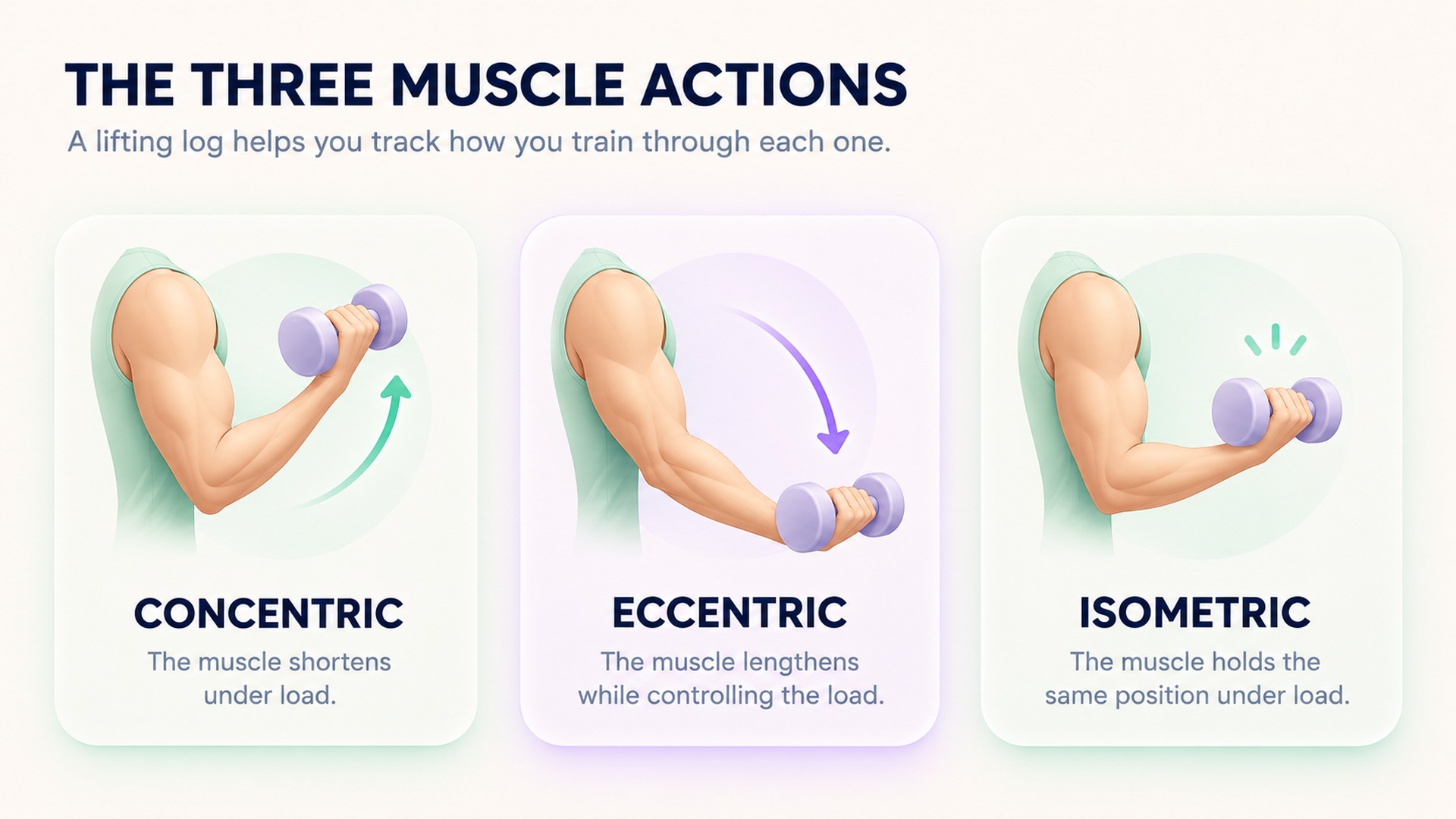
In a conventional curl, lifting the weight involves a concentric action and lowering it involves an eccentric action. An eccentric-only repetition may involve assistance during the lifting phase, followed by a controlled lowering phase. The physiology reference's definitions of muscle actions describe eccentric, concentric, and isometric actions by how muscle length changes during force production. That vocabulary helps label what occurred; it does not prescribe a training method.
How a repetition can contain one or more phases
Many resistance repetitions combine different phases. During a concentric action, the muscle shortens as it overcomes resistance. During an eccentric action, it remains active while lengthening under resistance. During an isometric action, force is produced without a substantial change in muscle length. These terms describe muscle actions and movement phases, not separate exercise names by themselves.
An exercise that includes lifting and lowering can contain both concentric and eccentric phases. A set of eccentric-only repetitions would isolate the lengthening phase, often with help or equipment for returning to the start position. The exact method varies. A machine may return the weight automatically, a partner may assist, or the person may reposition the load. The log should record the actual assistance rather than treating the setup as an ordinary unaided repetition.
The exercise information sheet on eccentric resistance exercise describes lengthening under load as an eccentric phase. For recording, the practical distinction is the same: identify whether the set included only that phase or whether it also included shortening, pauses, or external assistance.
Record the movement, not only the repetition count
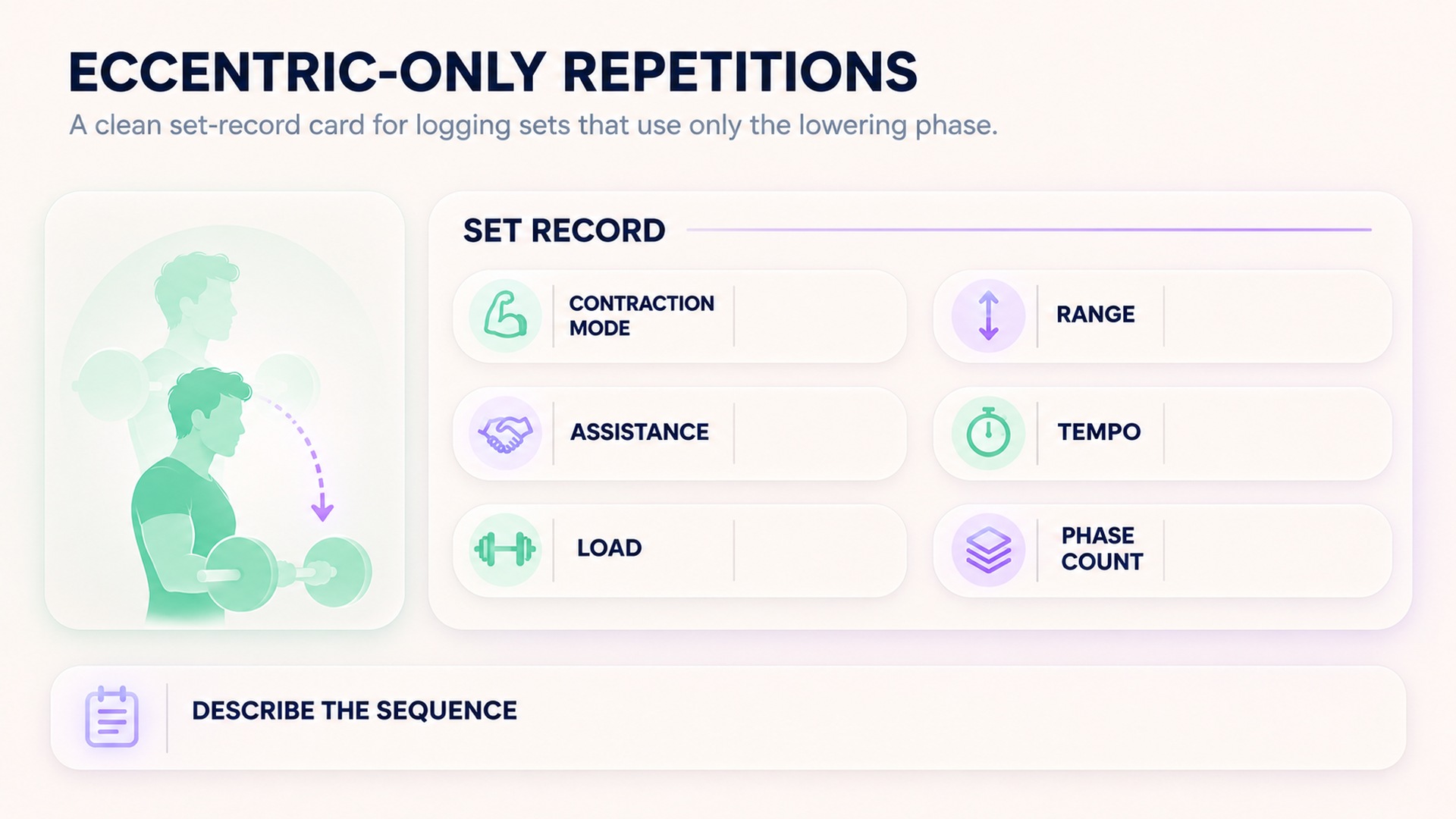
A useful entry should specify the exercise or movement, side if unilateral, number of eccentric phases completed, load if known, range used, tempo or duration when relevant, and how the load was returned to the starting position. Include the machine or assistance arrangement if it changes how the repetition is performed. A “rep” can be counted differently when one phase is assisted, so a brief description helps another reader understand the set.
Record the session date and the source of the load value as well. A machine's selected resistance, a plate total, and a device-estimated force are not necessarily the same measurement. Keep the original unit and identify any change in equipment or setup. If the exercise was performed on one side, label the side without assuming that the other side completed the same work. These details make the log specific enough to interpret without turning it into a laboratory record.
Keep the contraction mode close to the set record. If the app offers only a general repetition count, add a note such as “eccentric lowering only; assisted return” or “full lowering and lifting cycle.” The wording should match what happened. Do not infer the action from a video, exercise name, or a machine's label if the person completed a different sequence.
The study comparing eccentric, concentric, and combined resistance training used defined movement modes and speeds in a specific leg-extension protocol. Its results are tied to that study design and group. For an activity log, the important lesson is that movement mode and velocity can be distinct variables. A record that preserves both is easier to compare than one that reduces every set to load and repetitions.
Keep assistance and return phase explicit
The method used to return the load can change the meaning of a set. If a second person helps lift the weight so the participant can lower it, record that assistance. If a machine resets the resistance, note the machine or mode. If the person returns the weight independently, the set may include a concentric phase as well. Do not label the whole set eccentric-only if the person actively completed both directions under load.
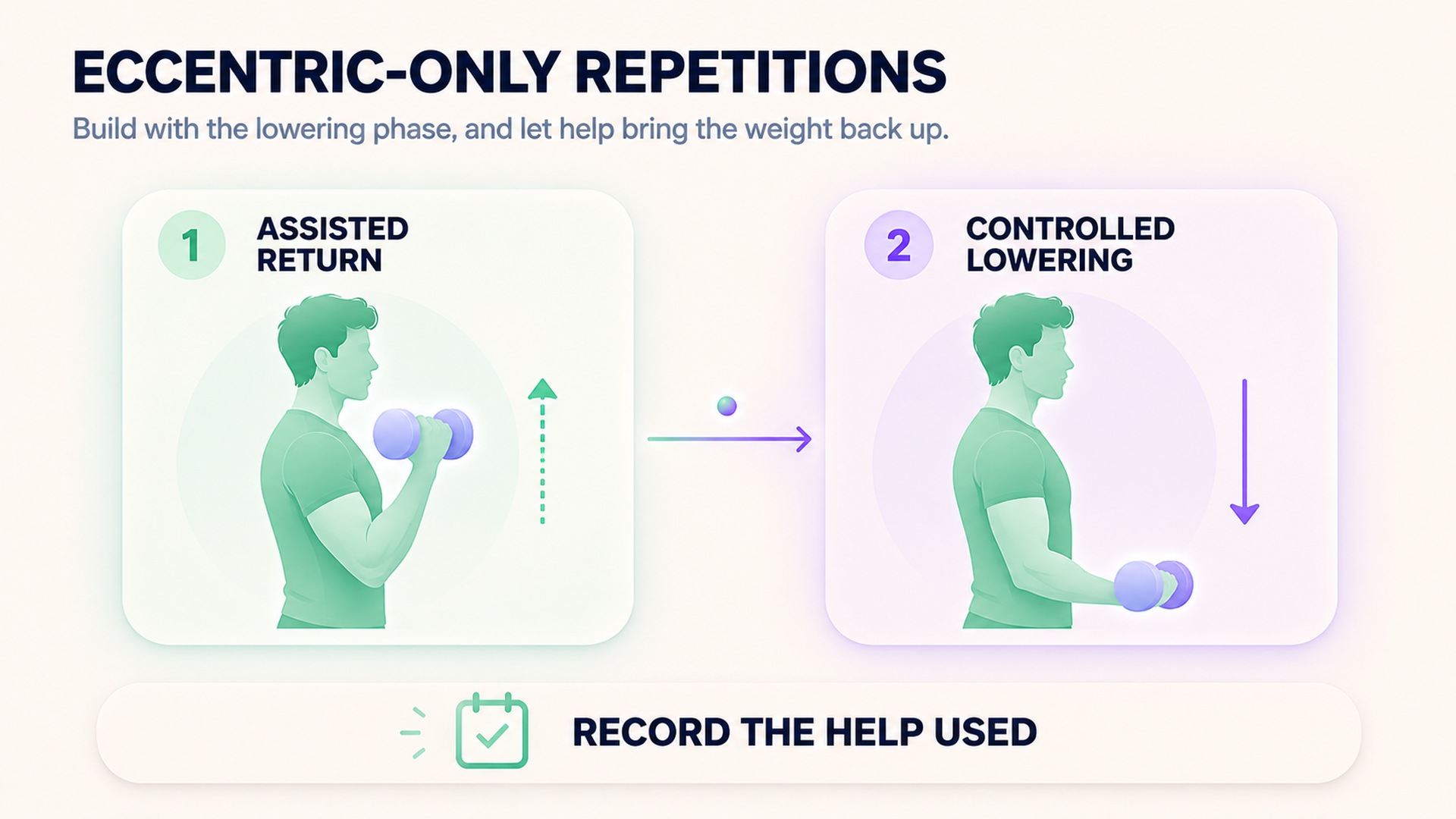
Assistance can vary from repetition to repetition. A concise note can state whether the person used help on every return, only after fatigue, or not at all. If the helper's role is uncertain, mark the record as uncertain rather than assigning a precise contraction mode. A training record is more useful when it distinguishes what was observed from what was inferred.
Range of motion also belongs beside the contraction label when it changes. A partial lowering phase and a longer controlled lowering phase are both eccentric actions, but they do not describe the same movement. If a machine records a start and end position, retain those fields. If the range was estimated by observation, say so rather than recording an exact angle that no instrument measured. The goal is to preserve enough context to compare the same exercise setup later.
Some equipment uses a flywheel or other mechanism that changes how effort is distributed across the movement. The device may describe the set with its own training mode. Preserve the machine's label and add the actual movement description if known. Avoid assuming that a label like “negative,” “eccentric,” or “resistance mode” has the same meaning on every device.
Keep tempo separate from contraction type
Eccentric-only describes which phase or action was performed. Tempo describes how long or how quickly a phase occurred. A controlled lowering phase may last several seconds, but that does not make every slower repetition eccentric-only. A normal lift-and-lower cycle still contains both phases even if one side of the repetition is slower.
Record tempo as a separate field when it matters, such as “lowering phase about three seconds” or a device's measured duration. Avoid treating a written tempo target as proof that the movement followed that speed. If the device did not measure phase timing, mark it as a cue or planned tempo rather than an observed value.
An existing explanation of how repetition tempo changes lifting records describes why pace belongs beside, rather than inside, the load and repetition count. Together, tempo and contraction mode give a clearer description of the set without implying that one style is better for every person.
What exercise studies can support
Studies comparing contraction modes use specific exercises, participants, loads, durations, and measurement procedures. One randomized study of eccentric-only, concentric-only, and combined training focused on a defined unilateral knee-extension protocol in healthy women. A different older study of eccentric-only leg training and detraining used its own sample and exercise design. Neither establishes a universal instruction for how an individual should perform a set.
The current overview of resistance-training research summarizes findings across multiple reviews and outcomes. The effects depend on the training question, population, and protocol. For the purpose of a log, the evidence reinforces the value of recording the movement mode and context rather than treating eccentric-only work as a single standardized intervention.
A study finding does not by itself prescribe how an individual should train. A training plan can involve a professional's judgment, equipment instructions, and individual considerations that are not captured by a movement label. The record can preserve what was completed and any assistance used, without recommending a load, number of repetitions, or progression.
Use a consistent set label
For repeat sessions, use the same wording to describe the same movement. One simple format is: exercise, side, contraction pattern, assistance, load, range, and tempo. For example, “knee extension, right side, eccentric-only lowering, assisted return, range recorded by machine” communicates more than “three reps.” Do not add a load or range that was not measured or documented.
If an entry was initially recorded as a standard repetition and later clarified as eccentric-only, keep the original entry and add a dated correction. This preserves the history of the record while making the movement more understandable. If assistance was not documented at the time, mark it as unknown instead of reconstructing it from memory with false precision.
The label should also identify whether the count refers to a completed eccentric phase or a full cycle. If someone completed six lowering phases and received assistance on each return, that is not the same record as six unaided lift-and-lower cycles. Clarity about the movement protects comparisons across sessions and across different exercise logs.
If the exercise includes a pause between phases, record that pause separately from the contraction itself. A pause at the bottom of a repetition does not automatically make the action isometric unless force is maintained without joint movement. If the person rests or repositions the load, note that as a transition. This avoids compressing the entire sequence into a tempo shorthand that another reader may interpret differently.
Frequently asked questions
What does eccentric-only mean in a lifting log?
It indicates that the logged repetitions consisted of the active lengthening phase under load, without an active shortening phase in the same repetition. Record how the load returned to the start position.
Is a slow lowering phase automatically eccentric-only?
No. A repetition can include both lifting and lowering phases even if the lowering is slower. Record contraction pattern and tempo as separate details.
What should I record if someone helped return the weight?
Note that the return was assisted and describe who or what provided the assistance if appropriate. Do not count that phase as an unaided concentric action.
*This article is for informational purposes only and is not a substitute for professional medical advice, diagnosis or treatment.*
Sources:
StatPearls Publishing·American College of Sports Medicine·Journal of Strength and Conditioning Research·Frontiers in Physiology·International Journal of Sports Medicine·Medicine & Science in Sports & Exercise
Related articles

Running pace and running speed use reciprocal units
Running pace measures time per distance, while speed measures distance per time. Keep the original unit and time basis visible when converting one display into the other.
Virtual cycling distance follows the simulation's rules
A virtual cycling app calculates speed and distance from its own inputs and route model. Keep that simulated value separate from wheel-based or outdoor distance when comparing activity records.

Single-sided cycling power relies on a symmetry assumption
A single-sided power meter measures one leg and may double that value to estimate total cycling power. Preserve which side and device produced the number so an estimate is not mistaken for a bilateral measurement.
Power meter zero offset needs its own setup record
A power meter zero offset records the sensor's unloaded baseline at a particular time. Keep the meter identity, procedure, conditions, and returned status separate from training targets and workout power values.
Handrail support changes the context of a treadmill session
Treadmill handrail use can change the movement task even when speed and incline stay constant. Record whether support was light, intermittent, or sustained so session comparisons do not assume the machine measured details it missed.
Treadmill incline percentages are not angles in degrees
Treadmill grade percentages and angles in degrees describe the same slope through different relationships. Preserve the machine's displayed unit and source so a workout setting is not mistaken for a measured angle.