Why Mental Stress and Physiological Stress Need Separate Labels
By Mr.Apps · Sep 25, 2026
Category:Stress

One word can refer to two different things
I treat a stress label as a statement about a particular kind of information. “Mental stress” describes how a person appraises demands and their ability to meet them. “Physiological stress” describes changes in bodily systems, such as heart rate, sweating, breathing or other responses that help the body adapt.
The two can be related. They are not interchangeable. A difficult conversation may feel demanding without producing a large or sustained signal in a wrist sensor. Physical exertion or a warm environment can raise bodily activation when someone does not feel worried. An app that gives both situations the same label compresses different observations into one word.
That matters because people can interpret a label as an assessment of how they feel. A physiological estimate does not directly read thoughts, emotion, coping or personal meaning. It summarizes patterns in signals the device can observe, under the conditions its model was built to recognize.
Research reviews find associations between psychological stress and measures such as heart-rate variability, while also describing variation in how stress is induced, measured and modeled. A review of HRV and psychological stress makes clear that the result depends on those methodological choices. A consumer estimate should therefore be named for the signal it summarizes, not presented as a complete account of a person's inner state.

Mental stress begins with appraisal
A mental stress response involves more than a number changing in the body. People assess what is happening, whether it matters to them, what they can do, and whether available resources feel sufficient. The same external demand can be experienced differently depending on its meaning, timing, prior experience and perceived control.
Those judgments are partly private. A sensor cannot know whether an event feels threatening, important, manageable or irrelevant unless a person supplies that information through a report or another validated assessment. Even a questionnaire is a structured self-report at a particular time, not an all-purpose measure of every aspect of mental health.
Physiological recordings can add another perspective. They can show patterns around a moment or period, but they do not explain the meaning of the situation that accompanied them. A multidimensional overview of stress measurement describes the importance of combining physiological and subjective approaches when the question concerns both bodily response and experienced stress.
I prefer wording that tells a reader what was observed. “Elevated physiological activation” is more specific than “you are stressed.” “Self-reported mental strain” identifies an experience that came from a person's own report. The distinction makes it easier to ask what the measurement can support before acting on it.
Physiological activation has many possible inputs
A body can change its heart rate, pulse pattern, skin conductance or breathing for many reasons. Movement and exercise are obvious sources. Heat, posture, a meal, poor sleep, discomfort, illness, hydration changes and medication may also affect one or more signals. The device sees the resulting pattern; the pattern alone may not identify its cause.
This is why a single sensor measure rarely functions as a universal stress detector. Heart-rate variability, for example, reflects variation between successive heartbeats and can be affected by measurement conditions, breathing, activity, time of day and individual differences. Its relationship with reported mental stress can appear under certain protocols and become weaker in ordinary life.
A large in-the-wild study comparing tracker HRV with perceived stress found a small relationship in naturalistic conditions, cautioning against using the measure alone as a substitute for a person's report.
The practical point is not that bodily signals have no value. It is that signals answer narrower questions than people often assign to them. A change may warrant checking the context, but it cannot by itself establish a specific emotion, cause, diagnosis or level of coping.
The label should describe the source
An app should make it possible to tell whether a stress-related value came from sensors, a self-report, a questionnaire or a combined model. If a single score blends more than one source, its label and explanation should say so. Otherwise, the reader cannot tell which part of the result came from a measured signal and which part came from interpretation.
Research in wearable monitoring illustrates this issue. Studies may define stress through a lab task, a questionnaire, an event marker or a model trained on data collected under particular conditions. These targets differ. A detector trained to distinguish resting from a timed challenge is not automatically measuring daily emotional strain.
A scoping review of wrist-based optical sensing reports promise alongside limitations in study size, setting and ground-truth methods. A systematic review of wearable stress models describes challenges in generalizing models across datasets and people, reinforcing the need for clear labels and definitions.

Useful product language can be brief: “This estimate reflects changes in heart rate, HRV and skin conductance during the measured interval.” It can then state what it does not establish: “It cannot determine whether you feel mentally stressed.” Those sentences are more informative than a single unqualified word.
Ask what the score is designed to summarize
Before comparing a score with how you feel, check its definition. Does “stress” refer to estimated autonomic activation, a self-report, a composite of several signals, or an inferred state? Does the app show the interval and contributing inputs? Was there enough signal coverage to generate a result?
If the definition is not available, do not fill in the gap with a confident interpretation. Treat the number as an opaque summary and use only the information that is actually displayed. A score without a definition cannot reliably distinguish emotional strain from movement, heat or another source of physiological change.
I also look for whether the system communicates uncertainty. A model may be less reliable when data are sparse, noisy or outside the situations represented in its training. If the app hides those conditions, a precise-looking result may invite more confidence than the underlying evidence supports.
A review of electrodermal sensing in daily contexts notes that much of the evidence has come from laboratory settings and that real-world application remains an important research need. Skin conductance can reflect sympathetic arousal, but interpretation depends on context and the device's method. A physiological measure is still useful when its role and boundaries are clear.
Use subjective and sensor information side by side
If the app offers a brief check-in, a person can record how they feel separately from the sensor estimate. The two entries should remain separate in the display. That preserves disagreement as information instead of forcing one source to overwrite the other.
A simple record might show three lines: “sensor estimate,” “self-reported mental strain,” and “context.” Context can be optional and concise. It could note movement, a warm room, a disrupted night or another relevant condition without claiming that any one factor caused the score.
This is not a request to log every detail. Excessive tracking can create work without improving decisions. A useful system asks for context only when it could change the interpretation, and it allows people to skip a check-in without treating the missing answer as a neutral emotional state.
The existing explanation of what a wearable stress estimate represents discusses the difference between a measured signal and the broader experience a label may imply. Reading that definition alongside a separate self-report can help prevent a sensor value from being mistaken for a judgment about mood.
Choose a response that fits the information
A high physiological estimate may be a cue to review the timeline or measurement conditions. If it follows movement, wait until the signal has settled before comparing it with a resting period. If there is no obvious context, check whether the sensor was worn as intended and whether the app reports missing or low-quality data.
If a person feels mentally strained while the sensor estimate remains low, the experience does not become invalid. The device may not detect the relevant signal, the window may miss a brief event, or the model may not represent that person's response. A low value is not evidence that someone should feel calm.
If the estimate is elevated and the person also reports distress, the agreement between the two sources can support a more useful conversation about needs and next steps. It still does not diagnose a condition or tell someone which treatment to pursue. Persistent, severe or concerning symptoms call for appropriate clinical support.
A well-designed feature should help people notice patterns, not assign an emotional state on their behalf. That requires clear labels, visible definitions, separation between report and sensor, and restrained language about what a score can establish.

Keep the two labels distinct
“Physiological stress” and “mental stress” describe related but different information. One refers to bodily activation inferred from signals; the other refers to an experienced appraisal of demands. A device may contribute observations about the first. It cannot replace a person's account of the second.
When the app gives the source, time window and limits of a score, the number can be interpreted more carefully. When it uses one broad label for several constructs, the reader should return to the signals and context that are actually available. A precise label supports a precise decision.
FAQ
Can a wearable measure mental stress directly?
Most consumer wearables record physiological signals and use models to infer patterns associated with activation. They do not directly observe thoughts or feelings.
Why can exercise raise a wearable stress score?
Exercise changes cardiovascular and other physiological signals that stress models may also use. The model may therefore register activation without knowing whether the cause was physical exertion, emotional strain or another factor. Check the time window, activity record and score definition before interpreting the result.
What should I do if my stress score does not match how I feel?
Treat your own experience as valid and check what the app actually measures. Review activity, timing, signal quality and other available context, then record a separate self-report if that is useful. Do not let a low sensor estimate overrule significant distress or replace professional advice when symptoms are persistent or concerning.
*This article is for informational purposes only and is not a substitute for professional medical advice, diagnosis or treatment.*
Sources:
Karger Publishers·National Academies Press·JMIR Publications·MDPI·Elsevier·Cambridge University Press
Related articles

Why Recovery From Stress Needs More Than One Calm Hour
One calm hour can be useful without erasing a full day of physiological demand. This guide explains how to read short recovery windows beside sleep, repeated peaks, symptoms, and longer trends.

What Resilience Means in a Health Tracker
A resilience score is usually an estimate of how stress exposure and recovery patterns change over time. This guide explains what the trend can show, what it cannot prove, and why resilience is not the same as mood or diagnosis.

How to Read a Stress Score Across Several Hours
A stress score is easier to understand as a time pattern than as one daily high point. This guide shows how to read duration, repeated peaks, movement, and recovery windows without treating a wearable estimate as a diagnosis.

Can Paced Breathing Work Without Watching a Screen?
Paced breathing does not require constant visual attention. This guide compares audio and haptic pacing, explains what a wearable may observe, and sets realistic expectations for relaxation and HRV without promising a guaranteed result.

Why a Health App May Tell You to Rest and Move at the Same Time
A health app can recommend rest and movement in the same day without either message being technically wrong. This guide shows how to check update time, purpose, symptoms, and the demands of the day before choosing a response.

Can a Wearable Measure Cortisol? What Your Stress Score Is Actually Estimating
Most consumer wearables estimate physiological stress from signals such as heart rate, HRV, temperature, and movement rather than measuring cortisol itself. I explain how to read those scores without mistaking an algorithmic clue for a hormone test.
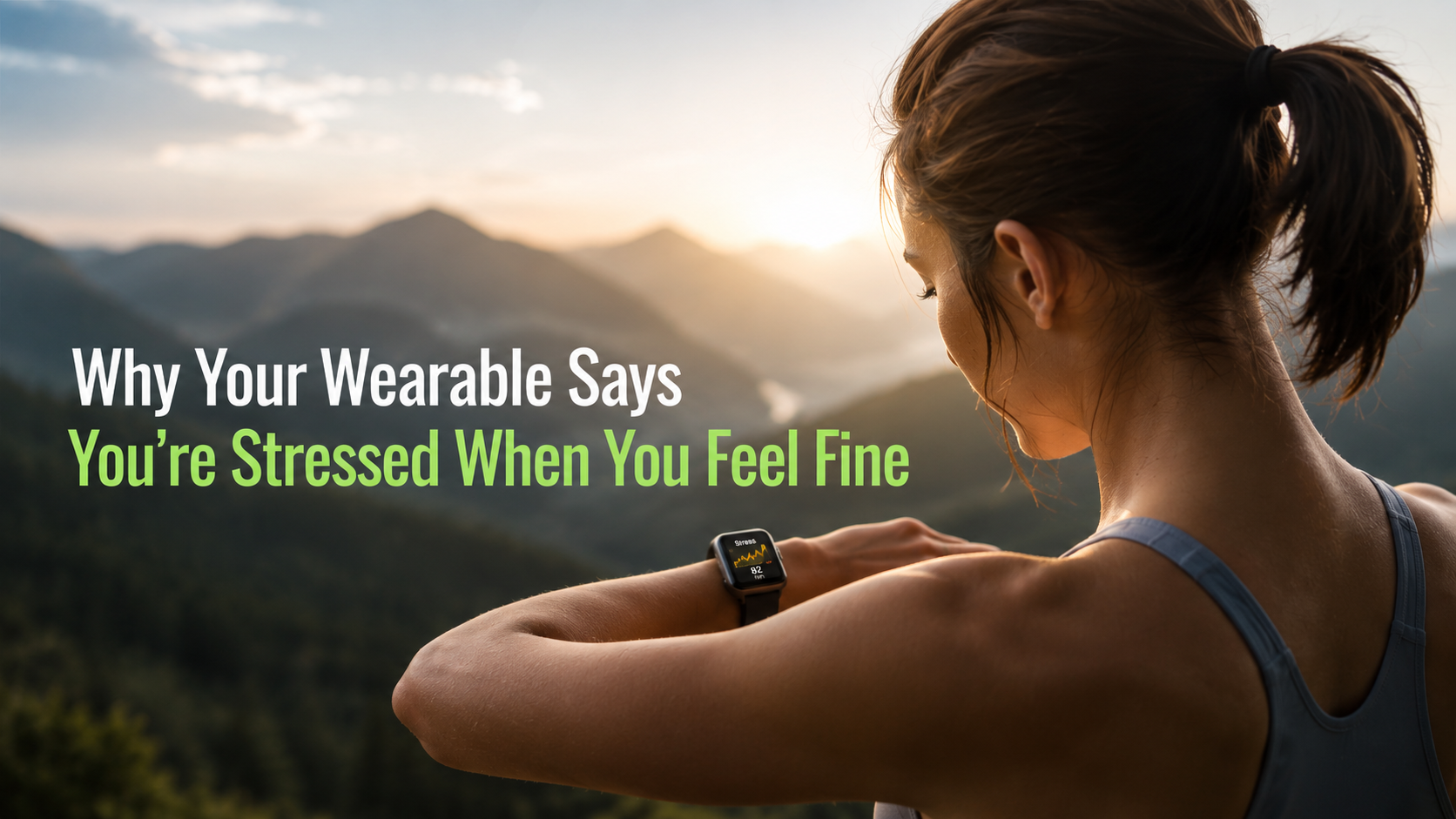
Why your wearable says you're stressed when you feel fine
Your watch measures physiological arousal, not worry. Caffeine, digestion, heat, short sleep, and a loose band can all push the score up while you feel fine.