Why You Should Review Your Wearable Data Before Changing Your Bedtime
By Mr.Apps · Sep 11, 2026
Category:Sleep

A low sleep score can make bedtime look guilty because bedtime is easy to change. The number may instead reflect a late wake period, a changed schedule, heat, noise, illness, alcohol, caffeine, device fit, or an algorithm that classified quiet wakefulness as sleep. Moving bedtime immediately can hide the original cause.
I review the record before moving the clock. The goal is not to defend the current bedtime. It is to identify the smallest change that answers a clear question and does not make the routine harder to maintain.
Start with the clock, not the score
Write down when you went to bed, when you tried

to sleep, when you think you fell asleep, final wake time, and when you got out of bed. Then compare those times with the wearable's sleep window. A gap between the two records is information, not a failure.
The CDC sleep guidance supports keeping a regular sleep schedule, including on weekends. Regularity is a useful principle, but it does not mean that one exact bedtime fits every person. The schedule has to match the required wake time and a realistic sleep opportunity.
Ask whether the problem is timing or duration. A bedtime that looks early may still produce too little time asleep if the person lies awake. A late bedtime may be acceptable when sleep is adequate and the schedule is stable, although a mismatch with obligations can still create difficulty.
Separate time in bed from time asleep
Wearables infer sleep from movement and other signals. They may be good at finding broad overnight patterns while missing quiet wakefulness or misclassifying brief awakenings. If you were awake but still, the app may display a smoother night than you experienced.
The review of wearable sleep technology explains that consumer devices use indirect signals and proprietary algorithms. Validation can differ by device, setting, and population. A sleep score is therefore an estimate, not a direct recording of every minute of sleep.
Compare the estimate with your experience. Did you remember long periods awake? Did you wake refreshed, foggy, sore, or unusually alert? Do not treat the subjective record as perfect either. Use both records to decide whether the question is about timing, sleep continuity, or the device.
Look for a repeated pattern
One poor night is weak evidence for a bedtime change. Review at least several comparable nights when possible. Look for the same problem at the same point: difficulty falling asleep, early waking, a long middle-of-night period, a short total sleep window, or a score that changes while the schedule stays similar.
If the problem appears only on nights with a late meal, evening stimulation, heat, or unusual stress, bedtime may be the wrong first variable. If it appears on every night with a long time in bed, the schedule and the sleep opportunity deserve a closer review.
The sleep deprivation overview describes how insufficient or poor-quality sleep can affect daytime alertness and functioning. That makes daytime function part of the review. A single score cannot tell you how much the night mattered in daily life.
Check the morning anchor
Wake time is often easier to keep consistent than bedtime. A stable morning anchor helps you observe whether sleep pressure builds naturally in the evening. It also makes comparisons clearer because the end of the sleep period changes less from day to day.
Do not force an early bedtime when you are not sleepy. Spending extra time awake in bed can make the bed feel like a place for monitoring and frustration. If a change is needed, use a small shift and observe whether falling asleep, total opportunity, and morning function change together.
Morning light and daytime activity can also influence the timing of sleep. Review these as context rather than turning them into a list of rules. The most useful change is one you can repeat long enough to observe.
Consider meal and activity timing carefully
Meal and exercise timing can move with bedtime. That does not mean they always cause a sleep problem. It means a change in bedtime may alter several other variables at once, making the result hard to interpret.
The research on meal timing and the circadian system found that effects depend on the design and conditions of the study. Avoid turning one study into a personal prescription. Record whether meals, activity, and light exposure changed alongside the sleep schedule.
The review of rest-activity rhythms also shows why timing is a system of cues rather than one isolated hour. A later meal, later light exposure, or later activity can travel with a later bedtime. Look for the pattern that repeats before choosing one lever.
Check the device and the sleep window
A loose strap, a changed ring position, an empty battery, a missing sync, or a software update can change the displayed night. Confirm that the device was worn as usual and that the record has no obvious gap. Compare the raw timeline or sleep window with the summary score when the app allows it.
Do not assume that a detailed stage chart is more trustworthy than a broad total. Extra precision in the interface does not remove uncertainty in the estimate. The sleep-wake physiology reference can explain the biology, but it cannot validate a consumer algorithm for a specific night.
If the app repeatedly records sleep while you remember being awake, keep that limitation in the interpretation. If the device misses the entire night, do not move bedtime to satisfy the missing data.

Change one variable deliberately
If the review points to bedtime, choose one modest change. Move the schedule by a small amount, keep the wake anchor as consistent as practical, and leave the rest of the routine stable. Define what you will observe before you begin: easier sleep onset, fewer long wake periods, better morning function, or a more workable schedule.
Do not judge the change by the first score alone. Look at the repeated pattern and include how you felt. A better score with worse daytime function is not a clear success. A similar score with easier mornings may still be useful.
If the change makes the routine harder, stop and reassess. A sleep plan that requires constant checking can add pressure without producing better rest. Review weekly rather than refreshing the app repeatedly.
Know when a bedtime experiment is not enough
Persistent insomnia, loud snoring, gasping, frequent breathing pauses, severe daytime sleepiness, or a major change in sleep deserves professional evaluation. A wearable cannot diagnose a sleep disorder or determine the cause of repeated fatigue.
Seek urgent care for urgent symptoms such as chest pain, severe breathing difficulty, faintness, or confusion. Do not postpone care while collecting more nights of data. If a clinician asks for a sleep record, include bedtime, wake time, symptoms, medication, and the device limits.
A review before changing bedtime
Use this checklist:
- Compare intended bedtime with the device's sleep window.
- Record wake time and time out of bed.
- Separate time in bed from estimated time asleep.
- Note remembered wakefulness and morning function.
- Check sleep opportunity, light, meals, activity, heat, and stress.
- Confirm device fit, battery, sync, and recent software changes.
- Change one variable only when the repeated pattern supports it.
A related guide on regular sleep schedules explains why consistency can matter without requiring rigid perfection. The practical aim is a schedule that supports adequate sleep and ordinary daily functioning.
Give the review a stopping point. After a week or two of comparable notes, decide whether the pattern is clearer, whether one small change deserves a trial, or whether the data are too uncertain to guide a change. Without a stopping point, a person can keep inspecting the same score while postponing a simple routine adjustment or a professional discussion.
Remember that bedtime is part of a larger day. A change that produces a slightly better score but reduces daylight, movement, concentration, or the ability to keep a consistent wake time may not be an improvement. Look at the whole schedule and the way it supports ordinary function. The best bedtime is not the earliest possible time. It is a workable part of a stable sleep opportunity.
Do not use the app to negotiate with every night. A healthy routine includes variation, and a difficult night does not require a new plan each morning. Review the pattern at the interval you chose, make one measured adjustment when the evidence supports it, and leave the routine alone long enough to see what the change actually does.
Keep the wake-time question visible as well. A bedtime change that makes mornings harder may not fit the real schedule, even if the overnight score improves slightly overall.
That daily fit matters.

FAQ
Should I go to bed earlier after a low sleep score?
Not automatically. Review sleep timing, wakefulness, duration, routine changes, symptoms, and device quality first. If the pattern points to insufficient sleep opportunity, a modest schedule change may help. Judge it over repeated nights and morning function.
Why does my wearable say I slept when I was awake?
Many consumer devices estimate sleep indirectly from movement and related signals. Quiet wakefulness can be misclassified. Compare the device timeline with your memory and keep that limitation visible when reading the score.
What is more useful than a single sleep score?
A repeated record that combines bedtime, wake time, sleep opportunity, estimated sleep, remembered wakefulness, morning function, symptoms, and routine context is usually more informative. The device score can be one part of that record.
*This article is for informational purposes only and is not a substitute for professional medical advice, diagnosis or treatment.*
Sources:
Centers for Disease Control and Prevention·National Heart, Lung, and Blood Institute·National Library of Medicine·National Library of Medicine·National Library of Medicine·National Institutes of Health
Related articles

Is Your Wearable's Sleep Window Too Narrow?
A wearable can record a sleep window that is shorter or less complete than the night you experienced. This guide explains why quiet wakefulness, device settings, and missing data can change the result, and how to add context without treating an estimate as a diagnosis.

What a Sleep Tracker Can and Cannot Tell You About a Short Nap
Short naps are difficult for many sleep trackers to classify because the quiet period is brief and the signals can look like still wakefulness. Learn how to log a nap, check the surrounding context, and avoid drawing a health conclusion from a missed or misclassified episode.

Sleep Scores Match, Deep Sleep Does Not: How to Compare Two Wearables
Two wearables can agree on total sleep while giving different estimates for deep sleep and other stages. This guide explains how to compare devices fairly, read repeated patterns, and avoid turning one night of stage data into a health judgment.

When Sleep Tracking Makes Sleep Worse: Orthosomnia and Score Anxiety
Sleep data can be useful until a nightly score begins shaping your mood, decisions, and ability to relax. I explain how orthosomnia develops and how to keep long-term trends while reducing score anxiety.

Best Smart Rings for Sleep Tracking in 2026
After weeks of switching between several sleep-tracking rings, I found no single model that wins on every metric that matters. This breaks down what actually affects accuracy, battery life, and subscription cost, along with which ring makes sense depending on whether you care most about precision, price, or your phone's operating system.

Blood Sugar Swings, Sleep, and Next-Day Energy: The Overlooked Loop
I spent three years blaming the room temperature for the way I lost my train of thought halfway through every morning workshop. It wasn't the room. Poor sleep changes how your body handles food the next day, and late meals change the night that follows. Here's how the loop works, what your wearable can actually tell you, and a two-week test that costs nothing.

How much deep sleep do you really need?
Your watch says 42 minutes of deep sleep and you want to know if that is bad. The honest answer is that there is no single correct number, and the device producing that number is estimating rather than measuring. Here is what deep sleep actually does, how much of it is normal at your age, and what I watch instead of the stage breakdown.

Why You Wake Up at 3 A.M. and Can't Fall Back Asleep
For most of one winter I woke between 3:08 and 3:22 almost every night. The cause turned out not to be one thing, and it was not what I expected. Here is how I worked through the usual suspects, from stress and late meals to room temperature, breathing and body-clock timing, plus what a sleep tracker can and can't actually tell you.

Snoring, Sleep Apnea, and Smart Rings: What They Can Actually Detect in 2026
A smart ring cannot measure airflow. Everything it reports about your breathing is inferred from oxygen estimates, pulse signals, and movement, which is why a wearable can stay silent while a partner in the same bed hears you stop breathing. Here is what these devices can genuinely detect in 2026, where cleared screening features differ from wellness metrics, and why a quiet result is not a clean bill of health.
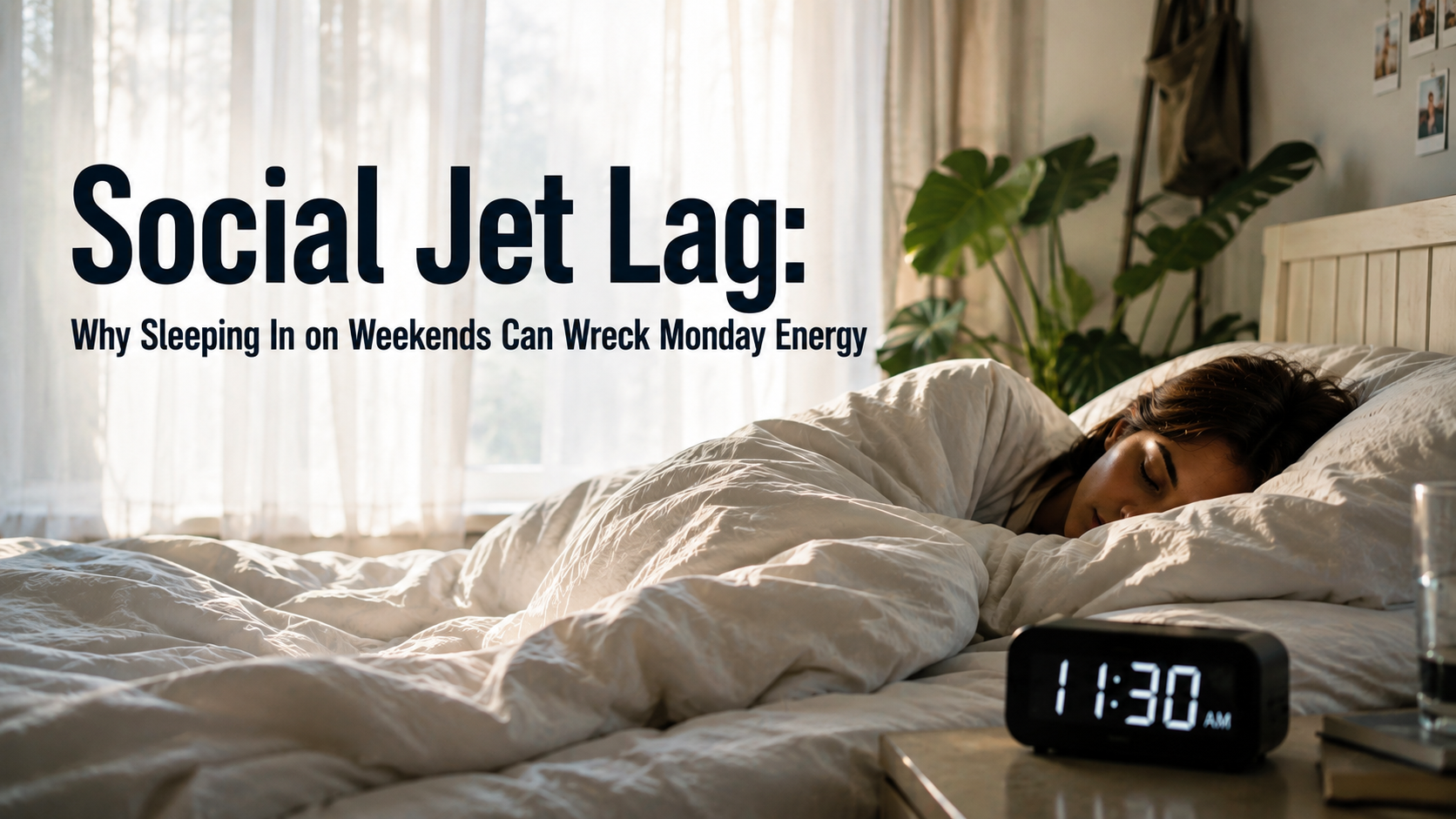
Social jet lag: why sleeping in on weekends can wreck Monday energy
Sleeping in on weekends shifts your body clock and drains Monday energy. Learn how to calculate your social jet lag and four realistic ways to reduce it.