Social jet lag: why sleeping in on weekends can wreck Monday energy
By Mr. Apps · Aug 3, 2026
Category:Sleep
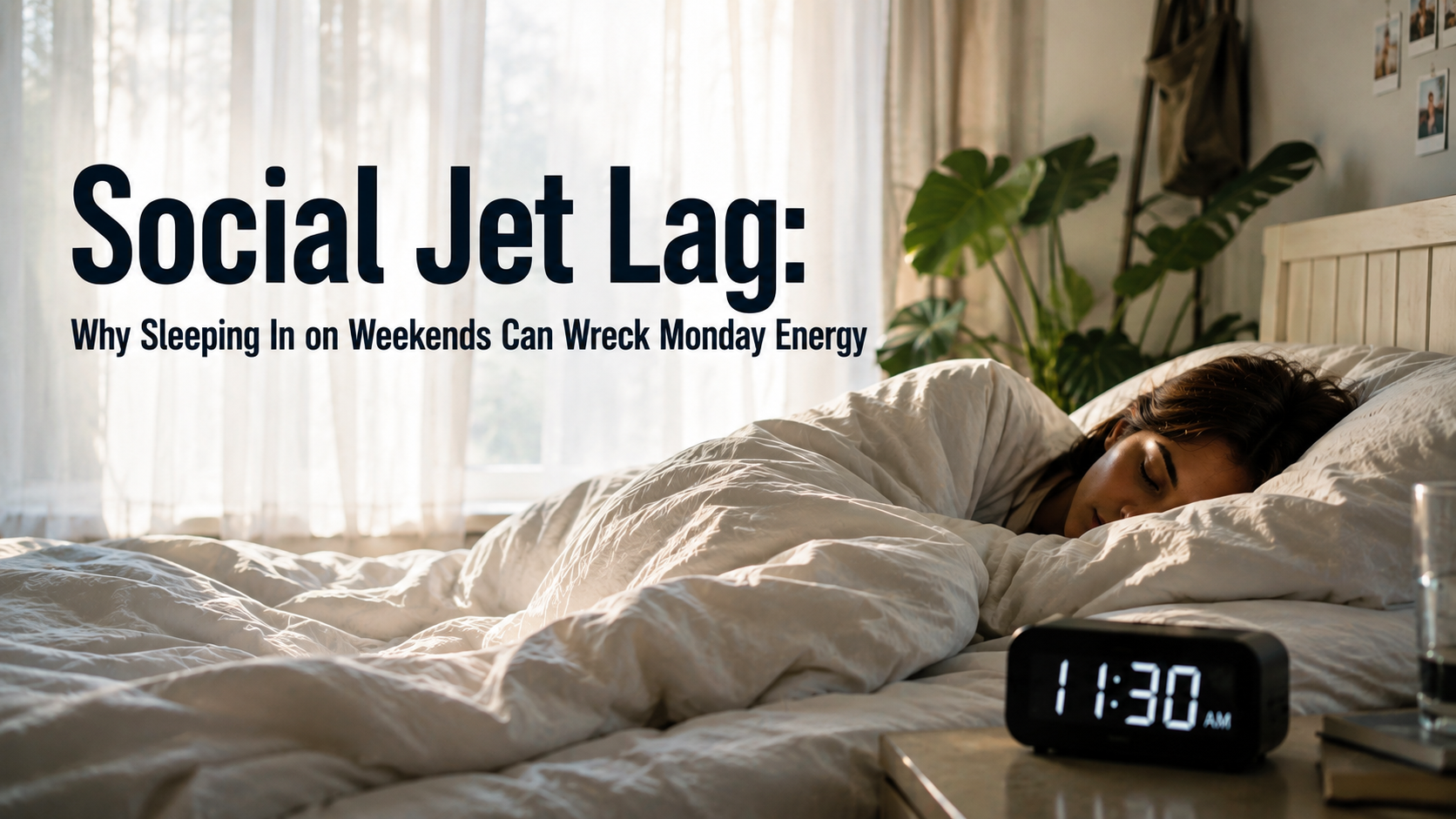
I have a telescope that I use badly and love anyway. Most of what I do with it is long exposure photography: set up after dark, shoot a few hundred frames of the same patch of sky, then stack them into one image. On a clear Saturday the work doesn't start until the sky is properly dark, and it ends whenever I decide to stop. I've gone to bed at three in the morning more times than I'd like to admit, slept until half past nine, and felt fine about it.
Sunday was always fine too. Monday was the problem. Around half past ten I'd look at a slide I had written myself and lose the thread of my own argument.
I blamed the workload for about a year. Then I started writing down my sleep and wake times, and the pattern was obvious. My worst Mondays came after my longest weekend sleeps, not my shortest. More sleep, worse Monday.
That's social jet lag, and it explains a lot of the tiredness people file under stress, weather, or getting older.
It's not the same as travel jet lag
Travel jet lag happens when you move and your body clock doesn't. You land five time zones away and your internal clock keeps running on the schedule it learned at home, so you're hungry at strange hours and wide awake at two in the morning until it catches up.
Social jet lag creates the same circadian misalignment without the flight. The term was introduced by chronobiologists in 2006 to describe the gap between biological time and social time, measured as the shift in your sleep timing between workdays and free days. Your body clock wants one schedule and your calendar demands another. Every Friday you let it drift, and every Sunday night you drag it back. The difference from real jet lag is how often it happens: most people cross time zones a few times a year, while this runs weekly, so the average adult goes through a small time zone change around a hundred times a year without leaving home.
A normal week, hour by hour
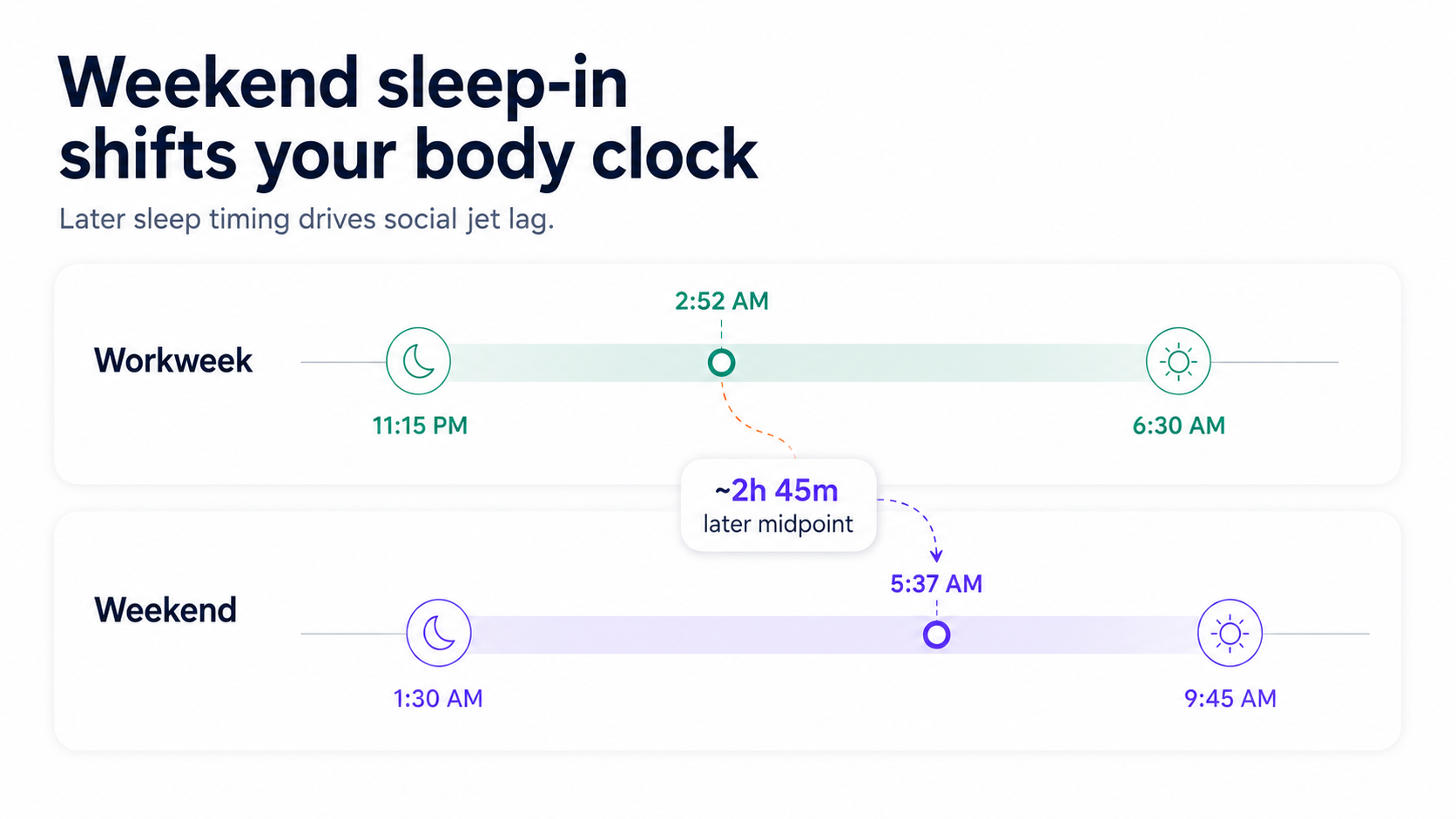
Take a schedule nobody would find alarming. Monday to Friday you're asleep by 23:15 and the alarm goes at 06:30, which is seven hours and fifteen minutes. Slightly short, but respectable. On Saturday and Sunday you fall asleep at 01:30 and get up at 09:45, which is eight hours and fifteen minutes. An extra hour a night, and it feels earned.
Total sleep for the week goes up. So does how rested you feel on Sunday afternoon. Monday is still worse, because your body clock doesn't average the week out. It reacts to when you sleep, not only how much.
The number that matters is the sleep midpoint, the clock time exactly halfway between falling asleep and waking up. Researchers studying social jet lag and cardiometabolic risk measure it this way and compare workdays against free days.
To find yours, take your usual workday sleep and wake times, count the hours between them, halve that, and add it to your sleep time. In the schedule above, 23:15 plus three hours thirty-seven gives a workday midpoint of 02:52. Do the same for Saturday night and 01:30 plus four hours seven gives 05:37. The gap between the two, two hours and forty-five minutes, is the size of your weekly time shift. Under an hour is minor. One to two hours is where most people with normal jobs sit. Past two hours, you're asking your body to fly east every Monday morning. I ran my own numbers expecting something modest and found just over three hours.
Why Sunday night is where it breaks
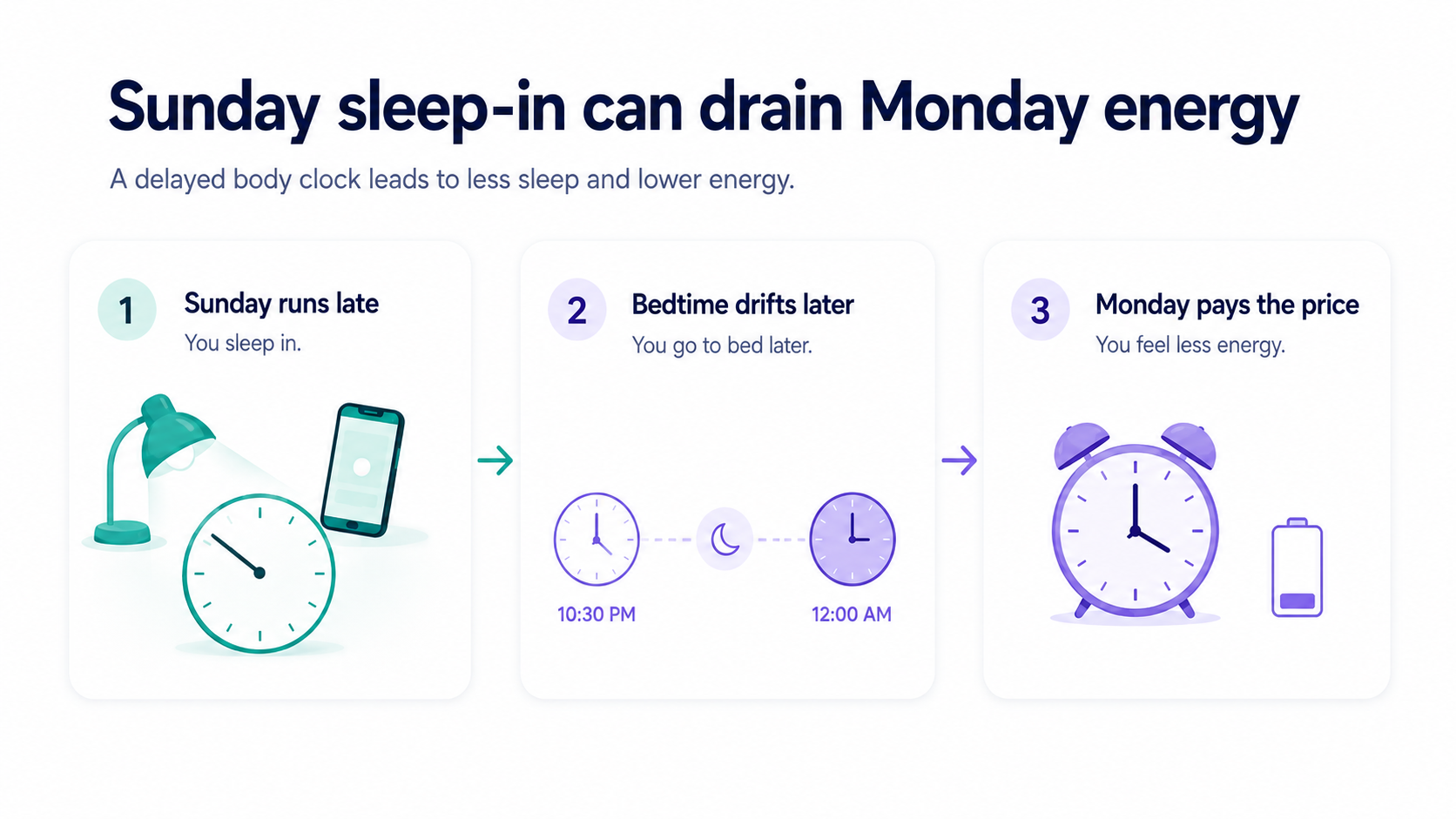
Light is most of the mechanism. A late Saturday keeps you under lamps long after sunset and hides you from daylight until nearly ten in the morning. Your clock reads that as proof the day now starts later, so melatonin release slides later too.
By Sunday evening your body is running on a delayed schedule. You go to bed at 22:30 trying to be sensible, and your physiology thinks it's 20:30. You lie there. You check your phone, which makes it worse. You fall asleep at midnight, the alarm still goes at 06:30, and Monday starts with a short night stacked on a mistimed one.
Appetite moves with it. The large German dataset behind the link between social jet lag and higher body mass found that the size of the weekly shift tracked with weight regardless of how long people slept. My own Mondays after a big drift weekend involved a lot more afternoon snacking and much less interest in cooking anything.
Alertness does the same. Waking at what your body still treats as an early hour leaves you with slower reactions and worse working memory, which is roughly the state I was in when I lost my place mid presentation.
The extra hours don't cancel the mistiming
This is the part I resisted longest, because catching up on sleep feels like it ought to work. In a controlled study of weekend recovery sleep, healthy adults went through a run of short weeknights, then a weekend with unlimited sleep, then back to short weeknights. The weekend helped in the moment. Late night snacking dropped and people slept about an extra hour a night. But once the short weeknights returned, their insulin sensitivity was worse than in the group that never got a catch up weekend at all, and their circadian timing had shifted later.
Extra hours are worth having. They just don't repair a schedule that keeps moving.
What actually helps
I'm not going to suggest waking at 06:30 on a Saturday, because nobody does that and the advice deserves to be ignored. The goal is to shrink the shift, not delete it, and the fastest way in is the wake time rather than the bedtime. Bedtime is hard to control when you have hobbies, children, or work that runs long. Wake time is one decision you make with an alarm the night before. Get up within an hour of your workday time and the rest of the system mostly follows, even after a late night. Sleeping in on weekends isn't the problem by itself. The size of the gap is.
Once you're up, get outside, particularly on Sunday. Light is the strongest signal your clock has and it costs nothing. One study found that a weekend spent under natural light alone moved circadian timing earlier by roughly two thirds of what a full week of camping achieved. You don't need a tent. Twenty to thirty minutes outdoors within an hour of waking does real work, and a grey morning outside still beats a bright kitchen.
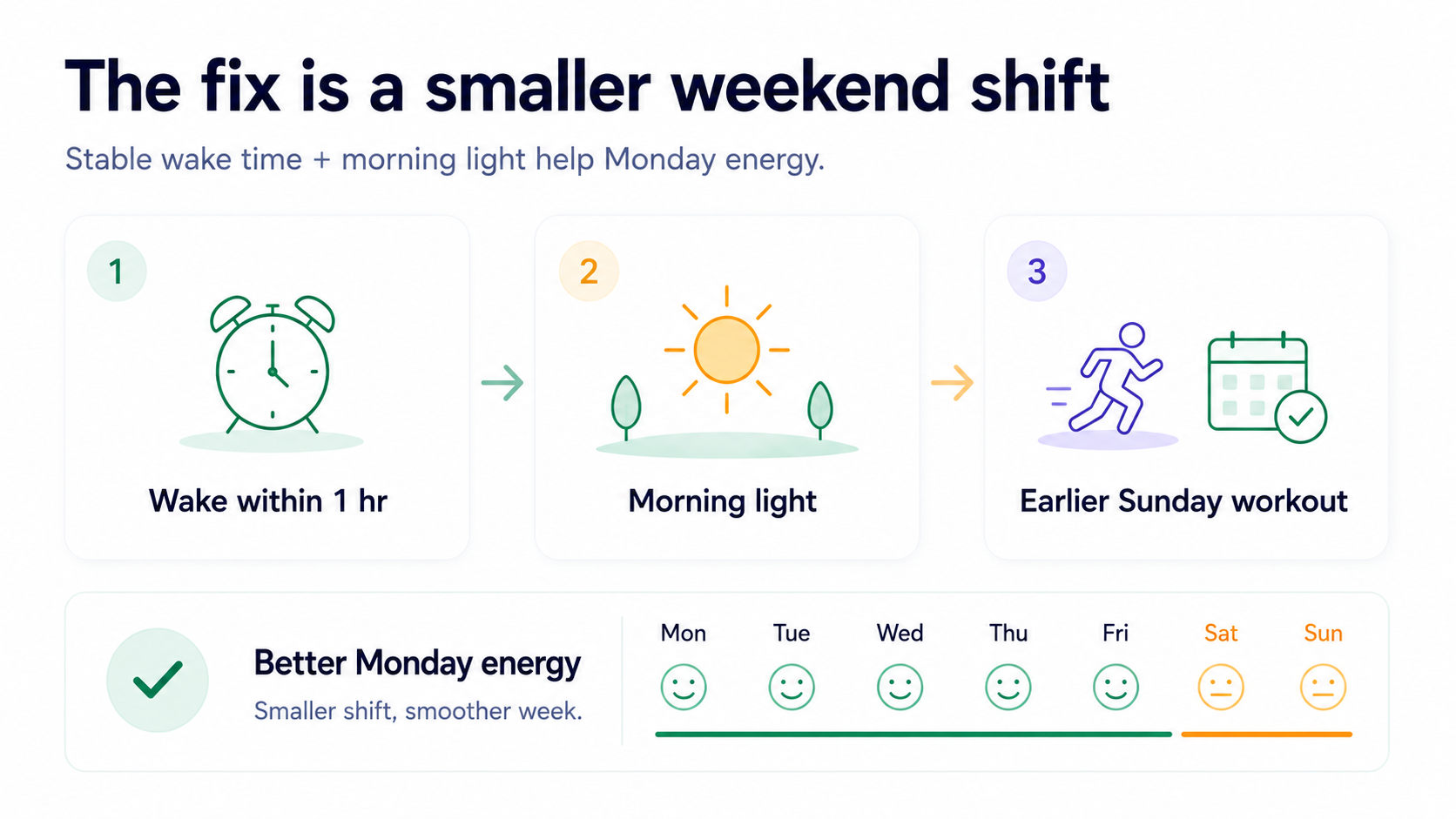
Training time matters as well, since exercise shifts the clock and the direction depends on the hour. Phase response curves show advances after morning and early afternoon sessions and delays after evening ones, so a 21:00 workout on Sunday pushes you the wrong way when you're already running late. Move the hard session to Saturday morning if you can.
Naps help on Monday if you keep them short. Twenty minutes early in the afternoon restores alertness. An hour at five in the evening wrecks Monday night and hands you the same problem on Tuesday, partly because the grogginess that follows a longer nap, known as sleep inertia, can outlast the nap itself.
What I do now
Two changes, neither heroic. I agreed to help run a beginners session at a climbing wall on Sunday mornings, and committing to something at 09:00 that involves other people did more for my wake time than any amount of good intention. An alarm can be argued with. Six people waiting for you cannot.
The second change is that imaging nights now have a stop time, usually 01:00, decided before I set up. I stack fewer frames than I'd like and the images come out slightly noisier. My Mondays don't.
Going back through my calendar, I also noticed I'd quietly stopped booking anything demanding before eleven on a Monday, which means I'd been designing my week around a problem I could have fixed in a weekend. If you change one thing, make it the Sunday alarm.
FAQ
How big does the shift have to be before it counts?
Under an hour of difference in your sleep midpoint is minor and unlikely to cause noticeable Monday fatigue. One to two hours is common among people on standard schedules and is where the tiredness usually starts. Above two hours, you're repeating a real time zone change every week. Work out your own number before deciding whether you have a problem, because it tends to be bigger than people expect.
Can I fix it by going to bed early on Sunday instead?
Rarely, and not on its own. How easily you fall asleep depends on your circadian phase, and after a delayed weekend that phase is running late, so getting into bed two hours before your body is ready produces frustration rather than sleep. Fixing the wake time on both weekend days, plus morning light, moves the phase earlier and makes an earlier bedtime possible instead of aspirational.
If I set a weekend alarm, am I not just adding to my sleep debt?
That question points at a different problem. If capping your weekend sleep leaves you exhausted, your weeknights are too short and the weekend has been doing damage control. The better fix is adding twenty or thirty minutes to your weeknight sleep rather than banking hours on Saturday. Steady timing and enough weekday sleep work together, and neither one rescues the other.
*This article is for informational purposes only and is not a substitute for professional medical advice, diagnosis or treatment.*
Sources:
Chronobiology International·JCEM·Current Biology·The Journal of Physiology·Nature and Science of Sleep
Related articles
Sleep Debt Is Real: How Long It Actually Takes to Recover Lost Sleep
Sleep debt doesn't clear in one long weekend. Here's what the research says about realistic recovery timelines, plus a 3 to 7 day plan that works.

Does Working From Home Improve or Hurt Your Sleep?

Exercise timing and sleep quality
Why Evening Screens Can Leave You Wired but Tired
We're told blue light is why screens ruin our sleep, so we dim the display and turn on the warm filter. But if you've ever put the phone down exhausted and then lay there wide awake, the light was never the real problem. Here's what is.
When "poor sleep" may be more than stress: red flags for sleep apnoea
Loud snoring gets dismissed as a quirk, morning headaches get blamed on stress, and daytime fog gets chalked up to a heavy calendar. Taken together, though, these signs can point to something a GP should know about: obstructive sleep apnoea. Here's what the real red flags look like, what home screening tools can and can't tell you, and when it's time to ask for a proper referral.
How to protect your sleep when your job keeps changing the clock
Shift work doesn't fail because people lack discipline. It fails because the body was never built to run a factory schedule. Here's what actually helps between rotating shifts, why "just going to bed earlier" doesn't work, and when persistent fatigue stops being normal and starts being something worth getting checked out.

When naps help your energy and when they quietly make sleep worse
The morning light habit that can improve sleep without changing your bedtime
Most sleep advice focuses on the evening, dim the lights, put the phone away, but that's only half the equation. A few minutes of daylight soon after waking helps set your body clock earlier, making it easier to fall asleep at a reasonable hour that night, no bedtime changes required. Here's why it works, what actually counts as "morning light" in a real schedule, and when the habit alone isn't enough.
Why a regular sleep schedule may matter more than an extra hour in bed
Evening Stress and Why Your Brain Won't Settle Down Before Sleep!
Falling asleep fast isn't the same as your brain settling down. What evening stress does to your sleep onset, and how to wind down when your mind won't.