Best Smart Rings for Sleep Tracking in 2026

For the past few years, my calendar has run on a mix of early product reviews, late releases, and calls that start at hours when most of my team is still asleep. At some point I stopped guessing whether I'd actually slept well and started measuring it. A smart ring turned out to be the easiest way to do that without changing how I sleep in the first place, since it disappears on the hand in a way a watch or a chest strap never quite does.
This comparison is built from published specifications, manufacturer documentation, third-party validation research, and patterns I've noticed after switching between several rings for weeks at a time, rather than a single lab test under my own roof. I'm reviewing it every quarter as firmware updates and new models replace older ones, so treat any specific battery figure or price mentioned here as a snapshot rather than a permanent fact.
What actually matters for sleep accuracy
A ring measures pulse through the arteries in your finger rather than through the wrist, which tends to produce a cleaner signal with fewer motion artifacts. That's part of why several evaluations, including a breakdown from the Sleep Foundation on how accurate sleep trackers really are, have found ring-based sleep staging tracks more closely with lab-based polysomnography than most wrist trackers, particularly for detecting REM and deep sleep. None of them match a clinical sleep study exactly, and a ring reporting your sleep stages down to the minute is offering an estimate rather than a diagnosis.

Comfort, battery life, and the charging reality
Comfort comes down to weight and profile more than brand. Most current rings sit between two and three grams, thin enough that after the first week you stop noticing it while typing or lifting weights. The exception is anyone who works with their hands throughout the day. Cooks, machinists, and anyone doing repetitive gripping tend to report the ring catching on gloves or tools no matter which model they choose.
Battery life across the category runs from about four days on the smallest, most feature-dense rings to eight or more on rings that trade a temperature sensor or extra LED for a bigger cell. I've left a charging case behind on a trip more than once, which is a decent argument for choosing a ring with a longer runtime if you travel often, rather than optimizing purely for the most sensors packed into it.
Sizing deserves more attention than it usually gets. Most brands mail out a plastic sizing kit before shipping the real ring, and it's worth wearing that sizer for a full day rather than trying it on for thirty seconds at a desk, since fingers swell slightly by evening and after exercise. Order too tight and the ring reads a worse signal from restricted blood flow; order too loose and it spins around your finger overnight and loses skin contact entirely. If you're between sizes, sizing up by one usually costs less accuracy than sizing down.

Platform compatibility: iPhone and Android
Most current rings work with both iPhone and Android, but feature parity between the two isn't guaranteed. Some manufacturers ship new metrics to Android first because their own companion app doubles as the primary health dashboard on that platform, while iPhone owners get pushed toward syncing data into Apple Health and lose some of the ring's own interpretation layer along the way. Before choosing between two rings, checking the current app store reviews on your specific phone's operating system tells you more than the marketing page does.
Recovery scores: useful signal or noise
Recovery scores are typically built from resting heart rate, heart rate variability, and how disrupted the previous night's sleep was. Heart rate variability, the small variation in time between heartbeats, is generally treated as a reasonable proxy for how much your nervous system has recovered from stress and exertion, though it also reacts to alcohol, illness, and a stressful conversation before bed.
My own recovery score has dropped by double digits after nights I felt fine and stayed high after nights I clearly didn't, usually tied to a late meal or an unresolved email thread rather than anything the ring could have anticipated. Treat the daily number as a trend to watch over weeks, not a verdict to obey each morning.
Temperature sensing and what it's good for
Skin temperature sensors track deviation from your personal baseline rather than an absolute body temperature, since finger skin runs several degrees below core temperature and shifts with room temperature and blanket use. That baseline deviation is still useful. A sustained rise in nightly skin temperature often shows up before other symptoms of illness or before ovulation, which is why several rings lean on it for both illness alerts and cycle tracking.
During a stretch of travel across several time zones, I watched my own baseline drift for nearly a week before settling back down, which lined up almost exactly with how long it actually took me to feel adjusted rather than just awake at the right hour.
Blood oxygen and apnea-related features: what to expect
Several rings now include a pulse oximeter and will flag repeated dips in blood oxygen overnight as a possible sign of disrupted breathing. That can be a genuinely useful nudge to bring data to a doctor, but it isn't a diagnostic tool. For context on what an at-home overnight reading can and can't tell you, the patient guidance on sleep apnea from board-certified sleep specialists is a better starting point than any ring's marketing copy, and it's worth knowing that pulse oximetry has been shown to be less accurate on darker skin tones across both consumer and clinical devices, which affects how much weight a single low reading should carry.

Subscriptions, apps, and getting your data out
Subscription models vary more within this category than almost any other spec. Some rings unlock their full sleep and recovery detail behind a monthly fee, others include everything with the hardware purchase and charge only for coaching extras, and a few have no subscription at all. If ongoing cost matters, read the current pricing page rather than an old review, since more than one manufacturer has changed its subscription structure after launch in response to complaints.
Data export is worth checking before you buy, not after. A ring that only lets you view trends inside its own app is far less useful if you ever want to hand your sleep and heart rate history to a doctor or move to a different device later. Health data collected by consumer wearables generally isn't protected the way medical records are, so it's worth reading how a manufacturer handles and shares the data it collects before agreeing to years of nightly tracking.
Best smart ring for sleep tracking, by category
Rather than naming one universal winner, it's more useful to sort by what you actually need:
- Best for tracking accuracy: rings backed by more independent validation studies and a finer-grained temperature sensor, worth the extra cost if you're managing a health condition or a serious training load.
- Best for battery life: rings that skip a secondary sensor or two in exchange for a bigger cell, useful if you travel often or simply don't want another device to remember to charge.
- Best for Android users: rings whose companion app ships new features to Android first and treats it as the primary dashboard rather than a secondary sync target.
- Best for iPhone users: rings with solid native Apple Health integration, so you're not stuck choosing between two incomplete data sets.
- Best for keeping costs down: rings sold without a mandatory subscription, since the underlying sensor hardware improves slowly enough that you're unlikely to feel you're missing much.
- Best for cycle and temperature tracking: rings with a longer baseline period before they start flagging deviations, since a rushed baseline produces more false alerts.
If none of that narrows it down, the position statement on consumer sleep technology from sleep medicine researchers is a useful gut check: treat these tools as a way to build awareness of your own patterns, not as a substitute for a clinical evaluation if something actually feels wrong. I've swapped rings on and off my hand for weeks at a time while working on this comparison, and the detail that mattered more than any single spec was whether I kept wearing it past the second week. A ring you take off because of charging reminders or skin irritation won't track anything at all.
Frequently asked questions
How accurate are smart rings compared to a sleep study? They get closer than most wrist trackers, especially for overall sleep and wake detection, but they still estimate sleep stages from heart rate and movement rather than the brain activity a clinical sleep study measures. Use the trends over weeks as a guide, not the nightly minute-by-minute breakdown as a fact.
Do I need a subscription to get useful sleep data from a smart ring? It depends on the ring. Some include full sleep and recovery detail with the hardware purchase, while others place most of the interpretation behind a monthly fee and only show raw numbers for free. Check the current subscription terms before buying, since several manufacturers have changed them after launch.
Can a smart ring detect sleep apnea? It can flag patterns, such as repeated drops in blood oxygen, that are worth discussing with a doctor, but none of these rings are approved as a standalone diagnostic tool for sleep apnea. A flag from a ring is a reason to seek an actual sleep evaluation, not a diagnosis on its own.
*This article is for informational purposes only and is not a substitute for professional medical advice, diagnosis or treatment.*
Sources:
Sleep Foundation·Cleveland Clinic·Sleep Foundation·American Academy of Sleep Medicine·New England Journal of Medicine·Journal of Clinical Sleep Medicine
Related articles

Blood Sugar Swings, Sleep, and Next-Day Energy: The Overlooked Loop
I spent three years blaming the room temperature for the way I lost my train of thought halfway through every morning workshop. It wasn't the room. Poor sleep changes how your body handles food the next day, and late meals change the night that follows. Here's how the loop works, what your wearable can actually tell you, and a two-week test that costs nothing.
Apple Watch Body Battery: How Ensta Brings Garmin's Best Feature to Your Wrist
Looking for an Apple Watch body battery feature? Ensta's Energy Score gives Apple Watch users a simple 0-100 recovery and energy metric that works like Garmin's Body Battery.

How much deep sleep do you really need?
Your watch says 42 minutes of deep sleep and you want to know if that is bad. The honest answer is that there is no single correct number, and the device producing that number is estimating rather than measuring. Here is what deep sleep actually does, how much of it is normal at your age, and what I watch instead of the stage breakdown.

Respiratory Rate on a Wearable: What a Change Overnight Can Mean
Most people can guess their resting heart rate but have no idea how many breaths they take while asleep. That makes overnight respiratory rate one of the least understood numbers on a wearable, and one of the most useful once you have a personal baseline to compare against. Here is what actually moves it, how to tell a real change from a bad reading, and when a rise is worth acting on.

Why You Wake Up at 3 A.M. and Can't Fall Back Asleep
For most of one winter I woke between 3:08 and 3:22 almost every night. The cause turned out not to be one thing, and it was not what I expected. Here is how I worked through the usual suspects, from stress and late meals to room temperature, breathing and body-clock timing, plus what a sleep tracker can and can't actually tell you.
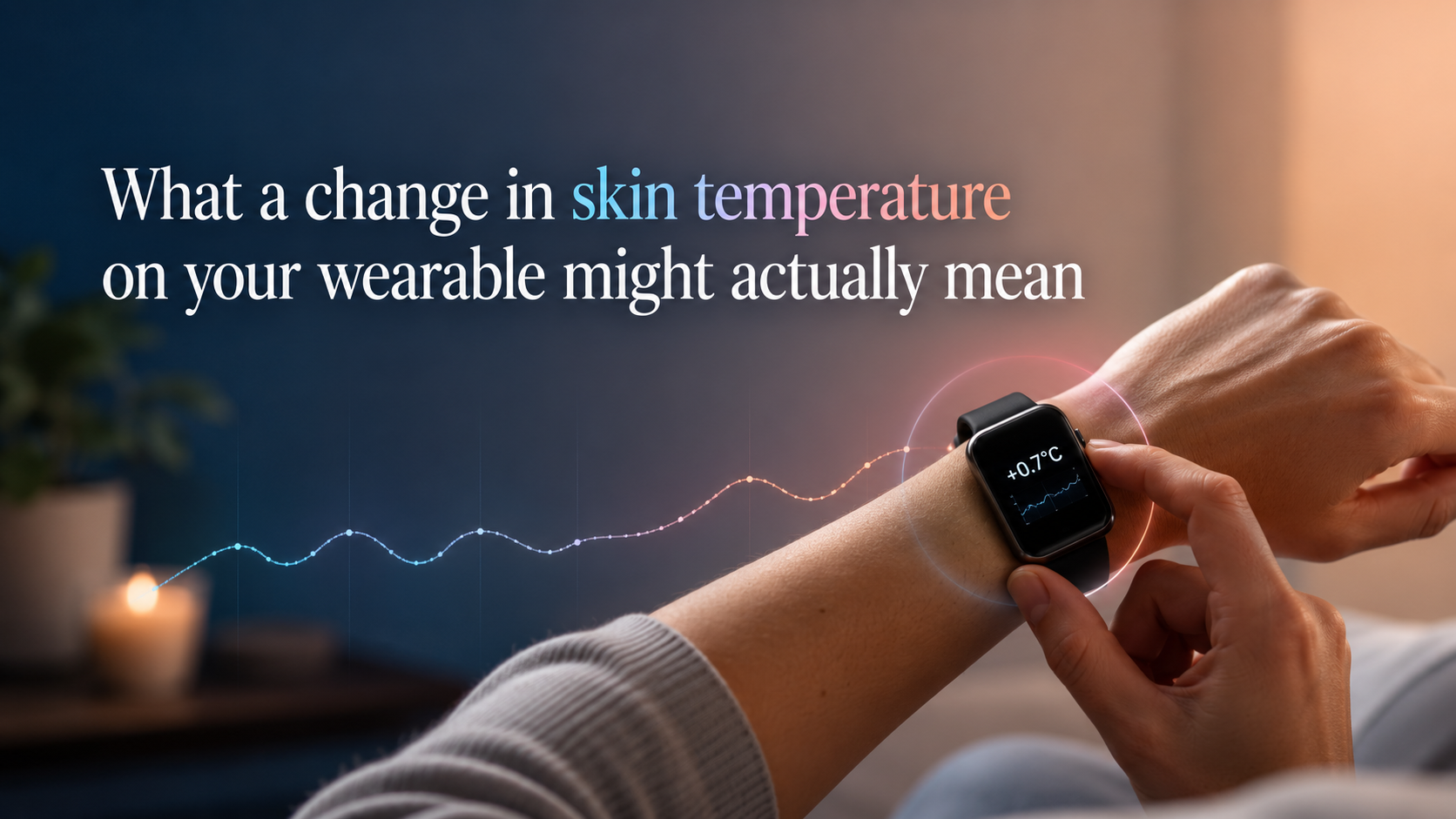
What a change in skin temperature on your wearable might actually mean
Your wearable's skin temperature isn't a fever reading. Learn what moves it at night, why deviation beats the number, and when to act.

Snoring, Sleep Apnea, and Smart Rings: What They Can Actually Detect in 2026
A smart ring cannot measure airflow. Everything it reports about your breathing is inferred from oxygen estimates, pulse signals, and movement, which is why a wearable can stay silent while a partner in the same bed hears you stop breathing. Here is what these devices can genuinely detect in 2026, where cleared screening features differ from wellness metrics, and why a quiet result is not a clean bill of health.
Social jet lag: why sleeping in on weekends can wreck Monday energy
Sleeping in on weekends shifts your body clock and drains Monday energy. Learn how to calculate your social jet lag and four realistic ways to reduce it.
Sleep Debt Is Real: How Long It Actually Takes to Recover Lost Sleep
Sleep debt doesn't clear in one long weekend. Here's what the research says about realistic recovery timelines, plus a 3 to 7 day plan that works.