What Heart Rate Recovery After Exercise Can Tell You About Fitness
By Mr.Apps · Jul 22, 2026
Category:Recovery

Most people look at heart rate during the workout.
Was the run in Zone 2?
Did the intervals hit the right peak?
Was the class hard enough?
Did the watch say the session was productive?
That is all useful. But there is another number people often ignore: what happens after the workout ends.
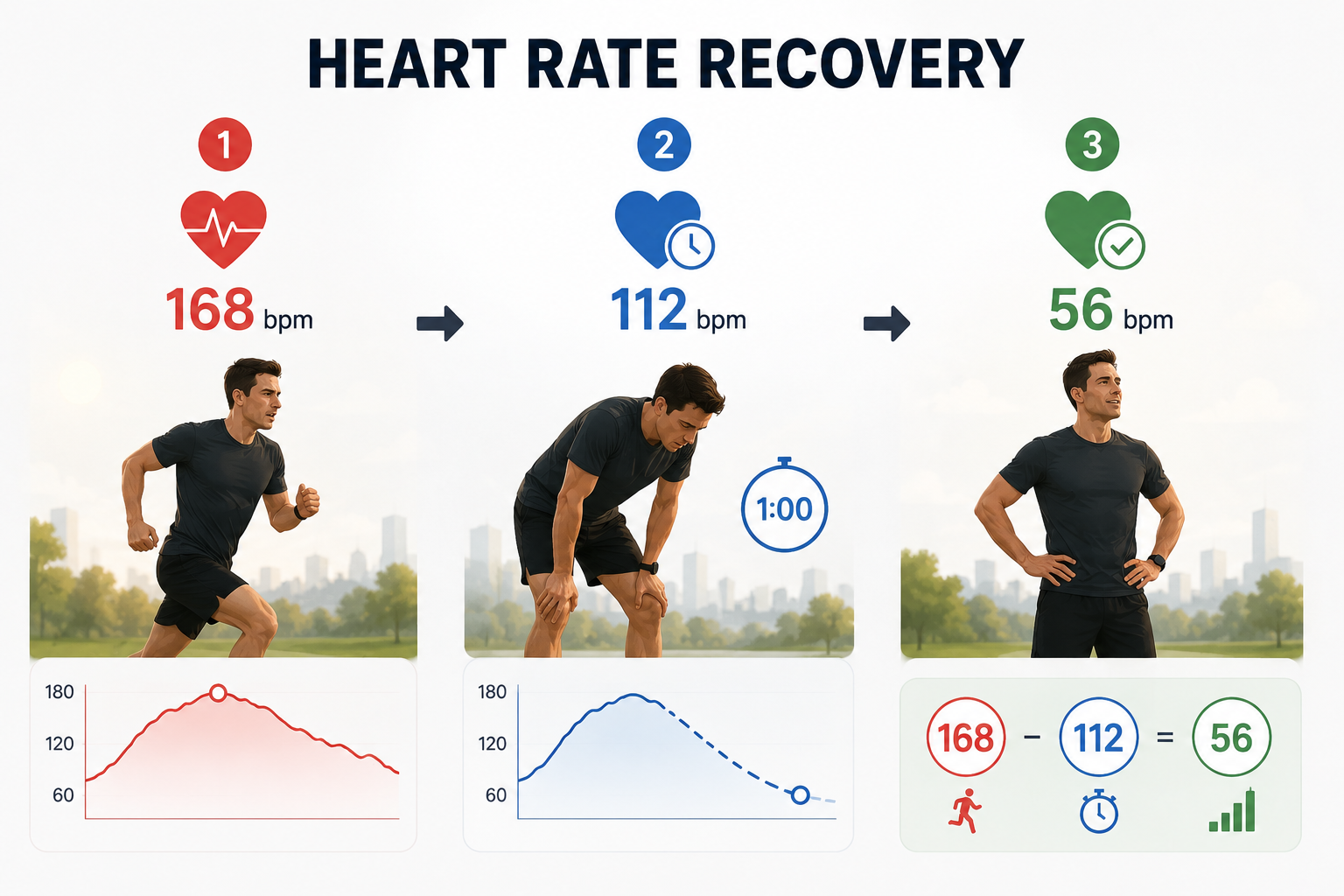
Heart rate recovery is the drop in heart rate after exercise. In simple terms, it shows how quickly the body can move from “work mode” back toward “rest mode.” That makes it one of the most practical recovery signals because it is easy to understand and easy to track.
The Cleveland Clinic defines heart rate recovery as the difference between your peak heart rate during exercise and your heart rate soon after stopping. The bigger the drop, generally, the faster the body is calming down.
That is why heart rate recovery is interesting. It is not just about how high your heart rate gets. It is about how efficiently the body comes back down.
A strong workout raises heart rate.
A fit, well-recovered body usually lowers it faster afterward.
That second part is where a lot of people miss useful information.
What is heart rate recovery?
Heart rate recovery, often shortened to HRR, is the number of beats per minute your heart rate drops after you stop exercising.
For example:
- peak heart rate at the end of exercise: 170 bpm
- heart rate after 1 minute: 145 bpm
- heart rate recovery after 1 minute: 25 bpm
That means your heart rate dropped by 25 beats in the first minute after exercise.
Some apps and watches also show 2-minute recovery or 3-minute recovery. The idea is the same. You are looking at how quickly the heart rate falls after effort.
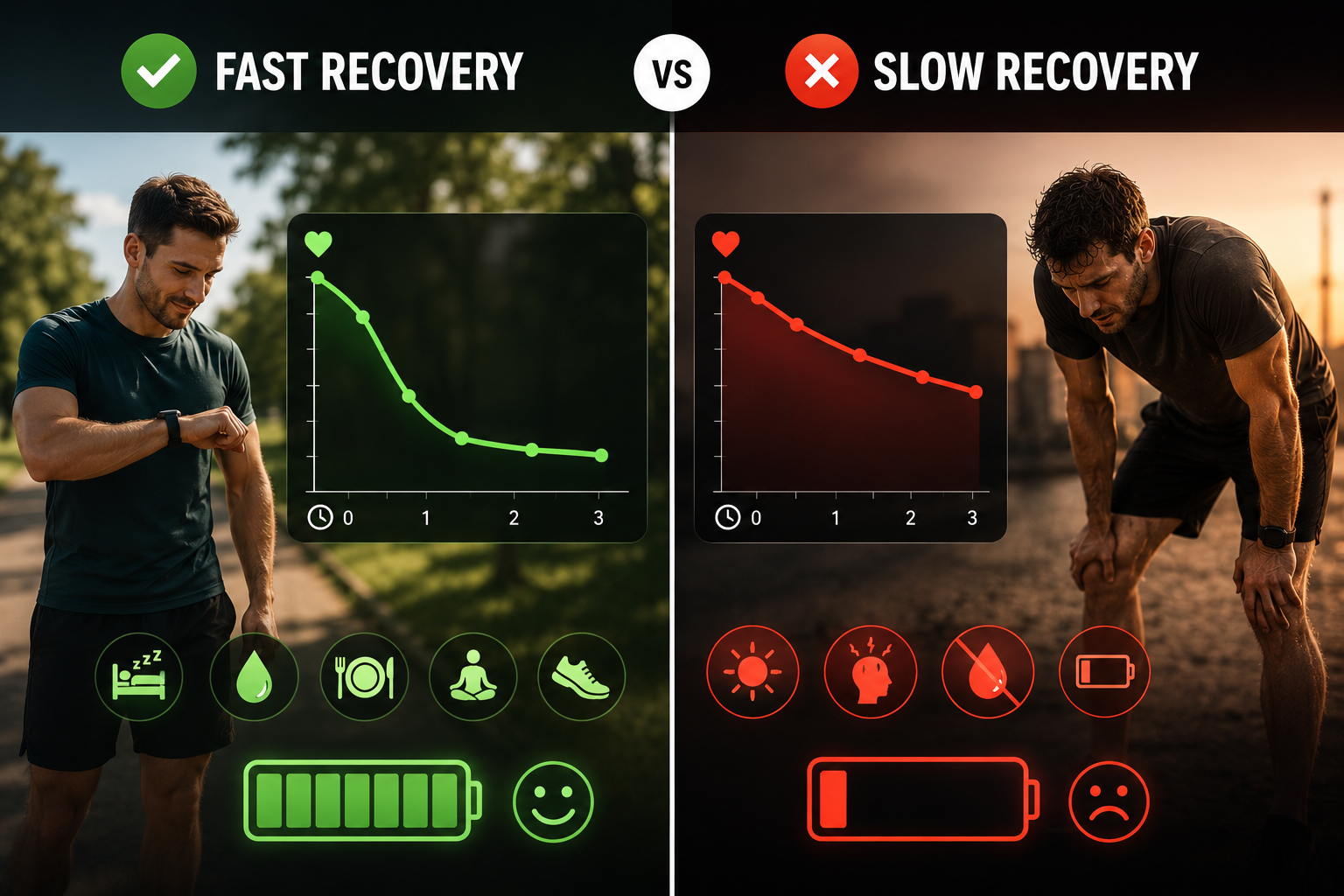
The reason this matters is that recovery is partly controlled by the autonomic nervous system. During exercise, the body shifts toward activation. After exercise, it needs to shift back toward recovery. A faster drop often suggests better cardiovascular fitness and better parasympathetic reactivation, while a slower drop may suggest fatigue, heat, stress, dehydration, illness, low fitness, or poor recovery.
That does not mean one bad heart rate recovery reading should scare you. It means the trend can be useful.
Why heart rate recovery says something different from workout heart rate
Workout heart rate tells you how hard the body is working.
Heart rate recovery tells you how well the body comes back down.
Those are not the same thing.
Two people can both hit 170 bpm during a hard run. One drops to 140 after a minute. The other is still at 162. The workout intensity may have looked similar, but the recovery response is different.
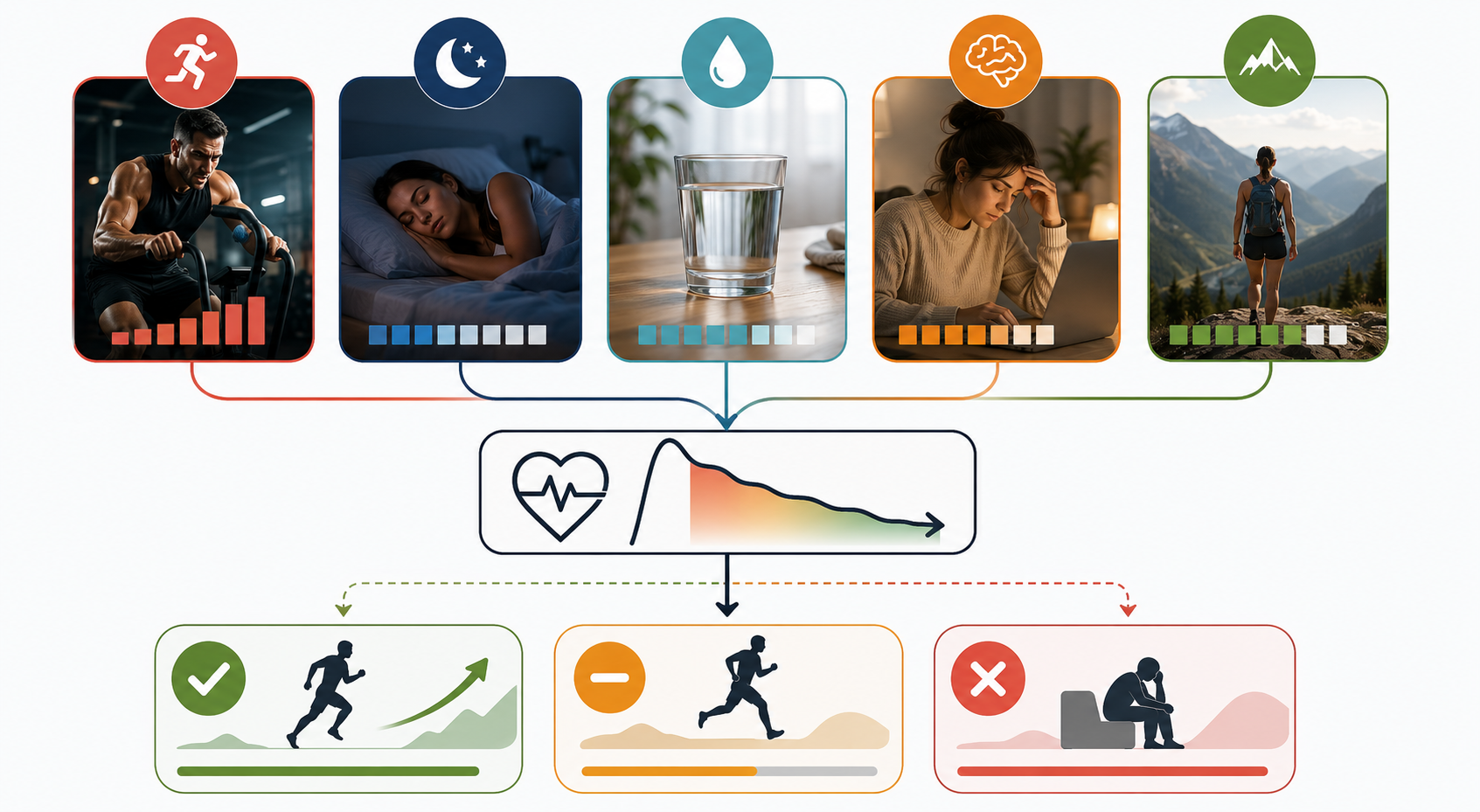
That difference can come from fitness, but also from context:
- sleep
- heat
- hydration
- stress
- caffeine
- illness
- training load
- how hard the workout really was
- whether the cool-down was active or passive
That is why HRR is not a perfect fitness score. It is a recovery clue.
A review on cardiac autonomic responses during exercise and recovery explains that exercise dose — intensity, duration, and type — affects heart rate and HRV recovery responses after exercise. Frontiers in Physiology
In plain English: do not compare recovery after a light jog with recovery after brutal hill repeats and pretend they mean the same thing.
The workout changes the recovery number.
Why faster recovery usually means better fitness
In general, better cardiovascular fitness is linked with a more efficient heart rate response. The heart can pump more effectively, the body handles effort better, and recovery after exertion often happens faster.
That is why heart rate recovery is used in exercise testing and clinical research. A classic study published in The New England Journal of Medicine found that delayed heart rate recovery after exercise was a powerful predictor of overall mortality in a clinical exercise-testing population. Europe PMC
That does not mean your smartwatch HRR is a diagnosis. It does mean HRR is taken seriously enough to be studied beyond fitness apps.
A large primary-prevention study also found that heart rate recovery was associated with cardiovascular risk factors, including diabetes, hypertension, smoking, and poor cardiorespiratory fitness. Journal of the American Heart Association
For everyday users, the practical lesson is softer:
If your heart rate recovery is improving over weeks and months, that may be a sign your fitness and recovery capacity are improving too.
If it is suddenly worse than usual, it may mean the body is under more stress than normal.
What is a “good” heart rate recovery?
This is where people want one universal number, and that is where things get messy.
A good heart rate recovery depends on age, fitness level, workout intensity, medication, health status, and how it is measured. A one-minute HRR after stopping completely is not the same as HRR after a walking cool-down. A chest strap may differ from a wrist sensor. A lab treadmill test is not the same as a watch reading after a random gym session.
Still, many people use 1-minute HRR as a practical benchmark because it is easy to measure.
A higher drop in the first minute generally looks better. A very small drop, especially if repeated, may be worth paying attention to. The Cleveland Clinic notes that HRR can reveal information about future heart disease risk and is often calculated during exercise stress testing. Cleveland Clinic
For everyday fitness tracking, the better question is not:
“Is my number perfect?”
The better question is:
“Is my number improving, stable, or suddenly worse than usual?”
That is the most useful version.
How to measure heart rate recovery
You do not need to make this complicated.
Option 1: Use a wearable
Many watches and fitness apps estimate heart rate recovery automatically after a workout. This is the easiest method, but the number depends on sensor quality, watch fit, skin contact, motion, and whether the app understands when the workout actually ended.
Wrist-based heart rate can be useful, but it is not perfect, especially during movement.
Option 2: Measure it manually
At the end of a workout:
- Note your heart rate immediately at the end.
- Stop or begin a very easy cool-down.
- Check your heart rate again after 1 minute.
- Subtract the 1-minute number from the peak number.
Example:
- end of workout: 165 bpm
- after 1 minute: 142 bpm
- HRR: 23 bpm
That number is your 1-minute heart rate recovery.
Option 3: Track 2-minute recovery
Some people prefer 2-minute HRR because it gives a little more time for the body to come down. That can be helpful, especially after harder sessions.
The key is consistency. Do not compare a 1-minute stop test to a 2-minute walking cool-down and treat them like the same metric.
What affects heart rate recovery?
Heart rate recovery changes for normal reasons. That is why one reading is less useful than a trend.
Fitness level
As cardiovascular fitness improves, heart rate often recovers faster after comparable exercise.
Workout intensity
Harder workouts usually keep heart rate elevated longer. A slow recovery after a maximal interval session does not mean the same thing as slow recovery after an easy walk.
Heat
Hot weather can keep heart rate higher because the body is also working to cool itself.
Dehydration
Dehydration can raise heart rate and make recovery feel slower.
Sleep
Poor sleep can leave the nervous system more stressed, which may slow recovery.
Stress
Mental stress can affect heart rate too. A workout after a brutal workday may recover differently than the same workout after a calm day.
Illness
Getting sick, even before symptoms are obvious, can raise heart rate and change recovery.
Caffeine and alcohol
Caffeine may keep heart rate higher for some people. Alcohol can affect sleep and recovery, which may show up the next day.
Medication and health conditions
Some medications and medical conditions affect heart rate response. This is one reason HRR should not be treated as a standalone diagnosis.
Heart rate recovery vs HRV
Heart rate recovery and HRV are related, but they are not the same thing.
Heart rate recovery looks at how quickly heart rate falls after exercise.
HRV looks at variation between heartbeats, usually during rest or sleep, and is often used as a stress and recovery signal.
HRR is more tied to the transition after exertion. HRV is more tied to baseline recovery state. Both can be useful, but they answer different questions.
A simple way to think about it:
- HRR: “How quickly did I calm down after that workout?”
- HRV: “How recovered does my body look overall?”
That is why using both can be helpful. If HRV is low before a workout and HRR is unusually slow afterward, that may be a sign the body is carrying more stress than usual.
How to use HRR in training without overthinking it
The best use of heart rate recovery is pattern recognition.
Do not change your life because of one weird reading. Instead, watch what happens across similar workouts.
Compare:
- similar route to similar route
- similar temperature to similar temperature
- similar intensity to similar intensity
- similar cool-down style to similar cool-down style
For example, compare your 1-minute HRR after the same easy run every Monday. Or after the same indoor bike session. Or after the same strength circuit.
That gives the number context.
A better HRR trend may suggest improved fitness. A worse HRR trend may suggest accumulated fatigue, poor sleep, stress, heat, or early illness.
This is especially useful for recreational exercisers because it gives more nuance than “I was tired” or “my workout felt hard.”
How to improve heart rate recovery
The most reliable way to improve heart rate recovery over time is to build fitness consistently.
That does not mean training hard every day. It means combining regular aerobic work, appropriate intensity, strength training, recovery, and sleep.
The American Heart Association explains that heart rate can help guide exercise intensity, and the Mayo Clinic Health System describes target heart rate ranges for moderate to vigorous exercise.
For practical training, try this:
Build your aerobic base
Easy cardio matters. Walking, jogging, cycling, rowing, swimming, or hiking at a sustainable effort can improve cardiovascular fitness without draining recovery every time.
Do hard sessions, but not every day
Intervals and hard workouts can help fitness, but too much intensity without recovery can backfire.
Cool down properly
A few minutes of easy movement after a hard session can help the body transition back down and may reduce dizziness or that “hit by a truck” feeling after stopping suddenly.
Hydrate and recover
If HRR is repeatedly worse in heat, after poor sleep, or after stressful days, the answer may not be more training. It may be better recovery.
Track the same way each time
Consistency makes the metric useful. Same timing, same workout type, same measurement method when possible.
When a slow heart rate recovery is a warning sign
A slow HRR once in a while is not automatically dangerous.
But repeated unusually slow recovery, especially when paired with symptoms, deserves attention.
Talk to a healthcare professional if you notice:
- chest pain
- fainting
- dizziness that feels unusual
- shortness of breath that feels out of proportion
- irregular heartbeat or palpitations
- heart rate staying unusually high long after exercise
- a sudden major change in exercise tolerance
This matters because consumer wearables are not medical devices, and HRR should not be used to diagnose yourself.
Use the data as context. Not as a verdict.
The honest take
Heart rate during a workout tells one side of the story.
Heart rate recovery tells another.
It shows how quickly the body can shift from effort back toward rest. That makes it useful for understanding fitness, recovery, stress, and how well the body is handling training.
A faster drop after similar workouts usually points in a good direction. A slower-than-usual drop may point to fatigue, heat, dehydration, stress, illness, or too much training load.
The key is not to obsess over one number.
Track the trend.
Compare similar workouts.
Notice when recovery looks different.
Use it alongside sleep, HRV, energy, and how you actually feel.
The workout matters. But what happens after the workout matters too.
That is where recovery begins.
FAQ
What is heart rate recovery?
Heart rate recovery is how much your heart rate drops after exercise. It is usually measured after 1 or 2 minutes.
What does heart rate recovery tell you?
It can give insight into cardiovascular fitness, recovery, and how quickly the body shifts from exercise mode back toward rest.
Is faster heart rate recovery better?
Generally, yes. A faster drop after similar workouts often suggests better fitness or recovery. But context matters, including age, workout intensity, heat, hydration, medication, and health status.
How do I measure heart rate recovery?
Check your heart rate at the end of exercise, then check it again after 1 minute. Subtract the second number from the first. That drop is your 1-minute HRR.
Can heart rate recovery show overtraining?
It can be one clue. If HRR is repeatedly worse than usual alongside poor sleep, low energy, poor performance, or elevated resting heart rate, it may suggest accumulated fatigue or insufficient recovery.
When should I worry about heart rate recovery?
Get medical advice if slow recovery is repeated and comes with symptoms like chest pain, fainting, unusual shortness of breath, palpitations, dizziness, or a sudden drop in exercise tolerance.
*This article is for informational purposes only and is not a substitute for professional medical advice, diagnosis or treatment.*
Sources:
Cleveland Clinic — Heart Rate Recovery·American Heart Association — Target Heart Rates Chart·Mayo Clinic Health System — Know your numbers: Heart rate·Europe PMC·Frontiers in Physiology·PMC — Prognostic Performance of Heart Rate Recovery·AHA Journals — Impact of Exercise on Heart Rate Recovery
Related articles
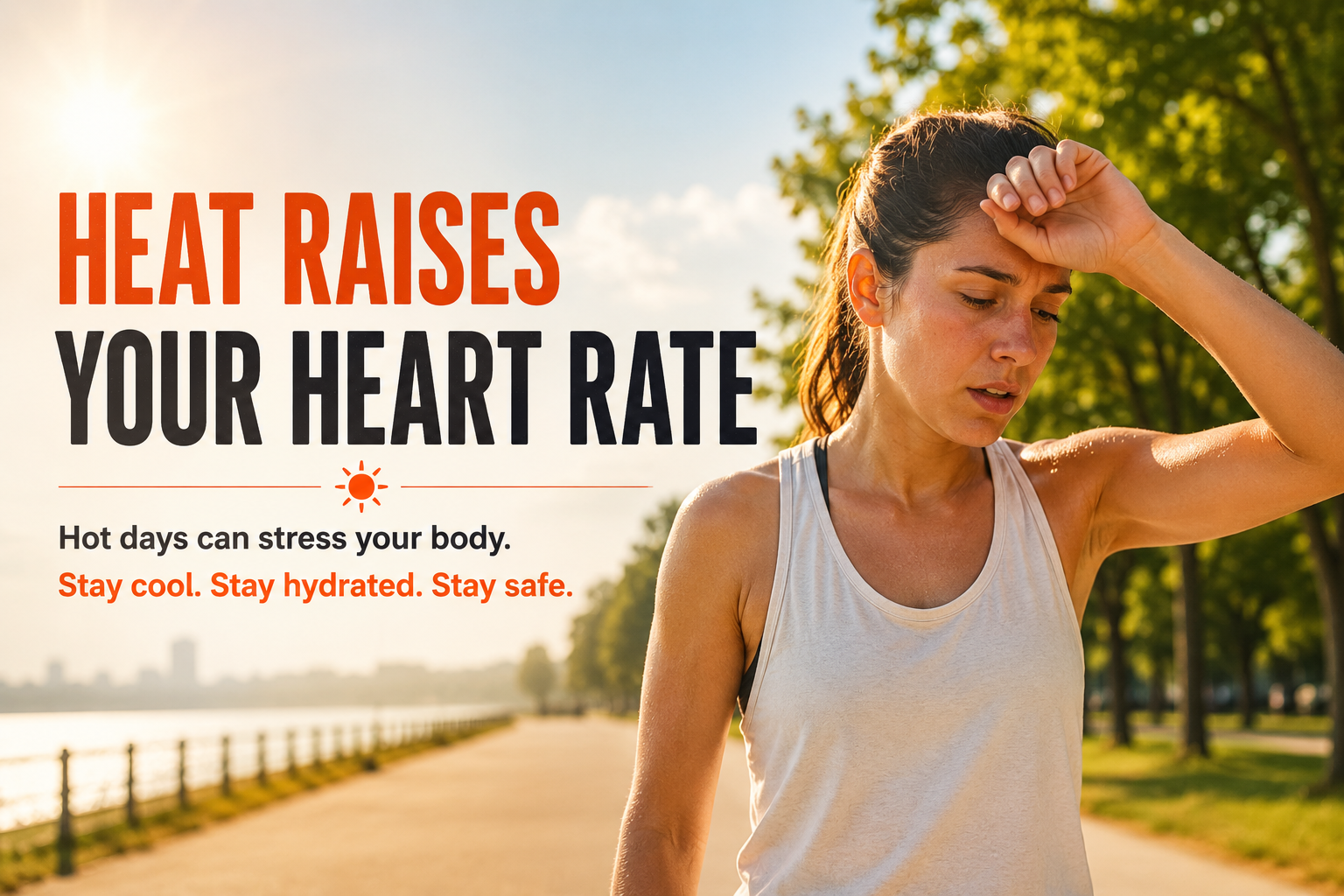
Why Hot Weather Can Raise Heart Rate and Lower Recovery
Hot weather can make your heart rate run higher, your HRV look worse, and your recovery score drop even when you did not train harder. Here’s why heat changes the body’s workload and how to protect your energy.
Best Apps to Track Poor Recovery and Fatigue in 2026

Your Bedroom May Be Too Warm for Good Recovery
For two summers, I lived in a bedroom that never quite cooled down after dark, and a heart rate tracker I was wearing for something else entirely showed me exactly what that was costing me overnight. It turns out a warm room doesn't just make sleep less pleasant. It measurably raises heart rate, lowers heart rate variability, and cuts into the recovery your body is supposed to get while you're asleep. Here's what the research says about why, who's most affected, and the small changes that actually help.

Why jet lag hits harder after some flights and how to recover faster
Some time zone changes barely touch you, and others wreck you completely, even when the shift on paper looks about the same. The difference usually comes down to direction: eastward travel fights your body's natural clock in a way westward travel doesn't, which is also why "I slept a full night" doesn't always mean you're actually recovered. Here's what the research says about why that happens, and a simple first-48-hours plan built around light, timing, and realistic expectations rather than gimmicks.
Best Apple Watch Apps for Recovery Tracking in 2026
Your Apple Watch already tracks sleep, HRV, heart rate, and activity, but recovery can still feel confusing without clear interpretation. This guide compares the best Apple Watch recovery apps for 2026, from simple daily energy scores to deeper training-readiness tools, helping you choose the right app for your goals.
Best Recovery Apps in 2026
Compare the best recovery apps in 2026, including Ensta, WHOOP, Oura, Athlytic, Elite HRV, and Muscle Recovery Tracker. Learn which recovery tracker is best for your body, sleep, HRV, stress, strain, training load, and daily energy score — whether you want a simple free recovery app, an Apple Watch recovery app, a sleep-focused readiness score, or an athlete-grade recovery tracker.