Why Overnight HRV and Daytime HRV Need Different Context
By Mr.Apps · Sep 22, 2026
Category:HRV

The same metric can answer different questions
HRV is not one universal observation. An overnight summary and a daytime spot reading may be collected at different times, under different movement and breathing conditions, and with different sampling rules. Their values should not be merged simply because the display uses the same unit.
I first ask how the value was collected. Was the person asleep, sitting, standing or moving? Was the number one sample, a short window or an overnight summary? The method is part of the result.
A review of wearable measurements recommends interpreting signals with data quality and personal context. Context prevents a simple comparison from becoming a misleading conclusion.

Overnight values have a sleep-window context
An overnight value may combine observations across a longer period. The system may select segments, remove artifacts and compare the result with a personal baseline. That can make it useful for a repeated sleep-based trend.
It can also hide variation inside the night. A single overnight summary does not show every movement, breathing change or missing interval. Review the window and coverage before treating it as a complete physiological description.
Daytime values have a measurement-condition context
A daytime reading may be affected by posture, movement, breathing, recent activity, caffeine, stress or the timing of the sample. That does not make it useless. It means the result answers a different question from an overnight summary.
Write down the conditions. A reading collected after movement should not be compared casually with a quiet seated reading. A value taken at a different time of day may reflect a different state rather than a direct trend.
A review of connected health data distinguishes accuracy from reliability and fitness for purpose. Repeated measurements are easier to interpret when their conditions are clear.
Do not combine unlike windows
The most common error is placing overnight and daytime values on one line without labeling the source. A visible trend can then suggest a change that actually reflects a change in posture, timing or sampling method.
Keep separate fields for overnight, waking and daytime observations. Compare within each field first. Only compare across fields when the question and method support that comparison.
Measurement method matters across devices
Two systems may use different sensors, intervals, cleaning rules and summaries. The same label does not guarantee the same calculation. A change after switching devices can be a method boundary rather than a change in the body.
A broad review of consumer wearables emphasizes metric-specific validation. Preserve the device or source beside the value instead of combining every result into one baseline.
If a software update changes how the metric is displayed, mark the date. A new chart or decimal place may alter interpretation without adding measurement quality.
Keep breathing and posture visible
Breathing pattern can influence beat-to-beat variation. Posture and movement can also change the conditions around a reading. A short measurement can be sensitive to those factors, especially when the sample is treated as a verdict.
Do not deliberately manipulate breathing to make one reading look better and then compare it with an ordinary overnight value. If breathing is part of the protocol, record it consistently and label the context.
A review of sleep measurement methods explains why agreement depends on the device, signal and physiological state being evaluated. Comparable questions need comparable conditions.
Read the trend without diagnosing
HRV can support a wellness trend review, but it cannot diagnose a condition or explain every symptom. General wellness guidance separates healthy-lifestyle functions from claims about diagnosing or treating a condition.
An existing guide on reviewing wearable data before changing bedtime shows why the surrounding record matters when a metric changes.
Build separate baselines
An overnight baseline can use one set of windows and a daytime baseline another. Keep them separate in the record. A combined average may look stable while both underlying conditions are changing in opposite directions.
Label the source, time, posture and window length. This small amount of structure prevents a later comparison from losing the information needed to interpret it.
Ask what changed before asking which value is right
If overnight HRV changes but daytime HRV does not, check sleep coverage, timing and the conditions around the daytime sample. If daytime HRV changes but overnight HRV does not, check movement, breathing, posture and recent activity.
Neither pattern automatically proves better or worse recovery. It identifies a mismatch between contexts that deserves a context-aware review.

Do not average away the difference
A single combined score may be convenient, but it can hide when the measurements came from different states. Keep the separate values visible even if an app also provides a summary. The summary should not replace the underlying context.
Use two separate comparisons
For overnight HRV, compare similar sleep windows and coverage. For daytime HRV, compare similar time, posture, breathing and rest conditions. Then note how current function and symptoms fit the pattern.
The goal is not to make the two values agree. The goal is to know what each value represents before deciding whether the change is meaningful.
For an overnight trend, keep the sleep window and coverage consistent. For a daytime trend, keep the time, posture and rest conditions as similar as practical. This creates two clearer comparisons before any cross-context question is attempted.
If the two trends move differently, describe that directly. It may reflect a different state rather than a contradiction. A daytime value can respond to movement or breathing while an overnight summary remains close to its personal reference.
The transition from sleep to waking can be informative, but it should not be treated as a seamless continuation of the same measurement. Mark when the device changes from an overnight summary to a daytime sample. Note whether the person moved, sat up, drank something or began an activity.
Decide in advance what would count as a comparable observation. For an overnight value, that may include a complete window and the same source. For a daytime value, it may include a similar time, posture and quiet period. A clear rule reduces selective comparisons after the number appears.
When one context changes and the other does not, preserve both results. The mismatch can help identify which conditions deserve review. It should not be compressed into a single recovery label that hides the difference.
Use the next comparable observation to test the pattern. A repeated change within one context is more informative than a one-time difference across two contexts.
An existing guide on sleep-window interpretation shows why the measured window should remain visible when a metric is interpreted.
A transition is a new context
The period between sleep and waking is not automatically equivalent to either an overnight summary or a daytime spot sample. Movement, posture and breathing can change quickly. If a device presents a value during that transition, label it rather than forcing it into one of the established baselines.
This is also important after activity. A daytime reading taken soon after movement may reflect the recovery from that movement, while a quiet reading later may reflect a different condition. Both can be valid observations when their context is recorded.

Compare questions, not just numbers
Ask whether you want to know the overnight pattern, the resting daytime state or the response after an event. Then choose the measurement window that answers that question. Combining unlike windows because they are available can create a neat chart with weak meaning.
Keep uncertainty visible
If the source does not explain how an overnight value was selected, record that gap. If a daytime sample is too short or affected by movement, record that too. A transparent limitation is more useful than a false appearance of precision.
This distinction also makes later discussions more precise. A disagreement between contexts is not automatically a contradiction; it may simply be a change in the question being measured.
The record is clearer when each value can be traced back to its time, state and source. That traceability matters more than forcing the values into one line.
Keep those labels attached when exporting or sharing the record so a later review does not separate the value from the conditions that produced it.
FAQ
Can overnight and daytime HRV be compared directly?
Usually not without context. Timing, posture, movement, breathing and sampling method can differ enough to change the meaning of the values.
Which HRV value should I trust?
Use the value collected under the most consistent, understood conditions for the question you are asking. Neither value is a complete health verdict.
What should I record beside HRV?
Record timing, posture, movement, breathing conditions, source, window length, coverage and current function. These details make repeated comparisons fairer.
*This article is for informational purposes only and is not a substitute for professional medical advice, diagnosis or treatment.*
Sources:
Journal of the American College of Cardiology·Digital Health·U.S. Food and Drug Administration·Centers for Disease Control and Prevention·U.S. National Library of Medicine·U.S. National Library of Medicine
Related articles

Why Breathing Pattern Can Change HRV Without Proving Better Recovery
Breathing pattern can change an HRV reading through the conditions of measurement. A short-term rise does not by itself prove better sleep, fitness or recovery.

Why HRV and Resting Heart Rate Can Move in Opposite Directions
HRV and resting heart rate describe different aspects of physiology, so they can move in opposite directions. Review timing, duration, personal baseline and data quality before treating the disagreement as a contradiction.

How to Read HRV When Sleep Duration Has Not Changed
Unchanged sleep duration does not hold timing, sleep quality, strain, illness or measurement conditions constant. Read HRV beside the full context and favor repeated comparable observations over one reading.

How to Use an Age-Based HRV Range Without Treating It as a Target
Age-based HRV ranges can provide broad population context, but they cannot define a personal target. Use your own repeated baseline, measurement conditions and symptoms before reacting to a wearable HRV value.

Why the Shape of Overnight HRV Matters More Than One Sample
A single overnight HRV value is only one point in a longer record. Learn how the direction, stability and coverage of an overnight pattern add context without turning a wearable graph into a diagnosis.

Why a Positive Metric Change Can Still Trigger a Health Alert
A metric that usually looks favorable can still be unusual enough to trigger an alert. This guide explains why anomaly systems monitor changes in both directions and how to add baseline, timing, and symptom context.

Vagus Nerve “Reset” Techniques: Can HRV Show Whether They Work?
HRV can show an immediate response to breathing, cold, or stimulation, but it cannot prove that the nervous system has been reset. I compare the main techniques and explain how to test a useful effect without overreading one impressive graph.

Personalized Heart-Rate Zones: Why the “220 Minus Your Age” Formula Often Fails
Age-based heart-rate formulas are convenient, but they can place an individual’s training boundaries far from their real physiology. I explain how resting heart rate, thresholds, field cues, medications, and better testing can produce safer custom zones.

Why Apple Watch, Oura, WHOOP, and Garmin Give You Different HRV Scores
Apple Watch, Oura, WHOOP, and Garmin can report different HRV values without any one device necessarily being broken. I explain how calculation method, sampling time, sensor location, artifact filtering, and baseline logic change the result, and why trends within one device are the safer comparison.

POTS and Wearables: What Standing Heart-Rate Patterns Can—and Can’t—Tell You
A watch can document how heart rate changes after standing, but a POTS evaluation also needs symptoms, blood pressure, timing, and alternative causes. I explain how to build a concise record for a clinician without turning a smartwatch into a diagnostic device.

Your Menstrual Cycle Changes Recovery Scores—Here’s How to Read the Pattern
Recovery, temperature, resting heart rate, HRV, and sleep can follow repeatable patterns across the menstrual cycle. I explain how to compare several cycles so a familiar monthly shift is not mistaken for a new health crisis.

Can dehydration raise your heart rate and ruin recovery?
For ten days last summer I was convinced I had overtrained. My resting heart rate was up, my easy runs felt hard, and cutting my training volume changed nothing. The problem was water. Here is how fluid loss raises your heart rate, why it drags out recovery, and how to tell it apart from everything else that does the same thing.
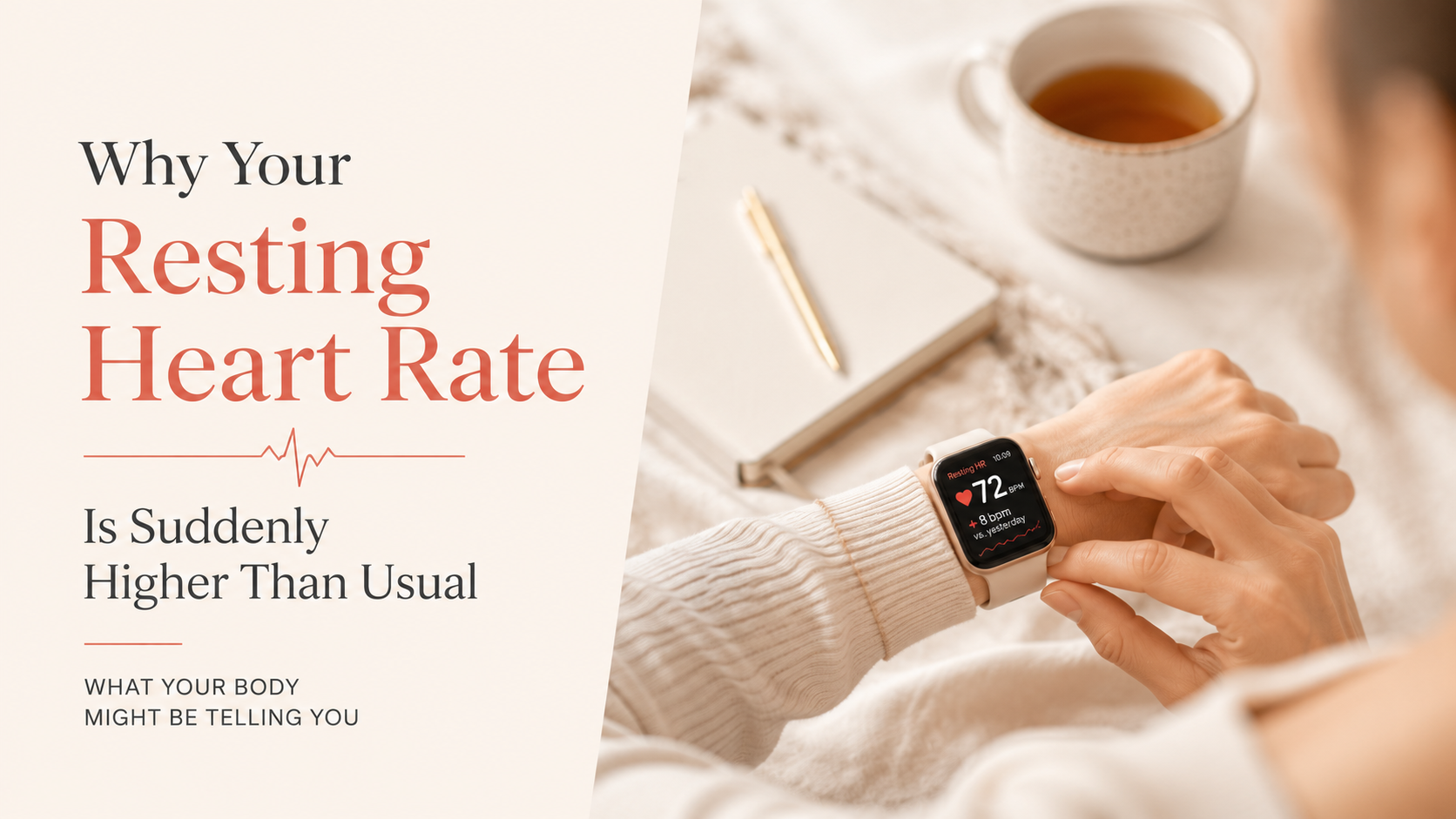
Why Your Resting Heart Rate Is Suddenly Higher Than Usual
A resting heart rate that jumps five or six beats and stays there is usually explained by the week, not the heart. Here's how I work through the usual causes, why one high night matters far less than three, and where the line sits between tracking it and calling someone.