Personalized Heart-Rate Zones: Why the “220 Minus Your Age” Formula Often Fails
By Mr.Apps · Sep 7, 2026
Category:HRV

Personalized heart-rate zones begin with a simple truth: age predicts a population average, not an individual's physiology. The "220 minus your age" formula can provide a rough starting estimate of maximum heart rate, but the error around that estimate is wide enough to place some people in the wrong training zone. Fitness, resting heart rate, threshold responses, medication, heat, fatigue, and measurement quality all affect what a given heart rate means.
I once followed an age-based zone during an easy run and spent most of the session slowing down to satisfy the screen. My breathing stayed comfortable and conversation was easy, yet the device insisted I had crossed into a harder zone. The problem was not my discipline. The default maximum was too low for me, so every boundary built from it shifted downward.
That experience changed how I use custom training zones. I treat formulas as estimates to test, not limits to obey.
Where 220 minus age falls short
The formula is popular because it is memorable. Its origin and validation are much less tidy. A major study of age-predicted maximum heart rate analyzed data from 18,712 people and cross-validated a different equation: 208 minus 0.7 times age.
The newer equation may estimate the group average better, but it does not remove individual variation. Two healthy people of the same age can have substantially different measured maximum heart rates. A formula cannot know which side of the average I occupy.
This matters because a small error at the top changes every percentage-based boundary. If my true maximum is 190 but the formula uses 180, a 70 percent target moves from 133 beats per minute to 126. The watch may call a comfortable effort "too hard," or the reverse if the estimate is too high.

Maximum heart rate is not a fitness score
A higher maximum heart rate does not automatically mean better fitness. Training can improve the pace or power I sustain at a given heart rate, increase stroke volume, and shift thresholds without producing a dramatic change in maximum heart rate.
Resting heart rate tells a different part of the story. A trained person may start lower at rest, giving a larger range between rest and maximum. That is why heart-rate reserve can be more individualized than a simple percentage of maximum:
Target heart rate = resting heart rate + intensity percentage × (maximum heart rate − resting heart rate)
Heart-rate reserve still depends on a reasonable maximum and a reliable resting value. It is not a substitute for symptoms, perceived effort, or threshold testing.
I prefer to judge progress by what I can do at a given effort. If the same comfortable heart rate supports a faster walk, steadier climb, or longer session after several weeks, that is more useful than trying to raise my maximum.
Thresholds describe transitions, not arbitrary slices
Laboratory testing can identify ventilatory or lactate thresholds during graded exercise. These are points where breathing and metabolism begin changing more sharply as intensity rises. They often give training zones a physiological anchor that fixed percentages cannot provide.
The first ventilatory threshold is near the transition from easy, sustainable work toward a more demanding domain. The second is near a harder transition associated with much shorter sustainable duration. Methods and zone naming vary, so "Zone 2" in a three-zone model may not match Zone 2 in a five-zone watch.
A systematic review of HRV-derived, ventilatory, and lactate thresholds found promising relationships but also substantial heterogeneity in testing and calculation methods. The lesson is not that thresholds are useless. It is that a label needs a definition.

When I receive test results, I want to know which protocol was used, which threshold was identified, and how the training zones were calculated. A polished chart is less helpful if the method is invisible.
Field cues can improve a default zone
Not everyone needs laboratory testing. I can combine a sensible estimate with breathing, speech, perceived exertion, pace or power, and repeated workout data.
The talk test is especially practical. The CDC describes moderate effort as an intensity where I can talk but not sing. At vigorous intensity, only a few words are comfortable before pausing for breath. This does not create precise laboratory boundaries, but it can reveal an obviously wrong watch zone.
I also compare similar sessions. If a flat 40-minute route repeatedly feels conversational at 140 beats per minute, yet a default formula labels 140 as near maximal, the settings deserve review. I first check sensor fit and signal quality, then examine maximum and resting heart rate values.
Heat, dehydration, altitude, stress, and accumulated fatigue can raise heart rate at the same pace. This cardiac drift does not always mean the zone boundaries are wrong. It may mean the body is working harder under different conditions.
Wearables can be customized, but the inputs still matter
Many watches calculate zones automatically from health data, then allow manual boundaries. For example, Apple's official heart-rate zone guide explains that the zones can be switched from automatic to manual and edited.
Before changing anything, I confirm that age, resting heart rate, and recorded maximum values are correct. I review several hard sessions rather than treating one brief sensor spike as a true maximum. Wrist optical sensors can lag or lock onto running cadence, especially during intervals, cold conditions, or movements with strong arm tension.
For important decisions, a properly fitted chest strap may provide cleaner exercise data. For the most accurate and clinically appropriate assessment, a supervised graded exercise test may be preferable.
I keep a record of the old and new boundaries. Otherwise, a sudden improvement in "time in zone" may simply reflect changed settings rather than changed fitness.
Medication can invalidate a generic target
Beta blockers deliberately slow heart rate and can blunt its rise during exercise. Some calcium channel blockers and other medicines can also affect the response. In that situation, age-based targets may be misleading or unsafe to pursue.
The American Heart Association's guidance on beta blockers and exercise recommends working with a healthcare professional to determine an adjusted target, sometimes using an exercise stress test. Perceived exertion and the talk test may also help when heart rate is pharmacologically limited.
I would never change medication to make a wearable zone look normal. The prescription has a medical purpose. The zone must adapt to the person, not the other way around.

My process for setting custom training zones
I use a five-step process:
- Check the data. Confirm age, resting heart rate, sensor fit, and plausible maximum readings.
- Define the model. Find out whether the app uses percentages of maximum, heart-rate reserve, or another method.
- Compare field experience. Match the zones with speech, breathing, perceived effort, pace, and power across repeated sessions.
- Consider context. Review medication, heat, fatigue, illness, and environmental changes.
- Escalate when needed. Use professional testing for performance precision, medical conditions, unusual symptoms, or conflicting data.
I then leave the settings alone long enough to learn from them. Constantly adjusting zones after every workout replaces one bad formula with another source of noise.
Heart rate also has limits in strength training, where short efforts and local muscular fatigue may not produce the same cardiovascular pattern as steady cardio. I use a broader view of strength training intensity rather than forcing every exercise into an aerobic zone model.
Safety boundaries matter more than perfect zones
Anyone with known cardiovascular disease, unexplained fainting, chest discomfort, unusual breathlessness, rhythm concerns, or a major medication change should seek qualified guidance before maximal testing or aggressive training.
The American Heart Association notes that symptoms and unusual heart-rate changes deserve attention. A personalized zone is a training aid, not clearance to exercise through warning signs.
For healthy people, an age formula can start the conversation. Repeated experience, better inputs, and appropriate testing can make the boundaries more useful. The goal is not a mathematically perfect zone. It is an intensity guide that matches physiology closely enough to support safe, consistent training.
FAQ
Is 220 minus age ever useful?
Yes, as a rough first estimate when no better information is available. It should not be treated as a measured maximum or a safety ceiling because individual error can be substantial.
Can I use the highest heart rate my watch has recorded?
Only after checking that the value came from a credible hard effort and was not a brief sensor artifact. Review several sessions and the surrounding graph. A supervised test is more appropriate when precision or medical safety matters.
How often should I update my heart-rate zones?
Update them when reliable testing, a sustained change in resting heart rate or fitness, a medication change, or repeated field evidence shows the current settings are wrong. Avoid changing boundaries after one unusual workout. Track heart-rate recovery after exercise separately because it answers a different question from zone setting.
*This article is for informational purposes only and is not a substitute for professional medical advice, diagnosis or treatment.*
Sources:
Journal of the American College of Cardiology·Sports Medicine Open·Centers for Disease Control and Prevention·Apple Support·American Heart Association·American Heart Association
Related articles

Vagus Nerve “Reset” Techniques: Can HRV Show Whether They Work?
HRV can show an immediate response to breathing, cold, or stimulation, but it cannot prove that the nervous system has been reset. I compare the main techniques and explain how to test a useful effect without overreading one impressive graph.

Why Apple Watch, Oura, WHOOP, and Garmin Give You Different HRV Scores
Apple Watch, Oura, WHOOP, and Garmin can report different HRV values without any one device necessarily being broken. I explain how calculation method, sampling time, sensor location, artifact filtering, and baseline logic change the result, and why trends within one device are the safer comparison.

POTS and Wearables: What Standing Heart-Rate Patterns Can—and Can’t—Tell You
A watch can document how heart rate changes after standing, but a POTS evaluation also needs symptoms, blood pressure, timing, and alternative causes. I explain how to build a concise record for a clinician without turning a smartwatch into a diagnostic device.

Your Menstrual Cycle Changes Recovery Scores—Here’s How to Read the Pattern
Recovery, temperature, resting heart rate, HRV, and sleep can follow repeatable patterns across the menstrual cycle. I explain how to compare several cycles so a familiar monthly shift is not mistaken for a new health crisis.

Can dehydration raise your heart rate and ruin recovery?
For ten days last summer I was convinced I had overtrained. My resting heart rate was up, my easy runs felt hard, and cutting my training volume changed nothing. The problem was water. Here is how fluid loss raises your heart rate, why it drags out recovery, and how to tell it apart from everything else that does the same thing.
Why Your Resting Heart Rate Is Suddenly Higher Than Usual
A resting heart rate that jumps five or six beats and stays there is usually explained by the week, not the heart. Here's how I work through the usual causes, why one high night matters far less than three, and where the line sits between tracking it and calling someone.
Best Apps That Explain Sudden HRV Changes in 2026
Why your HRV changed overnight, what it usually means, and the apps that actually help you figure out what to do next.
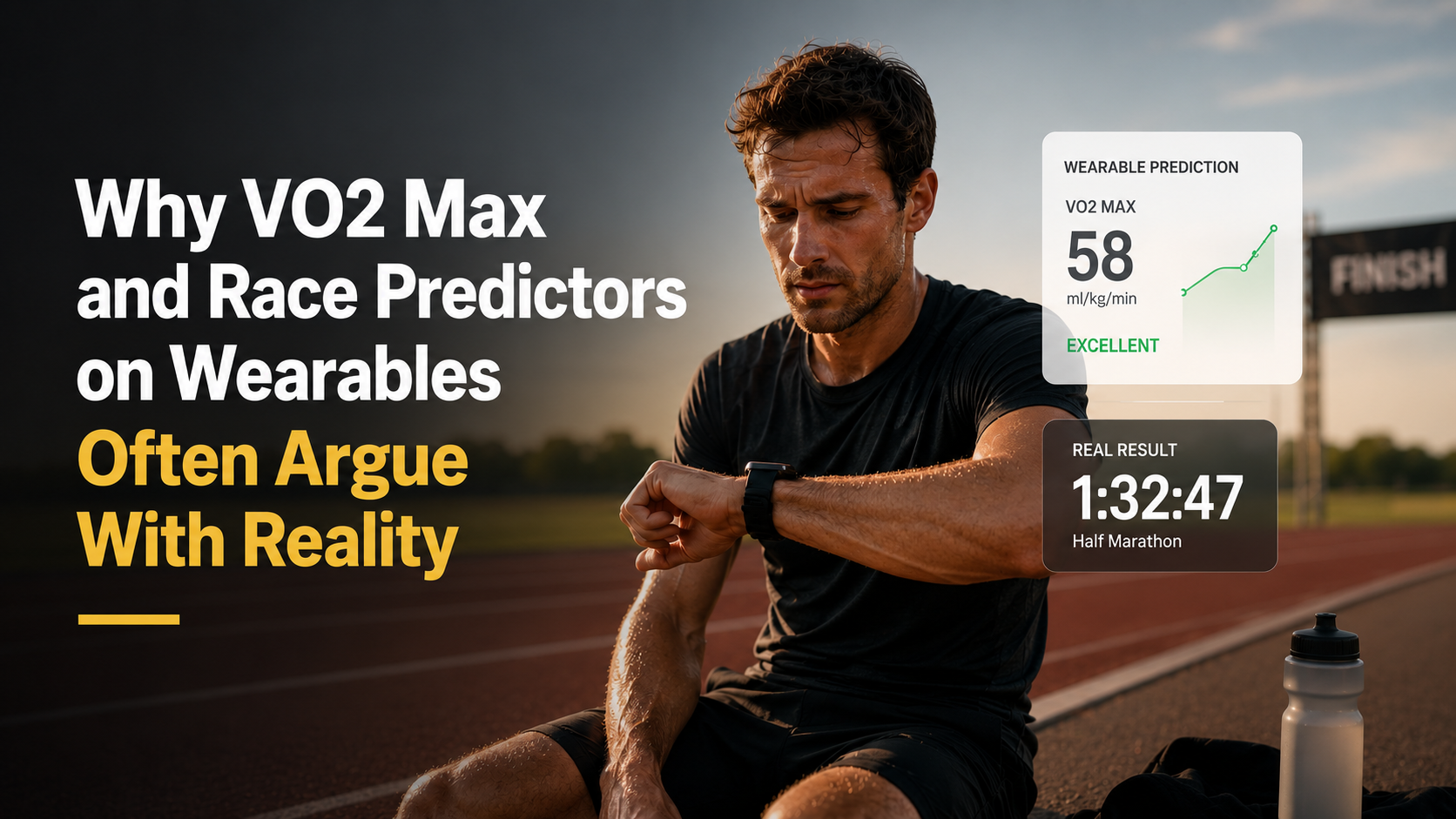
Why VO2 Max and Race Predictors on Wearables Often Argue With Reality
Your watch never measured your VO2 max, it guessed it from heart rate. Here's why that number drops in summer, why the race predictor lies, and how to read both.

Why heart rate alone doesn't explain strength training
What Does an HRV Spike or HRV Drop Actually Mean?
An HRV spike isn't always good and a drop isn't always bad. Here's why your HRV changed overnight, and when low HRV is stress, sickness, alcohol, or just noise.