Sleep Debt Is Real: How Long It Actually Takes to Recover Lost Sleep
By Mr. Apps · Jul 28, 2026
Category:Sleep
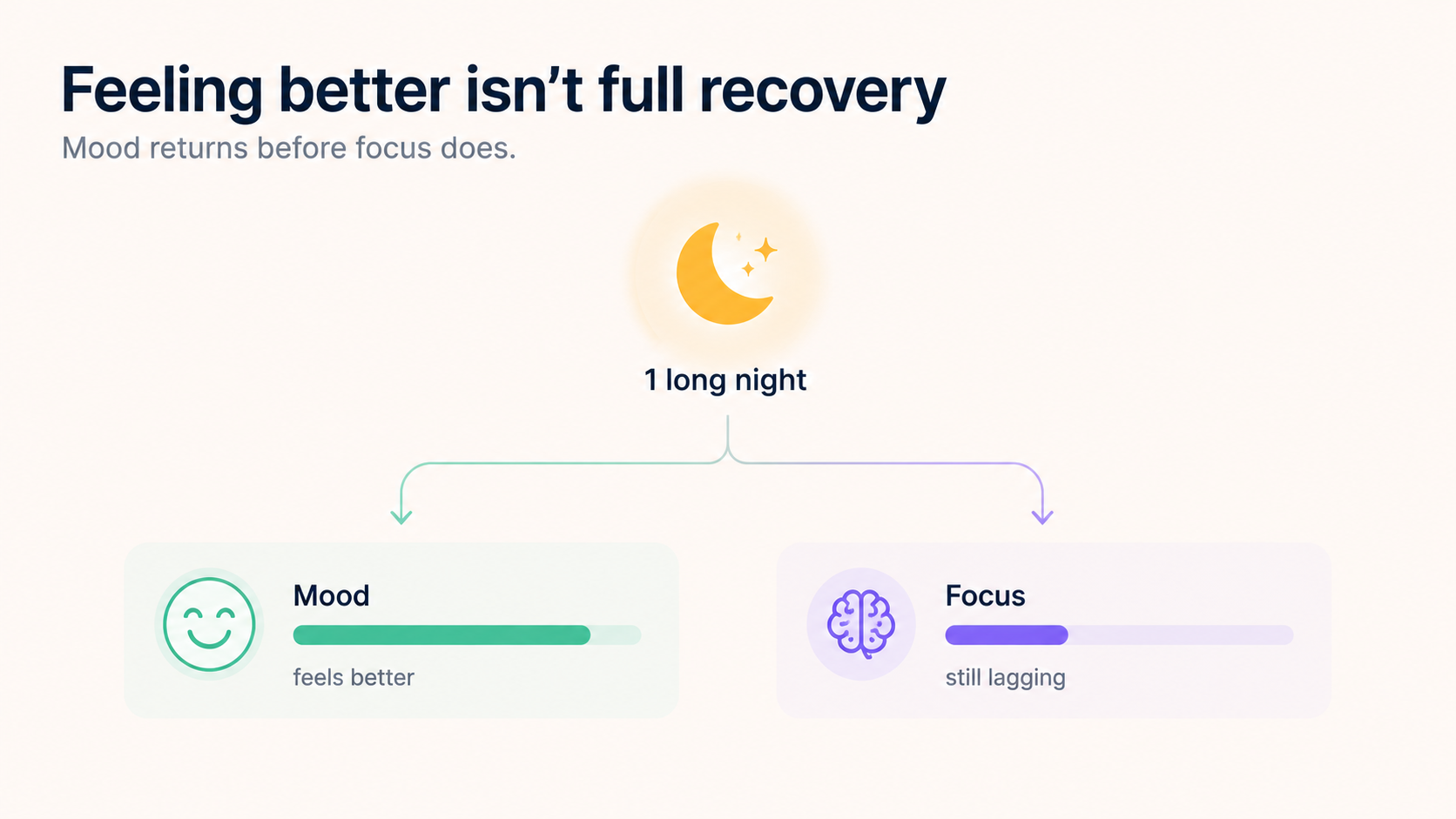
Two winters ago I closed out a six-night stretch of five-hour nights, slept ten hours on the Saturday, and woke up certain I had fixed it. I felt fine. I told people I felt fine. Then on Tuesday I read the same paragraph of a document four times and still couldn't have told you what it said.
That gap between feeling recovered and being recovered is what sleep debt does to you. One generous night resets your mood and your self-assessment long before it resets anything measurable. And because your judgment is the thing being impaired, you are the last person qualified to notice.
What sleep debt actually is
Sleep debt is the running difference between the sleep your body needed and the sleep you gave it, carried forward night after night. Lose 90 minutes a night from Monday to Friday and you arrive at the weekend about seven and a half hours short. The arithmetic is easy. The repayment is not.
The useful split is acute versus chronic. Acute debt is one rough night: a delayed flight, a sick kid, a deadline you misjudged. A single solid night mostly clears it. Chronic debt is the quiet version, six hours a night for three weeks, and it behaves nothing like the acute kind.
In a two-week laboratory study at the University of Pennsylvania, adults held to six hours in bed kept declining on attention tests every single day while rating their own sleepiness as only slightly worse. By the end, their performance sat in the same range as people who had gone two nights without sleep at all. They didn't know, because the instrument you would use to detect the problem is the same one the problem degrades.
Sleep debt symptoms show up in a specific order
Mine arrive in the same sequence every time, and I suspect most people's do too.
Irritability comes first, usually a day before I'd admit it. Then appetite, which is the one that used to confuse me. During those weeks I'd find myself assembling a second dinner at eleven at night, not out of hunger exactly, more out of a vague sense that something was owed to me.
Concentration goes next, and it goes in a specific way. Hard problems don't become impossible; easy ones stop being automatic. I keep a chess puzzle habit as a way to wake my head up in the morning, and over those weeks my rating fell about eighty points. Almost none of the failures were deep positional mistakes. They were one-move oversights, the kind I'd catch half asleep on a normal week. Which, I suppose, was the point.
The physical layer goes last and comes back last. Resting heart rate creeps up and an ordinary training session takes an extra day to shake off. I was learning a Bach prelude at the time, and a passage I'd drilled for weeks came apart under my fingers. Motor learning consolidates during sleep, so a short-sleep week quietly deletes some of the practice you already paid for.
Why one big weekend doesn't settle the account
Here is where my ten-hour Saturday theory falls over.
Researchers at the University of Colorado ran a study built around exactly this pattern: five nights of short sleep, a weekend to sleep as much as people wanted, then back to short nights. The catch-up weekend produced about an hour of extra sleep in total, no lasting metabolic benefit, and a worse insulin sensitivity picture once the short nights resumed than in the group that never caught up at all. Late-night eating dropped during the weekend and returned the moment the schedule did.
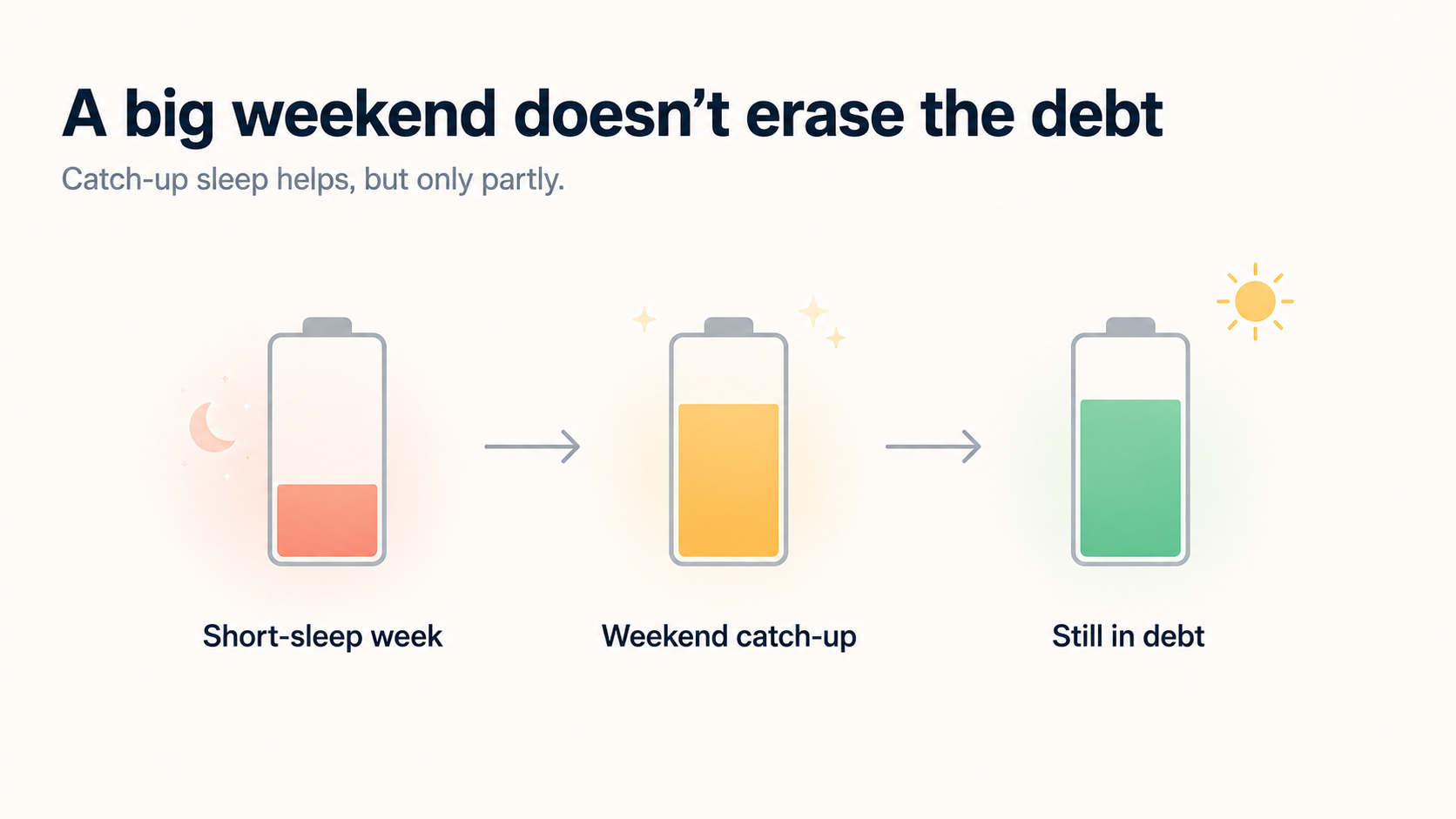
Two things break down. Capacity first: you can't sleep sixteen hours to repay eight, because the body takes back a fraction per night and refuses the rest. Then timing. Sleeping until noon on Sunday pushes your body clock later, which is why the Sunday-night ceiling stare is so reliable. I once "recovered" so thoroughly on a Sunday that I didn't fall asleep until two, and Monday was worse than any day of the week that caused the problem.
Can you repay sleep debt, and how long does it take?
You can, mostly, and it takes longer than a weekend.
The cleanest timeline I know of comes from a Polish study that put healthy adults through ten days of restricted sleep, then gave them seven days of unrestricted recovery in their normal lives. After a full week of recovery, only one measure, simple reaction speed, had returned to baseline. Everything else, including EEG measures and the structure of their daily activity, was still drifting back.
The cardiovascular side is slower still. A Penn State team tracked heart rate and blood pressure across five nights of restricted sleep followed by two recovery nights. Heart rate climbed roughly one beat per minute per day and neither heart rate nor systolic blood pressure had come back to baseline by the end of recovery. Participants had every opportunity to rest. Their cardiovascular systems hadn't got the message yet.
So the working numbers I use: one bad night, one to two nights. A short week, three to four days. A month of chronic short sleep, count in weeks and stop expecting a clean finish line.
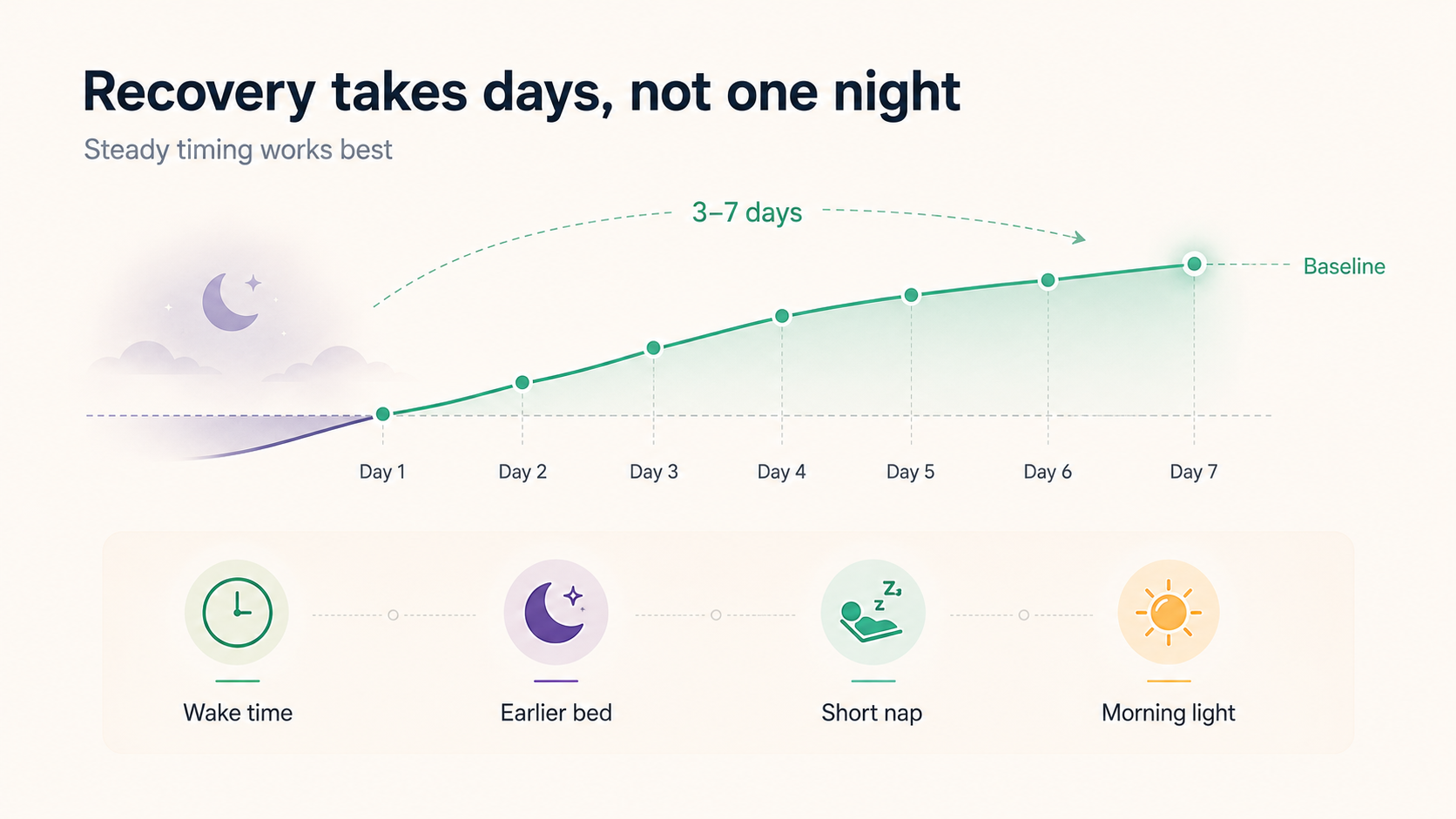
A three to seven day recovery plan
This is the version I actually run after a heavy stretch, in the order I run it.
Hold your wake time still and move your bedtime earlier
This is the whole plan in one sentence, and everything else is support. Wake time anchors the body clock. Bedtime is the flexible end. Go to bed 30 to 60 minutes earlier and add a little more each night. If your body wants the sleep, you'll fall asleep. If it doesn't, you've lost nothing.
Allow one lie-in of about an hour, not four
Sleeping in more than about an hour past your usual wake time buys a delayed clock in exchange for a little extra sleep. Bad trade during a recovery week.
Nap early, and keep it short
A study comparing 5, 10, 20 and 30 minute naps after a restricted night found the 10-minute nap delivered the best alertness gains with essentially no grogginess afterward. I aim for 20 minutes before three in the afternoon, somewhere I won't be tempted to extend it. A 90-minute nap at five feels better and costs you that night.
Get outside within an hour of waking
Morning light is the strongest signal your body clock takes. It pulls your rhythm earlier, so you get sleepy earlier that evening, which is exactly the direction you want during recovery. Fifteen minutes outdoors beats an hour by a window. Overcast still counts.
Move your last coffee earlier than feels necessary
In one of my favourite unfair studies, 400 mg of caffeine taken six hours before bed cut objectively measured sleep by more than an hour, and the participants didn't notice. Six hours. During a recovery week I stop by early afternoon, which I resent every time and which works every time.
Keep training, but drop the ambition
Easy aerobic work helps sleep pressure build normally. A session where you chase numbers on four hours of sleep mostly buys you a longer recovery and a higher injury risk. Walk, swim, cycle easy, lift light. Save the hard block for the following week.
What your wearable can and can't tell you here
Trend data helps here, as long as you read it as a trend and not a verdict.
After a bad stretch I watch whether resting heart rate is falling back toward my normal band, whether sleep is still fragmented, and whether the picture moves in one direction across several days. That winter, my resting heart rate stayed elevated for four nights after the ten-hour sleep that supposedly fixed everything. My own rating on the Sunday was "fine". The trend disagreed, and the trend was right.
What a wearable can't do is certify that the debt is settled. No consumer device measures insulin sensitivity or attention lapses. A single green recovery score after one long night tells you the acute layer improved, not that the account is closed. Read it as a rear-view mirror while your wake time does the steering.
When it isn't sleep debt
If you've held a consistent schedule for two or three weeks with adequate time in bed and you still wake unrefreshed, stop trying to sleep your way out of it. Persistent unrefreshing sleep, loud snoring, breathing pauses someone else has noticed, or daytime sleepiness that doesn't track with your nights are all worth a conversation with a doctor rather than another recovery week. Sleep debt responds to sleep, and sleep disorders generally don't.
I still occasionally have weeks I'd rather not repeat. The difference now is that I stopped negotiating with them on Saturday morning and started planning for the following Wednesday.
FAQ
How long does it take to recover from sleep debt? It depends on the size and shape of the debt. One short night usually clears in a night or two. A week of short nights takes three to four days of consistent, slightly extended sleep. Chronic short sleep over months unwinds over weeks, and it's gradual rather than a moment where everything snaps back. In one study of ten days of restriction, most measures still hadn't returned to baseline after a full week of recovery sleep.
Does catch up sleep on the weekend actually work? Partly. It reduces sleepiness and improves how you feel, which is worth having. What it doesn't reliably do is restore metabolic and cardiovascular measures, and sleeping several hours past your usual wake time shifts your clock later, making Sunday night harder and Monday worse. An hour is a fair compromise; four usually costs more than it returns.
Can napping repay sleep debt? Naps repay a slice of it and buy you function in the meantime, but they don't replace consolidated night sleep. Kept to 10 to 25 minutes and taken before mid-afternoon, a nap improves alertness without much grogginess and without stealing sleep pressure from the night. Long or late naps push your bedtime later, which is the opposite of what a recovery week needs.
*This article is for informational purposes only and is not a substitute for professional medical advice, diagnosis or treatment.*
Sources:
Oxford Academic·National Institutes of Health·PLOS ONE·Psychosomatic Medicine·Centers for Disease Control and Prevention·Journal of Clinical Sleep Medicine
Related articles

Does Working From Home Improve or Hurt Your Sleep?

Exercise timing and sleep quality
Why Evening Screens Can Leave You Wired but Tired
We're told blue light is why screens ruin our sleep, so we dim the display and turn on the warm filter. But if you've ever put the phone down exhausted and then lay there wide awake, the light was never the real problem. Here's what is.
When "poor sleep" may be more than stress: red flags for sleep apnoea
Loud snoring gets dismissed as a quirk, morning headaches get blamed on stress, and daytime fog gets chalked up to a heavy calendar. Taken together, though, these signs can point to something a GP should know about: obstructive sleep apnoea. Here's what the real red flags look like, what home screening tools can and can't tell you, and when it's time to ask for a proper referral.
How to protect your sleep when your job keeps changing the clock
Shift work doesn't fail because people lack discipline. It fails because the body was never built to run a factory schedule. Here's what actually helps between rotating shifts, why "just going to bed earlier" doesn't work, and when persistent fatigue stops being normal and starts being something worth getting checked out.

When naps help your energy and when they quietly make sleep worse
The morning light habit that can improve sleep without changing your bedtime
Most sleep advice focuses on the evening, dim the lights, put the phone away, but that's only half the equation. A few minutes of daylight soon after waking helps set your body clock earlier, making it easier to fall asleep at a reasonable hour that night, no bedtime changes required. Here's why it works, what actually counts as "morning light" in a real schedule, and when the habit alone isn't enough.
Why a regular sleep schedule may matter more than an extra hour in bed
Evening Stress and Why Your Brain Won't Settle Down Before Sleep!
Falling asleep fast isn't the same as your brain settling down. What evening stress does to your sleep onset, and how to wind down when your mind won't.
Why Am I Still Tired After 8 Hours of Sleep?
You slept 8 hours and still feel wrecked? Here's why sleep quality beats duration, what a dropping sleep score really means, and how to wake up with energy.