Why Daytime Stress and Nighttime HRV Need Separate Time Labels
By Mr.Apps · Sep 30, 2026
Category:Stress

Time labels keep separate signals separate
A daytime stress estimate and a nighttime HRV result may appear in the same health app, but they do not necessarily describe the same period or the same physiological signal. The stress estimate may summarize daytime patterns from several inputs. Nighttime HRV describes variation in heartbeat timing during selected sleep samples. Comparing them can be useful, but only if the time windows remain visible.
Without those labels, a reader may assume that the values are simultaneous, measured continuously, or directly linked. A stress score shown in the morning might summarize several awake hours from the prior day, while a nightly HRV result may represent only part of the sleep period. The display should identify when each measure was collected, when the result was calculated, and which date it belongs to.
A feature description that compares daytime stress with nighttime recovery measures is one example of why the distinction matters: an app may combine them in a longer resilience view while still measuring them during different windows. A composite view can bring signals together, but it should not imply that they were collected at the same time.

What a daytime stress estimate can represent
A consumer stress feature may use signals such as heart rate, HRV, movement, or skin temperature during waking hours to estimate physiological activation and recovery. The algorithm's window and inputs vary by product. The result is not the same as asking a person how stressed they feel, and it cannot identify the specific source of a bodily response on its own.
Some help material distinguishes a daytime estimate from nightly contributors in a separate resilience or stress dashboard. A separate example of a product-defined day boundary describes how a wake-time setting can determine when the displayed app day changes. These rules vary by product; the date label alone does not reveal the measurement window.
A daytime estimate may be sampled intermittently rather than continuously. It can also be unavailable during movement or when there are not enough usable data points. The app should indicate gaps, the affected hours, and whether the value is provisional. A smooth line must not make a partial record look complete.
The word “stress” needs care. Heart-rate patterns can respond to physical activity, posture, heat, digestion, illness, emotional events, or other conditions. An algorithm can estimate physiological activation from selected signals, but it cannot infer a person's full psychological experience from a chart. It should not label an ordinary bodily response as a mental-health diagnosis.
What nighttime HRV can represent
HRV describes changes in the time between consecutive heartbeats. Nighttime measures are often collected during selected sleep periods because movement and posture may be more stable than during the day. Even so, the value depends on which beats were recorded, which parts of sleep were included, and which calculation was applied.
A review of day-versus-night HRV from 24-hour recordings treats these as different analysis windows and notes that short recordings and 24-hour recordings are not directly comparable. A separate study of mental stress and circadian timing observed that both stress and circadian timing can influence cardiovascular measures. Those studies support attention to time and method; they do not prove that one consumer stress estimate caused a later HRV result.
HRV can vary with time of day, sleep, activity, breathing, body position, and recording method. A review of factors that influence HRV measurement describes why measurement conditions complicate comparisons. If the app changes its sleep window or HRV method, the next value may not be directly comparable with the earlier one.
The app’s day boundary can shift the date
A product may define a day by a wake-time setting rather than by midnight. A sleep window that crosses the calendar boundary can then be assigned to the day when the person woke, or to a prior-day record. The displayed date is not always the same thing as the collection interval. A daytime stress estimate may also use a waking period that starts at a selected wake time and continues until the next main sleep window. The report timestamp can be different again because processing may happen after the measurement window closes. The screen should show collection time, report time, and time zone as separate details rather than collapse them into one date badge.

That matters when two metrics are placed side by side. A chart might show a daytime estimate under one date and the following night’s HRV under a different date, even if both belong to one wake-to-wake cycle. A clear interface should expose the start and end times, the date-assignment rule, and the local time zone. If it uses “today” without defining the boundary, users may compare different periods by accident.
A changed routine can make a fixed boundary harder to interpret. Shifted sleep, a late wake time, travel, or an incomplete night can move the data window without changing the metric name. An app should indicate when a sleep record was carried into a different date, and when the daytime calculation is incomplete. That prevents a calendar label from implying that every measure covers the same 24 hours.
A timeline can show context without claiming cause
Suppose an app reports elevated physiological stress late in the day and a lower-than-usual HRV during the following sleep period. The sequence may be worth noticing, but it does not establish that the daytime score caused the nighttime value. Both measures can respond to overlapping conditions, and the device may collect different data for each.
The time labels should show whether the stress estimate covers the afternoon, the full waking day, or a rolling interval. The sleep card should show the start and end of the main sleep window and the subset used for HRV. If the morning report is delayed, it should distinguish the date of collection from the date it was delivered.
A single timeline can preserve those differences. Put the daytime measure on an awake-hours track and the HRV result on a sleep-period track. Mark gaps, identify when the values were calculated, and use a connector only to show time order, not causation. If the app creates a composite resilience score, label the combined time span and list the separate contributors.
The design should also explain whether the daytime value is a raw measurement, a physiological estimate, or a categorical score. The same applies to HRV: show the formula or method and whether the result is a nightly average, selected-stage estimate, or longer personal trend. A similar chart shape does not make two metrics equivalent.
How to compare the two responsibly
First, check the period attached to each number. Confirm that the stress value refers to the waking period you intend to review and that the HRV result belongs to the sleep window that followed. Do not compare a cumulative weekly stress measure with one night's HRV as though both represented the same span.
Second, look at the method and completeness. Was HRV collected consistently during comparable sleep windows? Did the stress estimate omit hours with movement or missing sensor data? Did a software or settings change alter either measure? If the product cannot answer these questions, treat a trend as a rough prompt rather than a precise account.
Third, separate bodily signals from reported feelings. A device may estimate a physiological response, while a journal or check-in records whether the person felt calm, pressured, or tired. Both perspectives can help organize observations, but they are different records. Neither one should be overwritten by the other.
Repeated patterns can be worth discussing with a clinician, particularly when they appear with symptoms or a health concern. Wearable scores are not a substitute for clinical assessment. The general-wellness guidance for consumer health features is relevant because a wellness estimate should not be treated as clinical monitoring or a diagnosis.
For readers who want to understand a single daytime line on its own, a guide to reading a stress score across several hours discusses the importance of its time window and shape.

Put the window beside each metric
Daytime stress and nighttime HRV can complement each other as separate observations. Their value depends on clear time labels, consistent methods, and an honest explanation of missing data. When the app combines them, it should show that the result spans different periods and inputs.
I would compare them as a sequence, not as interchangeable readings. Check when each was collected, what it includes, and whether the trend repeats under similar conditions. A timeline can reveal a pattern worth asking about, but it cannot establish the cause by itself.
FAQ
Are daytime stress and nighttime HRV measured at the same time?
Usually not. A daytime stress estimate concerns waking-hour data, while nighttime HRV is collected during a sleep window. The exact methods vary by product.
Can daytime stress cause a lower HRV that night?
A time sequence alone cannot show cause. Both measures can be affected by overlapping conditions, and they may use different inputs and calculation windows.
What should I check before comparing the two values?
Check their collection times, time windows, calculation methods, data gaps, and whether the values represent estimates or direct measurements.
*This article is for informational purposes only and is not a substitute for professional medical advice, diagnosis or treatment.*
Sources:
Oura·Bevel Help Center·National Library of Medicine·National Library of Medicine·National Library of Medicine·U.S. Food and Drug Administration
Related articles

Why a Restorative-Time Metric Needs Clear Start and End Rules
A restorative-time total depends on how a device defines the beginning, end, and eligibility of each interval. Learn which rules and coverage details make the estimate easier to interpret without treating missing data as proof that recovery did not occur.

Why Stress and Energy Scores Should Not Share the Same Alert Threshold
A stress estimate and an energy score can use overlapping signals while describing different things. Their alerts should reflect each score’s definition, time window and intended decision instead of applying one cutoff to both.

Why Mental Stress and Physiological Stress Need Separate Labels
A wearable can estimate changes in bodily signals without knowing what a person is thinking or feeling. Separating mental stress from physiological activation makes a health score easier to interpret and less likely to overstate what sensors can tell you.

Why Recovery From Stress Needs More Than One Calm Hour
One calm hour can be useful without erasing a full day of physiological demand. This guide explains how to read short recovery windows beside sleep, repeated peaks, symptoms, and longer trends.

What Resilience Means in a Health Tracker
A resilience score is usually an estimate of how stress exposure and recovery patterns change over time. This guide explains what the trend can show, what it cannot prove, and why resilience is not the same as mood or diagnosis.

How to Read a Stress Score Across Several Hours
A stress score is easier to understand as a time pattern than as one daily high point. This guide shows how to read duration, repeated peaks, movement, and recovery windows without treating a wearable estimate as a diagnosis.

Can Paced Breathing Work Without Watching a Screen?
Paced breathing does not require constant visual attention. This guide compares audio and haptic pacing, explains what a wearable may observe, and sets realistic expectations for relaxation and HRV without promising a guaranteed result.

Why a Health App May Tell You to Rest and Move at the Same Time
A health app can recommend rest and movement in the same day without either message being technically wrong. This guide shows how to check update time, purpose, symptoms, and the demands of the day before choosing a response.

Can a Wearable Measure Cortisol? What Your Stress Score Is Actually Estimating
Most consumer wearables estimate physiological stress from signals such as heart rate, HRV, temperature, and movement rather than measuring cortisol itself. I explain how to read those scores without mistaking an algorithmic clue for a hormone test.
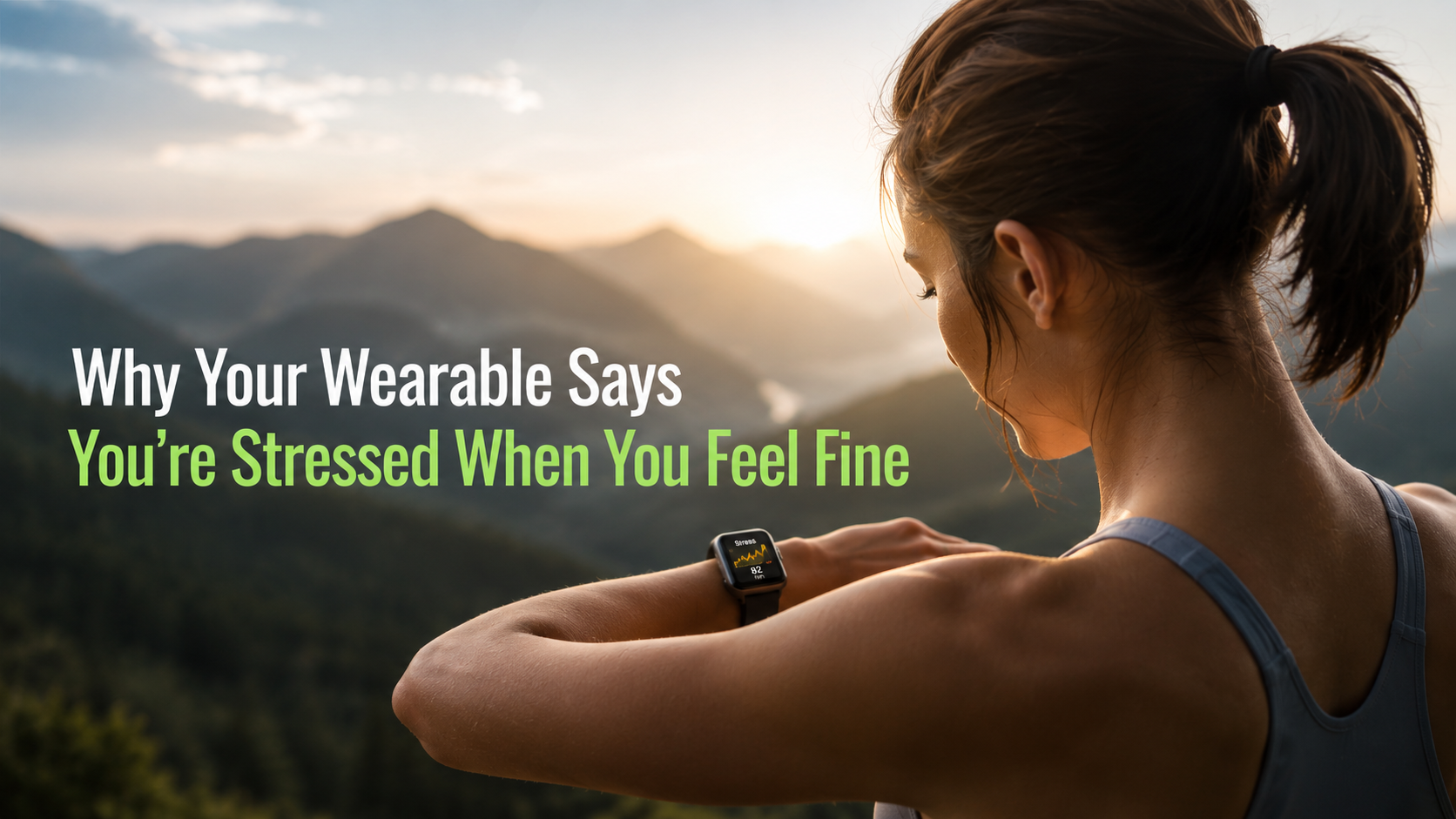
Why your wearable says you're stressed when you feel fine
Your watch measures physiological arousal, not worry. Caffeine, digestion, heat, short sleep, and a loose band can all push the score up while you feel fine.