Why Stress and Energy Scores Should Not Share the Same Alert Threshold
By Mr.Apps · Sep 25, 2026
Category:Stress

One cutoff cannot describe two different scores
I treat an alert threshold as part of a score’s meaning. When a value crosses a boundary, the interface signals that something deserves attention or a decision. If two scores summarize different constructs, use different time windows, or prompt different actions, applying the same cutoff can make the alerts confusing.
A stress score may estimate a pattern of physiological activation over a short interval. An energy score may represent a modeled reserve, a forecast, or a changing daily trajectory. They can share inputs such as heart rate, sleep, movement, or heart rate variability. That overlap does not make their outputs interchangeable.
An alert should therefore identify what changed and why the chosen boundary matters. “Stress is high” leaves too much unanswered. Does the value refer to bodily activation, a self-report, or a combined estimate? Is it a brief change or a sustained pattern? What action, if any, does the product intend the alert to support?
Research reviews describe how stress estimates depend on the signals and validation methods used. A scoping review of HRV and psychological stress identifies differences in stress definitions, measurement protocols and HRV methods. A threshold cannot be interpreted apart from those choices.

Name the construct before setting the boundary
A threshold begins with a definition. The word “stress” may refer to emotional strain, a bodily response, accumulated demand, or an algorithmic category built from several signals. “Energy” may mean a score, a forecast, or a metaphor for modeled capacity. An interface should state which meaning applies before it tells a person that the number is high or low.
The source of each value matters. A sensor estimate reflects inputs the device observed and the model processed. A self-report captures a person’s answer to a specific question. A combined score may contain both. If these are blended under one label, readers cannot tell whether the alert describes their report, their body signals, or the model’s interpretation.
A multidimensional overview of stress measurement explains why physiological indicators and subjective experience are distinct forms of evidence. Neither automatically replaces the other. An app can show them beside one another, but should not silently use one as a proxy for the other.
This distinction helps determine what an alert can responsibly say. If the system only observes a change in pulse or HRV, wording such as “physiological activation is above your usual range” is more precise than “you are stressed.” If the value comes from a person’s check-in, name it as a self-reported response.
Keep each score’s time window visible
A threshold applied to a short interval answers a different question from one applied to a whole day. Short windows can highlight a transient change. Longer windows can show persistence, but they also blend more events and may obscure when a change began. A daily total can be affected by the amount of data available across the day.
The window should appear with the alert or be one tap away. The product should also show whether the score updates continuously, at regular intervals, or after a nightly calculation. Without that context, two identical-looking numbers may summarize different periods.
A real-world study comparing wearable HRV with perceived daily stress found only a small association in naturalistic conditions. The result cautions against assuming that a physiological score and a person’s reported experience rise and fall in lockstep.
If an energy score is designed as a current estimate, compare it with other current values at a similar time. If it summarizes the completed day, compare completed days. A stress alert should use the observation window that matches its definition. A threshold copied across different windows can generate alerts that seem inconsistent even when each calculation is following its own rules.
Shared inputs still answer different questions
Two scores may include the same input but weight it differently or combine it with other information. A change in heart rate, for example, can contribute to a physiological activation estimate and also influence a broader energy model. The same sensor reading does not prove that both outputs represent the same state.
The system should document, at a useful level, which signals contribute to each score and how missing or low-quality inputs affect the result. It need not expose proprietary code. It should make clear whether a value is measured, derived, or predicted, and whether the score is complete enough to support an alert.
A review of optical wearable sensing for stress detection notes that the research base includes diverse study designs and limitations in real-world validation. A review of wearable stress models also discusses challenges in applying models beyond the data on which they were developed. Those reviews do not establish how any particular product calculates a score. They support a narrower design point: definitions, inputs and validation conditions should be visible before an alert is treated as meaningful.

Tie the alert to a clear decision
An alert needs a purpose. A notification may invite a person to inspect a trend, check data quality, pause and review context, or seek another form of guidance. Those actions have different consequences. A threshold should reflect the decision the system expects a reader to make, not merely the fact that a number can be colored red.
For a low-stakes wellness prompt, a quiet note may be enough. A message that suggests medical urgency requires evidence and authorization appropriate to that use. The current general-wellness guidance distinguishes wellness functions from functions intended for clinical purposes. Product wording and behavior should match the role of the feature.
A score should not trigger the same prompt simply because it passes a numerical boundary. “Check whether the estimate reflects a complete interval” is different from “change your planned activity.” The second may depend on symptoms, obligations, goals, and professional advice that the score does not contain.
I also avoid alerts that imply a person must act immediately when the measure is only a wellness estimate. A useful notification explains the source and period, states what the system detected, and lets the reader choose whether to review it. It should not make the reader guess whether an alarm is informational, predictive, or clinical.
Personalization must be understandable
A personalized threshold may account for a person’s baseline or typical range. That can make the value more relevant than a single cutoff applied to everyone. But “personalized” does not explain how the boundary was set, how much data were used, or how it changes over time.
A clear interface can show the reference period, the person’s usual range, and whether the current value is outside it. If the baseline is still being established, the app should state that. If the user changes devices, measurement methods, or wearing habits, the system should indicate whether that affects the comparison.
The threshold should not move so often that the reader cannot tell what changed. A model that adapts can explain the inputs and the update window in plain language. When a value crosses a personal boundary, the notification should say whether this is a brief deviation, a repeated pattern, or a missing-data condition.
A single alert should not become a diagnosis or an explanation of cause. A stress score might change alongside movement, sleep, heat, illness, or other factors. An energy value may reflect a model’s response to several signals. The label should not claim which factor caused the change unless the evidence supports it.
Show uncertainty and missing data
A threshold assumes that the score is sufficiently reliable for comparison. If a sensor has poor contact, an interval is incomplete, or a model has too little baseline history, a colored alert may communicate more certainty than the inputs support.
The interface should distinguish “outside the usual range” from “not enough information to compare.” Those states are not the same. It should show whether the data are missing, estimated, or delayed, and avoid carrying a stale number forward as if it were current.
For scores built from multiple inputs, a compact contribution view can show which components were available. A person can then see why the comparison is limited. If the score is unavailable, a short explanation is more useful than an alert that appears to indicate a reassuring or concerning value.
An existing article on how recovery, energy and readiness scores differ compares the questions different score types are meant to answer. A separate threshold for each score follows from those distinctions: the alert should match the construct, data window and intended action.
Review alerts as separate product decisions
Stress and energy scores should not share a threshold just because both appear in the same app or use overlapping sensor data. For each alert, define what the score represents, how long the observation window lasts, what information is missing, and what action the message supports.
Then test the wording with readers. Can they identify what changed? Can they tell whether the value reflects a measured signal, a model, or a self-report? Do they understand whether the alert is a prompt to review, a forecast, or a clinical notice? If not, the threshold and label need more explanation.

The goal is not to send more notifications. It is to make each alert specific enough to be useful and limited enough to remain trustworthy. A well-defined threshold makes the score’s intended role easier to understand.
FAQ
Should stress and energy scores use the same alert threshold?
Usually not when they represent different constructs, use different time windows, or lead to different decisions. A threshold should match the score’s definition and the purpose of its alert.
Can a wearable stress alert tell me what caused the change?
A sensor estimate alone generally cannot establish a cause. Review the available signals, interval and context, and treat the score as one source of information rather than a complete explanation.
What should an app show when a score lacks enough data?
It should state that the comparison is unavailable or uncertain, identify missing inputs where possible, and avoid presenting a stale or incomplete value as a confident alert.
*This article is for informational purposes only and is not a substitute for professional medical advice, diagnosis or treatment.*
Sources:
Karger Publishers·National Academies Press·JMIR Publications·MDPI·Elsevier·Food and Drug Administration
Related articles

Why Mental Stress and Physiological Stress Need Separate Labels
A wearable can estimate changes in bodily signals without knowing what a person is thinking or feeling. Separating mental stress from physiological activation makes a health score easier to interpret and less likely to overstate what sensors can tell you.

Why Recovery From Stress Needs More Than One Calm Hour
One calm hour can be useful without erasing a full day of physiological demand. This guide explains how to read short recovery windows beside sleep, repeated peaks, symptoms, and longer trends.

What Resilience Means in a Health Tracker
A resilience score is usually an estimate of how stress exposure and recovery patterns change over time. This guide explains what the trend can show, what it cannot prove, and why resilience is not the same as mood or diagnosis.

How to Read a Stress Score Across Several Hours
A stress score is easier to understand as a time pattern than as one daily high point. This guide shows how to read duration, repeated peaks, movement, and recovery windows without treating a wearable estimate as a diagnosis.

Can Paced Breathing Work Without Watching a Screen?
Paced breathing does not require constant visual attention. This guide compares audio and haptic pacing, explains what a wearable may observe, and sets realistic expectations for relaxation and HRV without promising a guaranteed result.

Why a Health App May Tell You to Rest and Move at the Same Time
A health app can recommend rest and movement in the same day without either message being technically wrong. This guide shows how to check update time, purpose, symptoms, and the demands of the day before choosing a response.

Can a Wearable Measure Cortisol? What Your Stress Score Is Actually Estimating
Most consumer wearables estimate physiological stress from signals such as heart rate, HRV, temperature, and movement rather than measuring cortisol itself. I explain how to read those scores without mistaking an algorithmic clue for a hormone test.
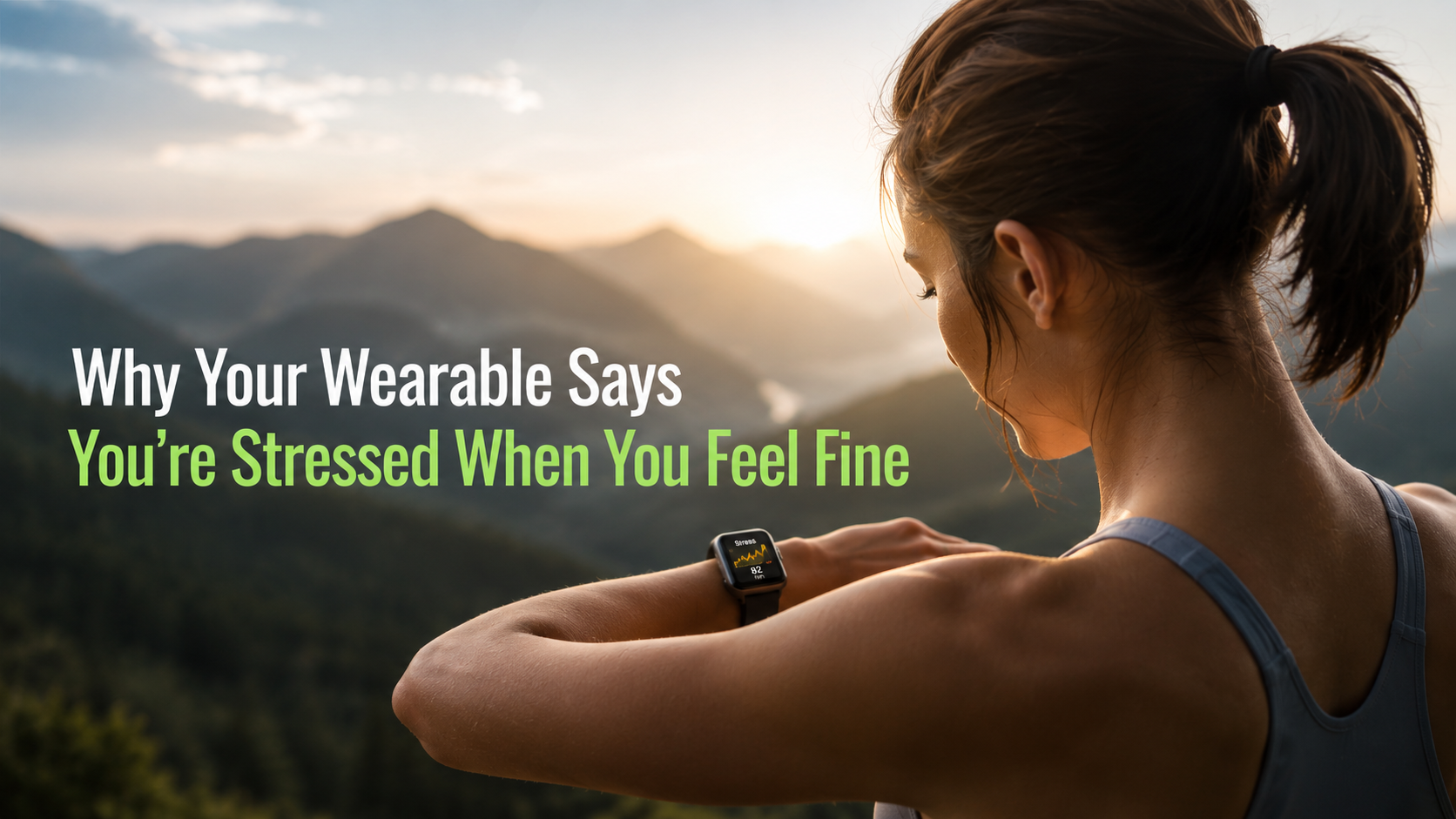
Why your wearable says you're stressed when you feel fine
Your watch measures physiological arousal, not worry. Caffeine, digestion, heat, short sleep, and a loose band can all push the score up while you feel fine.