A post-vaccine HRV change is not a personal immunity test
By Mr.Apps · Oct 26, 2026
Category:Energy
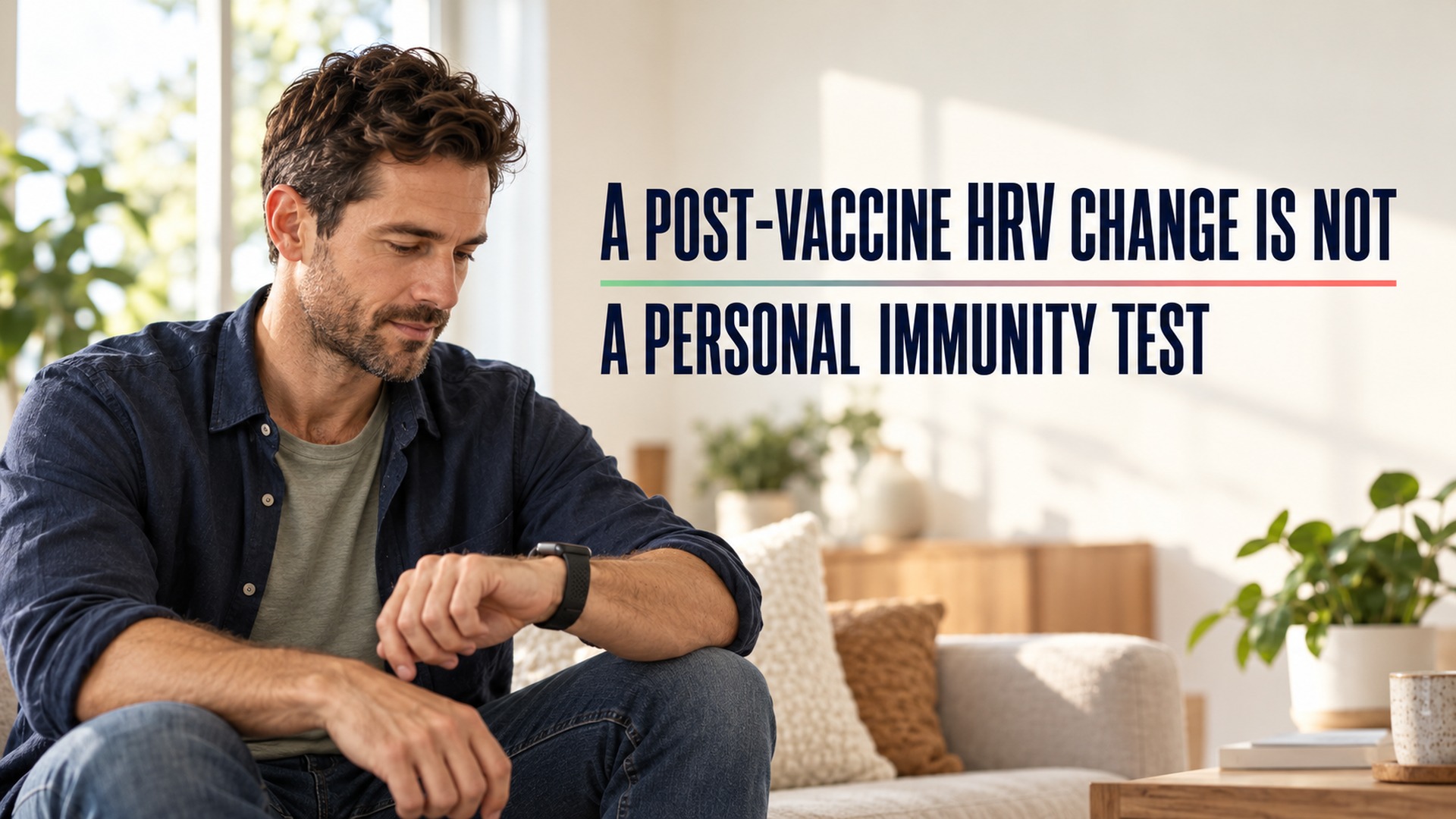
A wearable may show a change in heart rate variability (HRV) after vaccination. That change can be a physiological signal that coincides with the body's response, but it is not a personal immunity test. HRV describes variation in the time between heartbeats. It does not measure antibodies, immune memory, or how well a vaccine protects an individual. A temporary change is worth recording as context, not treating as proof of protection or failure.
Research has examined wearable signals around vaccination and found associations between some physiological changes and antibody measures in defined study groups. That does not make a consumer HRV reading a validated predictor for one person. The studies use particular vaccines, populations, devices, time windows, and outcome measures. A group-level statistical relationship cannot be turned into a personal threshold without separate validation. I keep the finding, the symptom record, and any question about protection in separate categories.
What HRV describes
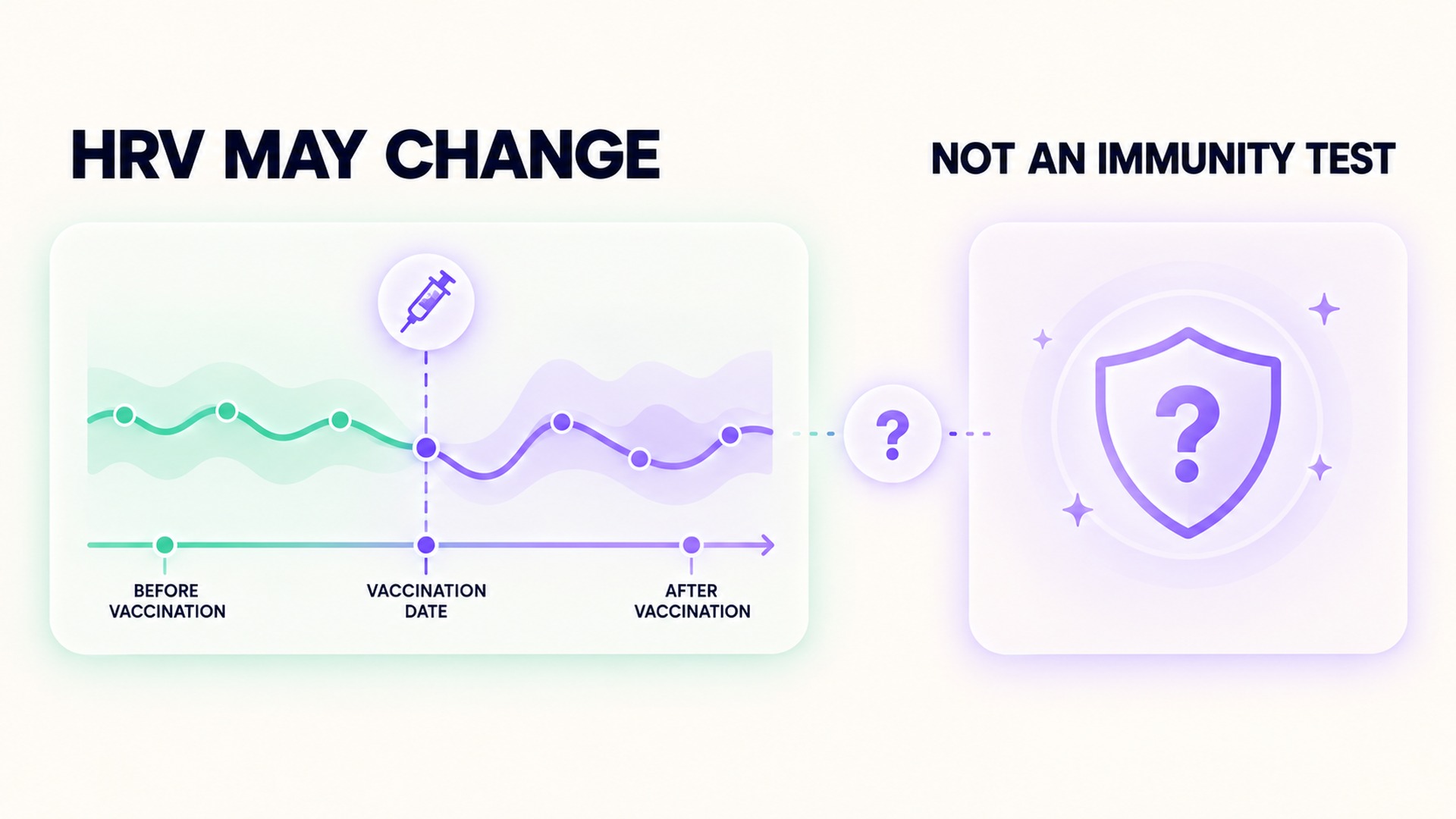
HRV is the variation in the time interval between consecutive heartbeats. The measure can be influenced by autonomic regulation and by many circumstances, including sleep, illness, physical activity, stress, medications, and measurement conditions. The heart rate variability guidance explains HRV as a beat-to-beat interval measure and discusses how it is used in monitoring physiological stress and adaptation. It is a signal about timing between beats, not a direct measure of immune protection.
A wearable's HRV value is also an estimate produced from a particular sensor and algorithm. Devices may collect data during different periods of sleep or rest and may summarize it differently. A change can reflect a true physiological shift, a difference in when or how the measurement was taken, or both. Comparing the value with an individual's prior baseline can help describe a change, but it does not identify what caused it.
A wearable's baseline is also a device-specific reference, not a laboratory reference interval. The algorithm may compare a recent value with a personal history, but that comparison depends on how much data were collected and which nights were included. If the device was not worn consistently before vaccination, the baseline may be less stable. The same applies when sleep timing, activity, or sensor contact changes around the event. Those details can affect how confidently a shift is described.
A vaccination date provides useful timing context. If a wearable trend shifts in the days after a dose, note the date, the measurement window, any symptoms, sleep changes, activity, and other relevant events. That record can help explain the timeline. It still cannot determine whether the immune response is adequate. The study of wearable metrics and antibody response after vaccination found associations in a defined vaccine cohort, but its findings do not validate a device reading as an individual immunity test.
Association is not an individual prediction
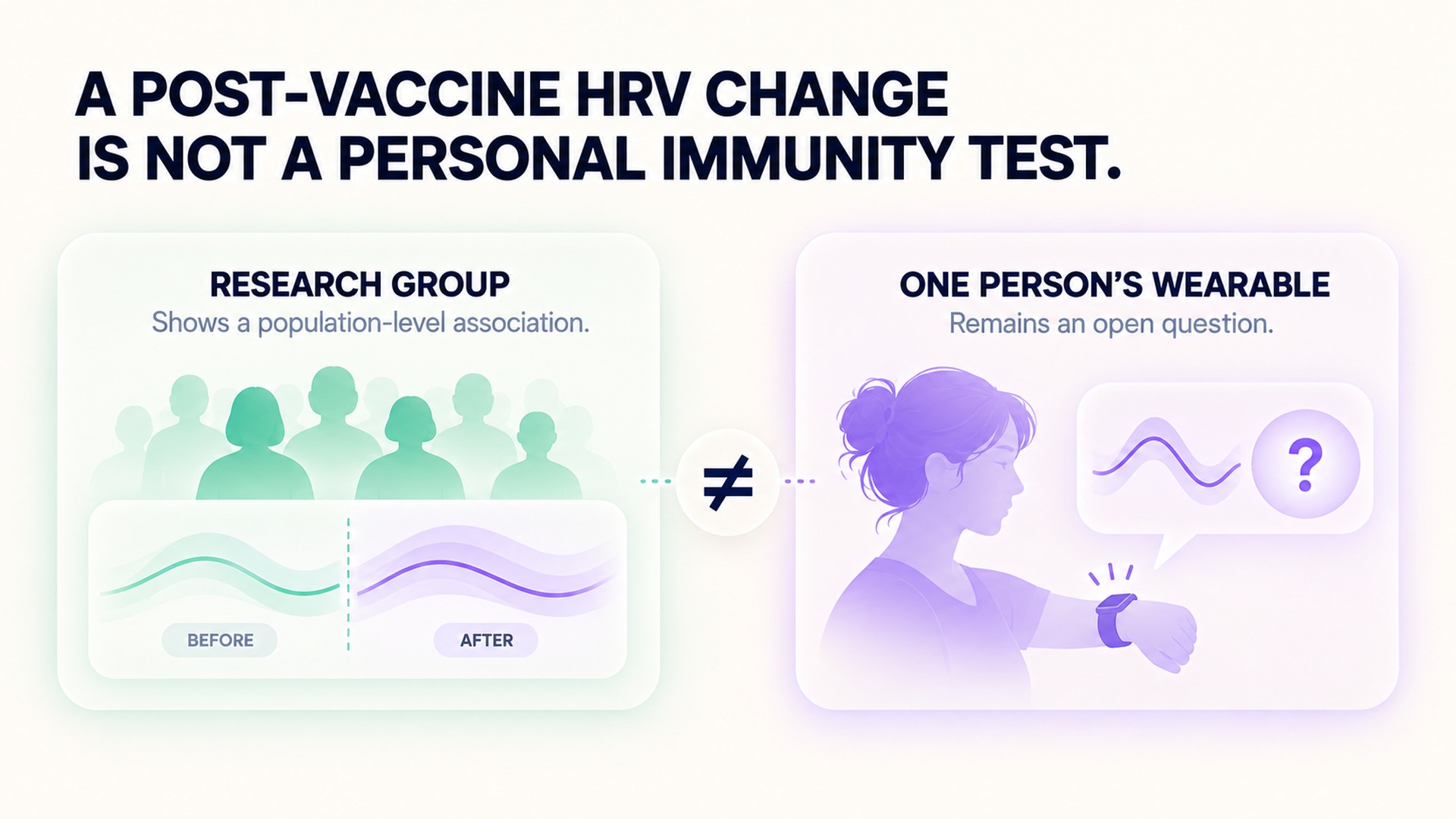
A research study can detect an average pattern across participants even when the measure is not accurate enough to classify any one participant. A group association means that two measured features varied together in that dataset. It does not show that the wearable signal caused an antibody response, nor that the same relationship applies across vaccines, ages, health conditions, devices, or testing schedules.
The study population and outcome matter. The same study examined device summaries and antibody measurements in a specific vaccination setting. It was not designed to provide a consumer-facing cutoff for immunity. A statistically significant group difference can still overlap widely between individuals. Without a validated threshold and evidence that acting on it improves decisions, a wearable score cannot be used to say whether a particular person is protected.
A study can also use antibody levels as a measurable outcome without proving that a particular level prevents illness in every participant. Antibodies are one part of immune response, and protection can depend on other immune processes and on characteristics of the vaccine and the person. A wearable metric that correlates with an antibody measurement inherits those limits. It does not become a direct immunity measure simply because the study included a blood test.
Another wearable study of temporary physiological changes after vaccination described changes in heart rate, respiratory measures, and sleep in a large device dataset. That work helps describe short-term physiology after vaccination. It did not establish that HRV could diagnose an immune response or forecast clinical protection.
The study's timing also matters. A short-term measurement around a dose is different from testing whether someone remains protected months later. The outcome, comparison group, and follow-up window determine what a finding can support. A trend that returns toward a personal baseline describes a physiological change over time; it does not establish whether an immune response is adequate or how likely someone is to develop disease. The distinction is important: observing that a signal changes after an event is different from proving what the signal means for one person's health.
Symptoms and protection answer different questions
Common post-vaccination symptoms can occur as the body responds, and some people report few or no symptoms. The presence, absence, or intensity of a symptom does not by itself tell how much protection a person has. The vaccine side-effect information describes expected reactions and emphasizes that they vary. A symptom record can help describe how someone felt; it is not an immune test.
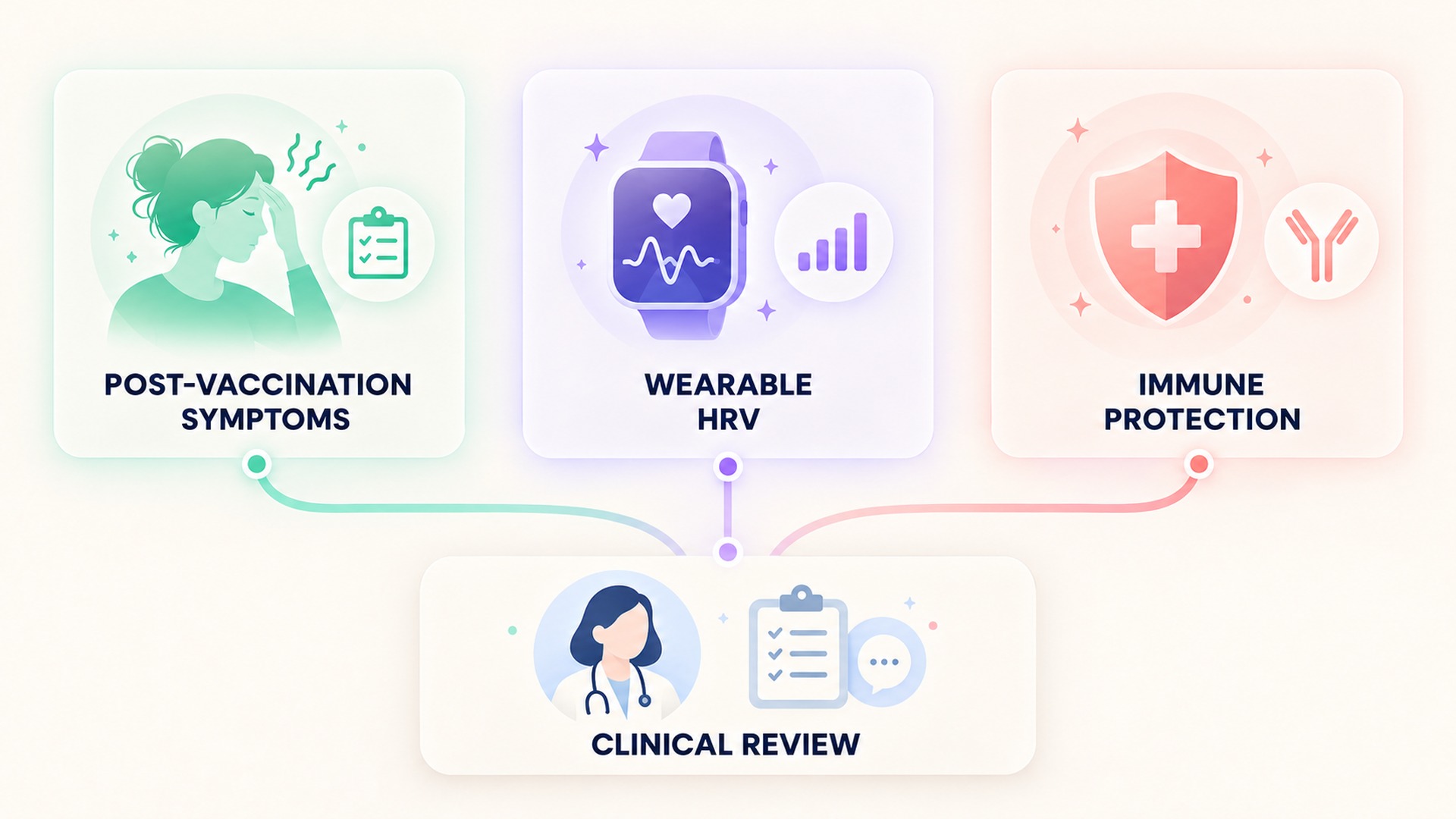
Wearable signals and symptoms may move together because both respond to physiological changes, but they remain different observations. A rise in resting heart rate, a lower HRV estimate, a sore arm, or fatigue does not say whether antibodies are present at a particular level or whether protection is sufficient. The vaccine safety overview provides general information about monitoring safety. It does not establish HRV as a measure of vaccine effectiveness.
For the specific infectious disease addressed in federal guidance, an antibody test is also not a general personal protection score. The antibody testing guidance explains that antibody test results in that context should not be used to determine whether vaccination worked or whether a person is protected. This reinforces a broader point: immune protection involves more than one marker, and a consumer HRV estimate measures something else entirely.
Keep a useful record without assigning a verdict
If tracking a response, record the vaccination date, when the HRV change appeared, the device's measurement period, and when the value returned toward baseline. Note symptoms in plain language, including when they started and how they changed. Avoid labels such as “strong response” or “weak immunity” unless those conclusions come from appropriate clinical evidence. A clear timeline is more useful than interpreting every fluctuation as a signal about protection.
Include the date of vaccination, the time window of the wearable measurement, and whether the device was worn as usual. If sleep, exercise, illness, or medicine use changed at the same time, record that briefly. Keep reported symptoms in a separate field from the HRV estimate. That distinction makes later review more accurate and clinically useful. This helps distinguish what the person felt from what the sensor calculated. If the question is whether a vaccine is appropriate or whether protection needs review, ask the clinician for guidance based on current recommendations rather than using a wearable trend as a substitute.
Keep other possible influences visible. Changes in sleep, travel, training, illness, alcohol, hydration, medication, or sensor fit can affect a wearable estimate. The point is not to explain away every change. It is to help a clinician understand what else was happening when a reading shifted. If symptoms are severe or concerning, follow appropriate medical advice rather than waiting for a score to normalize.
What a wearable can and cannot do
A wearable can help someone notice a pattern around a date and compare it with their own prior measurements. It can support a descriptive record of sleep, heart rate, or HRV. It cannot establish vaccine effectiveness, identify an individual's antibody level, or determine whether another dose is needed. Those questions require the appropriate clinical guidance and, where relevant, validated tests.
For a broader explanation of how health app measures should be interpreted, see this overview of health biomarkers. The practical conclusion is limited: HRV may change after vaccination, and research can study associations between wearable data and immune markers in groups. A personal HRV value does not reveal an individual's immunity.
Questions people ask
Does a lower HRV after vaccination mean the vaccine worked?
No. A change can be part of a temporary physiological response, but HRV does not measure antibodies or protection. Research associations in a group do not establish what one person's value means.
Can post-vaccination symptoms show how much protection someone has?
No. Symptoms vary, and some people experience few or none. Their presence or intensity does not independently determine immune protection. Discuss specific concerns with a health professional.
Should someone use an antibody test to check whether a vaccine worked?
That depends on the disease and the test. For the specific infection described in federal antibody-test guidance, those results should not be used to determine whether vaccination worked. Follow current clinical guidance for the relevant vaccine and health situation.
*This article is for informational purposes only and is not a substitute for professional medical advice, diagnosis or treatment.*
Sources:
Australian Institute of Sport·Vaccines·Journal of Applied Physiology·Centers for Disease Control and Prevention·Centers for Disease Control and Prevention·Food and Drug Administration
Related articles
Vitamin D blood levels should not become an automatic supplement dose
Learn what a vitamin D blood test measures and why the result does not automatically set a supplement dose. See how symptoms, medicines, testing reason, and health history shape interpretation.

Blood sodium concentration is different from sodium eaten
Learn why a sodium blood test measures a concentration while a food log estimates an amount eaten. See why a blood result cannot be converted into an instruction to add salt or change intake.
Recent lifting belongs in the context of a liver enzyme result
Learn why recent lifting belongs beside liver enzyme results and why it should not be assumed to explain an abnormal test. See how AST, ALT, CK, timing, symptoms, and the rest of the panel help shape clinical interpretation.
Keep the kidney function equation beside an eGFR trend
Learn why a change in the eGFR equation can shift a reported estimate without an equivalent biological change. See what to record beside each value so a trend can be interpreted with its method and clinical context.

Creatine kinase after exercise requires symptoms and timing
Learn why recent exercise, test timing, and symptoms all matter when a creatine kinase result is reviewed. See why CK is a clinical marker rather than a training target and when unusual symptoms need prompt attention.
Normal oxygen saturation does not establish a normal hemoglobin level
A pulse-oximeter percentage estimates how much available hemoglobin is carrying oxygen, while a blood count measures hemoglobin amount. Learn why one reassuring reading cannot replace the other test or a clinical review.
A raised CRP result cannot identify the source of inflammation
A raised CRP can signal inflammation, but it cannot identify where the process is or what caused it. Learn why standard CRP and high-sensitivity CRP serve different purposes and need clinical context.

When a vitamin B12 result needs a methylmalonic acid check
Learn why a clinician may consider methylmalonic acid when a vitamin B12 result leaves a question unresolved. See how kidney function, symptoms, medicines, and other tests shape interpretation.

Reading TSH and free T4 together in a fatigue review
Learn what TSH and free T4 contribute to a fatigue review and why the two results need clinical context. See how symptoms, medicines, timing, and prior results help keep a lab value in its proper role.

Why Metabolic Energy Efficiency and Daily Energy Are Different Concepts
Metabolic energy efficiency describes processes involved in handling fuel, while a daily energy score is usually a separate app estimate about patterns such as sleep, activity, and recovery. Similar wording does not mean the two measures track the same thing.