Urine albumin concentration needs its creatinine context
By Mr.Apps · Nov 2, 2026
Category:Energy

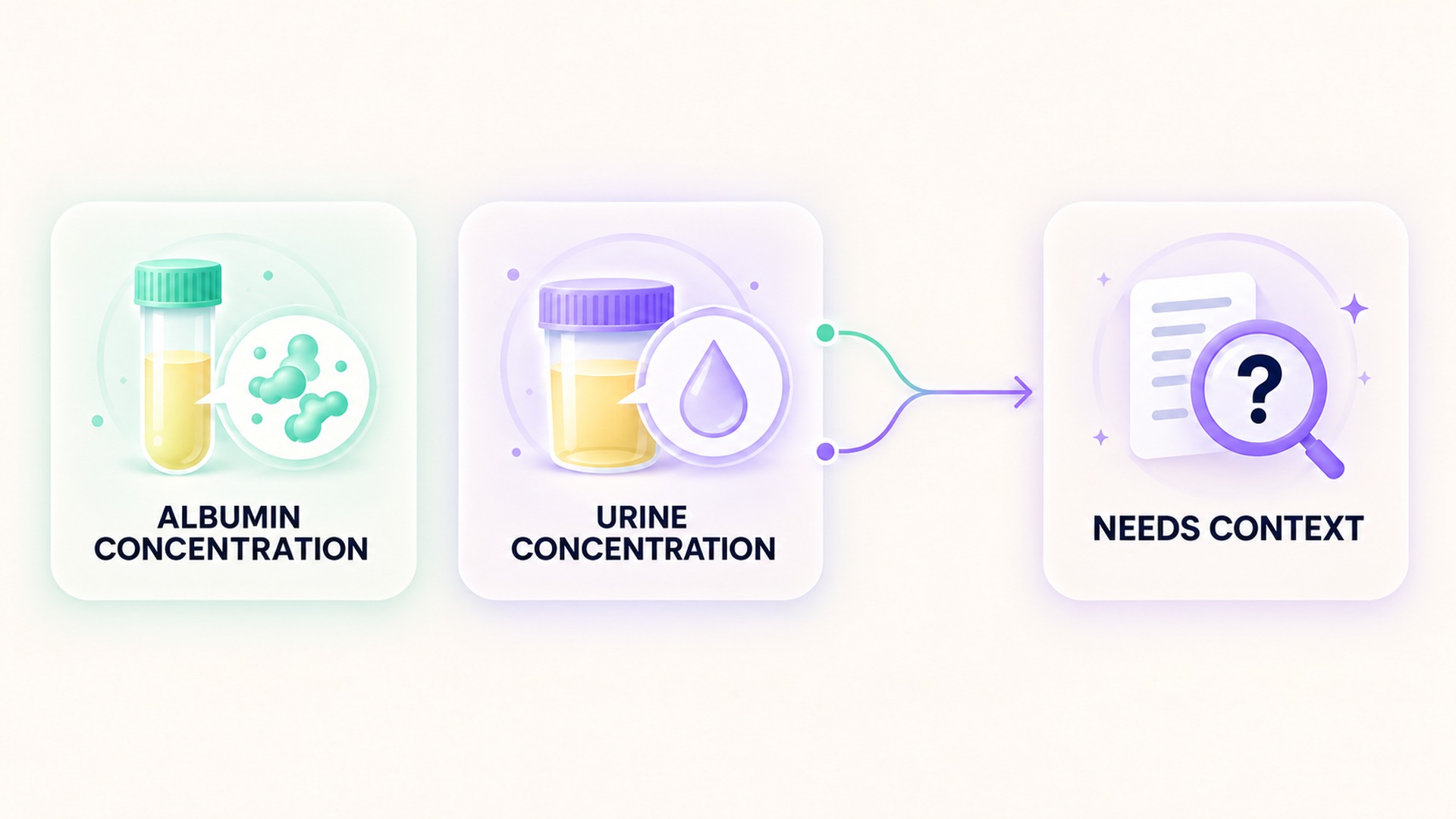
Why concentration needs creatinine context
Urine albumin concentration needs its creatinine context because a spot urine sample can be more or less diluted at the time it is collected. A concentration reports how much albumin is present in a given volume of that sample. It does not, by itself, state how much albumin is being excreted over a full day. The albumin-to-creatinine ratio, often shortened to ACR or UACR, uses two measured substances from the same sample to make the result less dependent on urine dilution.
I keep the exact test name, sample type, units, date, and laboratory together. “Urine albumin,” “albumin concentration,” and “albumin-to-creatinine ratio” are related terms, but they are not interchangeable results. If the report lists both albumin and creatinine values as well as a ratio, each has a distinct role. The ratio is usually the intended measure for screening or monitoring in a spot sample, while the two concentrations are its inputs.
The clinical guidance on assessing urine albumin describes a spot urine ACR as a recommended test and explains that it corrects for variation in urine concentration. This helps explain why a single albumin concentration can be difficult to compare between samples collected under different hydration conditions.
What a concentration means
A laboratory concentration is an amount divided by a volume. If two urine samples contain the same amount of albumin but different amounts of water, the concentration can differ. A more dilute sample can show a lower concentration, while a more concentrated sample can show a higher one. That change in concentration does not necessarily mean the kidneys filtered a different amount of albumin over the day.
The same issue occurs with other measurements in body fluids: the measured concentration describes the sample that reached the laboratory. It must be interpreted with the collection method and clinical question. A spot specimen is convenient, but the moment it is collected and the amount of water in the urine can affect the raw concentration. A timed collection answers a different question by gathering urine over a specified interval, and it also depends on collection completeness.
A dipstick may report a category or detect albumin above a method's threshold rather than provide a precise quantitative result. If a screening result is positive, a clinician may request a quantitative measurement or ratio. The patient explanation of urine albumin testing distinguishes a dipstick from a quantitative albumin and creatinine measurement. The exact next step depends on the reason for testing and the report.
What the ratio adds
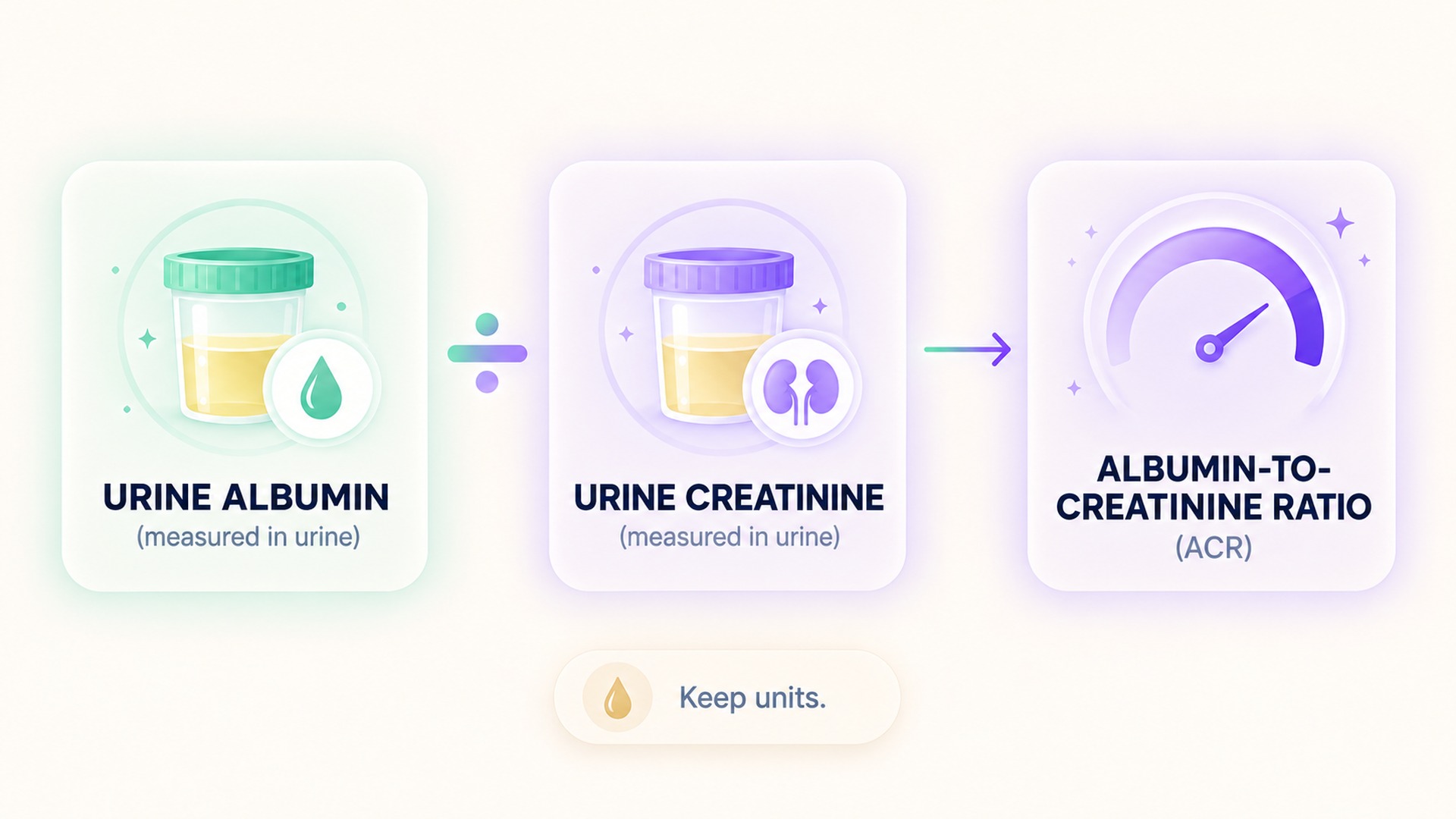
The ACR compares urine albumin with urine creatinine from the same specimen. Creatinine is a waste product produced during normal muscle metabolism and excreted into urine. Because water and dissolved substances are affected by urine concentration, using creatinine as a comparison can reduce the influence of dilution in a spot sample. The resulting ratio is reported with units such as milligrams of albumin per gram of creatinine or milligrams per millimole.
The ratio is a calculated relationship between two values, not a direct collection of a full day's urine. It can be used to estimate albumin excretion for common clinical purposes, but it is not literally a 24-hour measurement. Its interpretation depends on the units, the laboratory method, sample type, and clinical situation. Check whether the report labels the result as ACR, UACR, albumin/creatinine, or another similar term, and preserve the exact wording.
The kidney guideline on urine albumin measurement recommends reporting albumin concentration alongside a creatinine ratio in untimed samples rather than relying on concentration alone. It also notes that ratios reduce variation from urine flow, although interpretation can still be affected by differences in creatinine excretion. The ratio improves comparability; it does not remove every source of variation.
The reporting units explain why the raw concentrations cannot simply be compared without calculation. The numerator and denominator may be printed in different units, and the laboratory converts them when calculating a ratio. If a person copies only the albumin concentration into a spreadsheet, the entry may look like an ACR even though the denominator was never applied. Keep the value under the field name shown on the report. If only one of the two input concentrations is visible, do not reconstruct the ratio unless the report provides the method and units needed for that calculation.
A quick reference for UACR reporting describes the two measured substances and the relationship used in the ratio. It is useful for understanding the structure of the test, but it does not replace the laboratory's result or clinician's interpretation. Different reports may display the ratio first and list its inputs in another section. Preserve the full report so those fields stay connected.
When entering a result into a personal record, label the measurement type before entering the number. Useful distinct fields include urine albumin concentration, urine creatinine concentration, albumin-to-creatinine ratio, sample type, units, and date. If the app has only one generic “albumin” field, note the full laboratory label and units in a comment or keep the report attached. This small distinction prevents a later trend from combining unlike measurements.
Why the result still needs context
Creatinine excretion differs between people and can vary with factors such as muscle mass, body size, and recent activity. This means that an ACR can sometimes overestimate or underestimate albumin excretion compared with a timed collection. The ratio is useful, but a single value does not explain its own cause. The clinical team considers it with the person's history, other kidney measures, symptoms, and previous results.
Urine albumin can also vary from sample to sample. Temporary health conditions, collection timing, and handling may matter. A clinician may ask for a first-morning sample or a repeat result, especially when a screening finding needs confirmation. Do not treat a single number as a diagnosis or assume that every change reflects a lasting change in kidney function.
The laboratory recommendations for urine albumin testing discuss collection timing and repeatability, including using comparable conditions when a first-morning sample is not practical. These recommendations apply in a clinical testing context. Follow the instructions for the specific ordered test rather than changing fluid intake or collection habits to try to influence a result.
The report's units must stay attached to the value. A number in mg/g is not numerically interchangeable with the same number in mg/mmol. A raw albumin concentration may use units such as mg/dL, while urine creatinine uses a different concentration unit; the ratio calculation accounts for the unit conversion. Do not compare two values until their labels and units are clear. If the report includes both raw inputs and a ratio, avoid copying one into a tracker field intended for another.
How to keep the record useful
Save the entire laboratory report. Record the exact test name, albumin concentration, urine creatinine concentration if shown, ratio, units, sample type, collection time or date, laboratory, and any comments. If the result is labeled random urine, first-morning urine, or timed collection, keep that label. If the sample was not collected as instructed or the report has a quality note, preserve that information for the clinician.
For a trend, compare the same type of measure across tests. A raw albumin concentration should not be plotted as though it were an ACR. Two ACR values are more comparable when the sample type, units, laboratory method, and collection conditions are similar. If a laboratory changes its reporting units or method, keep both the original value and the explanation of the change instead of rewriting older records.
The overview of urine albumin-to-creatinine ratio testing explains that the ratio measures albumin relative to creatinine in a small urine sample. The report should still be interpreted by the care team, especially if it is unexpected or differs from prior results. A ratio can support a kidney assessment, but it does not identify the reason for an abnormal result on its own.
For broader kidney-test context, a related note on keeping the kidney-function equation beside an eGFR trend explains why method details belong with a laboratory trend. eGFR and urine ACR measure different aspects of kidney health. Keeping both with their units and exact test names helps the clinician review the results together without treating either one as a complete assessment.

Frequently asked questions
Is urine albumin concentration the same as an ACR?
No. Concentration describes albumin per volume of the sample. ACR compares albumin with creatinine measured in that sample and is less affected by urine dilution. Keep the report's exact test name and units.
Does an ACR measure albumin collected over a full day?
No. ACR is calculated from a spot urine sample. It can estimate albumin excretion for common clinical use, but it is not a timed 24-hour collection. A clinician decides which measurement fits the question.
Can one abnormal ACR diagnose kidney disease?
One result is not enough to interpret in isolation. The care team considers repeat measurements, sample conditions, other kidney tests, medical history, and the reason for testing before deciding what the result means.
*This article is for informational purposes only and is not a substitute for professional medical advice, diagnosis or treatment.*
Sources:
National Institute of Diabetes and Digestive and Kidney Diseases·National Institute of Diabetes and Digestive and Kidney Diseases·Kidney Disease: Improving Global Outcomes·National Institute of Diabetes and Digestive and Kidney Diseases·American Diabetes Association·National Kidney Foundation
Related articles

A hemolyzed blood sample can complicate a potassium result
Cell damage during collection or handling can affect a measured potassium value. Keep the sample-quality comment with the report and have the result reviewed in its clinical context.

Biotin supplements belong in the record before a blood test
Biotin in supplements can affect selected laboratory assays, and the effect depends on the method used. A clear product, amount, and timing record helps the testing team decide whether an assay-specific review is needed.

A post-vaccine HRV change is not a personal immunity test
A wearable HRV change after vaccination can describe a physiological signal, but it cannot measure antibodies or personal protection. Learn why study associations, symptoms, and immune status answer different questions.

Vitamin D blood levels should not become an automatic supplement dose
Learn what a vitamin D blood test measures and why the result does not automatically set a supplement dose. See how symptoms, medicines, testing reason, and health history shape interpretation.

Blood sodium concentration is different from sodium eaten
Learn why a sodium blood test measures a concentration while a food log estimates an amount eaten. See why a blood result cannot be converted into an instruction to add salt or change intake.

Recent lifting belongs in the context of a liver enzyme result
Learn why recent lifting belongs beside liver enzyme results and why it should not be assumed to explain an abnormal test. See how AST, ALT, CK, timing, symptoms, and the rest of the panel help shape clinical interpretation.

Keep the kidney function equation beside an eGFR trend
Learn why a change in the eGFR equation can shift a reported estimate without an equivalent biological change. See what to record beside each value so a trend can be interpreted with its method and clinical context.

Creatine kinase after exercise requires symptoms and timing
Learn why recent exercise, test timing, and symptoms all matter when a creatine kinase result is reviewed. See why CK is a clinical marker rather than a training target and when unusual symptoms need prompt attention.

Normal oxygen saturation does not establish a normal hemoglobin level
A pulse-oximeter percentage estimates how much available hemoglobin is carrying oxygen, while a blood count measures hemoglobin amount. Learn why one reassuring reading cannot replace the other test or a clinical review.

A raised CRP result cannot identify the source of inflammation
A raised CRP can signal inflammation, but it cannot identify where the process is or what caused it. Learn why standard CRP and high-sensitivity CRP serve different purposes and need clinical context.