A proprietary blend can hide individual supplement amounts
By Mr.Apps · Nov 4, 2026
Category:Energy

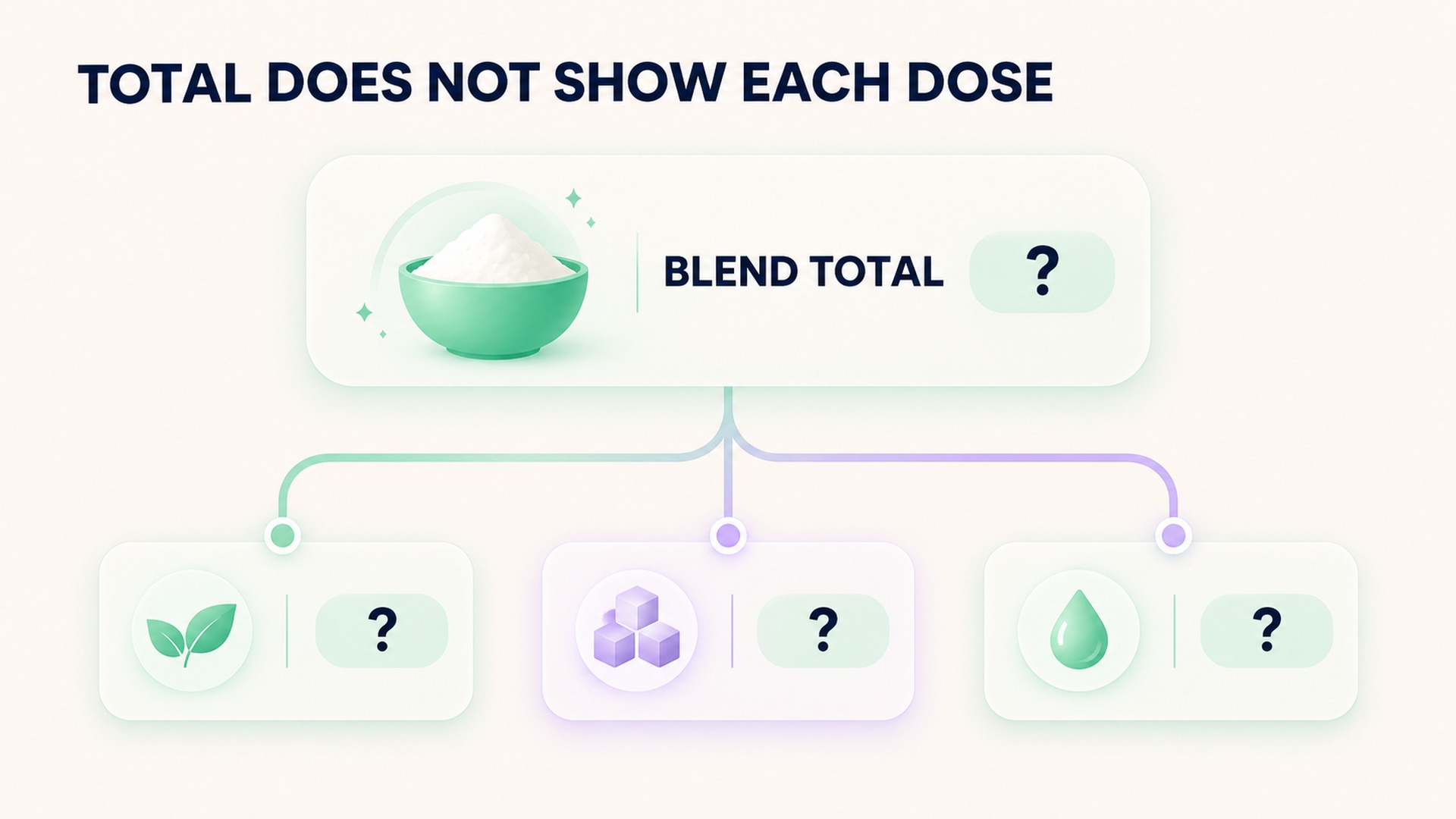
A blend total is not an ingredient-by-ingredient amount
A supplement facts panel may name a proprietary blend and show one total weight for that blend. That figure describes the combined blend, not the separate amount of each ingredient within it. If the ingredient list names several compounds but does not give their individual quantities, a reader cannot calculate each dose from the total alone. The amount of each item remains undisclosed. I mark those quantities as unknown rather than estimate them.
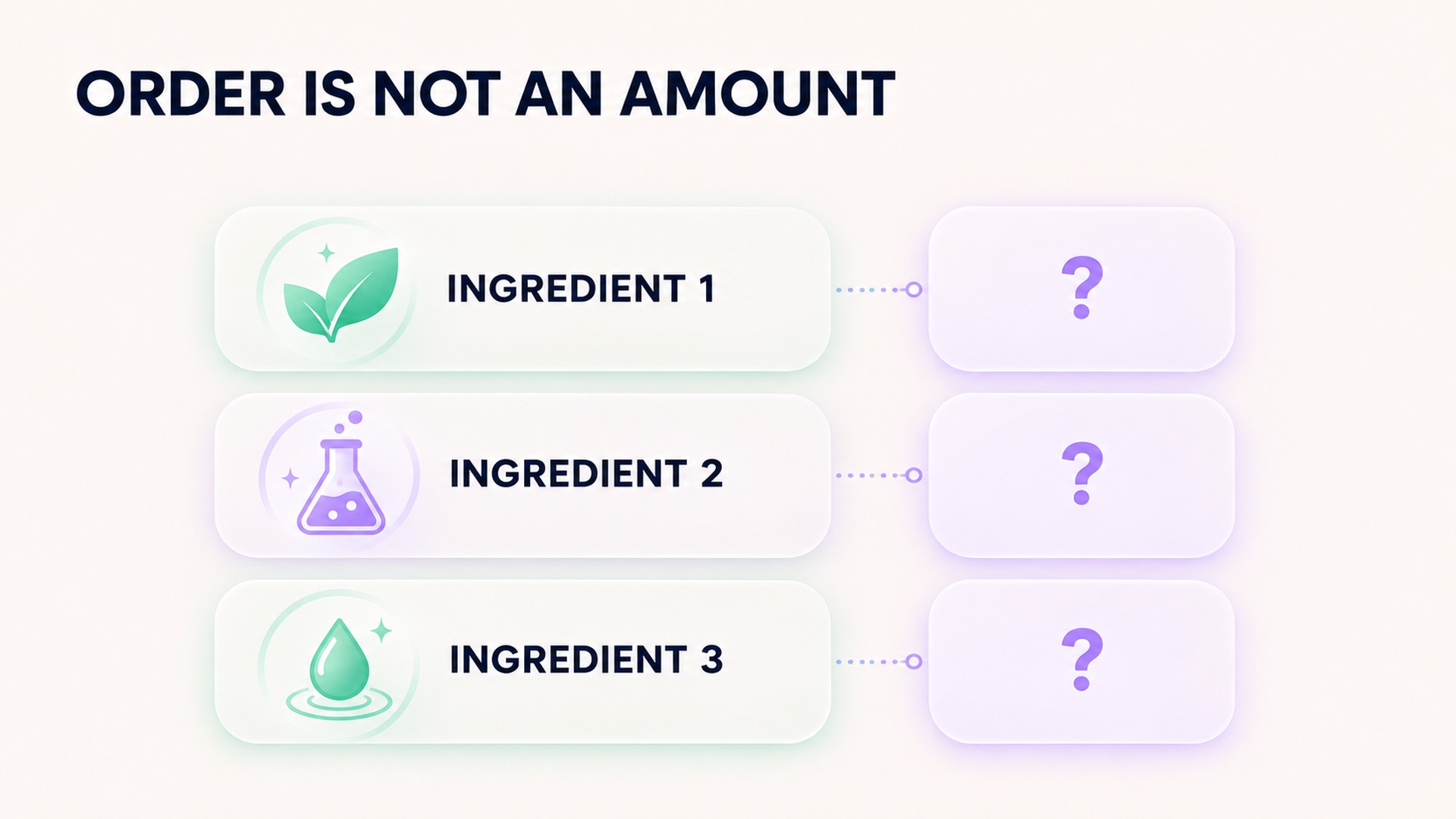
That distinction matters when comparing a product with a research study, checking a duplicate ingredient across products, or discussing a possible interaction with a health professional. A study’s tested amount applies to the ingredient and preparation used in that study. A blend total cannot establish that a commercial product contains the same amount. The label may provide an order of ingredients, but order is not a precise dose.
The dietary supplement labeling guidance explains that proprietary blends have a total weight and that ingredients are listed in descending order of predominance by weight under the applicable rules. It does not disclose the exact quantity of each ingredient when those amounts are not declared. A record should preserve that limitation instead of assigning estimated doses.
What the total weight tells you
A blend total is the combined weight of the ingredients grouped under that blend heading. It can help describe the amount of the mixture in one serving. It does not reveal how the total is divided among the listed ingredients. A panel that shows a total weight plus a list is therefore different from a panel that gives a separate weight for every item.
If the label lists three ingredients, one cannot safely divide the blend total by three and assume equal portions. The manufacturer may use unequal amounts, and the list’s order may indicate relative weight but not the size of the difference. A small amount of one ingredient and a large amount of another can still appear in sequence. Do not use ingredient order to reconstruct a dose.
The consumer information on dietary supplements describes supplement regulation and label information. A supplement’s presence on a shelf does not establish that its mixture has been tested for a particular outcome or that the disclosed total matches a clinical trial dose. The relevant question is what the label actually says and what remains unknown.
Why individual amounts matter
Ingredient-specific amounts are important when reviewing how much of a nutrient, botanical, stimulant, or other compound a serving contains. People may take more than one product, use fortified foods, or receive ingredients from medicines. If a blend hides the individual amount, a person cannot reliably total that ingredient across sources. A clinician or pharmacist may need the label to assess a possible interaction or duplication.
An ingredient may also have different forms, extracts, or preparations. A quantity in milligrams of an extract is not automatically equivalent to the same mass of a purified compound. The label may provide part of that information, but a blend total does not. Preserve the full ingredient name and any standardization or extract details that are declared.
A product’s marketing description can emphasize one ingredient even when its amount is not separately stated. A large blend total does not show how much of the highlighted ingredient is present. The label requirements for dietary supplement ingredients describe how Supplement Facts information is presented. Read the panel itself rather than treating a promotional headline as a quantitative disclosure.
A proprietary name can also make a blend sound like a single tested formula. Unless the manufacturer provides reliable documentation, that name does not identify a particular scientific study or establish that the combination has the same ratios as a studied product. Product names and trademarked ingredient phrases should not be used as proof of efficacy. A consumer record can simply transcribe the generic ingredients and state that individual amounts are not shown.
Compare labels without inventing precision
When comparing two products, first align the serving size and serving directions. Then note which ingredients are listed, which have separate amounts, and whether the total blend weight is stated. If one product discloses each quantity and another gives only a blend total, the labels do not support a direct ingredient-dose comparison. A precise-looking spreadsheet cannot fix missing source data.
Do not infer that an ingredient near the top is present in a clinically meaningful amount or that one near the bottom is negligible. The ordering rule describes relative weight within the group, not an exact quantity. The product may contain excipients or other dietary ingredients elsewhere in the panel. A consumer cannot derive the dose by subtracting known amounts from the total unless all other ingredient amounts are disclosed and the total refers to the same components.
The consumer overview of supplement labels recommends reading labels and considering the full product information. It also describes how supplements can affect medicines and health conditions. A label review is one step, not a guarantee that a product is safe or useful for a specific person. Discuss uncertain ingredients with a qualified clinician or pharmacist, particularly when medicines or medical conditions are involved.
If a product does not provide enough information for the intended comparison, record the gap. A note such as “blend weight shown; individual ingredient amounts not disclosed” is more accurate than an estimate. If a person needs a known amount of a specific nutrient or compound, a different product with clear quantities may be easier to assess, but selection should follow qualified advice and the person’s needs.
Claims and evidence are separate from amounts
A label’s structure and a product’s evidence are separate questions. The panel tells a reader what quantities are declared under the relevant labeling rules. It does not establish that a claimed benefit has been demonstrated for the product as sold. Likewise, evidence for one ingredient in a particular form does not prove the same result for a proprietary blend that may have different amounts or co-ingredients.
The information about supplement claims and consumer protection explains that health-related advertising claims need appropriate support. Marketing text should not be used to fill a quantitative gap in the Supplement Facts panel. If a company refers to a study, check whether the study tested the same ingredient form, serving, combination, and population. The product’s total blend weight alone cannot establish that match.
Some supplements can interact with medicines or be inappropriate under certain health conditions. The consumer guide to using supplements wisely encourages consumers to discuss supplements with health professionals and to consider the product’s ingredients. A blend with undisclosed amounts can make that review harder. Bring the full label and any available product information to the discussion.
A record should not convert “proprietary” into “secretly dangerous” or “uniquely effective.” It simply identifies a limit in the available information. The actual risk or benefit depends on the ingredients, the quantities, the person, and the evidence. A transparent statement of what is known keeps the discussion factual.
What to save with the product record
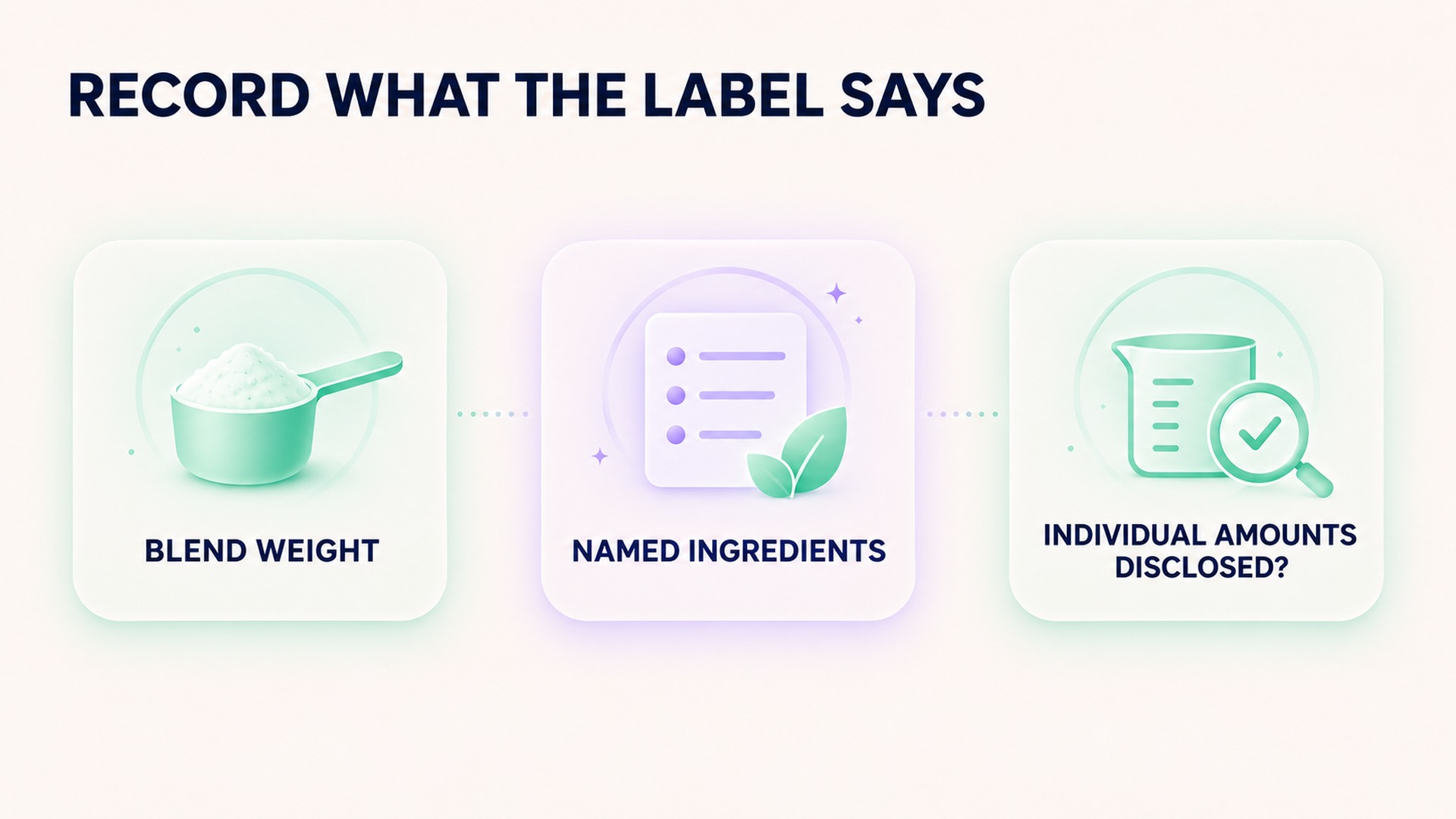
Keep a photograph or transcription of the Supplement Facts panel, the serving size, directions, ingredient list, declared blend total, and date of purchase or label review. Include any manufacturer contact information if a professional needs to ask for more detail. Product formulas can change, so keep the date and lot information when it is available and relevant.
A tracker should separate declared values from estimated or unknown ones. If the app asks for an amount the package does not disclose, do not enter the blend total under every ingredient. That would multiply the amount incorrectly. Use an “amount not disclosed” note or leave the field blank, depending on the system. If a healthcare professional has a method for interpreting the product, preserve that method and its source.
If the label uses a proprietary blend title, copy the generic ingredients exactly as written. Avoid translating them into a guessed active-compound quantity. If the exact form is unclear, mark it as unclear. If a product has several blend panels, preserve which ingredients belong to which blend. This prevents a later reviewer from mixing entries that were presented separately.
A related discussion of food notes alongside recovery data considers what a useful personal log can contain. Understanding a supplement label and making an individual decision may still require professional review. A combined weight describes the mixture. It cannot reveal each ingredient amount unless those values are separately disclosed.
A consumer may also ask the manufacturer whether an amount is available. If a response is provided, save its date and scope, because a customer-service statement may refer to one product version only.
FAQ
Does a proprietary blend total show each ingredient dose?
No. It shows a combined weight. If the individual amounts are not declared, they cannot be calculated from the total alone.
Does ingredient order reveal exact amounts?
No. Order can indicate relative weight under labeling rules, but it does not provide a precise dose for each ingredient.
Can I compare a blend with a clinical study dose?
Only when the relevant ingredient form and amount are known and match the study. A total blend weight does not establish that match.
*This article is for informational purposes only and is not a substitute for professional medical advice, diagnosis or treatment.*
Sources:
FDA·FDA·Electronic Code of Federal Regulations·NIH Office of Dietary Supplements·Federal Trade Commission·NIH Office of Dietary Supplements
Related articles

Glycemic index needs portion context to describe glycemic load
Glycemic index describes a tested food response under a defined protocol, while glycemic load also accounts for carbohydrate amount in a serving. Neither value predicts an individual sensor trace or replaces a care plan.

Potassium salt substitutes need more than a lower sodium goal
Some salt substitutes replace sodium chloride with potassium chloride, which changes the ingredient and mineral context. Keep the label and portion visible, especially when kidney disease or medicines may affect potassium balance.

Food date labels do not replace safe storage instructions
A printed date describes only part of a food’s context and may refer to quality or a specific product rule. Preserve the exact label phrase alongside opening, handling, and storage information that is known.

Lactose intolerance and milk allergy need different food notes
Lactose intolerance concerns digestion of a milk sugar, while milk allergy involves an immune reaction to milk proteins. Record the exact product wording and symptoms without treating a lactose-free claim as an allergy clearance.

Kilojoules and kilocalories need one consistent food-log unit
Food labels and trackers may use kilojoules or kilocalories for the same energy value. Keep the original label unit beside any conversion so every total remains clear and checkable.

Protein grams leave amino acid quality unreported
Protein grams show an amount for a stated serving, while amino acid composition and digestibility describe other properties. Keep the declared quantity separate from any quality measure or score that the source actually reports.

Time in glucose range needs the target range beside it
Time in range is a percentage calculated from glucose readings within chosen bounds over a defined period. Keep the target interval, units, sensor coverage, and clinical context beside the result so the percentage can be interpreted correctly.

Glucose sensor timing can lag behind changes in blood
Continuous glucose monitors sample interstitial fluid and estimate blood glucose from that signal. During rapid changes, the sensor reading may reflect a later point in the curve, so keep both measurement times and the device context visible.

Peak flow and spirometry report different breathing measures
Peak flow records the highest expiratory flow from a forceful breath out. Spirometry measures airflow and exhaled volume over time, so the test name, units, effort quality, and report comments should stay with each result.

A resting metabolic rate test depends on the test protocol
A resting metabolic rate test estimates energy use from gas exchange under defined conditions. The preparation, equipment, analysis method, and report details all affect how the value should be interpreted.