Protein grams leave amino acid quality unreported
By Mr.Apps · Nov 4, 2026
Category:Energy

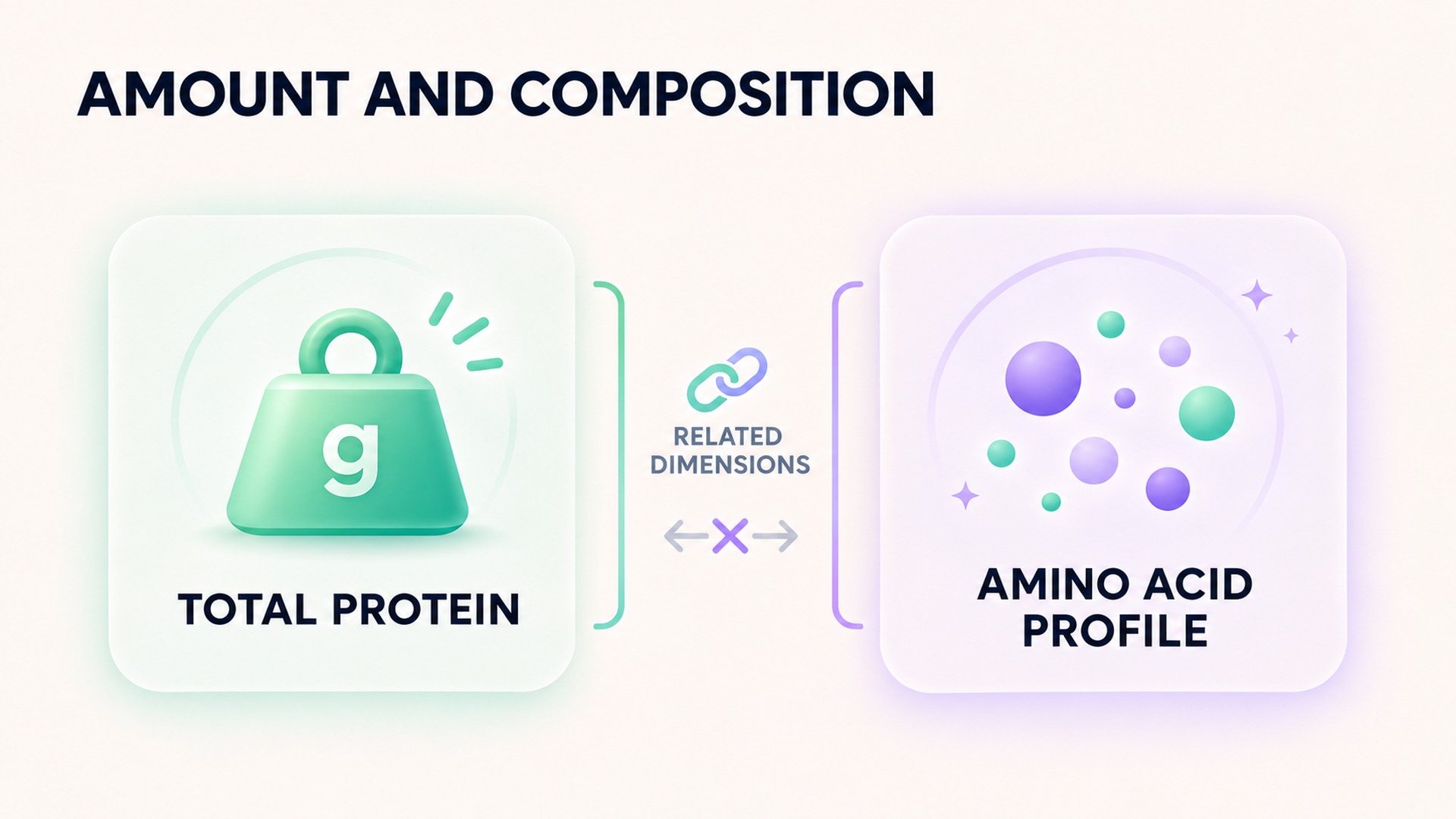
Protein grams describe an amount
A food record that lists protein in grams answers a specific question: how much protein is present in the stated serving. I keep that amount separate from any quality measure. It does not, by itself, describe the amino acid pattern, digestibility, or the way the food fits into a person’s overall diet. Those are related but distinct features. Two entries with the same protein grams can still differ in composition and in how the food was measured.
I keep the amount shown on the label with its serving basis, then retain any separate information about protein source or quality. This prevents a single number from carrying more meaning than it can support. The approach is useful whether the record comes from a package, a database, or a meal-planning tool. A number without its source and portion can be difficult to interpret later.
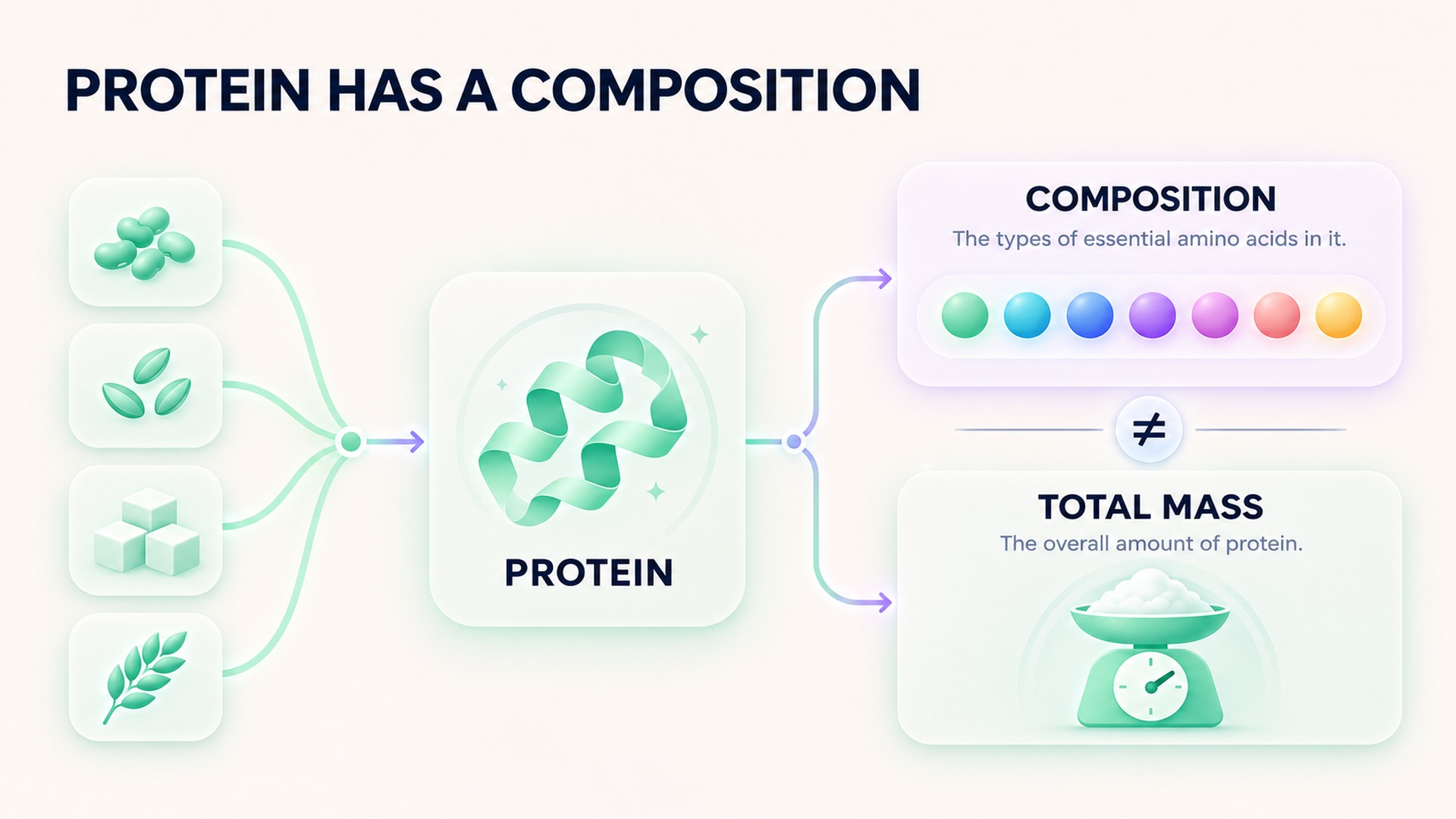
The protein guidance for exercise and performance discusses protein as a nutrient and notes that protein foods supply amino acids. The body uses amino acids in many processes, and some must be obtained through food because the body cannot make enough of them. A total gram value gives the mass of protein in an entry; it does not list each amino acid individually.
Amino acid composition adds another dimension
Proteins are built from amino acids. Dietary proteins contain different proportions of the amino acids used by the body. A nutrition record that captures only total protein grams therefore leaves the composition unreported. That limitation does not make the gram value useless. It simply means the value should be read as an amount, not as a complete description of protein quality.
The term “essential amino acid” refers to an amino acid that must be supplied by the diet under ordinary conditions. The pattern and amount of these amino acids in a food protein matter when researchers assess quality. A quality method can compare an amino acid pattern with a reference requirement, but the resulting score depends on the method and reference population. It is not automatically a rating of the whole diet or a prediction of strength, recovery, or health.
A review of protein quality and human nutrition explains that protein quality frameworks consider both amino acid composition and digestibility. A protein may have an amino acid pattern that appears favorable yet still be incompletely digested or absorbed. Conversely, a grams-only entry does not reveal where the food sits on a quality scale. The review discusses scientific assessment; it does not prescribe one food or supplement for every person.
A digestibility measure also has limits. Research methods may involve laboratory analyses, feeding studies, or calculations based on defined reference patterns. Results can vary with the food matrix, processing, and method. A score reported for an isolated ingredient should not be treated as the score of a mixed meal or an individual’s entire daily diet. When the method is not provided, the word “quality” can be too vague to compare items reliably.
Serving size and label context matter
The grams on a food label apply to the stated serving. If the amount eaten differs, the record needs the amount actually consumed or a clearly marked estimate. A serving-size error can be larger than any distinction between protein quality measures. Record the package serving, the portion used, and the protein value associated with that portion. If the portion was estimated, say so rather than presenting it as measured.
The Nutrition Facts label guide explains how serving size and the nutrient lines work together. Protein is listed in grams, while a percent Daily Value may or may not appear, depending on the product and labeling conditions. Those fields answer different questions. Grams state the declared amount in a serving; a percentage, when present, compares the serving with a reference Daily Value under the labeling rules.
A percent Daily Value is not a protein-quality score. It does not show the complete amino acid profile. It also does not make two foods equivalent if their serving sizes or ingredient composition differ. Under current labeling rules, the percent for protein is not required on every general food label. The labeling guidance for protein declarations describes separate methods used for the gram declaration and, where applicable, the percent Daily Value calculation. That regulatory distinction is one reason not to infer unlisted details from a gram amount.
Dietary supplements can use a Supplement Facts panel with its own rules. A product may list protein ingredients, amino acids, or a blend, but a label’s presentation does not establish that the product is necessary or superior. The supplement labeling guide describes what information is required for dietary ingredient amounts and how certain panel entries are presented. Read the actual serving size and ingredient declaration rather than relying on a headline claim.
Digestion and food form can affect interpretation
Digestibility describes how much of a protein’s amino acids become available after digestion and absorption. It is studied with defined protocols and can be affected by the food’s structure and processing. A protein score that includes digestibility therefore adds information beyond grams, but it still depends on the measurement method. Without that method, two published scores may not be directly comparable.
Food preparation can alter the protein matrix, and a mixed meal contains more than isolated protein. Fiber, fat, carbohydrate, and other compounds may affect how quickly the meal is eaten and digested. These factors do not allow a person to calculate an individual’s amino acid absorption from a food label. They are reasons to avoid treating one score as a complete personal prediction.
The Dietary Guidelines protein foods overview groups foods that contribute protein within a broader eating pattern. It is not a ranking of every food by a single quality score. A food can provide protein alongside other nutrients, and the dietary role depends on the entire meal and individual context. A grams-only log can remain useful when it is not asked to answer more than it measures.
When comparing two entries, first align the portions and data sources. Then note whether each value describes a food as purchased, prepared, or drained, and whether the protein figure is label-declared or database-estimated. Only after those basics are aligned does it make sense to ask whether a quality measure is available and relevant. A comparison that mixes a cooked portion from one record with an uncooked portion from another can be misleading even when the grams look similar.
What a protein record should preserve
For a practical food record, preserve the food name, portion, source, protein grams, and any qualifier such as cooked, dry, or drained. If an amino acid profile or a quality score is explicitly available, include the measurement name and source instead of writing a generic “high quality” label. If it is not reported, mark it as not reported. Do not estimate an amino acid dose from a total protein value or from the order of ingredients.
The source matters because food databases and labels have different purposes. A package label is tied to a particular product and declared serving. A generic database entry represents a described food and preparation. A study score may concern a specific test material under a controlled method. Keeping those sources distinct makes a later comparison more reliable. It also makes changes visible if a product’s formulation or serving size changes.
If a tracking application shows only protein grams, it is safest to treat that field literally. It may be adequate for a task that asks about total protein intake, but it cannot answer a question about essential amino acid distribution unless the application provides that information from a stated source. If another person uses the record for care planning, they should know whether the amount came from a label, a weighed portion, or an estimate.
A grams value is also not a recommendation. The appropriate amount of protein depends on age, health, dietary pattern, activity, and clinical circumstances. A record can support a conversation with a registered dietitian or clinician, but a single meal entry should not be used to diagnose deficiency or prescribe a supplement. In particular, do not equate a large amount with improved recovery or assume that an individual needs a powder because a product advertises a quality score.
For athletes, the same evidence discipline applies. Sports nutrition research may test particular populations, exercise conditions, and feeding protocols. Its findings can inform general discussion, but they do not automatically apply to every person or every meal. The food logging alongside recovery review is useful for separating established information from product marketing. A supplement’s advertised protein grams do not disclose the full dietary context.
Avoid turning a single score into a food rule
Protein quality measures are designed to answer particular research and labeling questions. They can help compare defined protein sources under stated assumptions. They are not a universal scale of a food’s total nutritional value. A score may omit other nutrients, portion size, affordability, tolerance, preference, or cultural fit. Those factors matter in real eating patterns but are not all contained in the score.
This careful distinction prevents two common errors: treating grams as a complete measure of quality and treating a quality score as a personalized outcome forecast. Keep amount, composition, digestibility, serving, and source in separate conceptual fields. That produces a useful record without promising that one number predicts muscle gain, satiety, recovery, or health.
FAQ
Do protein grams show the amino acid profile?
No. Protein grams report an amount for a stated serving. An amino acid profile requires separate composition data from a suitable label, database, or analysis.
Is percent Daily Value the same as protein quality?
No. Percent Daily Value is a label reference when shown. It does not provide a complete amino acid profile or an individual response estimate.
Does a protein-quality score tell me what to eat?
Not by itself. A score applies to a method and reference context. It is not a personal prescription or a complete measure of a food or diet.
*This article is for informational purposes only and is not a substitute for professional medical advice, diagnosis or treatment.*
Sources:
NIH Office of Dietary Supplements·Frontiers in Nutrition·FDA·FDA·FDA·U.S. Department of Agriculture
Related articles

Time in glucose range needs the target range beside it
Time in range is a percentage calculated from glucose readings within chosen bounds over a defined period. Keep the target interval, units, sensor coverage, and clinical context beside the result so the percentage can be interpreted correctly.

Glucose sensor timing can lag behind changes in blood
Continuous glucose monitors sample interstitial fluid and estimate blood glucose from that signal. During rapid changes, the sensor reading may reflect a later point in the curve, so keep both measurement times and the device context visible.

Peak flow and spirometry report different breathing measures
Peak flow records the highest expiratory flow from a forceful breath out. Spirometry measures airflow and exhaled volume over time, so the test name, units, effort quality, and report comments should stay with each result.

A resting metabolic rate test depends on the test protocol
A resting metabolic rate test estimates energy use from gas exchange under defined conditions. The preparation, equipment, analysis method, and report details all affect how the value should be interpreted.

Bone density T-scores and Z-scores use different references
A T-score compares bone density with a young-adult reference, while a Z-score uses a more closely age-matched reference. Keep the score type, skeletal site, and report interpretation together because the two numbers are not interchangeable.

Waist measurements need a consistent anatomical landmark
Waist circumference can differ when the tape crosses different anatomical sites or follows a different plane. Keep the landmark, posture, breathing phase, and tape position with each date so a trend uses a consistent protocol.

Lean tissue on a body scan includes more than muscle
A body-composition scan reports method-dependent compartments such as lean soft tissue, not a direct count of skeletal muscle. Keep the exact scan label, body region, method, date, and testing context with the result before comparing it over time.

Urine albumin concentration needs its creatinine context
A spot urine albumin concentration changes with how diluted the sample is. The albumin-to-creatinine ratio adds context, while the full report and clinical question still guide interpretation.

A hemolyzed blood sample can complicate a potassium result
Cell damage during collection or handling can affect a measured potassium value. Keep the sample-quality comment with the report and have the result reviewed in its clinical context.

Biotin supplements belong in the record before a blood test
Biotin in supplements can affect selected laboratory assays, and the effect depends on the method used. A clear product, amount, and timing record helps the testing team decide whether an assay-specific review is needed.