Kilojoules and kilocalories need one consistent food-log unit
By Mr.Apps · Nov 4, 2026
Category:Energy

Food energy is reported in more than one unit
A package can state energy in kilojoules, kilocalories, or both. A tracking record may then use a different unit from the label or from another entry. The number changes when the unit changes, even when the energy represented does not. That makes the unit part of the measurement, not a decorative suffix.
I keep the original label value with its unit and record a conversion as a separate value. That small habit makes a later sum auditable. If the original package is still available, the record can be checked against it. If an app or imported file changes a unit, the source can still be reconstructed without guessing what the bare number meant.
The energy-unit conversion table distinguishes calorie conventions and gives the energy relationships needed for conversion. For food records, the familiar large “Calorie” is a kilocalorie, commonly written kcal. A kilojoule is a smaller energy unit, so the numerical value in kJ is larger for the same amount of energy. The conversion is arithmetic; it does not describe a change in the food itself.
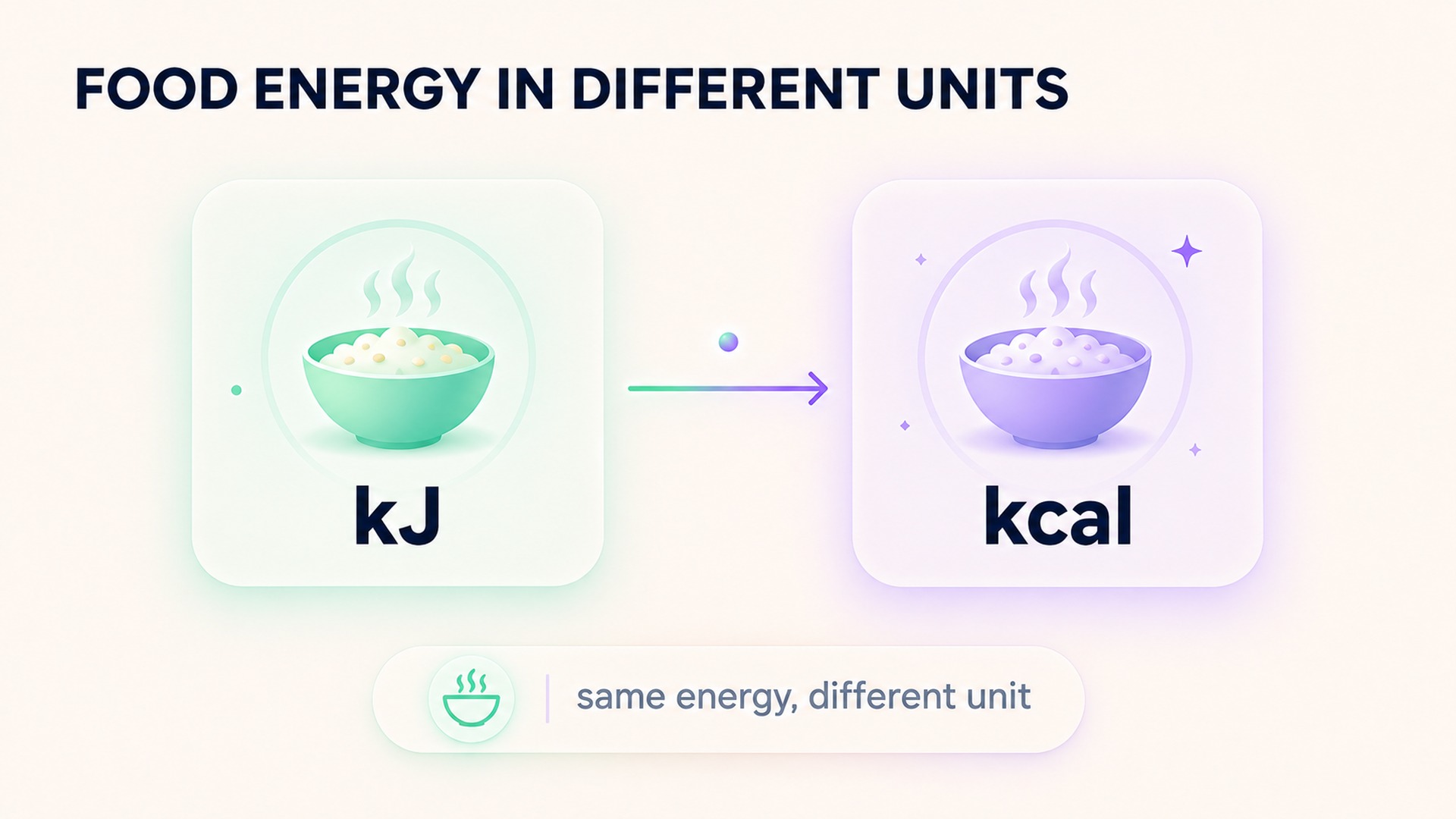
Kilocalorie and Calorie labels
In nutrition writing, “calorie” is often used informally for kilocalorie. On a Nutrition Facts label, the line called “Calories” is presented as a food-energy value. The capitalization convention can confuse a person comparing a label with a scientific table that uses the small calorie. Preserve the exact label wording in a note if the distinction matters, while using kcal when a technical unit is required.
A kilocalorie is 1,000 small calories. The small calorie is the energy required to raise a gram of water by one degree Celsius under a defined convention. The kilocalorie is correspondingly a thousand times larger. Food energy may also be expressed in kilojoules, a unit from the International System. A conversion between the two is not a nutrient conversion: it does not turn carbohydrate into fat or change the serving size.
The Nutrition Facts label guidance explains where calories appear and why serving size must be read alongside the energy value. That context is useful because the listed energy is associated with the label’s stated serving. It is not necessarily the amount eaten, the amount in the whole package, or the amount entered into a personal record. A correct conversion of the listed value cannot fix a serving-size mismatch.
A reliable record therefore preserves at least the food description, serving amount, original energy value, original unit, and source. When the entry uses a converted value, include the conversion direction and the resulting unit. Do not overwrite the package value with the converted figure. Keeping both values makes rounding and transcription differences visible.
Convert before combining values
A total can be calculated only after the entries use the same unit. Adding a number in kJ directly to a number in kcal is invalid even though both measure energy. The sum would have no coherent unit. This is similar to adding distances in miles and kilometers without first converting one scale: the arithmetic might produce a number, but the result would not represent a clear total.
There are two practical approaches. One is to keep the entire record in the label units and convert only when a comparison requires it. The other is to convert each entry into a chosen common unit before adding. Either can work if the chosen unit is clearly recorded and all entries in the total use it. For a small record, leaving values in their printed units can reduce transcription steps. For a summary across mixed labels, a consistent unit may be easier to read.
Use the conversion factor appropriate to the unit convention. The reference table lists several calorie definitions because the term has appeared in different technical contexts. For nutrition data, the kilocalorie convention is the one ordinarily intended by food “Calories.” If a dataset identifies another convention, retain that metadata rather than applying a familiar factor by assumption. The SI unit guidance helps distinguish units and prefixes; the prefix “kilo” means one thousand of the underlying unit. Food-composition entries can also be checked against the food nutrient database, while remembering that a database serving may differ from the package serving.
A useful audit checks four things: that the item and serving match the source, that the source unit was copied correctly, that the conversion used the right direction, and that the total contains one unit throughout. When an app supplies a total, confirm whether it silently normalizes entries or simply adds the displayed numbers. If the app’s behavior is unclear, keep the item-level records and calculate outside the summary rather than trusting an unlabeled total.
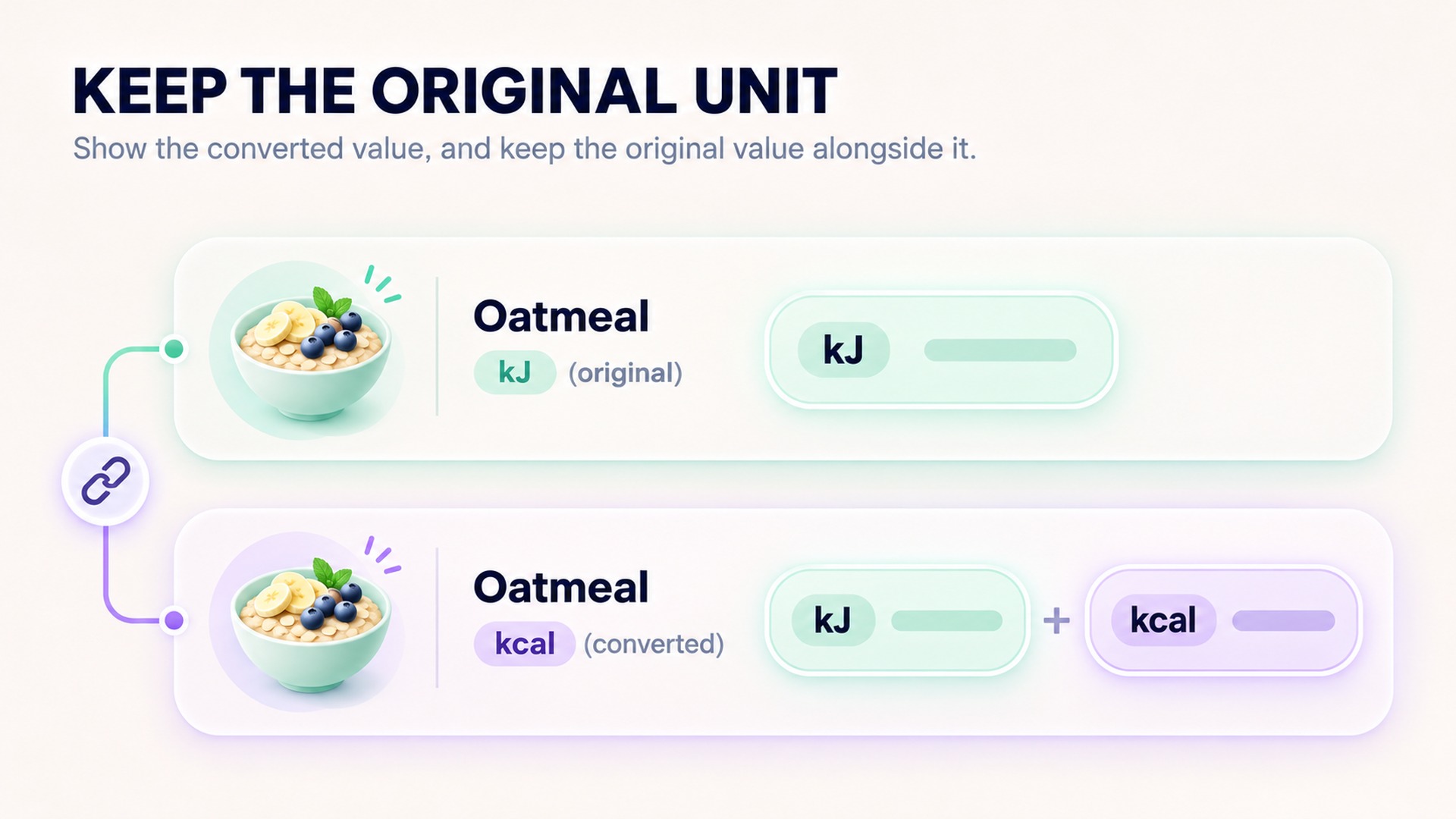
Food logs and imported data
Mixed-unit entries often appear after copying a value from a package, importing a database, or switching between regional food records. One source may report kilojoules per 100 grams, while another reports kilocalories per serving. The numerical values are not directly comparable until both the unit and the reference amount are aligned. First identify whether the difference comes from unit, serving basis, or actual food composition.
Record the database or label source and the date accessed when entries are likely to be revisited. Packaged products can change their recipes or serving presentation, and databases can update their records. A note saying only “oats, 150” is difficult to interpret later. “Oats, 150 kcal per recorded portion, copied from the package label” is clearer. If the original label lists energy in both kJ and kcal, preserve both values as printed and use one only for a combined total.
When entering a value into an application, check its selected unit before saving. Many nutrition applications let users choose between kcal and kJ at account or display level. The display preference may not change the underlying item, or it may convert automatically. A single entry with the wrong unit can distort the total without looking obviously implausible. The right correction is to confirm the original item value and application setting, not to edit the food quantity until the total “looks right.”
A spreadsheet should use separate columns for value and unit. It is tempting to store “250 kcal” in a single text cell, but separate fields make conversion and sorting more reliable. If the spreadsheet uses formulas, preserve the original imported value in a protected source column and place the normalized result in another column. This also helps identify whether a future mismatch was caused by a changed unit, a changed serving, or a changed product record.
What the energy total can and cannot tell you
A consistent energy total answers a narrow bookkeeping question: how much label or database energy is represented by the included entries, under the stated serving assumptions. It does not establish how accurately the portions were measured, how much energy a particular person absorbed, or what an individual should eat. A food-log number is not an assessment of overall nutritional adequacy by itself.
Labels themselves use regulated conventions and rounded declarations. They are useful for comparing packaged items in context, but they do not turn every serving into a laboratory measurement of the portion eaten. The additional calorie conversion factors distinguish defined units of energy. Separately, compare the quantity consumed with the label’s reference serving. If a package has multiple servings, the per-serving value should not be mistaken for the whole container.
The conversion factor is exact within its defined unit convention, but the input may be rounded. This distinction matters. A calculator can correctly convert an imprecise or rounded source number. The resulting precision should not be reported as if the underlying food energy were known to that many digits. A sensible record can keep the value at the label’s level of precision and show the converted unit without over-interpreting a final decimal.
If values seem inconsistent, investigate the record in order. Check the food identity, portion basis, unit abbreviation, and conversion direction. Then compare the source and the application’s value. A difference can arise because the database uses a different serving, a different food preparation, a different product formulation, or a different rounding rule. It is not necessarily an error in the unit conversion itself.
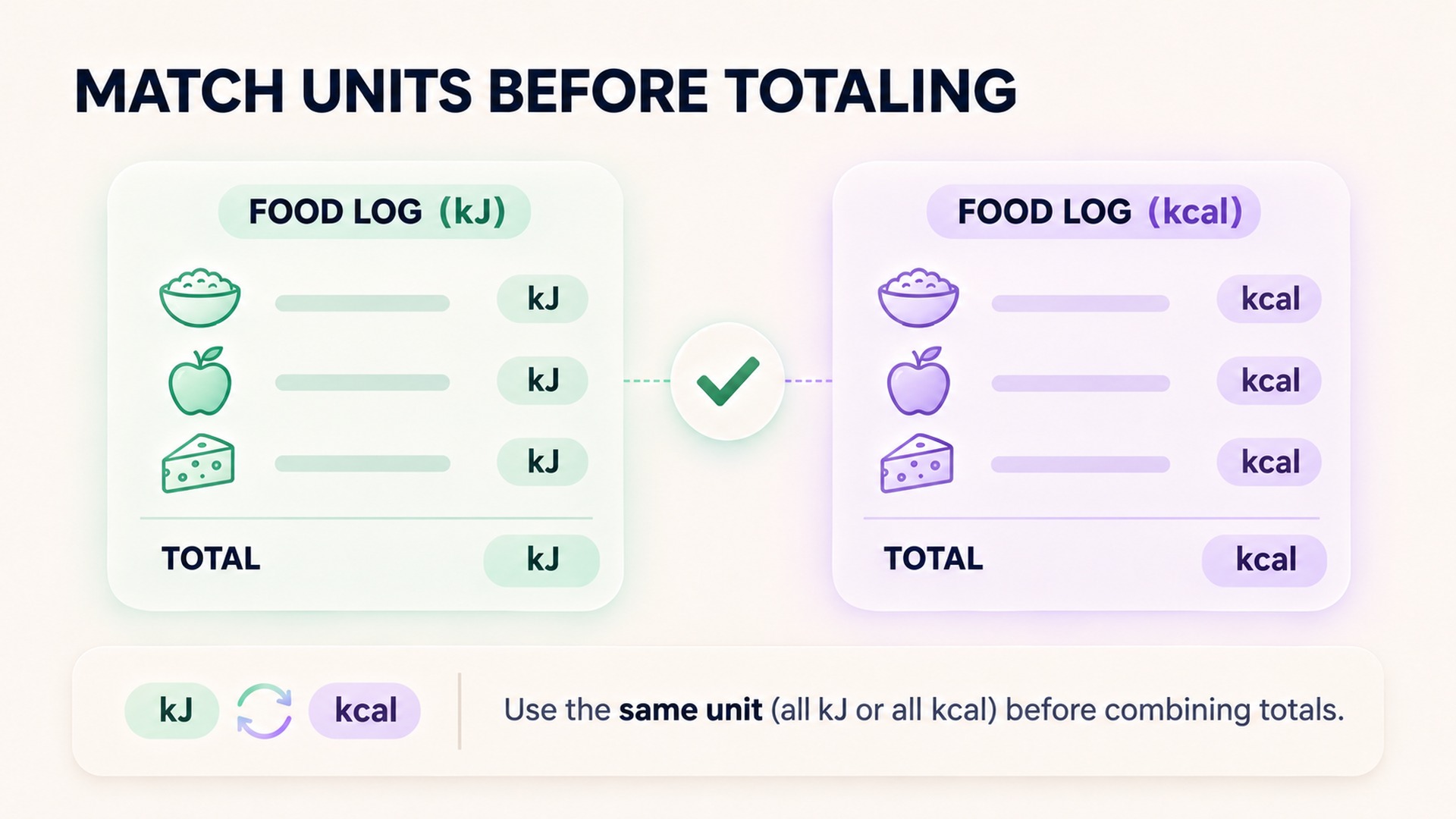
A simple record format
For a durable food-energy entry, I use the item name, source, portion or serving basis, printed value, printed unit, and any normalized value with its unit. The record can include a brief note if the source labels both kilojoules and kilocalories or if an app applies an automatic conversion. That format keeps the observed label information separate from the calculation.
If several entries are combined, write the total unit beside the result and note how mixed entries were normalized. A line that says “daily total: 8,400” does not communicate enough. “Daily total: 8,400 kJ; kcal entries converted using the stated nutrition-energy factor” is interpretable. The note need not become a long diary; one short, consistent convention is usually sufficient.
For a personal record, repeatability is more valuable than needless detail. Use the same unit across the summary, retain the original label value, and avoid changing the serving basis midstream. If the goal is clinical nutrition care, share the underlying records with the qualified professional rather than treating an app’s energy total as a prescription. Advice about intake depends on the person and the purpose of the assessment.
The packaged-food labeling guide can be consulted again for information about serving declarations. A related discussion of food notes alongside recovery data explains why a log needs a clear purpose and context. Keep the unit visible on the source, in the entry, in the conversion, and beside the final total.
FAQ
Are food Calories and kilocalories the same thing?
On nutrition labels, “Calories” ordinarily means kilocalories. In technical writing, kcal makes that convention explicit. Retain the label’s wording when copying its value.
Can I add kilojoules and kilocalories together?
No. Convert one set of values so every entry uses a common unit, then label the resulting total with that unit.
Should I replace the original value after converting it?
Keep the original value and unit. Record the converted value separately so the source can be checked and rounding remains visible.
*This article is for informational purposes only and is not a substitute for professional medical advice, diagnosis or treatment.*
Related articles

Protein grams leave amino acid quality unreported
Protein grams show an amount for a stated serving, while amino acid composition and digestibility describe other properties. Keep the declared quantity separate from any quality measure or score that the source actually reports.

Time in glucose range needs the target range beside it
Time in range is a percentage calculated from glucose readings within chosen bounds over a defined period. Keep the target interval, units, sensor coverage, and clinical context beside the result so the percentage can be interpreted correctly.

Glucose sensor timing can lag behind changes in blood
Continuous glucose monitors sample interstitial fluid and estimate blood glucose from that signal. During rapid changes, the sensor reading may reflect a later point in the curve, so keep both measurement times and the device context visible.

Peak flow and spirometry report different breathing measures
Peak flow records the highest expiratory flow from a forceful breath out. Spirometry measures airflow and exhaled volume over time, so the test name, units, effort quality, and report comments should stay with each result.

A resting metabolic rate test depends on the test protocol
A resting metabolic rate test estimates energy use from gas exchange under defined conditions. The preparation, equipment, analysis method, and report details all affect how the value should be interpreted.

Bone density T-scores and Z-scores use different references
A T-score compares bone density with a young-adult reference, while a Z-score uses a more closely age-matched reference. Keep the score type, skeletal site, and report interpretation together because the two numbers are not interchangeable.

Waist measurements need a consistent anatomical landmark
Waist circumference can differ when the tape crosses different anatomical sites or follows a different plane. Keep the landmark, posture, breathing phase, and tape position with each date so a trend uses a consistent protocol.

Lean tissue on a body scan includes more than muscle
A body-composition scan reports method-dependent compartments such as lean soft tissue, not a direct count of skeletal muscle. Keep the exact scan label, body region, method, date, and testing context with the result before comparing it over time.

Urine albumin concentration needs its creatinine context
A spot urine albumin concentration changes with how diluted the sample is. The albumin-to-creatinine ratio adds context, while the full report and clinical question still guide interpretation.

A hemolyzed blood sample can complicate a potassium result
Cell damage during collection or handling can affect a measured potassium value. Keep the sample-quality comment with the report and have the result reviewed in its clinical context.