Food date labels do not replace safe storage instructions
By Mr.Apps · Nov 4, 2026
Category:Energy

A date is only one part of a food record
A package date can be useful, but it does not describe every factor that affects food quality or safety. Terms such as “best if used by,” “sell by,” and “use by” can refer to different purposes. Their meaning depends on the product and the rules where it was sold. Storage temperature, whether the package was opened, handling, and the type of food also matter. A date printed on a package is not a complete history of how the food was stored. I preserve the exact phrase and add storage history when it is known.
The safest record preserves the exact wording and date, plus the handling information that is known. I would note whether the package was opened, when it was opened if known, how it was stored, and whether the label gives special instructions. If the storage history is uncertain, the date alone cannot fill that gap. The food’s appearance or smell is not a dependable test for every harmful microorganism.
The food product dating guidance explains that many dates are quality dates and that the exception for infant formula and certain baby foods must be considered. It also emphasizes proper handling and refrigeration. Date-label rules and terms differ by jurisdiction. A reader should use the applicable local guidance and the product’s instructions.
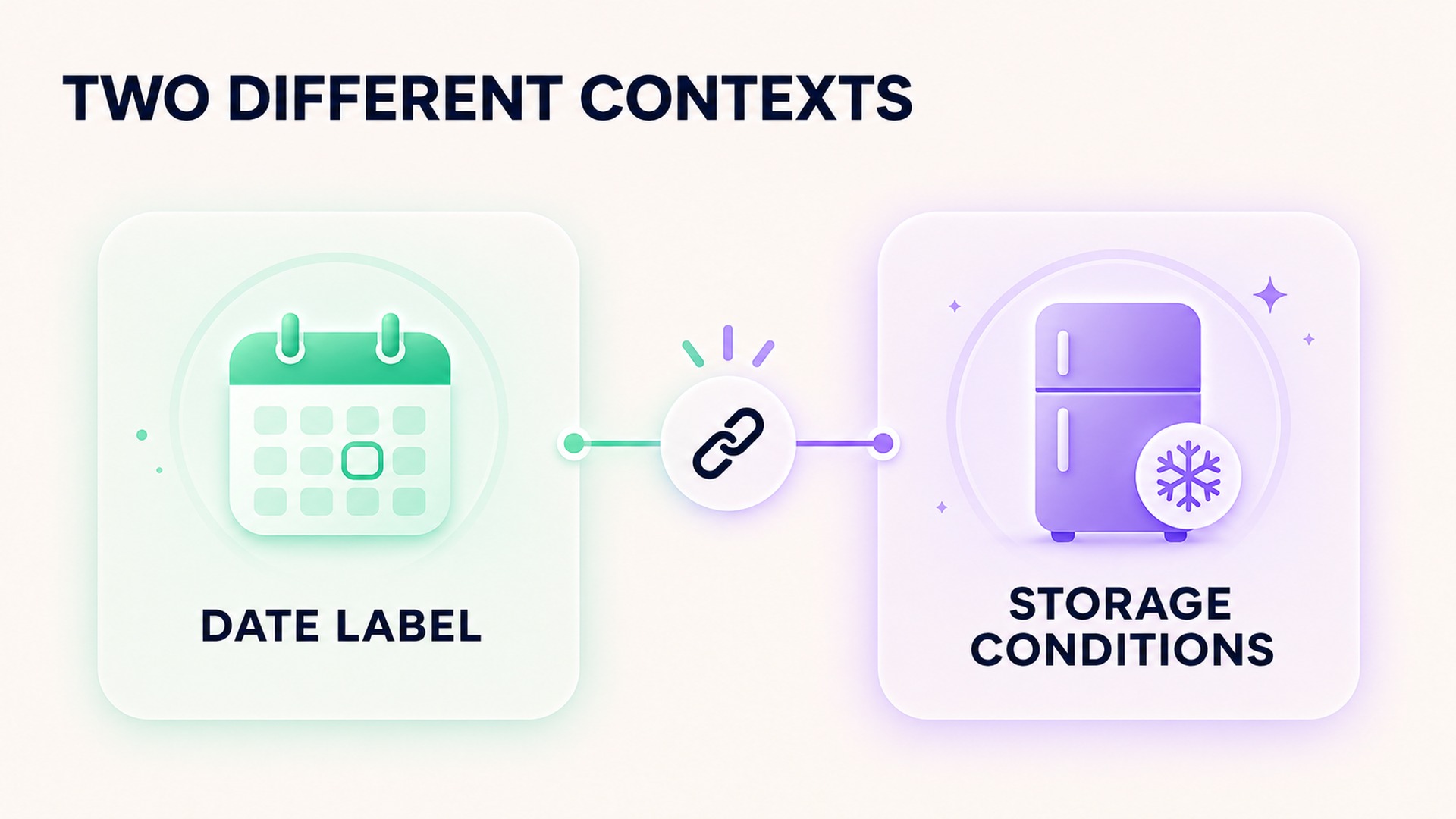
What common date phrases may mean
A “sell by” date is commonly intended for retail stock management. It is not automatically a consumer safety cutoff. A “best if used by” date generally concerns expected quality, such as flavor or texture. A “use by” phrase can also be used for quality on many foods, while certain products have specific safety requirements. The exact phrase, food category, and jurisdiction should be preserved rather than flattened into a generic “expiration date.”
Federal rules do not require most foods to carry a date label, with important exceptions. The consumer summary of federal food dating rules explains that dates on many products are not safety dates. This does not mean every food should be eaten after a date or that all products are governed identically. Infant formula is a notable exception, and perishable foods need attention to storage conditions.
Labels can use several phrases, and the same phrase may not have the same legal meaning everywhere. The food labeling and date explanation discusses consumer confusion and date-label practices. It is useful for understanding the limits of date wording, but it does not replace storage guidance for a particular food. A date label also cannot establish whether a package was kept cold during transport or at home.
A printed date should be treated as one source of information. The product’s handling directions, refrigerator or freezer conditions, time at room temperature, and package condition can change the assessment. If a perishable food was left out or the refrigerator was not operating properly, a later printed date does not undo that history. Conversely, a quality date passing does not automatically answer every safety question.
Storage instructions carry separate information
Food safety depends on handling as well as the date. Perishable foods should be refrigerated or frozen according to applicable guidance. The safe food storage overview discusses refrigeration, covered containers, and label directions. It notes that food may cause illness even when it does not look or smell spoiled. Sensory checks can identify some obvious quality problems, but they cannot reliably rule out harmful organisms.
Use the instructions on the package when they are present. Some foods require refrigeration before opening; others have a specific “refrigerate after opening” instruction. A shelf-stable product may become perishable once opened or prepared. A record that captures only the printed date misses the change in handling after opening. Note the date opened and follow the product’s stated directions or relevant official guidance.
The refrigerator’s actual temperature also matters. A display setting does not prove the interior remained at that temperature, particularly after a power interruption or prolonged door opening. If a food-safety decision depends on the storage history, consult food-specific guidance rather than relying on an app timer or the package date alone. Local food-safety authorities may provide storage tables and advice for particular categories.
For leftovers and prepared foods, the time since preparation and storage conditions can matter more than the manufacturer’s unopened-package date. The food storage chart and guidance provides category-specific information for refrigerated and frozen foods. Follow the chart’s stated assumptions and keep the storage record with the food. A general date-label explanation should not be used to extend a food beyond the conditions covered in a storage chart.
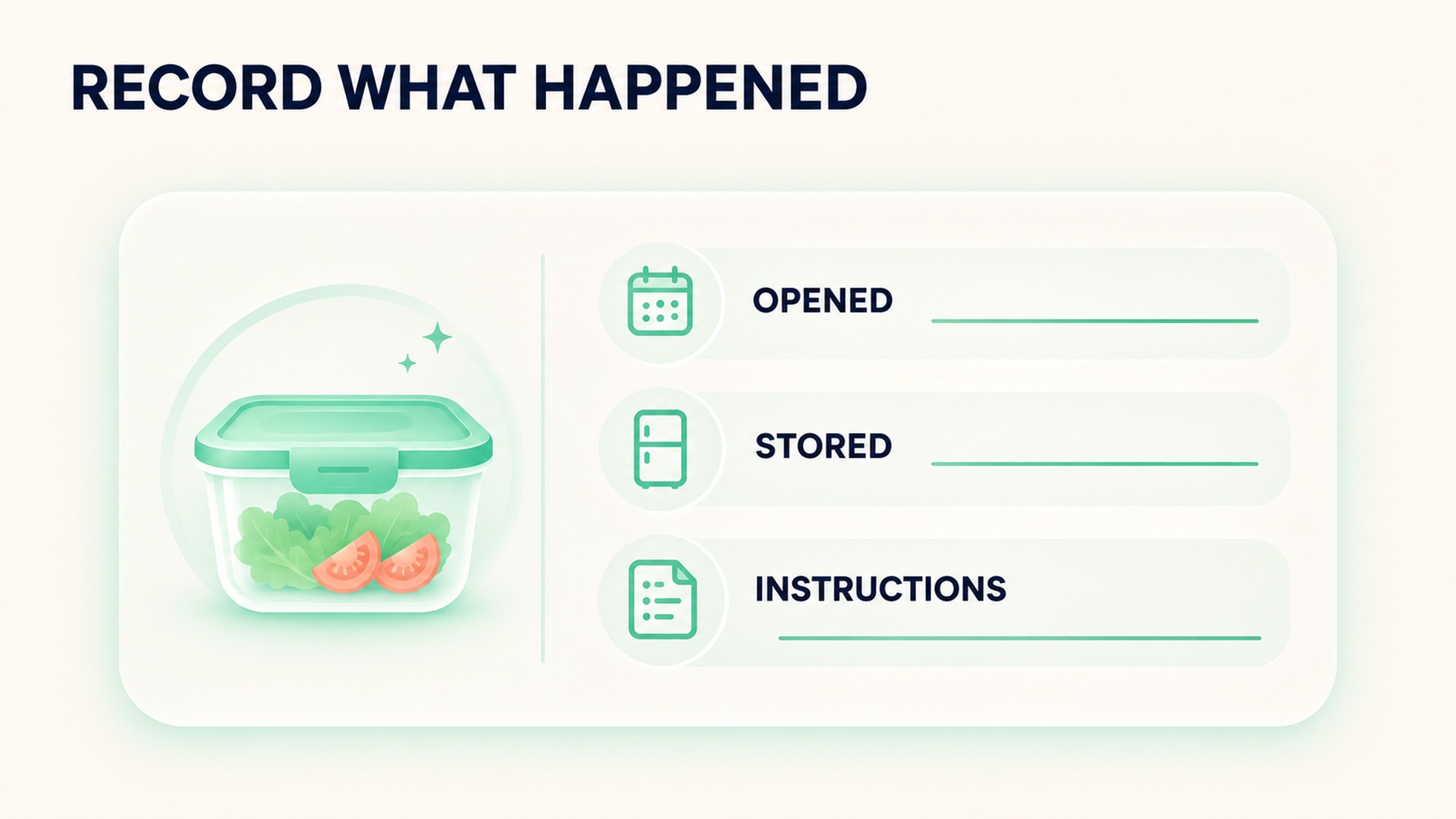
Keep the original date and the history
A practical food record includes the product name, the exact date phrase, the date itself, the package’s storage directions, whether the package was opened, and known storage conditions. If the food was transferred to another container, record that change. If a date label was difficult to read, mark it as uncertain instead of estimating. A photo of the label can preserve the exact wording if the image is stored securely and tied to the correct item.
For food purchased in bulk or divided into portions, the original package date and the date of repackaging are different facts. Record both when they matter. A freezer entry should show when the food was frozen and whether it remained frozen. A thawed food has a different handling history from one kept continuously frozen. The record should not silently carry the original package date forward as if nothing changed.
A digital food tracker may show a countdown based on a date entered by the user. That countdown is only as reliable as the date and storage assumptions supplied. It does not inspect the food, measure refrigerator temperature, or know whether the product sat in a car. A reminder can help with organization, but it is not a safety assessment.
Why “not past the date” is not enough
A package can be within its printed date while still having been mishandled. Damage, leakage, contamination, or temperature abuse can create concerns that the date does not reveal. Food that has been properly stored may retain acceptable quality past some quality dates, but that statement is not a blanket recommendation to eat any product after its date. The product category, storage history, and specific guidance matter.
Likewise, a food’s normal smell and appearance do not guarantee safety. Some disease-causing organisms do not create obvious spoilage signs. Do not taste a questionable food to decide whether it is safe. If official guidance says to discard it under the known storage conditions, follow that direction. If the history is uncertain and the food is high risk, avoid treating the printed date as proof of safety.
Infant formula requires special care because its date has a distinct safety role. Do not apply general quality-date explanations to formula or other regulated products. Check the product instructions and appropriate public-health guidance. The official food-date and storage information can be used alongside the package directions for the food categories it covers.
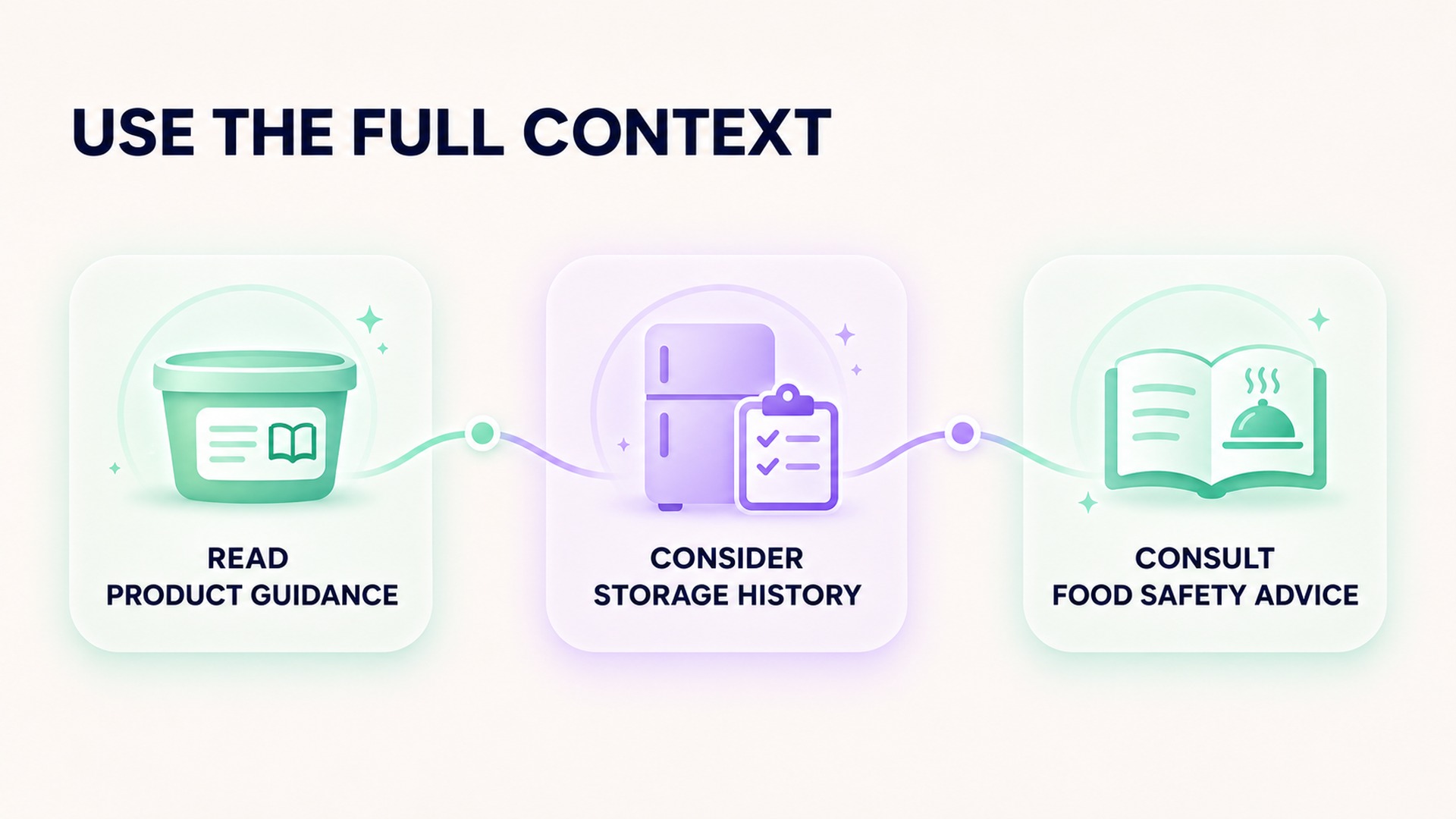
A clear decision record
When a question arises, write down what is known and what is not. The date phrase and date may be visible, while the time at room temperature or prior refrigeration may not be. Label those unknowns. A concise note such as “best-if-used-by date; opened yesterday; continuously refrigerated according to label” communicates more than “still good.” The entry should identify which item the note refers to. If storage was interrupted, record the interruption and use food-specific safety advice.
Record the printed date phrase with the handling details that are known. The phrase describes the manufacturer’s date information; storage guidance describes conditions. The storage history connects those details to the actual food. If an important part of the history is missing, a confident conclusion may not be possible.
If the food is associated with symptoms or suspected illness, preserve the product details, lot information, date, and storage history if available, and contact the appropriate health or food-safety authority for advice. Do not use a wearable score or a personal food log to diagnose foodborne illness. Severe symptoms or urgent concerns require medical care.
Keeping the phrase, date, opening status, and storage history together supports a more useful record. It also makes it clear why two packages with the same date may need different decisions. A related discussion of food notes alongside recovery data considers the purpose and limits of keeping a food log. For safety decisions, storage rules should be applied to the food and situation in front of you.
FAQ
Does a “best if used by” date always mean the food is unsafe afterward?
No. On many products it describes expected quality. Food category, handling, and applicable rules still matter.
Can a food be unsafe before its printed date?
Yes. Improper storage, damaged packaging, or contamination can matter regardless of the date. Follow product instructions and official food-specific guidance.
Does a normal smell prove that food is safe?
No. Some harmful organisms do not change smell or appearance. Sensory checks cannot replace safe handling and storage guidance.
*This article is for informational purposes only and is not a substitute for professional medical advice, diagnosis or treatment.*
Sources:
USDA Food Safety and Inspection Service·USDA Food Safety and Inspection Service·FDA·FDA·FoodSafety.gov·FDA
Related articles

Lactose intolerance and milk allergy need different food notes
Lactose intolerance concerns digestion of a milk sugar, while milk allergy involves an immune reaction to milk proteins. Record the exact product wording and symptoms without treating a lactose-free claim as an allergy clearance.
Kilojoules and kilocalories need one consistent food-log unit
Food labels and trackers may use kilojoules or kilocalories for the same energy value. Keep the original label unit beside any conversion so every total remains clear and checkable.

Protein grams leave amino acid quality unreported
Protein grams show an amount for a stated serving, while amino acid composition and digestibility describe other properties. Keep the declared quantity separate from any quality measure or score that the source actually reports.

Time in glucose range needs the target range beside it
Time in range is a percentage calculated from glucose readings within chosen bounds over a defined period. Keep the target interval, units, sensor coverage, and clinical context beside the result so the percentage can be interpreted correctly.

Glucose sensor timing can lag behind changes in blood
Continuous glucose monitors sample interstitial fluid and estimate blood glucose from that signal. During rapid changes, the sensor reading may reflect a later point in the curve, so keep both measurement times and the device context visible.

Peak flow and spirometry report different breathing measures
Peak flow records the highest expiratory flow from a forceful breath out. Spirometry measures airflow and exhaled volume over time, so the test name, units, effort quality, and report comments should stay with each result.

A resting metabolic rate test depends on the test protocol
A resting metabolic rate test estimates energy use from gas exchange under defined conditions. The preparation, equipment, analysis method, and report details all affect how the value should be interpreted.

Bone density T-scores and Z-scores use different references
A T-score compares bone density with a young-adult reference, while a Z-score uses a more closely age-matched reference. Keep the score type, skeletal site, and report interpretation together because the two numbers are not interchangeable.

Waist measurements need a consistent anatomical landmark
Waist circumference can differ when the tape crosses different anatomical sites or follows a different plane. Keep the landmark, posture, breathing phase, and tape position with each date so a trend uses a consistent protocol.

Lean tissue on a body scan includes more than muscle
A body-composition scan reports method-dependent compartments such as lean soft tissue, not a direct count of skeletal muscle. Keep the exact scan label, body region, method, date, and testing context with the result before comparing it over time.