Bone density T-scores and Z-scores use different references
By Mr.Apps · Nov 2, 2026
Category:Energy
Why the reference group matters
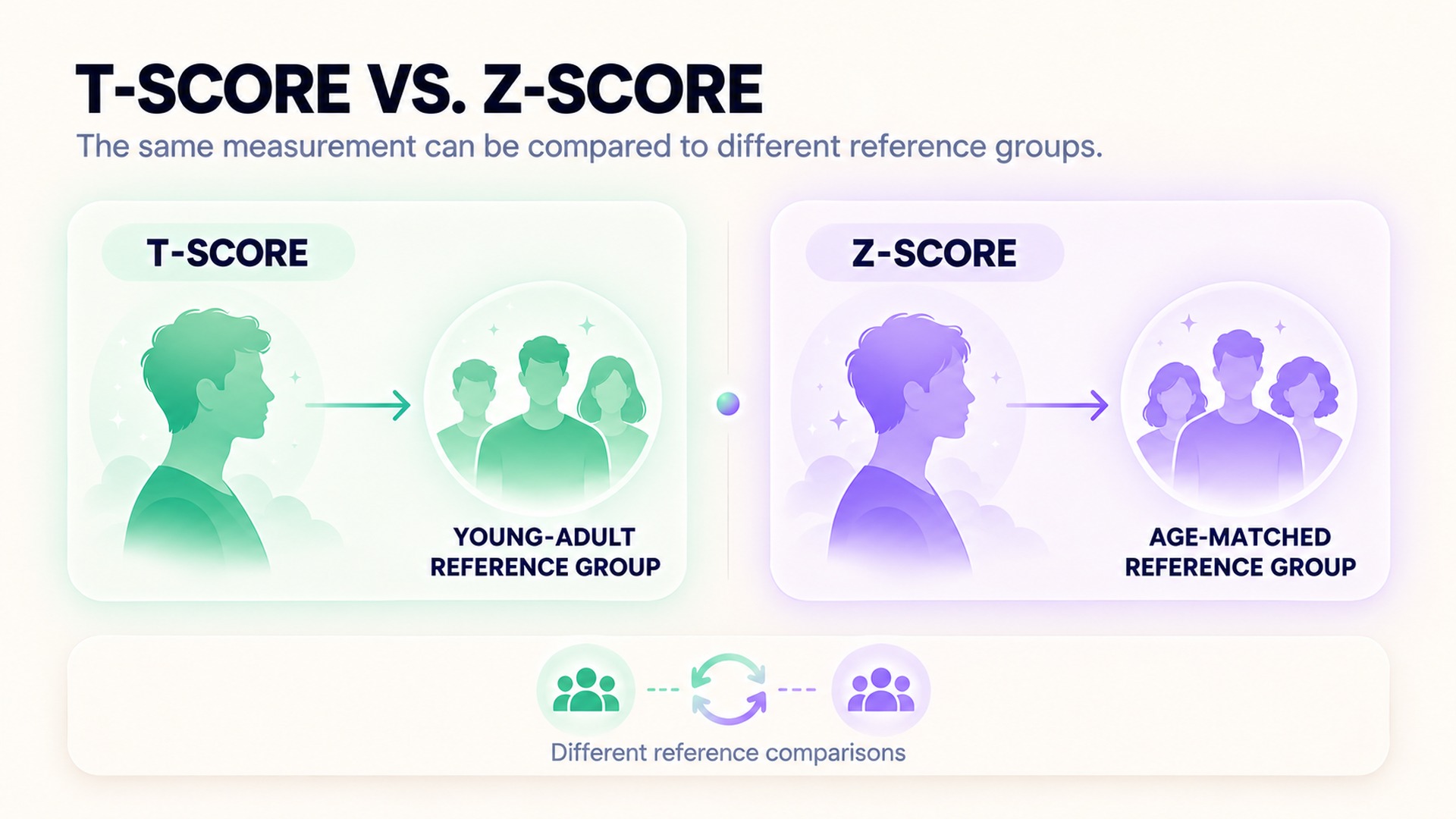
Bone density T-scores and Z-scores use different references. Both describe how a measured bone mineral density compares with a reference population, but the comparison group differs. A T-score compares the result with a young-adult reference. A Z-score compares it with a reference group matched more closely for characteristics such as age. They answer related questions with different baselines.
The score does not describe bone density in isolation. It depends on the skeletal site, scan method, reference database, and population for which the score is intended. A number copied without its label can lose the detail that gives it meaning. I keep the scan site, exact score type, units, date, and report interpretation together rather than treating a T-score and Z-score as interchangeable labels.
The bone-density score explanation describes a T-score as a comparison with a healthy young-adult reference and a Z-score as a comparison with people of similar age and other population characteristics. That distinction is the starting point for understanding the report. The clinician who ordered the scan can explain which score is relevant to the person and why.
What a T-score compares
A T-score expresses the measured bone density in relation to a reference value for young adults. It indicates how far the result is above or below that reference in standard-deviation units. The reference database and measured skeletal site matter. A score at the hip, for example, is not automatically interchangeable with a score at the spine, and the number should be read with the site stated on the report.
A T-score is used in certain clinical settings for classification, but the appropriate use depends on the person's age and clinical group, the site measured, and applicable professional guidance. A threshold used for one defined population should not be applied to every adult or to every scan site. A score alone also does not summarize fracture risk, symptoms, medical history, or the reason the scan was ordered.
The professional positions on bone-density reporting explain which reference databases and skeletal sites are used in clinical classification. They also distinguish diagnostic classification from a broader assessment of fracture risk. I do not interpret a score from a screenshot without confirming which site and database produced it.
What a Z-score compares
A Z-score compares bone density with a reference group that is more closely matched to the person, commonly by age and other population characteristics. It also expresses a difference in standard-deviation units. Because the reference group is different from the T-score reference, the two scores can differ even when they come from the same measured density.
A Z-score is often preferred in populations where comparison with a young-adult peak reference is not the appropriate clinical frame. The report should identify which score was calculated and how it should be interpreted. A Z-score is not a substitute for clinical judgment, and the label “within the expected range for age” is not the same as a full assessment of bone health.
The updated guidance on DXA testing and reporting describes when Z-scores are preferred and cautions against using them as a standalone diagnosis. The international positions on score calculation also describe reference database choices and the need to interpret scores within the population and report context. These recommendations can change as professional standards are updated, so the current report and the clinician's interpretation take priority over a general chart found online.
Why the same density can produce different scores
A score is a standardized comparison, not a raw density measurement. The reference population's average and variation affect the calculation. If the reference database changes, the score can shift without a matching biological change in the measured bone. This is why the report should name the score type and why a T-score should not be converted into a Z-score by changing a label.
Reference choices can also vary by site and by the purpose of the scan. Professional guidance identifies which locations and reference databases are appropriate for particular reporting tasks. If a report lists more than one site or score, do not select the most concerning or reassuring number on your own. Ask the ordering clinician to explain which result is being used and what the comparison can establish.
A clinical guideline on DXA practice describes bone-density assessment as one part of evaluating fracture risk and bone health. The actual interpretation can consider fractures, medical conditions, medicines, and other risk factors beyond the score. That context matters because two people with the same score can have different clinical histories and care questions.
What a standard-deviation score describes
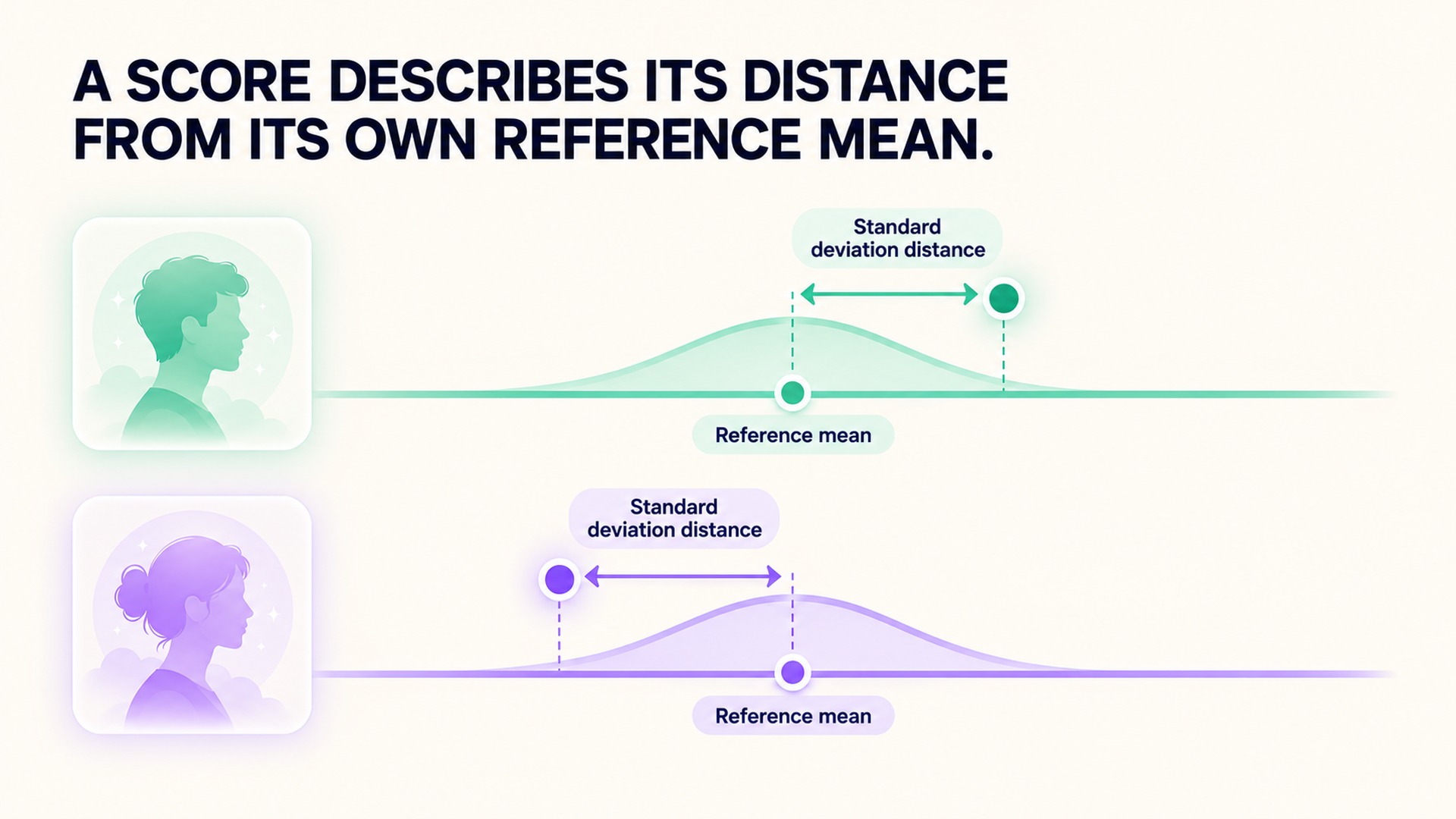
A T-score or Z-score expresses a distance from a reference mean in standard-deviation units. It is not a percentage of bone, a probability of fracture, or an amount of bone gained or lost. The same measured density can produce different standardized values when the reference population or calculation changes. The score makes a comparison possible, but the reference determines what that comparison means.
A report may include the raw bone mineral density value and one or more standardized scores. The raw value is usually reported in grams per square centimeter for a central DXA scan. Keep its units and skeletal site. A score without the measured site is incomplete because the hip, spine, and forearm may have separate values and can be assessed under different criteria. If multiple sites are listed, the clinician determines which one is relevant to the specific question.
The reference database is part of the test method. Professional positions define which database is used for particular scores and which sites are appropriate for clinical classification. A facility may use different scanner manufacturers or analysis software, so a report should identify enough details to support a comparison. If the report does not state its database or method, the ordering clinician or imaging facility can clarify it. Patients should not select a preferred reference group or recalculate a score from the raw value on their own.
This is also why a T-score and a Z-score should not be lined up on a personal dashboard as though they were successive values on one scale. A change from one score type to another may reflect a changed reference, not a change in bone density. Keep the dates and report labels visible. If the score type or site changes, make that transition explicit and ask whether the two reports can be compared for the intended purpose.
For people who need serial scans, the clinician may also consider the expected precision of the measurement and the time between scans. A small numeric difference may fall within measurement variation, while a larger change may still need interpretation with the scan quality and relevant clinical information. The interval and reason for repeat imaging are individualized. An online calculator cannot decide whether a new scan is needed or whether a change represents treatment response.
The reporting categories used by one professional standard may not be identical to every country's policy or every clinical pathway. The report's intended classification and the clinician's local guidance should be considered together. If a copied chart gives a different label from the report, keep the report's terminology and ask the clinician which standard applies. The goal is to understand the score's reference, not to make a diagnosis from a chart alone.
What to keep with the report
Save the complete report instead of only the score. Keep the test date, skeletal site, method, bone mineral density value and units if listed, T-score or Z-score label, reference interval or reference statement, and the interpreting clinician's note. If the report includes a technical limitation or excludes a site, save that detail as well. A note that merely says “bone score” is not enough to reconstruct which measurement was used.
If a new scan is compared with an earlier one, check whether both reports use the same machine, site, analysis method, and reference conventions. A change in technique, software, positioning, or region of interest can affect the comparison. When the clinic says the tests are comparable, preserve that explanation. If the method changed, mark a break in the timeline rather than quietly combining the numbers.
The guidance on DXA precision and reporting explains that scores can vary with the reference population and that precision is a separate measurement consideration. These technical details are useful when asking why two reports differ; they do not tell an individual what treatment to start.
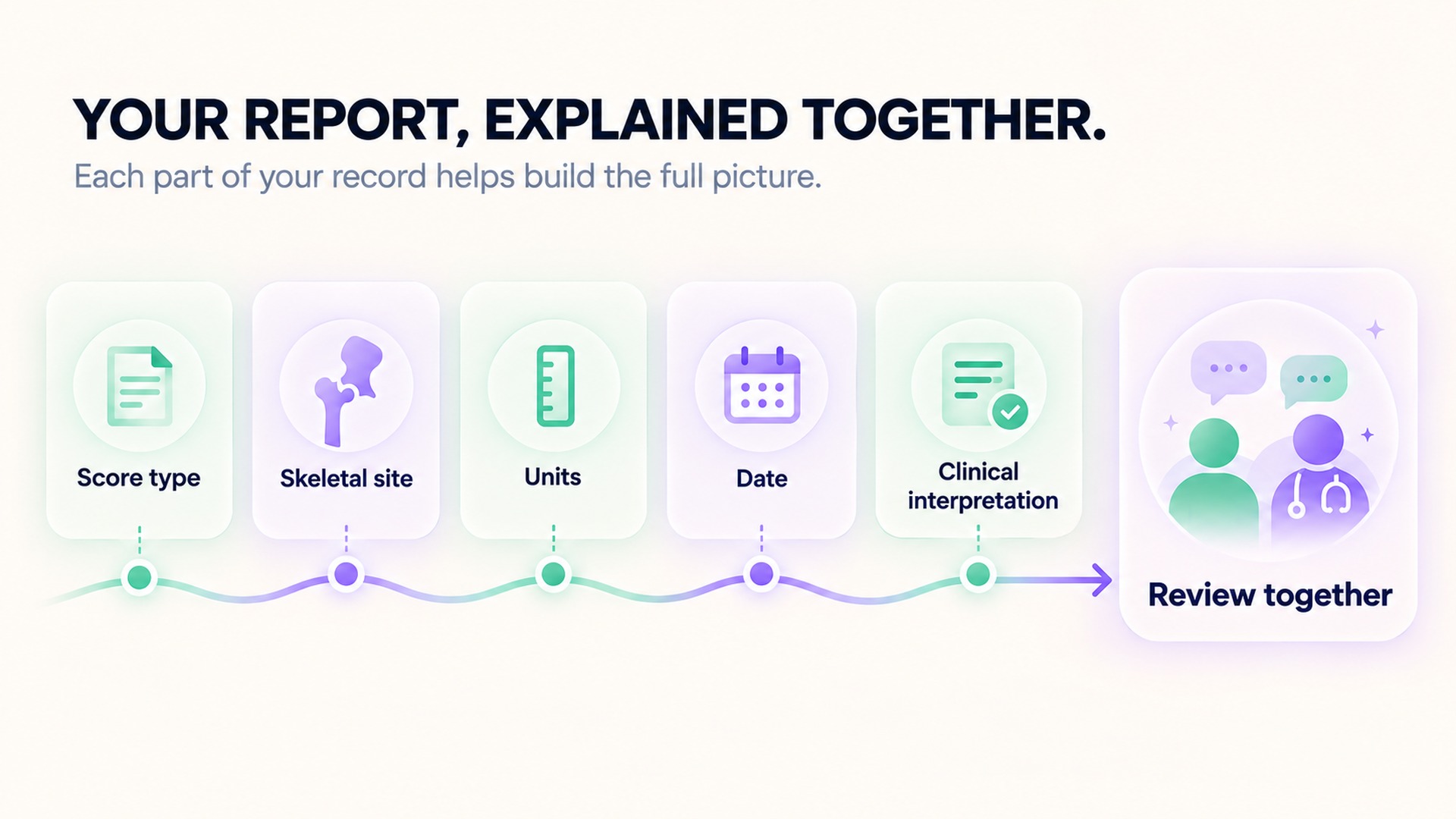
For broader context on keeping health measurements tied to their method, a related article on reading thyroid results together explains why a laboratory value is interpreted with related results and the clinical question. Bone-density scores are not blood tests, but the record-keeping principle is similar: preserve the measurement name, reference, date, and professional interpretation.
Frequently asked questions
What does a T-score compare?
It compares bone mineral density with a young-adult reference population. The result should be read with the skeletal site, reference database, and clinical group for which the score is intended.
What does a Z-score compare?
It compares bone mineral density with a population reference matched more closely to characteristics such as age. The score still requires the report's site, method, and clinician interpretation.
Can I compare a T-score directly with a Z-score?
No. They use different reference populations, so the numbers are not interchangeable. Keep the score type with the result and ask the clinician which measure applies to the scan and clinical question.
*This article is for informational purposes only and is not a substitute for professional medical advice, diagnosis or treatment.*
Sources:
National Institute of Arthritis and Musculoskeletal and Skin Diseases·International Society for Clinical Densitometry·European Journal of Nuclear Medicine and Molecular Imaging·International Society for Clinical Densitometry·Archives of osteoporosis·International Society for Clinical Densitometry
Related articles

Waist measurements need a consistent anatomical landmark
Waist circumference can differ when the tape crosses different anatomical sites or follows a different plane. Keep the landmark, posture, breathing phase, and tape position with each date so a trend uses a consistent protocol.

Lean tissue on a body scan includes more than muscle
A body-composition scan reports method-dependent compartments such as lean soft tissue, not a direct count of skeletal muscle. Keep the exact scan label, body region, method, date, and testing context with the result before comparing it over time.

Urine albumin concentration needs its creatinine context
A spot urine albumin concentration changes with how diluted the sample is. The albumin-to-creatinine ratio adds context, while the full report and clinical question still guide interpretation.

A hemolyzed blood sample can complicate a potassium result
Cell damage during collection or handling can affect a measured potassium value. Keep the sample-quality comment with the report and have the result reviewed in its clinical context.

Biotin supplements belong in the record before a blood test
Biotin in supplements can affect selected laboratory assays, and the effect depends on the method used. A clear product, amount, and timing record helps the testing team decide whether an assay-specific review is needed.

A post-vaccine HRV change is not a personal immunity test
A wearable HRV change after vaccination can describe a physiological signal, but it cannot measure antibodies or personal protection. Learn why study associations, symptoms, and immune status answer different questions.

Vitamin D blood levels should not become an automatic supplement dose
Learn what a vitamin D blood test measures and why the result does not automatically set a supplement dose. See how symptoms, medicines, testing reason, and health history shape interpretation.

Blood sodium concentration is different from sodium eaten
Learn why a sodium blood test measures a concentration while a food log estimates an amount eaten. See why a blood result cannot be converted into an instruction to add salt or change intake.

Recent lifting belongs in the context of a liver enzyme result
Learn why recent lifting belongs beside liver enzyme results and why it should not be assumed to explain an abnormal test. See how AST, ALT, CK, timing, symptoms, and the rest of the panel help shape clinical interpretation.

Keep the kidney function equation beside an eGFR trend
Learn why a change in the eGFR equation can shift a reported estimate without an equivalent biological change. See what to record beside each value so a trend can be interpreted with its method and clinical context.