Resistant starch is not a fixed share of every starchy food
By Mr.Apps · Nov 4, 2026
Category:Energy

Resistant starch varies with food and preparation
Resistant starch is starch that resists digestion in the small intestine and reaches the large intestine, where it can be fermented. It is not a fixed fraction of every food that contains starch. I leave the amount unestimated when no measurement matches the preparation. The amount can depend on the starch type, food structure, processing, cooking, cooling, storage, and reheating. A value from one controlled preparation should not be assigned automatically to a different meal.
That distinction matters when logging carbohydrates or interpreting a research result. A study may analyze a particular variety, cooking procedure, cooling period, or laboratory method. A home-prepared serving can differ in each of those details. A food record should preserve the food and preparation instead of subtracting an assumed resistant-starch amount from every carbohydrate entry. A total-carbohydrate declaration and a laboratory resistant-starch assay are separate data fields, and the assay may use a method unavailable to an ordinary food log.
The research review on resistant starch and food processing describes how cooling and other processing conditions can change starch fractions. It also notes that effects vary by food type and preparation. Those findings are useful for understanding why a single universal percentage would be misleading; they do not provide a conversion that applies to every plate of rice, potato, or grain.
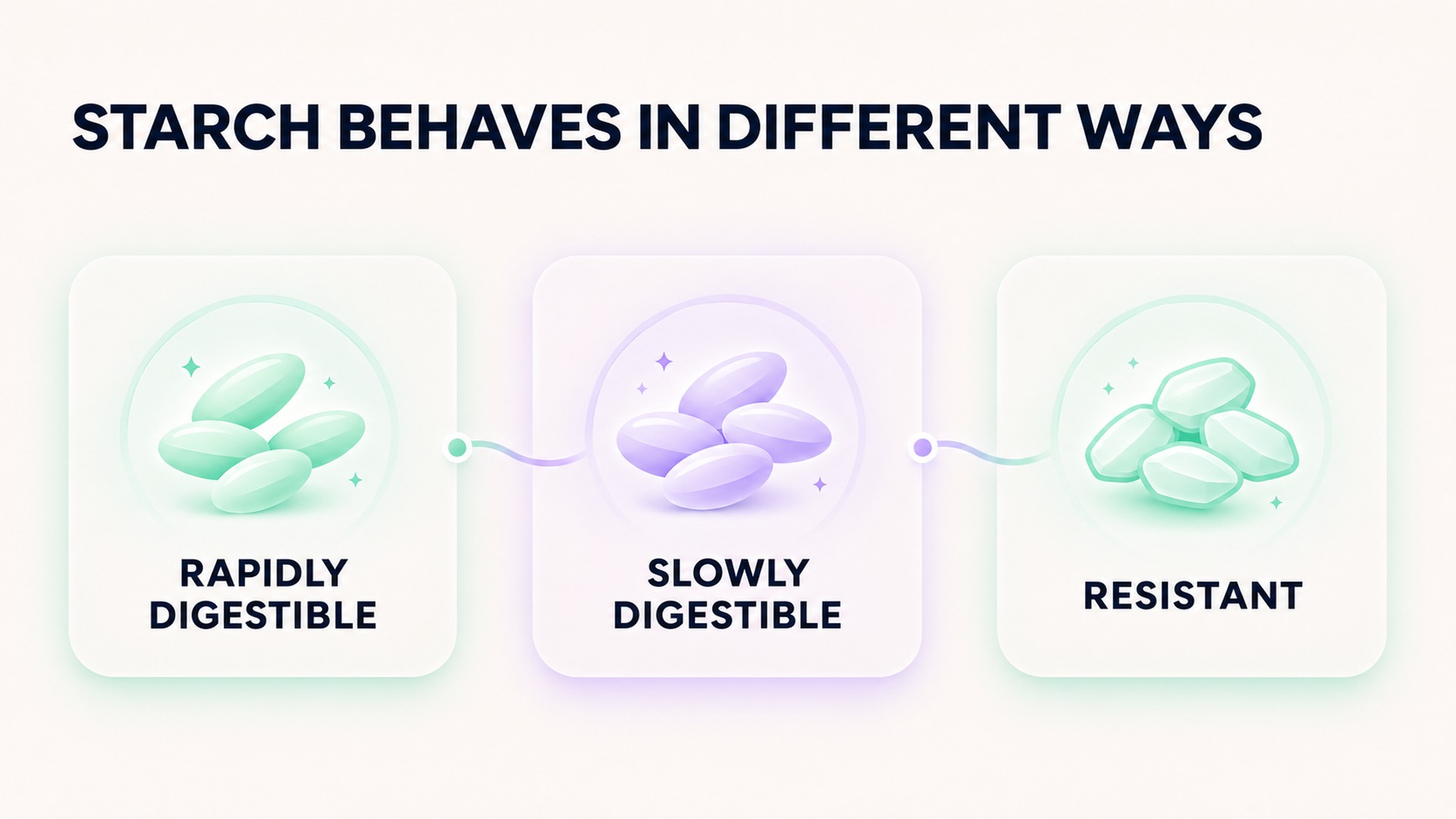
Several forms are described in research
Researchers classify resistant starch into types based on why it resists digestion. Some forms are physically inaccessible within intact food structures. Others are associated with raw or ungelatinized starch granules, certain modified starches, or starch that retrogrades after cooking and cooling. These categories describe mechanisms, not simple visual features that a person can identify from a food’s appearance.
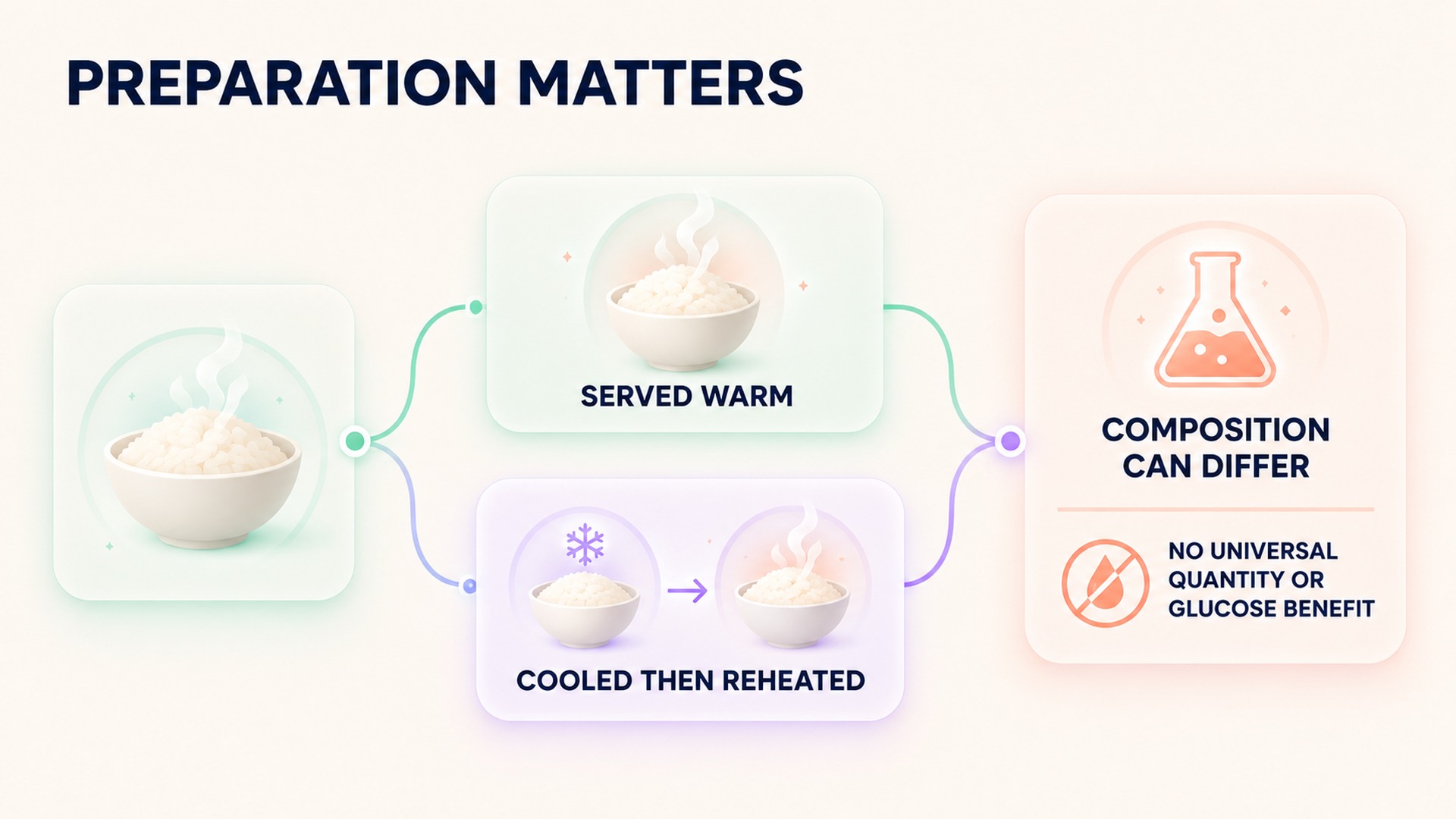
Cooking can gelatinize starch and alter its accessibility. Cooling may allow some starch molecules to reassociate into structures that resist digestion. Reheating can change that structure again, and the result depends on the food and method. This is one reason a cooled starch food cannot be assigned the same resistant-starch fraction as every other cooled starch food.
The study of resistant starch in prepared chilled foods examined specific food preparations and starch fractions. Its results are linked to the tested foods and procedures. They should not be generalized to any home recipe without matching the method, variety, serving, and laboratory analysis.
The term “resistant starch” also does not mean that the food contains no digestible carbohydrate. A food can contain several starch fractions. The measured amount depends on the analytic method and conditions. If a nutrition source reports total carbohydrate, a separate resistant-starch estimate should not be subtracted unless the source supports that calculation for the exact food and preparation.
Food preparation belongs beside the value
A record of cooked food should include how it was prepared and served. For example, cooking, cooling, storing, and reheating are separate steps. The timing and temperature can matter to the resulting starch structure, and food safety rules remain important during cooling and storage. A resistant-starch discussion should never imply that a person should handle food unsafely to change a nutrition estimate.
The analysis of potato resistant starch reports that content can vary with cooking method and service temperature under the study’s conditions. This is evidence about tested potatoes, not a universal value for every potato dish. A food log that lacks variety and preparation details cannot reproduce the study’s measurement.
Mixed meals add more variation. The portion of a starchy food, other ingredients, meal timing, and the person’s physiology can influence the observed post-meal response. A resistant-starch estimate is not a guarantee of a particular glucose response. A continuous glucose monitor also measures a person’s glucose pattern, not the resistant-starch content of the meal.
Keep estimates separate from measured values
Food labels generally report total carbohydrate according to the applicable rules; they may not state resistant starch as a separate quantity. Research values can come from laboratory methods that are not performed on the meal a person eats. A database may provide an estimate or a generic food entry. Record the source and measurement type rather than presenting all of these as equally precise.
If a research paper reports a percentage for a specific preparation, note the food, variety if given, cooking and cooling conditions, sample size, and analytic method. Do not convert that percentage into grams for a different portion unless the calculation is appropriate and the assumptions are stated. A precise number can be misleading when it is applied outside its source conditions.
A related discussion of food notes alongside recovery data considers the role of a personal log. The research on mechanisms and processing does not mean every food preparation produces the same amount or effect. Health outcomes in studies depend on their design, participants, and interventions. Do not infer that a home-cooked meal will reproduce a research outcome or reduce a person’s glucose in a predictable way.
For a meal record, a careful description may be more useful than a resistant-starch number: food, portion, cooking method, cooling or reheating history, and source of any estimate. If no reliable value matches the preparation, write “not quantified” rather than subtracting a generic amount from the carbohydrate total.
Distinguish starch fractions from carbohydrate totals
Total carbohydrate includes more than one type of carbohydrate. It can include sugars, starches, and fiber, depending on the labeling system. Resistant starch is a component of starch that resists digestion under defined conditions. That does not make it automatically absent from the total-carbohydrate declaration or directly comparable across food tables.
The dietary guidance on carbohydrate and fiber discusses carbohydrate-containing foods in the broader diet. It does not offer a universal resistant-starch subtraction for meals. A person tracking carbohydrate for medical reasons should follow the method recommended by their care team and should not adjust a medication dose based on an assumed resistant-starch percentage.
Some food tables may list resistant starch separately, while others do not. Check whether the value is measured, estimated, or calculated. If it is part of a laboratory study, retain the study’s definitions. If it is an app entry, check the database source and serving. Different methods may not produce directly comparable numbers.
A cautious interpretation of possible effects
Research investigates resistant starch for several reasons, including digestion, fermentation, and post-meal responses. A study’s result applies to the intervention and population tested. It does not show that all resistant-starch foods produce the same effect or that a particular preparation will improve an individual’s health. Avoid turning a mechanistic explanation into a treatment claim.
The overview of dietary fiber and digestion provides general background on fiber-rich foods and digestion. Resistant starch is a specialized concept and should be discussed with its specific measurement context. General fiber advice does not establish a resistant-starch content for a particular meal.
If a person has a medical condition or follows a prescribed eating plan, questions about carbohydrate counting and food preparation should be addressed with the qualified professional responsible for that plan. Food safety instructions still apply when cooling and storing cooked foods. Do not change handling practices or medication to pursue a predicted glucose response.
The human study of resistant-starch types and glucose response tested selected preparations, illustrating why findings stay attached to those samples. It is not a universal value for every starch-containing meal. Resistant starch is a variable fraction measured under defined conditions. Keep food type, preparation, portion, and source attached to any value. If those details are missing, mark the amount unknown instead of subtracting a fixed fraction from every starchy food.

Why measurement methods differ
Resistant starch is often measured with laboratory procedures that simulate digestion or analyze food fractions. Different procedures can classify starch differently. A paper’s methods section is therefore part of the result. Values from different methods may not be directly comparable, even when the foods share a name. A database that aggregates studies can simplify this detail, so record its source and whether the value is measured or estimated.
Food structure matters as well as temperature. Milling, ripeness, processing, moisture, and the ratio of starch components can influence how starch behaves during cooking and cooling. Two servings prepared with the same kitchen method may still differ because their starting foods differ. This is another reason a fixed resistant-starch share cannot be assigned to every starchy food.
A person who records a cooled or reheated food can describe the sequence without claiming a laboratory amount: cooked, cooled under the recorded conditions, stored, then reheated. If the temperature or duration is unknown, say so. A detailed process note improves reproducibility, but it still does not turn the home meal into the exact sample used in a study.
FAQ
Does every cooked-and-cooled starch food contain the same resistant starch amount?
No. The result can vary with food type, variety, cooking, cooling, storage, and the measurement method.
Can I subtract a standard resistant-starch percentage from a food label?
No. A study value should not be applied to a different food or preparation without matching evidence and stated assumptions.
Does resistant starch predict my glucose response?
No. A resistant-starch measurement and an individual glucose response are different observations. Meal and personal context matter.
*This article is for informational purposes only and is not a substitute for professional medical advice, diagnosis or treatment.*
Sources:
Frontiers in Nutrition·Nutrition Bulletin·Food Chemistry·National Institute of Diabetes and Digestive and Kidney Diseases·MedlinePlus·Journal of Nutrition and Metabolism
Related articles

Vitamin A records should preserve the form as well as the unit
Preformed vitamin A and provitamin A carotenoids are different forms with distinct conversion context. Keep the source form, original unit, and any calculated equivalent together rather than treating all values as interchangeable.

A proprietary blend can hide individual supplement amounts
A proprietary blend total reports the combined weight, not necessarily the amount of each listed ingredient. Keep undisclosed quantities marked as unknown instead of inferring a dose from ingredient order or marketing claims.

Glycemic index needs portion context to describe glycemic load
Glycemic index describes a tested food response under a defined protocol, while glycemic load also accounts for carbohydrate amount in a serving. Neither value predicts an individual sensor trace or replaces a care plan.

Potassium salt substitutes need more than a lower sodium goal
Some salt substitutes replace sodium chloride with potassium chloride, which changes the ingredient and mineral context. Keep the label and portion visible, especially when kidney disease or medicines may affect potassium balance.

Food date labels do not replace safe storage instructions
A printed date describes only part of a food’s context and may refer to quality or a specific product rule. Preserve the exact label phrase alongside opening, handling, and storage information that is known.

Lactose intolerance and milk allergy need different food notes
Lactose intolerance concerns digestion of a milk sugar, while milk allergy involves an immune reaction to milk proteins. Record the exact product wording and symptoms without treating a lactose-free claim as an allergy clearance.

Kilojoules and kilocalories need one consistent food-log unit
Food labels and trackers may use kilojoules or kilocalories for the same energy value. Keep the original label unit beside any conversion so every total remains clear and checkable.

Protein grams leave amino acid quality unreported
Protein grams show an amount for a stated serving, while amino acid composition and digestibility describe other properties. Keep the declared quantity separate from any quality measure or score that the source actually reports.

Time in glucose range needs the target range beside it
Time in range is a percentage calculated from glucose readings within chosen bounds over a defined period. Keep the target interval, units, sensor coverage, and clinical context beside the result so the percentage can be interpreted correctly.

Glucose sensor timing can lag behind changes in blood
Continuous glucose monitors sample interstitial fluid and estimate blood glucose from that signal. During rapid changes, the sensor reading may reflect a later point in the curve, so keep both measurement times and the device context visible.