Vitamin A records should preserve the form as well as the unit
By Mr.Apps · Nov 4, 2026
Category:Energy

Keep the vitamin A form with its unit
A vitamin A record can contain a number and still leave out important context. Preformed vitamin A, such as retinol, and provitamin A carotenoids such as beta-carotene are different forms. The body can convert some carotenoids to vitamin A, but the conversion relationship is not the same as treating every microgram of each form as identical. The unit and source form should stay together in the record. I keep the original label unit beside the named form.
This matters when reading foods, supplements, and nutrition databases. A value in retinol activity equivalents (RAE) expresses vitamin A activity using conversion factors that account for different forms. A value in international units (IU) may also require the source form to interpret. Keep the original label unit, the form listed, and any converted value as separate fields. Do not replace the original with a conversion that hides the ingredient type.
The vitamin A and carotenoid fact sheet explains that RAE accounts for differing bioactivities of retinol and provitamin A carotenoids. It also distinguishes preformed vitamin A from carotenoid sources in its discussion of intake and safety. The form can affect the conversion and the applicable safety information, so it should not be dropped from a food or supplement note.
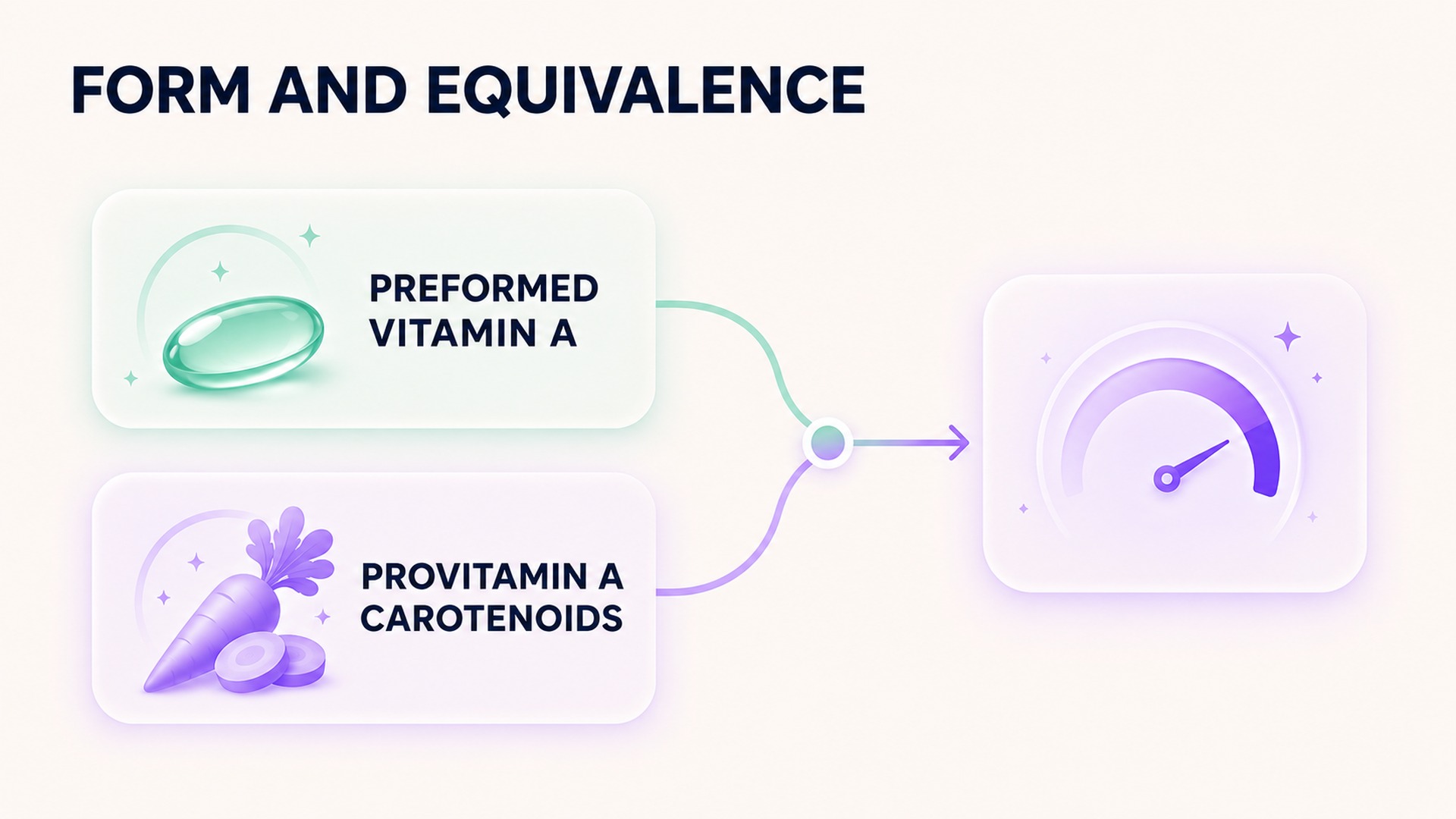
Preformed vitamin A and provitamin A are distinct
Preformed vitamin A is found in animal-derived foods and some supplements, often as retinyl compounds. Provitamin A carotenoids occur in plant foods; beta-carotene is one example. Some carotenoids can be converted into vitamin A, but conversion varies and the food matrix may matter. The term “vitamin A” can therefore refer to different source forms that should be distinguished when the record supports that detail.
RAE is a unit designed to express vitamin A activity across forms using specified conversion factors. It is useful for comparing dietary sources in a consistent system, but it does not mean the forms are chemically identical. Preserve whether a value was reported directly in RAE or converted from a specific form. If the source gives only a number without form or unit, the record is incomplete.
The consumer information on vitamin A describes food and supplement sources and the role of vitamin A. A general food list does not establish the exact amount in a particular serving. Product labels and database entries may describe different forms, portions, and units. When recording a supplement, copy the active ingredient form and the declared quantity exactly.
A label may use “retinyl palmitate,” “retinyl acetate,” or beta-carotene. These are not interchangeable strings. A database may aggregate them under a nutrient heading, while the product panel gives a specific source. Keep both levels if the task requires them: the nutrient total in the stated unit and the underlying source form. Do not infer the form from the color of a food or from a product’s marketing name.
Units and conversion context
When converting between IU and RAE, the source form matters because the conversion factors differ. The conversion is not a universal multiplier that can be applied to an unlabeled amount. Record the original unit and form before calculating. If either is missing, mark the conversion as uncertain rather than assigning a precise equivalent.
A conversion table can simplify arithmetic, but it cannot correct a mismatched serving or unknown source. A supplement facts panel may state an amount per capsule, while a food database may state an amount per 100 grams or per cooked serving. Align the basis before comparing totals. Keep the product label, serving size, unit, and ingredient form together.
The reference values for vitamin A were developed for defined populations and use specified units. They are not interchangeable with a personal supplement dose or a product’s marketing target. If a professional is reviewing intake, make the original form and unit available so they can interpret the record under the appropriate guidance.
The number of zeros can also create confusion. Micrograms and milligrams differ by a factor of one thousand. Keep the unit symbol beside every value, and double-check that a label’s unit was not copied incorrectly. A value written as “900” without a unit could mean very different things depending on the source. If a tracker automatically converts units, confirm how it handles form-specific vitamin A equivalencies.

Safety guidance depends on the form and context
Safety limits may apply differently to preformed vitamin A and provitamin A carotenoids. A single total that combines forms can obscure that distinction. A person should not use a generic “vitamin A” total to decide whether a supplement dose is safe without considering the form, other sources, age, pregnancy status, health conditions, and relevant professional guidance.
The dietary reference intake explanation for vitamin A provides context for recommended intakes and upper levels. Those population-based values are not a personalized prescription. Upper limits are designed for particular forms and populations; reading the number without those conditions can lead to a false conclusion. A clinician or dietitian can interpret the relevant value in the person’s situation.
A supplement can contain preformed vitamin A, beta-carotene, or a combination. The ingredient panel may list more than one source. Keep each declared ingredient and amount separate where possible. If the product uses an RAE declaration but does not disclose enough to distinguish the exact form, preserve that limitation. Do not assume a supplement is harmless because its amount is described using a familiar unit.
People considering supplements should review the full product and all other sources with an appropriate professional, especially when pregnancy, a medical condition, or medicines are relevant. This article is about accurate records, not choosing a dose. Do not start or stop a supplement based only on a conversion table or one isolated label number.
Food records and databases
A food database may provide total vitamin A activity for a defined food and portion. The actual amount in a meal can depend on the food type, preparation, and serving. When a database provides the carotenoid composition, keep those component fields if the question requires them. When it provides only an aggregated nutrient total, do not fabricate a detailed breakdown.
For packaged products, use the current label and note the serving basis. Formulations can change, and a product photographed months earlier may no longer match the current package. If a label changes from one form to another, the record should show the date and version rather than merging them under one generic entry. This is particularly important when comparing supplement labels across time.
The supplement label information can help identify common sources, while a product-specific label is needed for its declared formulation. A food list should not be treated as a measured assay of the portion eaten. If the amount comes from an estimate, mark it as an estimate.
A practical record includes the item, portion, source, form, value, unit, and whether the value was copied or converted. If converting, note the source form and conversion method. This prevents a converted total from appearing more certain than the underlying data. When information is missing, explicitly write “form not reported” or “unit not provided.”
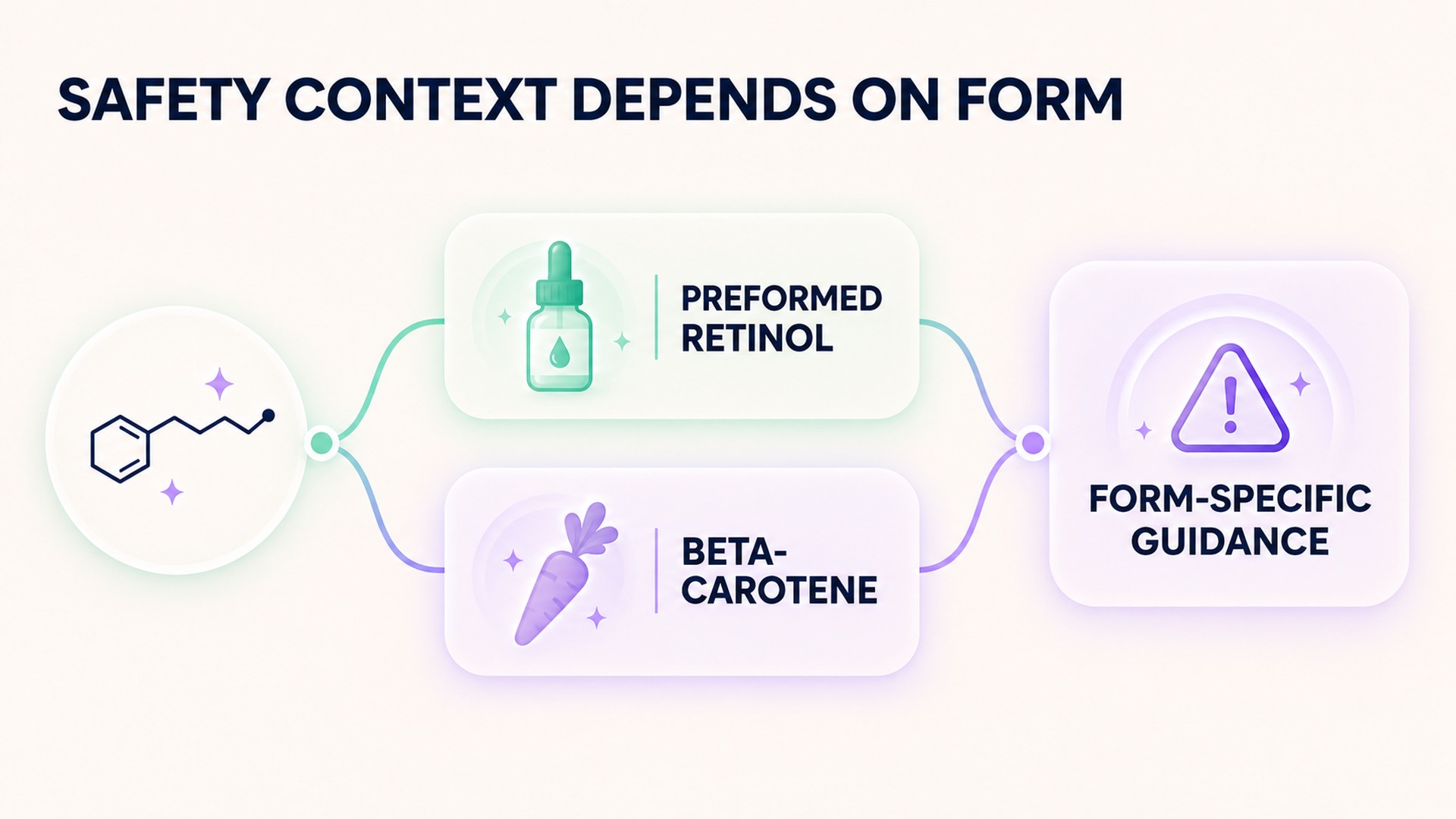
Avoid collapsing forms into a dosing decision
The purpose of retaining form and unit is to describe what the data say. It is not to calculate an ideal intake or assess a health condition from a food diary. Vitamin A needs vary across people, and supplement use may have specific safety considerations. A record can make a consultation more productive, but the record itself does not determine whether an amount is appropriate.
If a database value and a supplement label seem inconsistent, check the units, form, serving, and whether the source reports vitamin A activity or a specific compound mass. The numbers may describe different things. Do not average them or pick the larger value without understanding the basis. Ask a qualified professional if the discrepancy affects care.
The form is especially important when multiple products are used. A multivitamin, a standalone supplement, and fortified food can contribute different forms. A label review should account for each source rather than adding raw numbers with different units. Keep the data source and the date beside the entry so later reviewers can reproduce the calculation.
A consumer vitamin A overview provides general information about sources and the nutrient’s role. A related discussion of food notes alongside recovery data considers how nutrition records can support understanding without providing an individual prescription. The recordkeeping takeaway is to preserve that context: identify preformed vitamin A or provitamin A when known, keep the original unit, and label any calculated equivalent. If the form is unknown, leave it unknown rather than treating all forms as interchangeable.
If a label abbreviates the unit or form, preserve the package wording and ask a professional or manufacturer for clarification rather than silently expanding an uncertain abbreviation.
FAQ
Is beta-carotene the same form as retinol?
No. Beta-carotene is a provitamin A carotenoid; retinol is preformed vitamin A. The record should preserve which source is reported.
Can I convert vitamin A units without knowing the form?
Not reliably when the conversion depends on the source form. Keep the original unit and note the missing information.
Does an RAE value tell me what supplement dose to take?
No. RAE expresses activity using defined conversion factors. Personal supplement decisions need individualized professional guidance.
*This article is for informational purposes only and is not a substitute for professional medical advice, diagnosis or treatment.*
Sources:
NIH Office of Dietary Supplements·NIH Office of Dietary Supplements·National Academies Press·NIH Office of Dietary Supplements·FDA·MedlinePlus
Related articles

Glycemic index needs portion context to describe glycemic load
Glycemic index describes a tested food response under a defined protocol, while glycemic load also accounts for carbohydrate amount in a serving. Neither value predicts an individual sensor trace or replaces a care plan.

Potassium salt substitutes need more than a lower sodium goal
Some salt substitutes replace sodium chloride with potassium chloride, which changes the ingredient and mineral context. Keep the label and portion visible, especially when kidney disease or medicines may affect potassium balance.

Food date labels do not replace safe storage instructions
A printed date describes only part of a food’s context and may refer to quality or a specific product rule. Preserve the exact label phrase alongside opening, handling, and storage information that is known.

Lactose intolerance and milk allergy need different food notes
Lactose intolerance concerns digestion of a milk sugar, while milk allergy involves an immune reaction to milk proteins. Record the exact product wording and symptoms without treating a lactose-free claim as an allergy clearance.

Kilojoules and kilocalories need one consistent food-log unit
Food labels and trackers may use kilojoules or kilocalories for the same energy value. Keep the original label unit beside any conversion so every total remains clear and checkable.

Protein grams leave amino acid quality unreported
Protein grams show an amount for a stated serving, while amino acid composition and digestibility describe other properties. Keep the declared quantity separate from any quality measure or score that the source actually reports.

Time in glucose range needs the target range beside it
Time in range is a percentage calculated from glucose readings within chosen bounds over a defined period. Keep the target interval, units, sensor coverage, and clinical context beside the result so the percentage can be interpreted correctly.

Glucose sensor timing can lag behind changes in blood
Continuous glucose monitors sample interstitial fluid and estimate blood glucose from that signal. During rapid changes, the sensor reading may reflect a later point in the curve, so keep both measurement times and the device context visible.

Peak flow and spirometry report different breathing measures
Peak flow records the highest expiratory flow from a forceful breath out. Spirometry measures airflow and exhaled volume over time, so the test name, units, effort quality, and report comments should stay with each result.

A resting metabolic rate test depends on the test protocol
A resting metabolic rate test estimates energy use from gas exchange under defined conditions. The preparation, equipment, analysis method, and report details all affect how the value should be interpreted.